Foreign
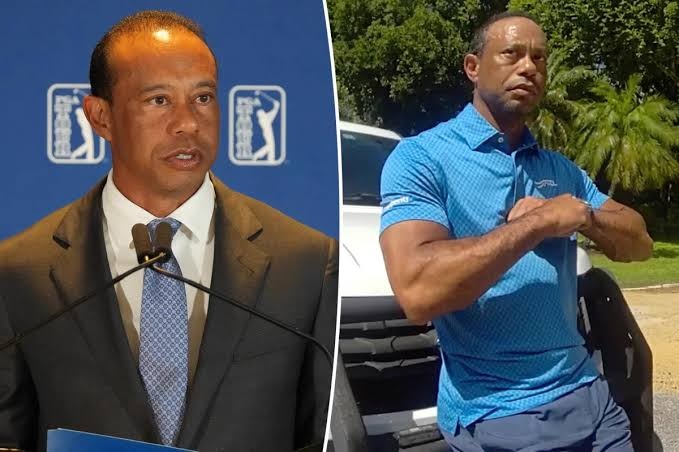
Popular Champion Golfer, Tiger Woods, Loses Driver’s License Over Reckless Driving
Tiger Woods has been fined and suspended from driving for five years after entering a plea agreement to a reckless driving charge, following March’s rollover car crash in Florida.

The 15-time major champion was arrested in March and spent eight hours in jail before being bailed, after the Land Rover he was driving rolled over in a collision with a pick-up truck towing a trailer.
Woods previously entered a written plea of not guilty via his lawyers to charges of driving under the influence, property damage and a refusal to submit to testing.

The former world No 1 attended a plea conference hearing at Martin County Courthouse in Florida on Wednesday, where he pleaded guilty to a lesser charge of reckless driving and the refusal to submit an unlawful test.
Judge Darren Steele accepted the plea agreement, which amended the original DUI charge and resolved the refusal to submit a test charge, while Woods also entered a plea to a careless driving citation.
On the reckless driving second offence charge, Woods received a $1,000 (£748) fine and a five-year driving suspension.
On the second count, the refusal to submit to a lawful test, he received a $500 (£370) fine.
“There are no exceptions. If you were to drive for any reason at all, you would go immediately back to jail,” Steele told the court.
Woods was ordered to pay the minimum fine for the careless driving citation, which also carries a five-year driving ban to run concurrently with the suspension on the reckless driving charge.
The 50-year-old said little during the hearing. He arrived at the courthouse with Vanessa Trump, his girlfriend and President Donald Trump’s former daughter-in-law, who sat behind him during a hearing that lasted under 10 minutes.
He was also fined court costs, according to court documents. A no-contest plea is not an admission of guilt, but means the accused will offer no defense.
The plea is treated as a conviction in the criminal justice system.
The police report from the March 27 crash said deputies found two hydrocone pills – used to treat pain – in his pocket, and he showed signs of impairment.
It described Woods’ movements as slow and lethargic when speaking to deputies at the scene.
The report also said Woods appeared to be sweating, his eyes looked glassy, and his pupils were dilated.
Woods managed to crawl out of his car without any injuries and told a deputy he was looking down at his phone and changing the radio station when he hit the truck.
Woods has not featured in a professional golf event since missing the cut at The Open in July 2024.
He made his first public appearance since returning from treatment in Switzerland on June 23, when he introduced the PGA Tour’s plans to revamp its schedule for 2028.
Woods remained as chairman of the PGA Tour’s Future Competition Committee after his arrest.
Foreign
American power, AI and a walkout – key moments from Trump’s UN speech
US President Donald Trump returned to the stage at the United Nations on Tuesday, where he touted his administration’s policies in front of world leaders and issued pointed threats to some of those gathered in the room.
The lengthy speech was wide-ranging, covering the war in Iran, AI, Cuba and the role of America’s military.
The BBC’s correspondents who covered the address have picked five key moments that stood out.
1. Trump pushes message of American power
The US president has no great respect for the United Nations – he accused it of imposing a far-left agenda – but he does relish the global platform it gives him.
He used Tuesday’s speech to tout his achievements, and claim the mantle of a peacemaker, at the same time as he issued a number of pointed threats.
Iran might be annihilated, lethal strikes on small boats suspected of drug smuggling will continue and the Cuban regime may even be toppled.
The clear message was: America is still prepared to use its military might wherever Trump thinks it might be required to secure its national interests.
Trump said he was “reasserting American power” and flexed what he called the country’s “unmatched military might”.
“The United States will no longer permit threats to America to gain a foothold anywhere in the Western Hemisphere,” he said.
Once again, Trump has made the full-throated assertion to the world of “America First”.
2. Cubans walk out as Trump calls nation ‘failed state’
Trump took aim at one of the US’s closest neighbours, Cuba, calling it “an absolutely failed state” and saying his administration has been pursuing “a fundamental change in the situation in Cuba”.
“It will fall,” he said.
The Cuban delegation walked out of the hall as Trump continued his remarks.
Over the last year, the US president become more vocal in criticising Cuba’s communist government. On Tuesday, he said it was under “enormous pressure” and “failing like never before”.
The US has not, however, provided a detailed picture of what it believes change will look like in Cuba.
Cuba’s foreign minister reacted angrily to Trump’s comments and accused the US president of spreading “falsehoods”.
“The US government is incapable of accepting that Cuba is and has the right to be a full sovereign and independent country,” Bruno Rodriguez wrote on X.
3. A direct threat to ‘annihilate’ Iran
Trump presented Iran with a stark choice at the UN General Assembly: reach an agreement with Washington and rebuild the country, or face the rapid “annihilation” of the Islamic Republic.
He then again predicted that a deal to end the war would probably follow the US midterm elections in November.
His remarks illustrated Trump’s familiar strategy of coercive diplomacy – keeping negotiations open while also threatening overwhelming force.
But his language blurred the distinction between destroying the political system and threatening Iran itself.
International law experts have previously expressed concern at what they called “alarming rhetoric” used by US officials, including Trump himself, who has posted that the US might “obliterate” Iran’s power plants.
References on Tuesday to leaving “no chance of survival” and “no hope” for future generations will likely have stoked similar alarm. There is also an irony in delivering this warning at the United Nations, an organisation founded to save future generations from war.
Yet the speech was not a declaration that diplomacy has failed.
It was an attempt to define the terms of possible negotiations: the US remains prepared to make a deal, but only under the shadow of an existential threat.
4. Trump hails new Greenland security deal
Trump also praised a new deal with Greenland under which he said the US would build two military bases in the Arctic territory.
“We will have the complete ability to do what is necessary to defend the American continent and also Europe,” he said of the deal, which he first announced on Friday.
He added that it “very much enhances” the defence alliance Nato.
The US, Denmark and Greenland held a joint signing ceremony at the UN shortly after Trump’s address.
Although Greenland is a semi-autonomous territory, it is part of the Kingdom of Denmark which primarily handles its foreign policy.
Trump administration officials are already hailing the agreement as enhancing US security at minimal cost – and with relationships intact.
Denmark and Greenland’s governments, however, will be hoping it ends the long-simmering disagreement that began when Trump threatened to take Greenland by force.
That threat shook the Nato alliance and sorely tested the US-Danish relationship.
Given Trump had tried for months to purchase or annex the semi-autonomous territory, some analysts are viewing it as a quiet win for diplomacy.
5. An attempted rebrand of AI
Trump has a penchant for branding, and in his speech he gave Artificial Intelligence a new name: Super Intelligence.
“The use of the word artificial makes it sound fake,” he said. “It’s not fake, it’s actually amazing. But we have to be careful.”
“Welcome to the new world of Super Intelligence – SI,” he added.
Trump has previously argued that the US must come out on top in the AI development race, saying last week: “Whoever wins AI, wins.”
The president is firmly against government regulation or introducing new guardrails – and that puts him at odds with many of those gathered at the UN.
For those who are calling for regulation, the question is whether the slow pace of diplomacy can keep up with AI’s rapid development.
Foreign
Brazilian Jet Carrying Singer Rey Vaqueiro Overruns Runway, Catches Fire
A Cessna 550 Citation Bravo carrying Brazilian singer Rey Vaqueiro and seven other people has overrun the runway while landing at Parelhas Airport in Rio Grande do Norte, Brazil.
The aircraft, with registration PP-WMO, was involved in the incident during the early hours of Sunday, September 13, according to aviation news platform FL360aero, which reported the incident in a post on X.
The aircraft reportedly ran beyond the runway while landing at the airport and subsequently caught fire, with both engines said to have been engulfed in flames.
Firefighters battled the blaze for approximately five hours before it was brought under control.
All eight people on board, comprising six passengers and two crew members, reportedly evacuated the aircraft.
Some of the occupants were said to have sustained minor injuries, while no serious injuries were reported.
The aircraft was destroyed by the fire.
The circumstances surrounding the incident remain under investigation by Brazil’s Centre for Investigation and Prevention of Aeronautical Accidents (CENIPA).
The incident involved a Cessna 550 Citation Bravo, a business jet commonly used for private and charter flights.
Foreign
More Flights Delayed As UK Air Traffic Control Problem Causes disruption
More flights are expected to be delayed in the United Kingdom (UK) after a technical problem with the country’s air traffic control system led to more than 2,000 cancellations.
A total of 291 flights were cancelled on Wednesday after 1,750 were cancelled on Tuesday, according to aviation analytics firm Cirium. Tens of thousands of passengers have been affected by the disruption.
National Air Traffic Services (NATS), the UK’s air traffic control provider, blamed the disruption on a technical glitch. Its chief executive, Martin Rolfe, apologised and said a full investigation would be carried out.
He admitted that resolving the problem had taken “longer than hoped”.
Foreign Secretary Ed Miliband described the outage as “unacceptable”, while Transport Secretary Heidi Alexander summoned Rolfe to explain what happened.
The disruption affected several major UK airports, including Heathrow, Gatwick, Manchester and Birmingham. Airports in Ireland also reported disruption.
At Heathrow, departures were initially paused on Tuesday before operations resumed and then faced further disruption later in the day.
Heathrow said its operations were recovering on Wednesday but warned passengers of further delays because aircraft and crew needed to be repositioned.
Gatwick also said flights had resumed but warned that it would take time for operations to return fully to normal.
Passengers have been advised to check directly with their airlines before travelling to airports. Heathrow said passengers should only travel if they have a confirmed flight.
The technical fault affected NATS’ flight data processing system. Rolfe said it was not the same system that failed during a major disruption in 2023.
However, the latest incident is the third technical problem experienced by NATS in three years. A computer shutdown in 2023 caused widespread disruption affecting around 700,000 passengers, while another outage in 2025 resulted in about 150 cancellations.
Airlines including Ryanair and Wizz Air have called for changes to NATS. Wizz Air UK managing director Yvonne Moynihan said the company needed to consider whether NATS was “fit for purpose”.
Despite the disruption, Rolfe defended the UK’s air traffic control system, saying it remained one of the best in the world.
However, former NATS air traffic control manager Doug Maclean said repeated failures were undermining the system’s reputation.
Even though the technical issue has been resolved, passengers are expected to face further disruption because of the backlog of flights, aircraft and crew.
NATS said it was working to restore normal operations as quickly as possible.
(BBC News)
-
News24 hours agoPrimate Ayodele Blasts Bishops Again! Dismisses Their Defense, Insists Their Endorsement of Tinubu Is Selfish Not Spiritual
-
Economy24 hours agoDangote To Support Two Million Women With Refinery IPO Share Ownership – Aliko Dangote
-
News23 hours agoOsun assembly endorses state police
-
News23 hours agoEx-LASU VC: Public varsities must charge N1m tuition per student to sustain financial independence
-
News23 hours agoAlleged Phone Tapping: Court to Rule in El-Rufai’s No-case Submission Oct 26
-
Sports24 hours agoSadio Mane Builds $20.4m Mango Processing Plant In Hometown