News
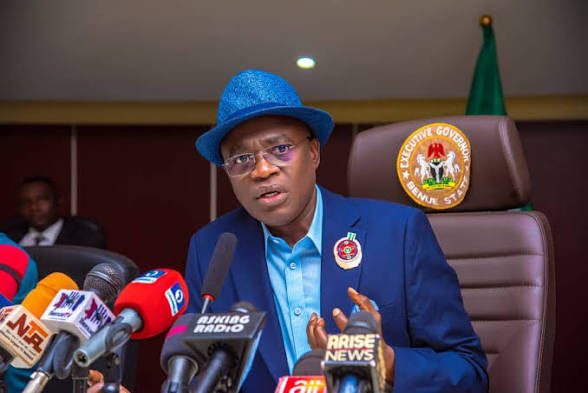
Alia’s Claim Under Heavy hammer as Photos Show Benue Govt Was Informed Ahead of Obi’s Visit
- /home/naijuinz/public_html/wp-content/plugins/mvp-social-buttons/mvp-social-buttons.php on line 27
https://naijablitznews.com/wp-content/uploads/2026/09/IMG_0565.jpeg&description=Alia’s Claim Under Heavy hammer as Photos Show Benue Govt Was Informed Ahead of Obi’s Visit', 'pinterestShare', 'width=750,height=350'); return false;" title="Pin This Post">
- Share
- Tweet /home/naijuinz/public_html/wp-content/plugins/mvp-social-buttons/mvp-social-buttons.php on line 72
https://naijablitznews.com/wp-content/uploads/2026/09/IMG_0565.jpeg&description=Alia’s Claim Under Heavy hammer as Photos Show Benue Govt Was Informed Ahead of Obi’s Visit', 'pinterestShare', 'width=750,height=350'); return false;" title="Pin This Post">
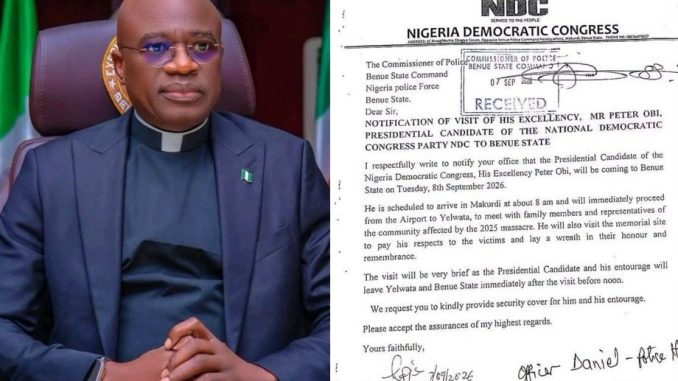
Evidence has surfaced of an official Nigeria Democratic Congress (NDC) letter notifying the Benue State Commissioner of Police of Peter Obi’s planned visit to Yelwata on September 8, 2026.

The letter, which was stamped as received, requested security for the NDC flagbearer’s short humanitarian stop.
The development challenges statements from Governor Hyacinth Alia’s aides that state authorities had no prior knowledge of the visit.

The Benue Police Command has also confirmed that it was informed and deployed officers.
Despite the notification, Obi’s convoy was blocked by youths on the Makurdi-Gboko road.
Obi’s camp described the blockers as thugs and linked the disruption to the state government. The government, however, denied involvement or prior knowledge of the visit and rejected the allegations.
The released letter has further intensified the dispute over whether notifying the police amounts to informing the Benue State Government, as well as who was responsible for the roadblock.

News
FG Pays 8-Month Tools Allowance to University, Poly Lecturers
The federal government yesterday said it had released full payment of the Consolidated Academic Tools Allowance (CATA) to academic staff of federal universities, polytechnics, and Colleges of Education for January to August 2026.
Minister of Education, Dr Tunji Alausa, disclosed the payment shortly after inaugurating the Ministerial Committee on Accreditation.
Alausa warned heads of tertiary institutions against compromising the integrity of accreditation exercises, saying officials who manipulate the process risk losing their jobs while private institutions could have their licences revoked.
Alausa, also yesterday, directed all federal universities in Nigeria to move their advancement offices from the offices of registrars to the direct supervision of the vice chancellors.
CATA is a financial allowance provided to academic staff to support the purchase of essential tools and materials required for teaching, research, and other academic activities.
Alausa said the payment was in accordance with the provisions of the 2025 Federal Government–Academic Staff Union of Universities (FGN/ASUU) agreement and reaffirmed the government’s commitment to its implementation.
He said, “The Office of the Minister of Education is happy to announce that the full CATA payment has now been released by the federal government from January to August 2026 to all universities, all polytechnics and colleges of education.
“All these institutions should have received notification to start paying CATA to all academic staff.”
The minister added that payment to non-academic staff was also being processed.
“And also, the payment to non-academic staff, we’re hoping that these funds will be made available, hopefully, in the next few weeks,” he added.
Alausa said the payment was another indication of President Bola Tinubu’s commitment to improving the welfare of academic and non-academic staff in the country’s tertiary institutions.
“President Bola Tinubu made a commitment to ensuring that the quality and welfare of our staff are prioritised. He has prioritised the welfare of our staff,” he said.
Alausa said the administration’s education reforms extended beyond staff welfare, stating that significant investments are also being made in infrastructure across tertiary institutions, as well as in basic and postgraduate education.
“Beyond prioritising the welfare of our staff, he has also significantly invested in infrastructure at all our tertiary institutions and also basic and postgraduate education,” the minister said.
He added that the administration was committed to ensuring that Nigerian children received quality education that could compete with standards anywhere in the world.
Alausa said, “This is a president that believes so much in education. He has delivered beyond his promises to ensure that every single child in this country gets the highest quality of education comparable to anywhere in the world.”
Meanwhile, Alausa warned heads of tertiary institutions against compromising the integrity of accreditation exercises, saying officials who manipulate the process risk losing their jobs while private institutions could have their licences revoked.
Alausa issued the warning yesterday in Abuja, at the inauguration of the Ministerial Committee on Strengthening the Accreditation and Quality Assurance System for Tertiary Institutions.
He said the government would no longer tolerate institutions that presented inflated or misleading records of their academic capacity during accreditation exercises, stressing that the quality of graduates produced by Nigerian tertiary institutions must reflect the standards approved by regulatory agencies.
According to him, the consequences of weak accreditation are already evident in the difficulty employers face in finding qualified graduates.
He stated, “People say they want to hire engineers. They will have 500 candidates, but they wouldn’t be able to get two, three, four or five qualified applicants. That’s the damage we’re doing to this university.
“But guess what? This Ministry of Education is not going to let this continue. Other presidents, other governments may have allowed this to continue, but we are not going to let this continue.”
The minister also announced that the federal government would end the practice whereby institutions temporarily borrow academic staff, equipment and facilities from other institutions to meet accreditation requirements.
His position comes amid controversy surrounding the accreditation of the law programme at Atiba University, Oyo State.
In August, the Council of Legal Education imposed a 10-year moratorium on the university’s law programme, citing inadequate facilities as well as the admission and graduation of students without the requisite approval.
The development has left affected students and their parents seeking government intervention, including possible transfers to accredited law faculties to prevent years of study and financial investments being lost.
Alausa said accreditation must provide an accurate picture of an institution’s actual and sustainable capacity rather than a temporary representation assembled solely for an accreditation visit.
He said, “An institution should not be able to prepare a temporary picture of itself simply for the purpose of an accreditation visit.
“Sadly, this is what persists in the majority of instances.”
He said the government would tackle the practice of temporarily moving academic and non-academic personnel between institutions or presenting them for accreditation before they are returned to their original institutions.
The same measures, he said, would apply to the temporary movement, borrowing or presentation of laboratory equipment, workshop resources, library materials, and other facilities solely for accreditation purposes.
According to the minister, whatever an accreditation team sees and verifies must represent the institution’s genuine and sustainable capacity.
The minister said the reform was designed to strengthen the credibility, integrity, transparency, efficiency, and sustainability of accreditation exercises across universities, polytechnics, and Colleges of Education.
He said the National Universities Commission (NUC), National Board for Technical Education (NBTE), and National Commission for Colleges of Education (NCCE) had critical responsibilities in protecting the quality of tertiary education.
Alausa stated, “An institution should not meet prescribed standards only when the NUC, NBTE or NCCE accreditation team is expected to visit. Those standards should be met every day of the year.
“With a robust digital accreditation platform, much of the institutional information required for accreditation can be continuously maintained and periodically verified.
“Before an accreditation team arrives, the accrediting agency should already have reliable information on institutional staffing, facilities, laboratories, workshops and other equipment.
“The physical visit will remain important, but it should increasingly serve to validate verified data rather than begin the verification process from scratch.”
The minister said the committee’s mandate was not to weaken the existing accreditation system, but to modernise and strengthen it through transparent, efficient, evidence-based, and difficult-to-manipulate processes.
He directed the committee to develop mechanisms for verifying the authenticity and continuous availability of academic and non-academic staff presented for accreditation.
The committee is also expected to establish mechanisms for verifying the ownership, functionality, adequacy, accessibility, and sustained availability of facilities and equipment presented by institutions.
Alausa said technology would be deployed to transform accreditation from a predominantly manual and periodic exercise into a digital, data-driven and continuously verifiable system.
He called for the use of geospatial mapping, geotagging, and appropriate digital identification technologies for physical infrastructure, laboratories, workshops and major equipment.
“Critical equipment presented for accreditation should be capable of being digitally identified and linked to a specific institution and physical location,” he said.
He blamed the situation partly on the tolerance of irregularities under previous administrations but assured Nigerians that the Tinubu administration would no longer allow such practices to continue.
Responding, Chairman of the Ministerial Committee and former Registrar of the Joint Admissions and Matriculation Board (JAMB), Professor Is-haq Oloyede, pledged the committee’s commitment to addressing abuses in the accreditation process.
Oloyede said accreditation should not be treated as an exercise for which institutions temporarily prepare, stressing that continuous monitoring is critical to ensuring that standards are maintained beyond accreditation visits.
He said the committee would also examine how regulatory and professional bodies could better integrate their accreditation processes and agree on relevant criteria to prevent situations where students completed programmes but were unable to proceed to professional training or registration.
Similarly, Alausa, yesterday, directed all federal universities in Nigeria to move their advancement offices from the offices of registrars to the direct supervision of vice chancellors.
Alausa gave the directive in Abuja while speaking at the opening of the inaugural National University Advancement Programme Forum organised by the Nigeria Higher Education Foundation (NHEF), in partnership with the Federal Ministry of Education, for vice chancellors and officials of advancement offices in federal universities.
He stressed the strategic importance of university advancement offices to institutional development and financial sustainability; and directed vice chancellors to immediately communicate the new arrangement to their colleagues.
“Take the advancement offices away from under the registrar and bring them under the vice chancellor’s office,” he stated
According to him, universities should also ensure stability in their advancement offices by appointing directors for a minimum tenure of five years, renewable at the discretion of the institution.
He stated, “You should put a tenure of at least five years for your director of advancement which, at your liberty, can be renewed. The final beneficiary will be your institution, your students and, more importantly, you. It is your legacy, so protect them.”
The minister also urged vice chancellors to rebuild their advancement offices by recruiting qualified personnel and avoiding frequent changes in leadership and staffing.
He called on universities to develop institutional memory by maintaining adequate staffing levels in their advancement offices rather than relying on a single officer who could eventually retire.
“Don’t just put one person in your advancement office. They will retire at some point. You don’t want to start all over again. You start building institutional memory,” he said.
Alausa disclosed that the Federal Ministry of Education would support the deployment of a technology platform developed by NHEF to assist universities in building and managing their advancement data.
He said the platform would be vetted by the ministry before being transferred to the federal government, adding that the government would bear the cost of its deployment.
According to him, “Each institution would have its own login and retain ownership of its data, while the Federal Ministry of Education would not have access to the individual institutional data.”
The minister also emphasised that sustainable university financing could not depend solely on government funding or internally generated revenue.
He said universities must explore blended financing involving government investment, research funding, endowments, philanthropy, alumni support, industry partnerships and other credible sources of institutional finance.
“Government funding alone is not the answer; neither is internally generated revenue alone. The answer to a sustainable future lies in blended financing,” Alausa said.
The minister said the responsibility of stakeholders was now to build a sustainable university system capable of serving future generations.
Earlier, Chairman of NHEF, Wale Adeosun, said the organisation was established in 2004 with support from the MacArthur Foundation to help Nigerian universities become financially self-sustaining.
Adeosun stated that the foundation initially worked with Ahmadu Bello University, Zaria; Bayero University, Kano; University of Port Harcourt; and University of Ibadan, before expanding its work to include the University of Nigeria, Nsukka, and University of Lagos.
He stated that despite NHEF’s 22-year existence, the forum marked the first significant formal interaction between the foundation and the Federal Ministry of Education.
Adeosun commended Alausa for recognising the importance of university advancement and alumni engagement in strengthening institutional financing.
He said universities possessed a major untapped resource in their alumni, stressing that systematic identification and engagement of alumni could significantly reduce institutions’ dependence on government funding.
Speaking on the impact of the programme, Proessor. Chinwe Alisi, Director of Linkages and Advancement at the Federal University of Technology, Owerri, explained that the training had exposed gaps in the institution’s advancement structure.
Alisi said the university had previously focused largely on linkages, leaving the fundraising and advancement component underdeveloped.
She said the institution subsequently developed an advancement framework and donor policies to provide guidelines for engaging donors and managing donations.
Similarly, Director of the Directorate of Advancement and Linkages at the National Open University of Nigeria said the workshop had broadened her understanding of the role of advancement in university administration.
She stated that advancement offices could work closely with vice chancellors to attract additional funding, support, and goodwill for their institutions.
Director of the Directorate of Advancement and International Education at Ahmadu Bello University, Zaria, also emphasised innovation and stronger institutional support as key takeaways from the programme.
News
Police Arrest 46 Suspects Over Attack on Peter Obi’s Convoy in Benue
Operatives of the Benue State Police Command have arrested 46 suspects in connection with an attack on the motorcade of Peter Obi, the presidential candidate of the Nigeria Democratic Congress (NDC), following an interception along a major federal roadway in Benue State.
Announcing the operational development on Wednesday, the Benue State Commissioner of Police, Cletus Nwadiogbu, confirmed that a detailed investigation into the incident remains ongoing. Nwadiogbu noted that law enforcement officers are actively trailing key youth leaders suspected of involvement in the disturbance.
The police chief issued a stern warning against acts of political intolerance as the general election approaches, stressing that the Benue State Police Command will not tolerate violence or unlawful disruptions. He assured the public that the command will take all necessary steps to identify everyone involved and guarantee that any person found culpable faces the full weight of the law.
The incident reportedly began a few meters away from the local airport when Peter Obi‘s convoy ran into a roadblock positioned across the two-lane Makurdi-Gboko federal highway. The blockade effectively halted the procession, preventing the politician from proceeding to Yelwata, where he was scheduled to meet and commiserate with victims of the attacks recorded in June 2025.
While official police statements maintain that 46 individuals were apprehended following the disruption, Ejes Gist News has learned that independent verification regarding the exact number of arrests could not be immediately established at the time of this report.
News
Lagos Govt To Arrest, Prosecute Lagosians Patronising Roadside Traders
The Lagos Waste Management Authority (LAWMA) has announced plans to arrest and prosecute persons who buy goods from traders operating illegally on roads, medians, setbacks, walkways and other unauthorised public spaces across the state.
The Managing Director/Chief Executive Officer of LAWMA, Dr Muyiwa Gbadegesin, disclosed this on Tuesday at the Authority’s headquarters, saying the enforcement would begin next week.
The announcement was made in a post shared by the Lagos State Government on Facebook.
Gbadegesin said the measure formed part of a renewed enforcement strategy aimed at curbing illegal trading, indiscriminate waste disposal and the obstruction of public infrastructure across Lagos.
He explained that enforcement would no longer target only illegal traders, as customers who patronise them would also be held accountable under Section 151, subsection 2 of the Lagos State Environmental Management and Protection Law 2017.
“The Law does not only prohibit illegal street trading. It also makes it an offence to buy goods exposed or offered for sale in prohibited places.
From next week, anyone found buying from traders operating on roadsides, medians, walkways, setbacks or other unauthorised spaces will be arrested, alongside the traders, and prosecuted in accordance with the law,” he said.
According to the LAWMA boss, anyone convicted of the offence could face a fine of N90,000, imprisonment for six months, or both.
Gbadegesin said illegal roadside and median markets often generate waste that is dumped into drains, on roads and in other public spaces, obstructing drainage channels, worsening traffic conditions and creating public health risks.
“Our objective is to stop the cycle that allows illegal trading and indiscriminate waste disposal to return after enforcement operations. Traders occupy public spaces because people continue to patronise them.
Buyers must understand that their actions sustain the problem and that they are also accountable under the law,” he said.
He said LAWMA was also strengthening waste collection services in inner streets and communities surrounding areas previously cleared of illegal dumping.
Gbadegesin stressed that identified service gaps would be addressed, while deliberate dumping, redumping and patronage of illegal markets would attract enforcement.
He urged residents and businesses to patronise recognised markets and use approved waste collection channels, stressing that personal convenience should not come at the expense of public health, environmental sanitation, road safety and the orderly use of shared public spaces.
The LAWMA chief executive reaffirmed the Authority’s commitment to sustained enforcement, stakeholder engagement and improved waste collection services as part of efforts to eliminate open dumping and achieve a cleaner Lagos.
-
News17 hours ago49.70kg heroin: Fugitive drug kingpin, Festus Ibewuike, arrested after years on the run+Photos
-
Economy19 hours agoSee Dollar to Naira exchange rate today, September 9, 2026
-
News19 hours agoAdeboye, wife celebrate 59 years of marriage
-
News19 hours agoKara Bridge closure cripple Lagos-Ibadan Expressway
-
News19 hours agoPolice Arrest Woman After Vigilante Member Dies During Sex in Ile-Ife
-
News15 hours agoPolice Probe Blockade of Peter Obi’s Convoy in Benue, Vow to Unmask Organisers
-
News9 hours agoAkpabio Petitions DSS Over Viral ‘Anti-North’ Statement, Demands Probe
-
News16 hours agoReps Probe N432bn Oil Revenue Debt, Summon Debtors