By Gloria Ikibah


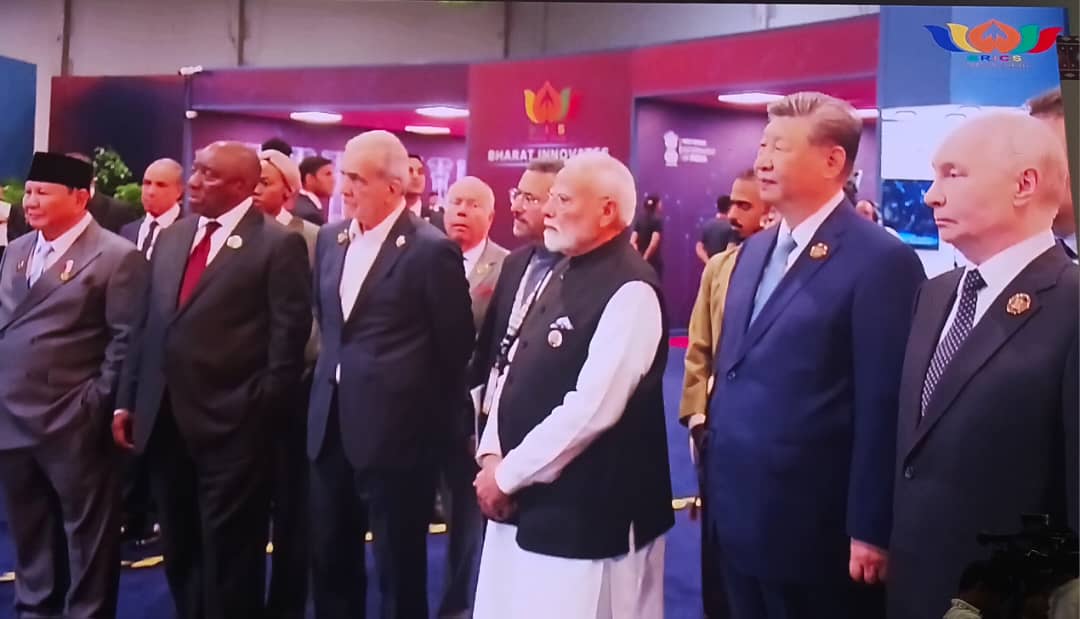
BRICS leaders have adopted the New Delhi Declaration, reaffirming their commitment to reforming global governance institutions and giving developing countries a stronger voice in international affairs.
The declaration was adopted at the 18th BRICS Leaders’ Summit in India, as the grouping marked two decades of institutionalised cooperation. 
Briefing journalists after the leaders’ session, Secretary (Economic Relations) in India’s Ministry of External Affairs and BRICS Chair, Shri Sudhakar Dalela, said India’s fourth BRICS chairship had focused on practical, forward-looking and people-centred cooperation.
He said the chairship was guided by the theme, “Building for Resilience, Innovation, Cooperation and Sustainability”.
According to Dalela, India had organised more than 350 meetings since assuming the chairship in January, covering ministerial engagements, working groups, business meetings and people-centred initiatives held both physically and virtually.
The member session was held under the theme, “Inclusive Global Governance and Strengthening Multilateralism”.
Dalela said leaders broadly agreed on the need to strengthen multilateralism and make global governance institutions more representative, inclusive, effective and responsive to contemporary realities.
He said BRICS leaders reiterated their support for comprehensive reform of the United Nations, including the UN Security Council, to strengthen the representation of developing countries.
They also backed reforms of the international financial architecture to give countries of the Global South a greater voice in global economic decision-making.
The discussions, he said, reaffirmed BRICS principles of mutual respect, equality, solidarity, openness, inclusiveness and consensus, with differences to be addressed through dialogue and consultation.
Leaders also exchanged views on ongoing geopolitical conflicts and economic uncertainties, stressing diplomacy, dialogue and peaceful settlement of disputes.
Modi proposes four initiatives
Indian Prime Minister Narendra Modi, in his intervention at the summit, called for a stronger voice for the Global South and reforms to global governance institutions to reflect contemporary realities.
Modi also stressed the need for BRICS to remain focused on practical cooperation and development-oriented outcomes that improve people’s lives.
He proposed four initiatives for BRICS cooperation: the creation of a BRICS Troika mechanism; a BRICS roadmap on global governance reform; a Seafarer Emergency Support Initiative Network to assist seafarers in distress worldwide; and a Global South Negotiation Support Initiative.
The latter initiative is aimed at building the capacity of officials and young professionals in emerging areas such as technology and global rule-making.
Dalela described the adoption of the New Delhi Declaration as one of the defining outcomes of India’s chairship, saying it demonstrated the ability of BRICS members to reach consensus on issues of global significance.
He commended member countries for their cooperation throughout the year, saying the declaration reflected shared priorities and commitments.
A fact sheet released alongside the declaration outlines more than 50 practical outcomes across the four pillars of India’s chairship: resilience, innovation, cooperation and sustainability.
Focus on sustainability
As part of the summit’s sustainability agenda, BRICS leaders participated in a joint tree-planting initiative, reflecting India’s emphasis on environmental stewardship and climate action.
A commemorative postal stamp marking two decades of BRICS cooperation was also released during the summit.
The summit marked the conclusion of India’s latest BRICS chairship, with the New Delhi Declaration providing the framework for continued cooperation on global governance reform, development, sustainability and other areas of shared interest.