By Gloria Ikibah


The Economic Community of West African States (ECOWAS) has called for a new regional compact to tackle climate change, environmental degradation, population displacement and insecurity, warning that the region can no longer treat climate change as an environmental concern alone.
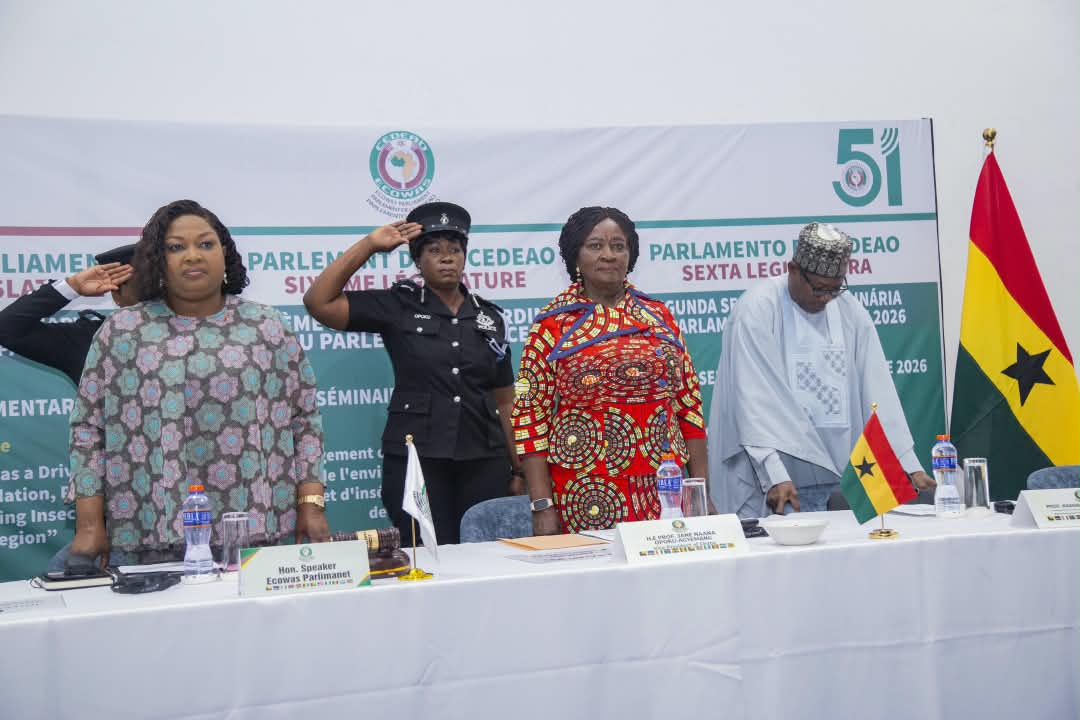
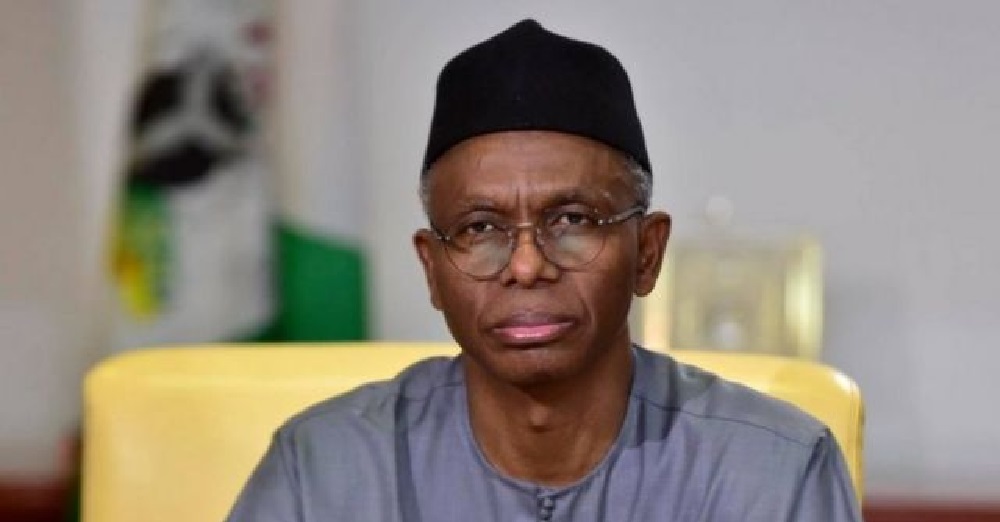
The call was made on Tuesday by the President of the ECOWAS Commission, General Birame Diop, represented by the Commissioner for Human Development and Social Affairs, Professor Nassirou Bako-Arifari, at the Second 2026 Joint Parliamentary Seminar in Accra, Ghana. 
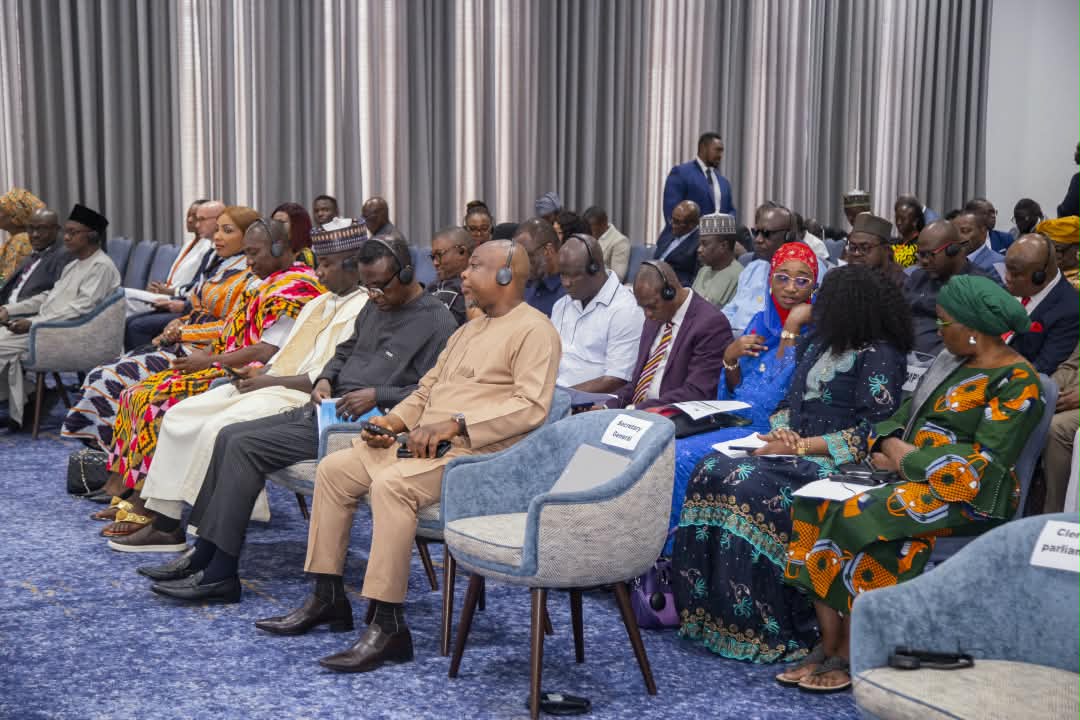
The seminar, which runs from September 21 to 23, is focused on “Climate Change as a Driver of Environmental Degradation, Population Displacement and Rising Insecurity in the ECOWAS Region.”
Prof. Bako-Arifari said the consequences of climate change were already placing growing pressure on communities, livelihoods and regional stability, making coordinated action by governments and parliaments increasingly necessary.
He said: “The theme before us is not simply an environmental issue. It is a development issue, a humanitarian issue, a peace and security issue, and ultimately an issue of human survival and regional stability confronting ECOWAS member states. West Africa is among the regions of the world particularly vulnerable to the consequences of climate change. Rising temperatures, changing rainfall patterns, prolonged droughts, desertification, coastal erosion, floods and the degradation of forests and farmlands are placing unprecedented pressure on communities and livelihoods.”
Naijablitznews.com reports that the World Bank has projected that West African countries could see as many as 32 million people moving within their own countries by 2050 because of climate factors if concrete climate and development action is not taken.
Bako-Arifari said ECOWAS had begun work to address the financing challenge facing climate action, including efforts to establish a regional carbon market platform under Article 6 of the Paris Agreement.
“Honourable Parliamentarians, Since 2024, the ECOWAS Commission has initiated an ambitious process aimed at establishing a regional carbon market platform in accordance with Article 6 of the Paris Agreement, a mechanism intended to mobilise necessary investments to address climate financing needs estimated at $294 bn for the region.
“Against this background, this Seminar is organised to provide a veritable platform for dialogue, knowledge-sharing, inter-institutional consultations to come up with concrete recommendations to strengthen climate resilience, human security and sustainable development in the ECOWAS Region”, he noted.
According to ECOWAS the region’s climate financing needs are estimated at $294 billion, while its regional carbon market initiative is being developed as one avenue for mobilising additional resources.
The ECOWAS commissioner placed particular emphasis on the role of parliamentarians, saying lawmakers had the power to translate regional commitments into national policies and practical action.
“This brings us to the critical role of Parliamentarians. Parliaments are uniquely positioned to translate regional commitments into national action. You provide the legislative frameworks, approve national budgets, exercise oversight and, importantly, serve as a direct bridge between governments and citizens”, he said.
Bako-Arifari proposed stronger climate-responsive legislation and oversight, increased domestic and regional financing, better early-warning systems and more inclusive management of natural resources.
“First, strengthen climate-responsive legislation and oversight. Our laws and policies must adequately address environmental protection, climate adaptation, disaster risk reduction and sustainable management of natural resources.
“Second, prioritise climate financing. Climate resilience cannot be achieved through declarations alone. We need predictable domestic and regional resources, while also mobilising international climate finance and strengthening access to available funding mechanisms.
“Third, strengthen early warning and early action. We must move from reacting to climate-related disasters to anticipating and preventing them. Regional early warning systems should be linked to communitylevel preparedness and rapid response mechanisms.
“Fourth, promote inclusive management of natural resources. Land, water, forests and fisheries must be managed transparently and sustainably. Local communities, women, young people, traditional authorities and other stakeholders must have a meaningful role in decision-making.
“Fifth, place youth and women at the centre of climate resilience. They are not merely victims of climate change. They are innovators, entrepreneurs, community leaders and agents of resilience. Investing in their skills, enterprises and participation is therefore an investment in the future stability of our region.”
Bako-Arifari said ECOWAS must also strengthen cooperation among member states on climate adaptation, disaster management, food and water security, environmental protection and the management of resources shared across borders.
He therefore called for closer collaboration between governments, parliaments, civil society organisations, traditional authorities, the private sector, academia and development partners.
On the broader security implications, he said ECOWAS needed to adopt a wider understanding of security which went beyond the protection of borders and prevention of armed conflict.
But cautioned against waiting for environmental pressures to develop into humanitarian or security crises.
“The scale and complexity of this challenge require us to move from fragmented responses to a comprehensive regional climate-resilience and human-security agenda. We need a new understanding of security—one that recognises that security is not only about protecting borders and preventing armed conflict. It is also about ensuring that citizens have access to food, water, livelihoods, a safe environment and opportunities for a dignified life.
“We must therefore be proactive and invest in resilience before crises occur. We must protect our ecosystems before they become irreversibly degraded. We must create livelihoods before desperation drives communities into displacement. Last but not the least, we must address grievances before they become conflict”, he added.
The commissioner urged parliamentarians to ensure that the seminar produced practical outcomes rather than becoming another forum for discussing the region’s climate challenges.
“Let us build an ECOWAS region embedded in in which climate resilience is development planning; where displacement is managed with dignity; where natural resources become instruments of cooperation rather than sources of conflict; and where our young people see a future of opportunity rather than one defined by environmental vulnerability and insecurity.
“Let our efforts continue to advance peace, security, resilience and sustainable development in the ECOWAS Region as ECOWAS transitions from ECOWAS of States to ECOWAS of People and Prosperity for All”, he stated.