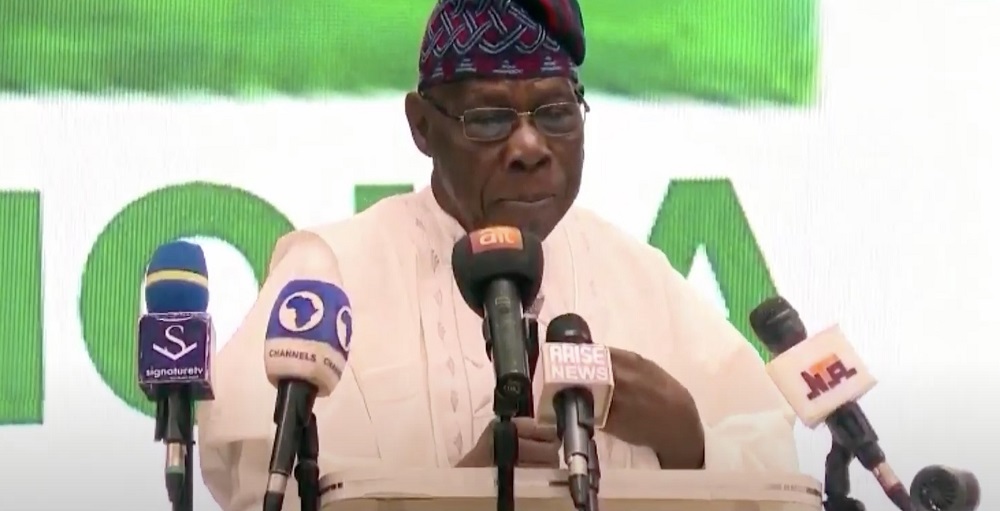
Former President Olusegun Obasanjo has recounted how he rejected an offer of political asylum from the United States despite warnings that he would be arrested upon returning to Nigeria, only to be subsequently arrested and imprisoned by the regime of former Head of State, late General Sani Abacha.


Obasanjo disclosed this while narrating his experience under Abacha’s military government in an interview published by BBC News Pidgin on Tuesday.
The former president, now 89, also explained how his decision to venture into farming after retiring from the Nigerian Army eventually became part of his life before his arrest. 
Obasanjo, who became Nigeria’s military Head of State on February 13, 1976, following the assassination of General Murtala Muhammed, governed the country until October 1, 1979, when he handed over power to the civilian administration of President Shehu Shagari.
Reflecting on his retirement from the military, Obasanjo said he had attained the highest possible position in the armed forces, having become a four-star general and served as Head of State at the age of 42.
He explained that although he had not initially intended to retire from the Army at such an early age, he considered farming a suitable venture after leaving public office.
“When I was leaving government as military head of state, there was — I was leaving too early. I didn’t join the army to retire at the age of 42.
“At the age of 42, I had become a four-star general. There’s nothing else I can do in the army. I’ve become the military head of state. That’s the highest political office I could rise.
“So what can I do? I decided I would go into farming. It really was going well, and it went well until I was arrested,” he said.
Obasanjo disclosed that his troubles began during Abacha’s administration when he was informed by the American ambassador to Nigeria that the United States government had offered him political asylum because of concerns that he would be arrested if he returned to the country.
According to him, the offer placed him in a difficult position because he believed he had committed no offence that warranted his arrest.
He, however, declined the offer, insisting that he had no reason to seek refuge outside Nigeria.
“Abacha had decided that I must be liquidated; otherwise, he would not be able to have his way. I didn’t know that. I was travelling and coming back, and the American ambassador in Nigeria called me and said his country had offered me political asylum because they knew that I would be arrested if I returned home.
“This was difficult for me. I don’t — I haven’t done anything. What do they want to arrest me for? I don’t want political asylum,” he recalled.
The former president said his international passport was subsequently seized, after which he proceeded to his farm.
On arriving at the farm, however, one of his security personnel informed him that government security operatives had surrounded the premises.
He said a policeman dressed in mufti later approached him, claiming that he had been invited by an Assistant Inspector-General of Police to assist with an unspecified matter.
Obasanjo said he rejected the approach, insisting that if the police chief genuinely needed his assistance, he should come personally rather than send an invitation through an officer.
He eventually drove himself to the police station, where the AIG informed him that he had received instructions to arrest him.
“So it was my own car that I used to take myself to the police station. We saw the AIG, and the AIG said, ‘I have been instructed to arrest you,’” he recounted.
Obasanjo further disclosed that former United States President Jimmy Carter intervened on his behalf by appealing to Abacha over his detention.
According to him, Carter’s intervention initially resulted in his being moved to house arrest after he had been confined at an undisclosed location.
However, the reprieve was short-lived as security operatives eventually came for him in the middle of the night and took him to prison.
He recalled that the arrest occurred around 1am while he was playing squash.
“Then President Jimmy Carter came. He pleaded, and then they put me under house arrest. Then they came one day; I was playing squash at about 1am.
“They came and said they were taking me away. And they took me away, and from there, I went to prison,” he said.
Abacha, who assumed power on November 17, 1993, following the overthrow of the Interim National Government headed by Ernest Shonekan, remained in office until his death on June 8, 1998.
Obasanjo was released from prison following Abacha’s death.
He subsequently contested and won the 1999 presidential election on the platform of the Peoples Democratic Party, becoming Nigeria’s first elected president of the Fourth Republic when he was inaugurated on May 29, 1999.