Government Ekpemupolo, popularly known as Tompolo, has reportedly donated 633 vehicles valued at an estimated N3.68 billion to mobilise support for President Bola Ahmed Tinubu’s re-election bid and other All Progressives Congress (APC) candidates ahead of the 2027 general elections.

Tompolo, Chief Executive Officer of Tantita Security Services Nigeria Limited and Grand Patron of the PBAT Door-to-Door Movement, has distributed the vehicles across at least 21 states as part of efforts to strengthen the president’s campaign mobilisation structure.
The donation has raised questions about compliance with the Electoral Act 2026, which stipulates a N500 million limit on individual donations to candidates, amid concerns over the regulation of non-cash contributions to political campaigns.
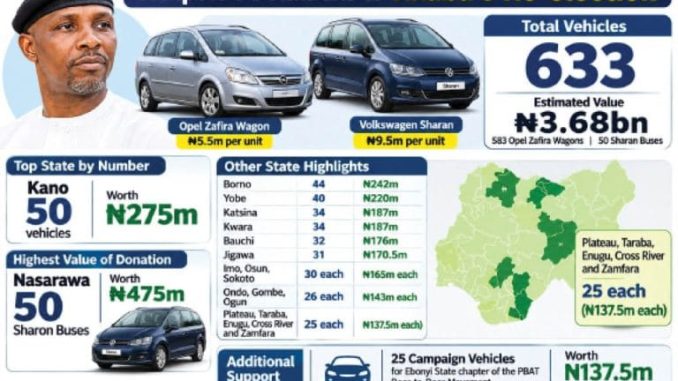
The reported fleet comprises 583 Opel Zafira wagons and 50 Sharon buses, with an estimated combined market value of N3.68 billion, based on average prices of fairly used vehicles in Nigeria.
However, the Independent National Electoral Commission (INEC) has said the application of the donation limit to contributions in kind may require judicial interpretation, as the law does not expressly distinguish between cash and non-cash donations.
Section 92(8) of the Electoral Act 2026 provides that an individual or other entity shall not donate more than N500 million to a candidate.
Under subsection (9), a candidate who knowingly contravenes the provision is liable, upon conviction, to a fine of one per cent of the permitted campaign expenditure limit, imprisonment for up to 12 months, or both.
Subsection (10) also stipulates that an individual who knowingly exceeds the donation limit is liable to a fine of five times the excess amount.
Although there is no publicly established evidence that Tompolo directly donated cash exceeding the threshold to Tinubu’s campaign, reports of the distribution of hundreds of vehicles through the political mobilisation group have prompted questions about how the law applies to material contributions.
Breakdown of Tompolo’s vehicle donations
Media reports indicate that Kano received 50 vehicles estimated at N275 million, while Borno received 44 vehicles valued at N242 million and Yobe received 40 vehicles estimated at N220 million.
Katsina received 34 vehicles valued at N187 million, Bauchi received 32 vehicles estimated at N176 million, while Kwara received 34 vehicles worth about N187 million.
Jigawa received 31 vehicles valued at N170.5 million, while Imo, Osun and Sokoto received 30 vehicles each, estimated at N165 million per state.
Ondo, Gombe and Ogun received 26 vehicles each, valued at N143 million, while Plateau, Taraba, Enugu, Cross River and Zamfara received 25 vehicles each, estimated at N137.5 million per state.
Nasarawa received 50 Sharon buses valued at an estimated N475 million, making it the state with the highest reported value of vehicle donations.
Tompolo also recently donated 25 campaign vehicles estimated at N137.5 million to the Ebonyi State chapter of the PBAT Door-to-Door Movement, bringing the reported total to 633 vehicles.
The vehicles, fitted with speakers, microphones, amplifiers and generators, were presented during the inauguration of the movement’s state chapter. Tompolo was represented at the event by Kestin Pondi, Managing Director of Tantita Security Services Limited.
The estimated N3.68 billion valuation is based on an average market price of N5.5 million for each Opel Zafira and N9.5 million for each Sharon bus.
A Weekend Trust report put the prices of fairly used Opel Zafira vehicles in Nigeria between N3.5 million and N7.5 million, while a Maiduguri-based car dealer, Alhaji Muhammad Hussaini, reportedly said the vehicles were purchased from importers for N5.2 million and sold for approximately N5.5 million each.
The estimated price of the Sharon buses was based on average Toyota Hiace listings on the Nigerian vehicle marketplace Carloaded.
When contacted for comments, Tompolo’s media aide, Paul Bebenimibo, said he could not speak on the donations, adding that some journalists had been selected to report the activities of the movement.
He did not address questions about whether the donations complied with the Electoral Act and had yet to respond to a text message sent to him.
### INEC says donation limit may require court interpretation
INEC National Commissioner and Chairman of the Information and Voter Education Committee, Malam Mohammed Haruna, said the law did not expressly specify whether the donation ceiling applied to cash or contributions in kind.
“The section did not mention cash or kind; it just mentioned the amount. We wouldn’t know until it is tested in court. And no case has come up yet. I’m not a lawyer, and even a lawyer cannot give you a categorical answer on that,” Haruna said.
A senior INEC official, who spoke on condition of anonymity, said the commission monitored different forms of campaign support but declined to give a definitive interpretation of the donation limit.
The official said determining the value of non-cash contributions could be complicated, particularly where vehicles and equipment were provided for campaign purposes without necessarily being transferred permanently to beneficiaries.
According to the official, some contributions could be presented as leases or temporary support, making it difficult to establish whether they amounted to donations.
The official said INEC monitored visible campaign support, including facilities and billboards, while working with relevant agencies to track financial transactions and other forms of support.
The uncertainty surrounding the application of the donation ceiling has raised concerns about possible loopholes in campaign finance regulation ahead of the 2027 elections, particularly the potential use of third-party contributions and non-monetary donations to circumvent spending restrictions.
### Other campaign-related donations
Tompolo’s reported vehicle donations are among several material contributions linked to political mobilisation ahead of the 2027 elections.
The First Lady, Oluremi Tinubu, has also been associated with the donation of seven Toyota Land Cruiser Prado SUVs to selected leaders of the APC National Youth Wing.
The development followed a video shared by APC National Youth Leader, Dayo Israel, showing seven brand-new Toyota Prado SUVs presented to selected youth leaders.
Reports put the estimated market price of a brand-new 2026 Toyota Prado at between N120 million and N160 million, depending on specifications and dealer, placing the potential value of the seven vehicles between N840 million and N1.12 billion.
In Kebbi State, the Executive Chairman of the State Pilgrims Welfare Agency, Faruq Aliyu Yaro Enabo, reportedly donated 62 vehicles and 225 motorcycles to support the 2027 re-election campaigns of Tinubu and Governor Nasir Idris.
The donation comprised 60 saloon cars, two Lexus SUVs and 225 motorcycles.
Governor Idris received and commissioned the vehicles at the Government House in Birnin Kebbi, with 21 saloon cars allocated to campaign coordinators across the state’s 21 local government areas.
Ten cars were allocated to the vice-president’s campaign team, six to the three serving senators and nine to members of the House of Representatives.
Two Lexus SUVs were allocated to the APC state chairman, Kana Zuru, and the zonal vice-chairman, Shehu Idris, while reports indicated that two vehicles each were allocated to the governor’s two wives.
The donation also included 225 motorcycles for APC ward chairmen, with Enabo reportedly planning further assistance to committees across 3,627 polling units and women through sewing machines and other livelihood equipment.
The specific models of the Lexus SUVs were not disclosed, while the manufacturers and models of the 60 saloon cars and motorcycles were also not established.
Using a minimum estimated price of N6 million per saloon car, the 60 vehicles would be worth at least N360 million, excluding the SUVs.
The 225 motorcycles were estimated to cost between N247.5 million and N562.5 million, based on an assumed price range of N1 million to N2.5 million each.
The estimated value of the disclosed vehicles and motorcycles alone would therefore be at least N607.5 million, excluding the SUVs and other empowerment items.
Enabo attributed the donations to support from Governor Idris, other individuals and his personal resources, while denying allegations that pilgrims’ funds were used.
“I was able to purchase all these vehicles and motorcycles through the support of the Governor and other individuals.
“Some people have alleged that pilgrims’ funds were used, but I wish to state categorically that the funds belonging to pilgrims remain intact and are properly accounted for,” he said.
He also said the donations were funded through legitimate business activities, personal resources and assistance from the governor and other individuals.
### Tompolo’s security contracts
Tompolo’s Tantita Security Services Nigeria Limited has been involved in oil and gas infrastructure protection, particularly pipeline surveillance, under contracts with government agencies.
The company’s predecessor outfit reportedly worked with the Nigerian Maritime Administration and Safety Agency (NIMASA) in 2011 and 2012, providing platforms, equipment and expertise to assist in securing Nigeria’s waterways and improving revenue collection under a 10-year arrangement valued at $103.4 million involving 20 vessels.
The Nigerian National Petroleum Company Limited (NNPCL) awarded Tantita a pipeline surveillance contract in August 2022 valued at N48 billion, which was subsequently expanded and renewed for three years in 2023.
The company’s operations cover pipeline protection and surveillance in Delta, Ondo, Bayelsa, Rivers and Imo states, as well as parts of Akwa Ibom and Abia.
Amid criticisms of the contract, former NNPCL Group Chief Executive Officer, Mele Kyari, defended the arrangement, saying the government was dealing with a company in which Tompolo had interests rather than directly engaging the former militant leader.
Kyari argued that pipeline surveillance required the involvement of private entities and community stakeholders alongside security agencies to ensure effective protection of oil infrastructure.
About the Author