…parliament to scrutinise 2027 budget
…Diop call for stronger parliamentary diplomacy
By Gloria Ikibah
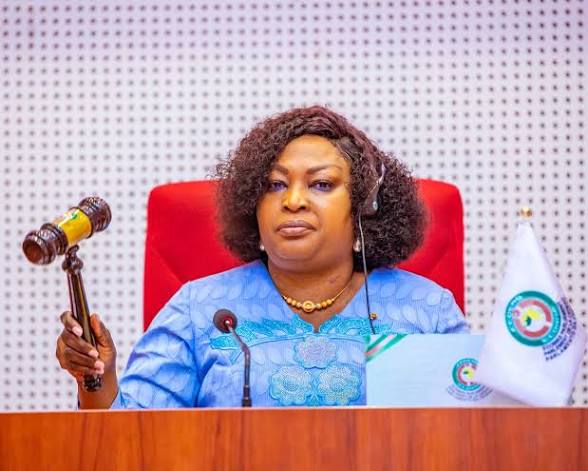
The Speaker of the ECOWAS Parliament, Rt. Hon. Memounatou Ibrahima, has called for stronger regional institutions and greater parliamentary influence in addressing West Africa’s mounting security, economic and political challenges, warning that the Community is at a critical crossroads.
The Speaker said regional integration can only succeed through stronger institutional cooperation, public trust, democratic governance and a Parliament capable of speaking directly for the people.
Ibrahima made the call on Friday while declaring open the Second Ordinary Session of the ECOWAS Parliament for 2026 in Abuja, where she urged member states and regional institutions to turn their commitments into tangible results for citizens.
She said the region was facing profound geopolitical and strategic changes that had heightened its economic, security, social, climate and technological vulnerabilities.
“The challenges confronting our region are so complex that no single institution can address them alone.
“Our collective success depends on the strength of our institutional relationships and our shared determination to translate regional commitments into concrete achievements for the benefit of our citizens,” she said.
The Speaker assured the President of the ECOWAS Commission, General Birame Diop, of the readiness of Parliament to work with other Community institutions to advance regional priorities, noting that West Africa was at a defining moment in its integration journey.
She emphasised that the Parliament must not remain on the sidelines of the region’s transformations but should position itself as a legitimate political voice for citizens and an instrument for bringing regional institutions closer to the people.
“Our Community is undoubtedly at a crossroads, where decisions must be made about the future of regional integration and a renewed drive towards our collective ambition.
“The ECOWAS Parliament must therefore not remain a mere observer of the ongoing transformations. It must establish itself as a strong and legitimate political voice of the people; an influential actor; and a powerful instrument for bringing institutions closer to citizens, while promoting greater ownership and deepening the regional integration process in West Africa,” Ibrahima said.
She also welcomed the Lungi Declaration, which reaffirmed the commitment of ECOWAS leaders to strengthening the Parliament’s legislative and oversight responsibilities.
According to her, regional integration will remain fragile without institutions that enjoy the confidence of the people and uphold democratic principles.
“Indeed, Ladies and Gentlemen, there can be no sustainable regional integration without legitimate institutions. There can be no legitimacy without the trust of citizens, and no lasting trust without an unwavering commitment to the rule of law, democracy and justice,” she said.
Speaker Ibrahima congratulated Cabo Verde on the successful conduct of its presidential election on November 15, describing the peaceful process as another demonstration of the country’s democratic credentials.
She congratulated President José Maria Neves on his re-election and the renewed mandate given to him by the electorate.
She also urged The Gambia and Nigeria, which are preparing for elections in December and January 2027 respectively, to ensure peaceful and credible electoral processes.
“To our Member States preparing for crucial electoral contests, particularly The Gambia, scheduled for December 5, and the Federal Republic of Nigeria, in January 2027, I express the hope that these electoral processes will be conducted in a peaceful atmosphere and contribute to strengthening democratic governance, peace and stability within our Community,” she said.
The Speaker said the session will feature country reports, parliamentary oversight reports, consideration of Community instruments and deliberations on major issues affecting the region.
She disclosed that lawmakers will examine reports on the Interconnected Goods in Transit Management System (SIGMAT), the ECOWAS Mission in The Gambia (ECOMIG), projects of the Regional Agency for Agriculture and Food, and the second phase of the Programme for the Promotion of a Climate-Friendly Electricity Market in the ECOWAS Region (ProCEM II).
The Parliament will also receive the strategic plan of the ECOWAS Commission President and his report on the State of the Community, providing lawmakers an opportunity to assess the new leadership’s priorities, progress and challenges.
The Speaker identified the consideration of the 2027 Community budget as one of the major highlights of the session, warning that mounting financial pressures and increasing development demands required careful scrutiny of public resources.
She said the economic difficulties facing member states, including pressure on public finances and rising debt, could affect their ability to remit the Community Levy, further complicating the financing of regional programmes.
Ibrahima urged lawmakers to ensure that budget allocations were tied to clear needs, justified spending and measurable results.
“Our responsibility is to ensure that every allocation addresses a clearly established need; that every expenditure is justified by its relevance and impact; and that the selection of priorities is guided by the demands of efficiency, performance and tangible results for the benefit of our populations,” she said.
She also called on national parliaments to intensify efforts to ensure member states remit the Community Levy promptly and consistently.
“I wish to urge our national parliaments to intensify their advocacy efforts with Member States at the appropriate political level to ensure the collection and systematic remittance of proceeds from the Community Levy,” she said.
The Speaker said the Parliament’s credibility will ultimately depend on the quality of its recommendations, the effectiveness of its oversight and its ability to influence policies that improve the living conditions of citizens.
“Our credibility will ultimately be measured by the quality of our recommendations, the effectiveness of our oversight and our ability to significantly influence the direction of policies and strategies towards improving the living conditions of our populations,” she said.
She urged members to approach the session with an open mind and a strong sense of responsibility, expressing hope that their deliberations would strengthen the vision of a united, prosperous and peaceful West Africa.
In his remarks, the President of the ECOWAS Commission, General Birame Diop, urged lawmakers to strengthen parliamentary diplomacy, describing it as necessary for building trust and sustaining dialogue amid geopolitical tensions and growing security threats.
Diop said parliamentary engagement was particularly important when diplomatic channels faced difficulties, as legislators could maintain communication, promote understanding and strengthen relationships among peoples and governments.
He called for greater regional cooperation to address terrorism, migration, climate change, humanitarian concerns and other cross-border challenges, warning that such threats could not be contained by national borders.
He said the security situation in the Sahel continued to deteriorate, with terrorist threats spreading towards coastal states, requiring a coordinated regional response.
Diop said ECOWAS was pursuing renewed security cooperation with international partners, including the United States, while prioritising border security, mobility and institutional collaboration.
He also emphasised the importance of African solidarity, particularly in addressing security threats in the Sahel and the Gulf of Guinea.
The Commission President said regional integration remained essential to unlocking West Africa’s economic potential, pointing to its population, agricultural resources, mineral wealth, energy opportunities, transport corridors and growing entrepreneurial capacity.
He, however, warned that these advantages will remain largely untapped without connected markets, reduced trade barriers, harmonised customs procedures and stronger regional value chains.
Diop called for accelerated digitalisation, industrial development and the removal of obstacles to the free movement of goods and people, saying regional integration must translate into practical benefits for traders, farmers, entrepreneurs and young people.
He said the new strategic direction of the ECOWAS Commission, which he referred to as Agenda 309, will be presented to lawmakers during the session, inviting their contributions towards shaping the Community’s priorities.
The Commission President also highlighted the need to strengthen the Parliament’s legitimacy and role in ensuring that regional policies were understood, implemented and embraced by citizens.
He said the integration process must move beyond decisions taken within institutional circles and become a shared undertaking driven by the people of West Africa.
The session is expected to conclude with parliamentary opinions, resolutions and recommendations aimed at strengthening regional integration, improving security, promoting economic development and advancing the welfare of citizens across the ECOWAS region.
About the Author