By Gloria Ikibah


The Presidency has reaffirmed its commitment to working closely with the National Assembly to advance security, economic recovery and good governance, insisting that cooperation between both arms of government is essential to delivering the Renewed Hope Agenda.
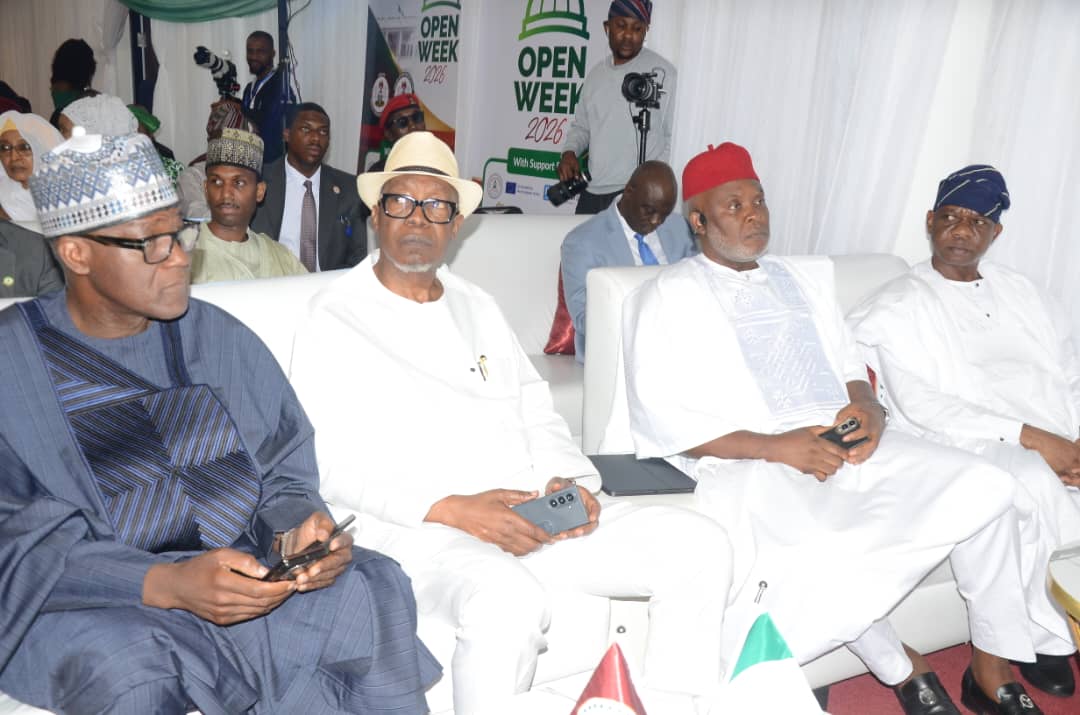
The assurance came on Tuesday as the House of Representatives opened its National Assembly Open Week in Abuja, an initiative aimed at showcasing the work of parliament and strengthening public engagement under the theme, “Three Years of the 10th National Assembly: Advancing Transparency, Inclusion and Reform.” 
Representing President Bola Tinubu, the Chief of Staff, Rt. Hon. Femi Gbajabiamila, said Nigerians expect government institutions to work together in the national interest, while stressing that the Open Week should serve as more than a ceremonial event.
He said: “An Open Week must be more than the ceremonial opening of the gates of Parliament. It should be an invitation to scrutiny, dialogue and partnership.
“Citizens should be able to follow how laws are made, understand how public resources are appropriated and see how legislative oversight protects the national interest.
“Equally, the legislature must continue to hear from young Nigerians, women, persons with disabilities, civil society, the private sector, professional bodies and communities across the federation.”
Gbajabiamila praised the leadership of the National Assembly, led by Senate President Godswill Akpabio and Speaker of the House, Tajudeen Abbas, for reforms undertaken since the inauguration of the 10th Assembly.
He emphasised that collaboration between the Executive and Legislature strengthens, rather than weakens, democracy.
“While the Executive and the Legislature are separate arms of government, they share one ultimate mandate which is to improve the lives of the Nigerian people. Constructive cooperation does not diminish legislative independence, nor does robust debate amount to institutional conflict. Our democracy is strengthened when both arms engage with mutual respect, constitutional fidelity and a clear focus on results.
“As we reflect on the first three years of the 10th Assembly, I encourage us to look beyond the record of activities to the measure of impact: laws that solve real problems; budgets that translate into visible development; oversight that improves performance; and representation that renews citizens’ confidence in government.
“The Presidency remains committed to a productive relationship with the National Assembly in pursuit of security, economic renewal, social justice and shared prosperity under the Renewed Hope Agenda. Nigerians expect their institutions to work together.
“I congratulate the 10th National Assembly and all partners who have made this Open Week possible. May this gathering deepen public trust, strengthen democratic accountability and remind us all that public office is, above all, a public trust”, he added.
In his keynote address, Speaker Abbas Tajudeen defended the performance of the House over the past three years, revealing that lawmakers had processed 2,747 bills, with 363 passed by the National Assembly and 72 already signed into law by President Tinubu.
He said the figures represented the most productive legislative record since the return to democratic rule in 1999.
He said: “These were not lines upon a page but measurable and lasting change. Those figures represent the highest for any Assembly since 1999.”
According to the Speaker, one of the landmark laws guarantees interest-free student loans, while others have overhauled revenue administration and created regional development commissions.
“One of those laws now offers young people interest-free student loans, so that no Nigerian student is turned away from a lecture hall for want of means.
“Another has reformed how the nation raises and shares its revenue. Others have created commissions to carry development into every region of the Federation.
“The landmark statutes are only part of our work: more than 800 citizens have petitioned this House, and we have already brought hundreds of those matters to resolution. That, in my estimation, is this House at its most faithful.
“Where we have served the nation well, the Scorecard records it. Where we have fallen short, it records that also. At our inauguration in 2023, we asked to be measured against our own promises, and we meant it”, Abbas added,
The Speaker described the Open Week as an opportunity for direct engagement between parliament and the public.
“This week was designed not as a lecture but as a national conversation, and at every table, a place has been reserved for the citizen.”
The Speaker also defended the Assembly’s support for the Tinubu administration’s economic reforms, saying parliament had provided the legal framework required to implement key policies.
“President Bola Tinubu asked us to accept a difficult but necessary course of reforms. They reached into the very foundations of our economy, into how it is financed, how our currency is valued, and how our common revenue is shared and invested in our people.
“Every policy of the Executive still had to become law, to pass through appropriation, and to withstand legislative scrutiny. That is the indispensable work this House has performed.
“We laid the legal foundation for the tax reforms that will render our revenue fairer for generations to come.
“We enacted budgets directing resources toward infrastructure, toward power, and toward the human capital upon which all else depends.
“We gave statutory force to the reform of student financing. The President furnished the vision; the National Assembly furnished the laws that render the vision enforceable. That is the true measure of legislative support, and it is worth far more than applause”, he stated.
On security, Abbas maintained that progress was being made despite continuing challenges.
“Nothing tests a government, or a parliament, so severely as the safety of the citizen.
“Let me speak plainly: our security forces are gaining ground, and we will not rest until every Nigerian is safe.”
The Speaker also dismissed claims that the National Assembly merely rubber-stamps Executive proposals.
“Some assume, in good faith, that when a President signs a Bill quickly, then the legislature is a rubber-stamp. That is not how the work is done.
“Swift assent is usually the reward of months of committee work, completed long before the cameras arrive.
“Even the Congress of the United States has, in urgent moments, passed sweeping legislation in a single day, and no serious observer called it surrender.
“Speed built on hard preparation is the mark of a Parliament that is working, not one that has stopped thinking.”
He urged Nigerians to become more involved in the legislative process.
“My appeal to the citizen who observes us today is therefore a simple one: draw closer. Acquaint yourself with the true workings of your Parliament.
“Read a Bill before you pass judgement upon it. Submit your memoranda when we call for them. We take your submissions seriously and consider your input in amending laws”, he added.
Senate President Godswill Akpabio said the National Assembly remained focused on supporting government through legislation and budget approvals that improve the economy.
“I also insist that any sort of finance or those running our economy also take care of our contractors across the board so that money will be released to the society for things to function”, he said.
He also praised President Tinubu’s relationship with the legislature.
“He has visited us more times than any president. Whether it is June 12th or whether it is time of budget, he comes here in person and always very excited.
Executive Director of the Policy and Legal Advocacy Centre (PLAC), Clement Nwankwo, acknowledged the Assembly’s progress in areas including constitutional amendment, electoral reform and citizen engagement, but challenged lawmakers to strengthen oversight of the Executive.
“The Legislature is at its strongest not when it agrees with the Executive, but when it faithfully discharges its constitutional duty to scrutinise executive action, protect public resources and ensure that government remains accountable to the people”, he said.
Nwankwo urged lawmakers to conclude the constitutional review process, strengthen Nigeria’s electoral laws, pass the Special Seats Bill for Women, deepen transparency and ensure oversight delivers measurable benefits for citizens.
Former Speaker Aminu Masari commended the Open Week initiative, describing it as evidence that the House was living up to its reputation as the “People’s House.”
Emeritus Archbishop of the Catholic Archdiocese of Abuja, John Cardinal Onaiyekan, reminded lawmakers that their legitimacy comes from the electorate and urged them to place the interests of Nigerians above every other consideration.
Executive Secretary of the National Assembly Library, Hon. Henry Nwawuba, said the Open Week reflects parliament’s commitment to openness and accountability, while noting that it coincides with the second anniversary of the National Assembly Library, established by President Tinubu to preserve Nigeria’s legislative history and improve public access to parliamentary information.