
Opinion
The Sundiata Post Model (3): The Dual Engine Architecture


- /home/naijuinz/public_html/wp-content/plugins/mvp-social-buttons/mvp-social-buttons.php on line 27
https://naijablitznews.com/wp-content/uploads/2026/07/IMG-20260628-WA00132-1000x600.jpg&description=The Sundiata Post Model (3): The Dual Engine Architecture', 'pinterestShare', 'width=750,height=350'); return false;" title="Pin This Post">
- Share
- Tweet /home/naijuinz/public_html/wp-content/plugins/mvp-social-buttons/mvp-social-buttons.php on line 72
https://naijablitznews.com/wp-content/uploads/2026/07/IMG-20260628-WA00132-1000x600.jpg&description=The Sundiata Post Model (3): The Dual Engine Architecture', 'pinterestShare', 'width=750,height=350'); return false;" title="Pin This Post">


By Max Amuchie | The Sunday Stew
In the 7 June 2026 article which marked the formal unveiling of the Decoupling Sovereignty Index (DSI), I articulated a defining institutional proposition. The launch of the DSI was presented not merely as the introduction of a new analytical instrument, but as another milestone in the evolution of Sundiata Post into what I described as a dual engine architectural powerhouse. That statement marked an important transition. It signalled that Sundiata Post was no longer to be understood solely as a digital news platform, but as an institution consciously integrating journalism, strategic intelligence and scholarly research within a single operational framework.
The proposition advanced on that occasion was straightforward. On the front end, Sundiata Post would continue to function as a digital-first, high-velocity news organisation, reporting events, investigating public issues, analysing developments and informing citizens through timely, credible journalism. On the back end, the Sundiata Post Intelligence Unit (SPIU) would operate as a proprietary knowledge engine, generating original research, developing analytical frameworks, curating datasets, publishing working papers and preserving institutional knowledge through globally recognised scholarly repositories.
This series develops that proposition into a formal institutional architecture.
The first part in this series argued that the newsroom of the twenty-first century must evolve beyond the production of daily news to become a knowledge institution. The second situated that proposition within a broader intellectual tradition, demonstrating through the works of Walter Lippmann, Hannah Arendt, Nnamdi Azikiwe and Obafemi Awolowo that journalism has historically served not merely as a conveyor of information but as a builder of public reason, democratic culture and national development.
Having established the philosophical foundations, we now turn to the question of institutional design. Every enduring institution requires more than a compelling vision; it requires an architecture capable of translating principles into sustained practice. Ideas alone do not create institutions. Institutions endure because they are deliberately designed to produce consistent outcomes, preserve organisational memory, adapt to changing environments and outlive their founders.
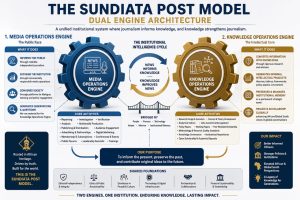
The Sundiata Post Model is therefore built upon what I call the Dual Engine Architecture. Simply stated, the Dual Engine Architecture is an institutional design in which a Media Operations Engine generates public value through journalism while a Knowledge Operations Engine transforms that journalistic enterprise into a permanent system of knowledge production.
The first engine is the Media Operations Engine—the visible newsroom that performs the essential functions of journalism through reporting, verification, investigation, editing, publication and audience engagement. The second is the Knowledge Operations Engine—the institutional infrastructure through which research is conducted, theories are formulated, datasets are curated, policy knowledge is generated and intellectual assets are systematically preserved.
These engines are neither parallel organisations nor competing departments. They are interdependent components of a single institutional system. Journalism supplies the observations, evidence and questions that shape the research agenda. Research, in turn, enriches journalism with deeper context, analytical rigour and conceptual innovation. The output of one continuously strengthens the other, creating an institutional intelligence cycle in which news informs knowledge and knowledge improves news.
The significance of this architecture extends beyond Sundiata Post itself. It offers a framework for reimagining the modern newsroom in an era defined by rapid technological change, information overload and declining public trust. Rather than treating journalism as a transient response to the daily news cycle, the Dual Engine Architecture positions the newsroom as the public-facing component of a broader knowledge enterprise—one that simultaneously informs the present, preserves the past and contributes original ideas to the future.
The Media Operations Engine
The first pillar of the Sundiata Post Model is the Media Operations Engine. This is the institution’s public-facing operational system—the visible enterprise through which Sundiata Post fulfils its journalistic, commercial and public engagement responsibilities. It represents the front end of the organisation, integrating editorial excellence with audience development, revenue generation and public-facing institutional activities.
At its core, the Media Operations Engine performs the traditional functions of a professional news organisation. It identifies stories of public importance, deploys reporters to the field, verifies facts through rigorous editorial procedures, produces multimedia content, provides analysis and commentary, and disseminates information across digital platforms. These activities remain the foundation of the institution’s commitment to informing society accurately, independently and responsibly.
Beyond the newsroom, however, the Media Operations Engine encompasses the broader business of media. It includes advertising and brand partnerships, digital marketing, audience growth strategies, subscription and membership initiatives where applicable, commercial publishing, multimedia production, and other revenue-generating activities necessary to sustain editorial independence. Within the Sundiata Post Model, commercial operations are not peripheral to journalism; they are carefully managed institutional functions that provide the financial capacity required for long-term public-interest reporting and knowledge production.
The engine also extends the institution’s public engagement beyond daily news publishing. Conferences, annual lectures, policy dialogues, public forums, media masterclasses, leadership summits and other convening platforms become integral components of the media enterprise. These engagements transform the organisation from a publisher of information into a convener of ideas, creating spaces where journalists, scholars, policymakers, business leaders and citizens can deliberate on issues of national and continental importance. In doing so, the Media Operations Engine strengthens the institution’s civic presence while simultaneously generating new networks, partnerships and editorial opportunities.
Within the Sundiata Post Model, the Media Operations Engine performs an additional function that distinguishes it from conventional news organisations. It serves as the institution’s principal observational system. Every news report, investigative assignment, interview, audience interaction, conference discussion and field observation constitutes more than a discrete media product. Collectively, they generate the empirical evidence, public conversations and emerging questions that feed the institution’s knowledge infrastructure.
In many conventional media organisations, these valuable intellectual assets dissipate with the passing of the news cycle. The Sundiata Post Model rejects this linear conception of journalism. Instead, every verified report, public engagement and editorial initiative is regarded as a potential contribution to a cumulative institutional intelligence system.
Accordingly, the Media Operations Engine performs four interconnected functions. First, it informs the public through credible journalism. Second, it sustains the institution through commercially responsible media operations. Third, it convenes society by creating platforms for dialogue, learning and policy engagement. Fourth, it continuously generates the empirical observations and strategic questions that become the raw material for the Knowledge Operations Engine.
The Media Operations Engine is therefore far more than a newsroom. It is the institution’s interface with society—observing events, engaging audiences, building relationships, generating revenue and producing the empirical foundation upon which the Sundiata Post Model’s broader knowledge enterprise is constructed.
The Knowledge Operations Engine
If the Media Operations Engine is the public face of the Sundiata Post Model, the Knowledge Operations Engine is its intellectual core. It is the institutional infrastructure through which information is transformed into knowledge, knowledge into analytical frameworks, and analytical frameworks into enduring intellectual assets. While the front end responds to the immediacy of events, the back end seeks to understand their underlying structures, causes and long-term implications.
The Knowledge Operations Engine is anchored by the Sundiata Post Intelligence Unit (SPIU), which serves as the institution’s research and strategic intelligence hub. It is responsible for designing and executing research programmes, developing original concepts and theories, constructing analytical indices, curating datasets, producing policy papers, publishing working papers and peer-reviewed scholarship, maintaining institutional standards for methodology, research quality and knowledge governance, and preserving institutional knowledge through globally recognised academic repositories.
In this architecture, research is not an adjunct to journalism but an integral institutional function.
Unlike conventional newsroom research desks, whose work is often confined to supporting daily editorial production, the Knowledge Operations Engine pursues an independent programme of knowledge creation. It identifies recurring patterns across time, interrogates complex governance and security challenges, develops explanatory models, and subjects those models to empirical testing. The objective is not merely to explain individual events but to contribute original intellectual frameworks capable of advancing scholarly and policy debates.
The engine is also responsible for the stewardship of institutional memory. Research datasets, methodological notes, interview archives, conceptual papers, technical documentation and analytical outputs are systematically organised, preserved and made retrievable. Rather than allowing institutional knowledge to disappear with personnel changes or the passing of the news cycle, the Sundiata Post Model treats these materials as strategic assets that accumulate value over time. This commitment to preservation transforms the institution from a producer of content into a custodian of knowledge.
A defining characteristic of the Knowledge Operations Engine is its commitment to openness and scholarly engagement. Where appropriate, research outputs are deposited in recognised academic repositories, enabling scrutiny, replication, citation and further development by the global research community. By exposing its analytical frameworks and datasets to independent examination, the institution embraces the principle that durable knowledge grows stronger through critical evaluation rather than institutional isolation.
The Knowledge Operations Engine therefore performs four interconnected functions. First, it converts empirical observations into structured knowledge through rigorous research and analysis. Second, it generates original intellectual products—including theories, indices, policy frameworks and methodological innovations—that extend beyond the immediate demands of journalism. Third, it preserves and manages the institution’s intellectual capital as a permanent strategic resource. Fourth, it projects African or Global South scholarship into global academic and policy ecosystems, ensuring that ideas developed within the newsroom contribute to international conversations on governance, security, development and media innovation.
The Knowledge Operations Engine is therefore not simply a research department. It is the institutional mechanism through which journalism acquires permanence, evidence is transformed into understanding, and a media organisation evolves into a knowledge-producing institution. Together with the Media Operations Engine, it completes the Dual Engine Architecture that lies at the heart of the Sundiata Post Model.
If the preceding sections explain how the Sundiata Post Model works, an equally important question remains: Is this architecture unique to Sundiata Post, or can it become a framework for journalism more broadly?
Beyond Sundiata Post
The Sundiata Post Model is proposed as a universal institutional framework for twenty-first-century journalism. Although it originated within Sundiata Post, it is not conceived as an organisation-specific model. Rather, it offers a general institutional architecture that can be adapted by news organisations operating in diverse economic, technological, political and cultural environments.
In this formulation, Sundiata Post is not the model; it is the founding implementation and proof of concept—a living institutional demonstration that such an architecture is both practicable and sustainable. The relationship is similar to the Toyota Production System, which began inside a single company but evolved into a global management framework adopted by organisations far beyond the automotive industry. Likewise, the Sundiata Post Model is intended to transcend the organisation in which it was first developed.
Its long-term significance will therefore be determined not solely by its success at Sundiata Post, but by its capacity to be tested, adapted, replicated and refined by media organisations across different societies. The true measure of any institutional model is not that it works for its originator, but that it enables others to build stronger institutions of their own. If the Sundiata Post Model ultimately proves capable of helping news organisations across Africa, the Global South and beyond become enduring knowledge institutions, then its greatest contribution will not be what it achieved for Sundiata Post, but what it made possible for journalism itself.
Trust is sacred. Stay seasoned.
•Dr. Max Amuchie is a Scholar-Journalist, Media CEO, Lead Researcher at the Sundiata Post Intelligence Unit (SPIU), and an Expert Member and Peer Reviewer at ScienceOpen. He is the architect of The Insecurity Triad framework for African security analysis as well as the Trinity of Sovereignty Decay (formerly Trinity of State Decay) theory, and the Decoupling Sovereignty Index (DSI)—original frameworks for understanding, categorising, and measuring conflict, state decay, and sovereignty in the Global South.
X: @MaxAmuchie | Email: max.a@sundiatapost.com

By Ken Harries Esq
“Vision is the art of seeing what is invisible to others,” observed Jonathan Swift. Every generation encounters leaders who solve today’s problems, but far fewer produce leaders who design tomorrow’s possibilities. The true measure of visionary leadership lies in the ability to recognise opportunities long before they become obvious, to imagine possibilities where others see only limitations, and to lay foundations whose full significance may not be appreciated until years later. History’s greatest builders are remembered not merely for the projects they completed, but for the future they envisioned before anyone else believed it was possible.
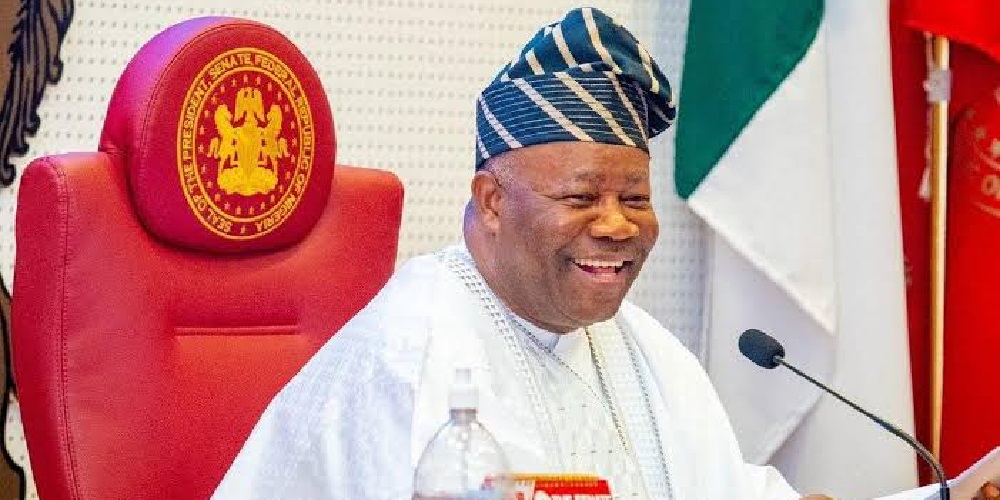
The true measure of visionary leadership lies not in the number of projects conceived, but in the ability to understand how seemingly unrelated sectors of the economy can reinforce one another to produce lasting prosperity. That was the deeper story behind Senator Godswill Akpabio’s presentation at the 2nd South South Economic Summit in Asaba in April 2012.
Many remember the address for its most celebrated proposal—the Ibom Deep Seaport. Yet the speech revealed something far more profound: a philosophy of development that viewed infrastructure not as isolated monuments, but as interconnected instruments of economic prosperity and social transformation.
That philosophy permeated virtually every aspect of the presentation. It was evident in aviation. At a time when aircraft maintenance in Nigeria depended almost entirely on foreign facilities, Akpabio announced plans for what he described as West Africa’s first Maintenance, Repair and Overhaul (MRO) facility alongside the Akwa Ibom International Airport. Once again, the objective was not merely to construct another public facility. It was to retain within Nigeria the economic value, technical expertise, and skilled employment that routinely left the country whenever aircraft were serviced abroad.
Long before expressions such as local value addition, industrial self-reliance, and reducing capital flight became part of mainstream policy discussions across Africa, those ideas had already found practical expression in the development strategy he articulated in Asaba.
Even his brief remarks on state policing now possess remarkable contemporary relevance. Years before today’s broad national consensus that Nigeria’s security architecture requires fundamental reform, he argued that governors could not reasonably be held fully accountable for security while operational control remained centralised. Over time, national debate has steadily moved closer to the position he advanced.
Vision, however, should never be mistaken for perfection. Every transformative project encounters obstacles—financing constraints, regulatory hurdles, political transitions, implementation delays, and public controversy. The Ibom Deep Seaport has experienced each of these realities. When Governor Udom Emmanuel renamed the project from the Ibaka Deep Seaport to the Ibom Deep Seaport, many perceived the change as accompanying a relocation of the proposed site from Ibaka in Mbo Local Government Area to a coastal location in Ibeno Local Government Area. Government maintained that the final location emerged from rigorous technical evaluation, but the episode illustrated how even the most carefully conceived projects can become entangled in local sensitivities and competing interests.
Yet the endurance of the underlying idea is precisely what makes the original vision remarkable. Governments changed. Political actors came and went. Debates arose and subsided. But the central economic concept endured. The Federal Executive Council approved the project’s business case in 2015, and successive administrations have continued to advance it under the Ibom Deep Seaport name. Good ideas possess a resilience that often outlives the administrations that first conceive them.
Therein lies perhaps the greatest lesson of the Asaba address. Vision is not measured by how loudly it is proclaimed, but by how far ahead it sees. History’s greatest builders were rarely those who merely responded to the demands of their own generation and time. They were those who imagined opportunities others could not yet see and laid foundations whose full value would only be appreciated years later.
Nigeria’s development story will ultimately belong not only to those who completed great projects, but also to those who first conceived them. The true legacy of public leadership is not merely the structures that rise from the ground, but the ideas that continue to shape a nation’s future long after the speeches have ended and the applause has faded. Judged by that standard, the Akpabio’s Asaba address remains an enduring lesson in visionary leadership.
Ken Harries Esq is an Abuja based development Communication Strategist


By
Sonny Aragba-Akpore
With an ambitious move to generate nearly N600b in revenue yearly, the Digital Switch Over (DSO) programme launched recently by the Federal Government of Nigeria may not be as smooth as envisioned despite its promise of free-to-air broadcast systems. The government also anticipates nearly $1b from Spectrum sales alone, and other speculated income streams, and the Information and National Orientation Minister, Mr Idris Mohammed, and his Communications, Innovation and Digital Economy counterpart, Mr Bosun Tijani, are very enthusiastic that DSO will certainly be a game changer.
Nigeria is about 20 years behind the schedule announced by the International Telecommunications Union (ITU). With a wobbling analogue television broadcasting believed to be inefficient and massive misuse of radio frequency bands, the government feels that the transition to DSO, no matter how late, will boost government revenues. “Turning off analogue transmitters frees up high-value frequencies in the 700MHz and 800MHz bands.”
Government intends to sell this freed-up space—known as the “Digital Dividend”—to telecommunications companies for 4G and 5G rollout and mobile broadband expansion to boost internet connectivity, and this single process is projected to generate over $1 billion in direct auction revenue. 40 million homes are expected to pay minimal yearly fees to keep their converter boxes active, thus creating a recurring, high-volume pool of capital, and the government takes a regulatory cut of these administrative fees.
But is revenue generation the ultimate purview of the government? Apart from the Information and Communications Ministries’ involvement at policy formulation levels, the National Broadcasting Commission (NBC) and Nigerian Communications Satellite Limited (NIGCOMSAT) are expected to play key roles as regulators and service providers.
Already, Nigcomsat has a Direct to Home (DTH) centre where it is expected to warehouse programmes with the help of content creators, beam signals of about 100 programmes to multiple radio stations nationwide via its satellite, the Nigcomsat 1R, at no cost to subscribers.
Although there are expected free set-top boxes to track signals for radio stations and TV with no monthly fees, NBC has structured the setup boxes to include a yearly access or activation fee (often called a “Free TV Carriage Fee” or smartcard renewal fee, as the case may be. But that is where the excitement stops.
Millions of homes paying a minimal yearly fee to keep their converter boxes active creates a recurring, high-volume pool of capital. The government takes a regulatory cut of these administrative fees. Analysts say that under the old analogue regime, individual TV stations owned and managed their own expensive transmission masts. By the DSO model, TV channels focus only on making content. They must pay licensed National Signal Distributors (like ITS or Pinnacle) to transmit their channels to the public.
The government generates direct revenue by licensing these signal distributors and takes a percentage-based regulatory levy on the carriage fees paid by the TV stations to remain on the Free TV network. The free set-up boxes are internet-enabled, and so users will have unfettered access to crisp digital signals for optimal content. There will be an advertisement boom projected to hit over N600 billion, from which the government will have cuts as tax. But beautiful as the initiative is, it will not gain currency until December 31, 2028.
Although the DSO programme appears populist, can it compete with DSTV and Star Times even though their tariffs are prohibitive? We just hope DSO is not a wild goose chase. ITU initiated DSO in 2006 with a mandate to migrate tv and radio broadcasts from analogue to digital terrestrial broadcasting.
The 2006 decision was reached at the Regional Radiocommunication Conference held in Geneva. Member nations signed the Geneva 2006 (GE06) Agreement, which originally set a global switch-off deadline for June 2015. Because many regions struggled to meet this target, it was subsequently extended to 2020. Nigeria officially began its DSO journey with a pilot programme in Jos, Plateau State, on April 30, 2016. Following a steady progression, the Federal Government initiated a major nationwide rollout of the DSO but was stifled by a lack of political will laced with alleged personal interests.
While other countries on this belt are striving to create an enabling environment for the implementation of DSO, some countries, including Nigeria, were unable to catch up. The updated rollout pivots to a satellite-first approach to reach nationwide coverage faster, offering seamless picture quality and audio. Even when there are manifest prospects from DSO, there are also palpable contradictions and concerns over its availability.
The hybrid satellite approach appears not to be comfortable with some stakeholders in the Broadcasting Organisations of Nigeria (BON). Analysts reason that true DSO legally requires Digital Terrestrial Television (DTT) to free up bandwidth for telecom operators, warning that the satellite model shifts dish and decoder costs to citizens. And this is unfortunate. The satellite option may be on edge as the Nigerian satellite operator has no backup satellite to mitigate the situation in the event of downtime.
If fully realised, the DSO may free up premium frequency bands (like 700MHz and 800MHz) for auctioning to telecom operators to expand 4G/5G broadband. It is also designed to create thousands of jobs in local content creation and offer an integrated audience measurement system for advertisers with an estimated turnover of over N600 billion yearly. StarTimes and DSTV may lose market shares as advertisers will cash in on the free tv channels to boost their revenue.
But Star Times has a comparable advantage since it is uniquely insulated because it operates as the primary technical partner to the Nigerian Television Authority (NTA) through its joint venture, Integrated Television Services (ITS)—one of the licensed national signal distributors. Because StarTimes built much of the digital terrestrial television (DTT) infrastructure used for the DSO, the company stands to generate substantial business-to-business revenue from transmission fees and infrastructure management.
MultiChoice’s lower-tier GOtv packages face immense pressure; its premium DStv tier remains relatively protected. FreeTV cannot compete with DStv’s exclusive live sports broadcasting rights (such as the English Premier League) and expensive international content libraries. MultiChoice will likely be forced to pivot aggressively toward premium exclusivity and its Showmax streaming platform to hedge against losing the market.
The nationwide platform launch of June 17, 2026, was the official activation of Nigeria’s National Digital Broadcasting Platform. Managed via a partnership between the NBC and NIGCOMSAT, this initial rollout went live with over 57 digital channels, scaling toward a target of 100+ free-to-air stations. From 2026 – 2028 (The Hybrid Rollout Phase) will lead to the deployment of a converged broadcast model.
This combines Direct-to-Home satellite (DTH), Digital Terrestrial Television (DTT), and Internet Protocol (IP) networks to resolve regional infrastructure gaps. December 31, 2028, is the definitive deadline for all analogue transmitters across Nigeria to be permanently turned off. Beyond this date, standard TV antennas will no longer pick up broadcast signals without a digital converter box.
By Ken Harries, Esq.
It often begins as an ordinary day. A commercial bus pulls out before dawn, its passengers expecting nothing more than traffic delays and bad roads. Traders carry the week’s earnings. Students return to school. A nursing mother cradles her child. A retired civil servant travels to visit his family. Elsewhere, anxious parents wave goodbye as a school bus disappears through the gates, expecting to see their children again that afternoon. Then, somewhere along a lonely highway or beside a quiet rural school, armed men emerge from the bush. Within minutes, ordinary life gives way to terror. Passengers are dragged into the forest. Schoolchildren are herded into waiting vehicles. Families receive the dreaded telephone call demanding ransom. By nightfall, another community has joined the growing list of Nigerians praying that their loved ones will return home alive.
That story is no longer exceptional. It has been repeated so often, in different states and under different circumstances, that it has become a grim national pattern. Across Nigeria, parents hesitate before sending their children to school. Farmers weigh every trip to their fields against the possibility that they may never return. Travellers study routes not for the shortest distance but for the greatest chance of survival. In a country blessed with enormous human and natural resources, fear has become an invisible checkpoint on countless roads.
It is against this backdrop that the debate over state police has acquired fresh urgency.
For decades, Nigerians have argued over whether policing should remain the exclusive responsibility of the Federal Government or whether states should be empowered to establish their own police services. It is a conversation that has generated more heat than light, with strong emotions on both sides.
The State Police Bill, now making its way through the constitutional amendment process, represents the most determined effort yet to answer that question and make community policing a constitutional reality.
More importantly, it reflects a growing national consensus that the country’s evolving security challenges require a policing structure that is closer to the people, more responsive to local realities, and better equipped to detect and prevent crime before it occurs. Whether one ultimately supports or opposes state police, there can be little doubt that the debate has moved beyond theory. It is now about finding practical solutions to one of the greatest threats confronting Nigeria’s unity, stability, and future.
It is certainly an ambitious proposal. The strongest argument in favour of state police begins with a simple reality: Nigeria has grown too large, too complex, and too diverse for a completely centralised policing structure to respond effectively to every local security challenge.
A police officer deployed hundreds of kilometres away can rarely know a community as intimately as those who live there. Local officers are more likely to understand the terrain, recognise unfamiliar faces, detect emerging threats, and build the trust that encourages residents to volunteer vital intelligence before crimes occur rather than after lives have been lost. They also have a deeper personal stake in preserving peace. Their families live in the community. Their friends are there. Their children attend its schools. Their lives are woven into its social fabric. That sense of belonging often translates into a stronger commitment to preventing crime because every threat to the community is also a threat to the people and places they call home.
Such local knowledge can make all the difference. It can be the difference between prevention and tragedy. It can enable security agencies to identify suspicious movements before they become deadly attacks, respond more swiftly to kidnappings and violent crimes, resolve communal tensions before they escalate, and gather intelligence that outsiders might never obtain. At the same time, it would allow federal security agencies to concentrate their resources on terrorism, organised crime, transnational offences, and other threats that transcend state boundaries.
There is another advantage that is often overlooked. Effective policing depends not only on uniforms, weapons, and patrol vehicles, but also on public confidence. People are far more likely to cooperate with law enforcement when they regard police officers as members of their own communities rather than distant representatives of an impersonal bureaucracy. They are more willing to report suspicious activities, identify criminal elements, and volunteer intelligence that could prevent crimes before they occur. In the fight against insecurity, timely information is often the most powerful weapon, and that information flows most readily where trust has been earned.
Yet, if the promise of state police is considerable, so too are the risks. No constitutional reform should be judged solely by its potential benefits; it must also be tested against the possibility of unintended consequences. It is here that the debate becomes more complex.
Nigeria’s political history gives critics ample reason for caution. Governors already wield significant influence within their states. Entrusting them with operational control over police formations inevitably raises difficult questions. Could state police be used to intimidate political opponents? Could elections become even more contentious if security agencies are perceived to serve incumbents rather than the law? Could legitimate dissent be treated as political disloyalty? These are not hypothetical concerns. They arise from Nigeria’s own political experience and deserve credible constitutional and institutional safeguards.
Beyond the question of political misuse lies an equally practical challenge: funding. Professional policing is expensive. It requires far more than uniforms and patrol vehicles. Officers need rigorous training, competitive remuneration, modern equipment, reliable communication systems, forensic capabilities, intelligence infrastructure, and continuous oversight. Many states already struggle to pay salaries and finance essential public services. Without a sustainable funding framework, some states could build highly professional police services while others struggle to maintain basic operational capacity. That would not strengthen national security; it would simply replace one centralised policing problem with thirty-six unequal policing systems.
There is also the issue of coordination. Criminals do not stop at state borders to admire welcome signs. They move across jurisdictions with ease. Any state policing framework must therefore establish clear rules for cooperation between state and federal agencies, intelligence sharing, joint operations, and conflict resolution. Otherwise, confusion could become as dangerous as the insecurity the reform seeks to address.
These are difficult questions, but difficult questions are precisely what serious legislatures exist to confront. That is why the Senate’s handling of the State Police Bill deserves plaudits.
Under the leadership of Senate President Godswill Akpabio, the 10th Senate has chosen engagement over avoidance. Few constitutional questions are as politically sensitive as those touching the nation’s security architecture. They evoke competing interests, regional anxieties, constitutional concerns, and deeply held convictions about the nature of the Nigerian federation. Faced with such complexity, the easier course would have been to postpone the debate or leave it to another Assembly. Instead, the Senate elected to confront the issue directly, recognising that a nation under relentless security pressure cannot indefinitely defer difficult decisions.
By encouraging public hearings, inviting diverse perspectives, and steering deliberations through the constitutional process, the Senate has transformed what was once an endless national argument into structured legislative engagement. That is how democratic institutions are supposed to function. The objective is not to eliminate disagreement. It is to channel disagreement into laws that strengthen the republic.
The State Police Bill is certainly not a magic wand. No legislation, however well crafted, can eliminate insecurity overnight. Laws create frameworks; institutions and leadership determine outcomes. The success of state police will therefore depend not merely on the passage of the Bill but on how faithfully its provisions are implemented and how effectively its safeguards are enforced. Independent oversight, merit-based and transparent recruitment, sustainable funding, clear operational protocols, professional accountability, and robust protection against political interference will determine whether state police emerge as trusted guardians of public safety or degenerate into instruments of partisan power.
Achieving those objectives is not solely the responsibility of the National Assembly. It demands a sustained commitment from every stakeholder in the security ecosystem. State governments must resist the temptation to politicise the police. Security professionals must uphold the highest standards of professionalism and integrity. Civil society must remain vigilant in demanding accountability, while citizens must embrace the civic responsibility of cooperating with law enforcement. Only through such a shared commitment can the promise of state police be translated into lasting public safety.
Still, there is value in recognising progress when it occurs. For too long, Nigeria’s security conversation has revolved around managing recurring crises instead of questioning whether the structures themselves require reform. The State Police Bill signals a willingness to examine first principles and ask whether yesterday’s solutions remain adequate for today’s realities.
That willingness matters. Nation-building is seldom about finding perfect answers. More often, it is about having the courage to ask the right questions and the wisdom to improve institutions one reform at a time.
The Senate has opened that door. What remains is to ensure that what ultimately emerges from it strengthens security, deepens accountability, and restores public confidence in law enforcement. The true test of state police will not be the passage of the Bill but whether it produces police officers who know the communities they serve, share in their hopes and anxieties, and recognise that every threat to those communities is also a threat to their own families, neighbours, and future. Only then will Nigerians have renewed confidence that the institutions established to protect them are not distant enforcers of the law, but trusted guardians of the communities whose fate and destiny they share.
Ken Harries Esq is an Abuja based Development Communication Strategist

FHC grants Miyetti Allah President N2.6bn bail over $2.63m money laundering

Court sentences pastor to death for killing daughter over witchcraft claim

Six dead, 15 rescued as canoe capsizes in Jigawa



-

 Sports16 hours ago
W’Cup: Messi in tears, hails Spain as better after losing back-to-back dream
-
 News16 hours ago
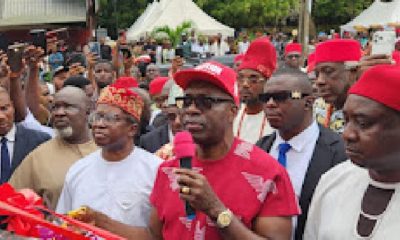
Anambra Reclaims Intellectual Heritage As Governor Soludo Unveils Achebe Monument
-
 News22 hours ago
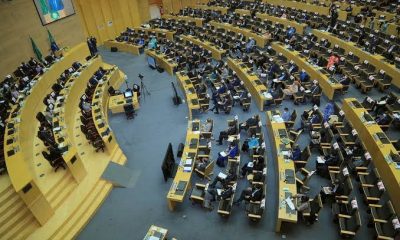
Nigeria Pushes for Stronger ECOWAS, Condemns Afrophobia, Calls for Deeper Regional Unity
-
 News16 hours ago
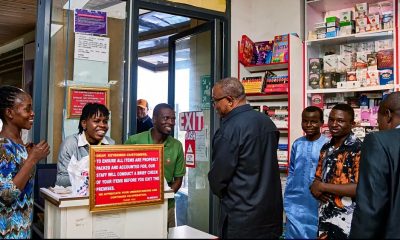
Peter Obi Stuns Shoppers As He Makes Surprise Appearance at Abuja Supermarket
-
 Metro16 hours ago
Rivers: Navy Uncovers, Deactivates Illegal Refining Sites
-

 Sports16 hours ago
2026 FIFA World Cup: What To Know About The Prize Money For Winner
-

 Sports16 hours ago
Rodri wins Golden Ball as Spain dominate World Cup awards
-
 News16 hours ago
SERAP faults data bill, warns against social media crackdown