
News
Reps Push National Drone Policy to Strengthen Defence Industry, Combat Insecurity



By Gloria Ikibah
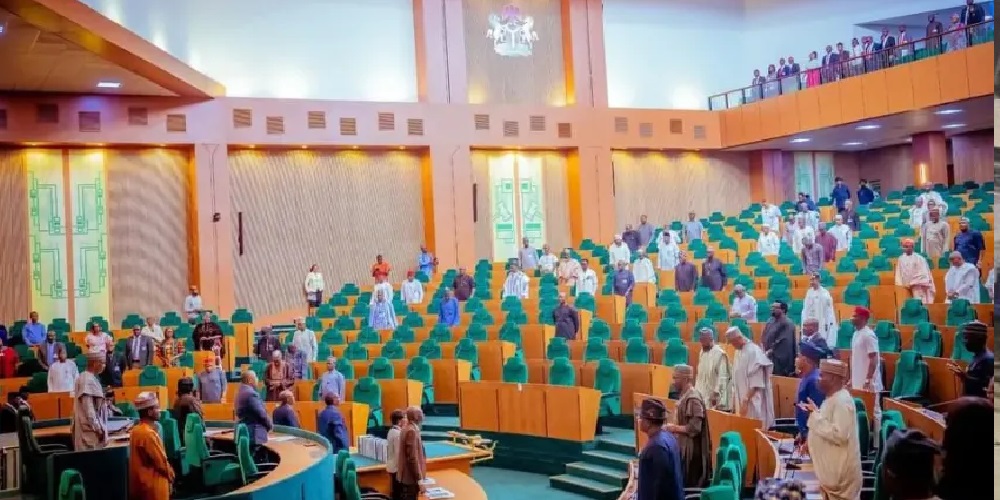
The House of Representatives has called for the development of a National Drone Industrialisation Policy aimed at strengthening Nigeria’s indigenous defence manufacturing capacity and improving the country’s ability to respond to rising security threats.
The lawmakers also urged the Federal Government to provide targeted financial support to local drone manufacturers, including Beirech UAS, Terra Industries, Elites Group, Pro-force and the Air Force Institute of Technology (AFIT), through the Bank of Industry, the Defence Industries Corporation of Nigeria (DICON) and other financing platforms to help them expand production and meet military procurement standards.
The resolution was sequel to the adoption of a motion sponsored by Rep. Ademorin Kuye on Wednesday during plenary.
Nigeria has continued to battle terrorism, banditry, kidnapping, oil theft and other forms of violent crime, prompting increasing calls for the deployment of advanced technology to support military and security operations. Globally, unmanned aerial vehicles (UAVs), commonly known as drones, have become indispensable tools for intelligence gathering, surveillance, reconnaissance and precision operations. In recent years, security experts have also warned that non-state actors, including terrorist organisations, are increasingly deploying commercial drones during attacks, underscoring the need for Nigeria to strengthen its domestic production capacity.
Debating the motion, Rep. Kuye said the country’s worsening security situation had placed enormous pressure on the Armed Forces and other security agencies.
He noted that drones have become vital assets in modern military operations, adding that terrorist groups such as Boko Haram and the Islamic State West Africa Province (ISWAP) have already incorporated commercial drones into their operations against Nigerian troops.
The lawmaker, however, said Nigeria has made notable progress in indigenous drone development, pointing to the successful production of the Tsaigumi Unmanned Aerial Vehicle by the Air Force Institute of Technology in 2018 as evidence of the country’s growing technological capability.
He argued that Nigeria possesses the resources needed to become Africa’s leading drone technology hub if supported by deliberate government policies.
He said: “The House is concerned that Nigeria, with a pool of engineering talent, a growing technology entrepreneurship ecosystem, existing military-industrial partnerships and the largest economy in Africa, possesses the foundational conditions to become the hub for drone technology, provided there is structured government policy, capital and legislative support.”
Kuye expressed concern that despite the country’s potential, local drone manufacturing remains largely driven by private investors who face limited access to financing, inadequate government support and weak technology transfer arrangements.
Following the adoption of the motion, the House mandated its Committees on Defence; National Security and Intelligence; Science and Technology; and Industry and Commerce to develop a comprehensive National Drone Industrialisation Policy that would serve as a roadmap for transforming Nigeria’s drone manufacturing sector into a strategic, government-backed industry.
Lawmakers also directed the Committees on Defence and National Security and Intelligence to work with the military and relevant government agencies to negotiate technology transfer agreements with reputable international drone manufacturers. The proposed agreements are expected to facilitate the training of Nigerian engineers, encourage local production and gradually reduce the country’s dependence on imported drone components.
The House further tasked its Committees on Defence; Industry and Commerce to collaborate with relevant agencies in establishing specialised Defence Industrial Zones dedicated to drone manufacturing, research and maintenance. The zones are expected to benefit from fiscal incentives, improved infrastructure and supportive regulatory frameworks capable of attracting both local and foreign investors.
The house unanimously adopted the motion and mandated its Committees on Defence; National Security and Intelligence; Industry and Commerce; Air Force; and Science and Technology to review existing laws governing defence procurement, local content, aviation and investment incentives with a view to introducing amendments that would promote drone industrialisation, including tax incentives and stronger protection for intellectual property developed by Nigerian innovators.
The committees were given four weeks to submit their report for further legislative consideration.

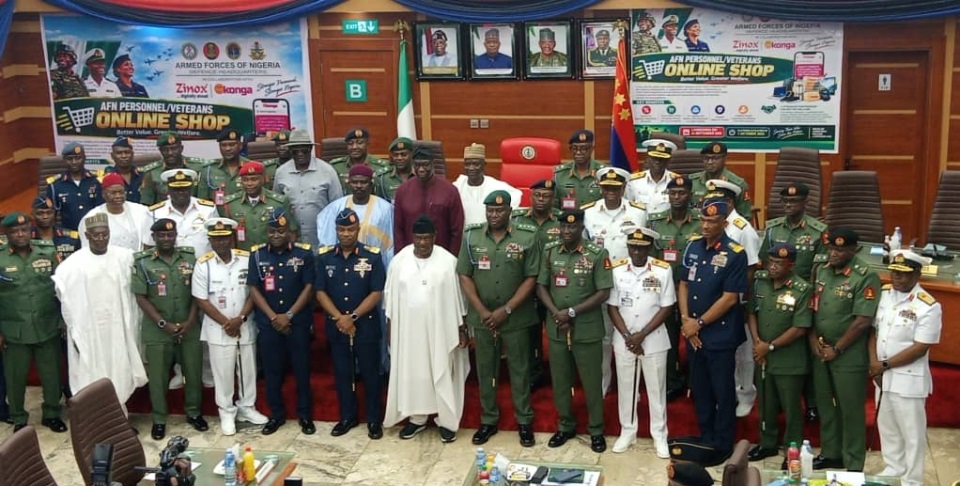
The Federal Government has unveiled an online discount shop to provide serving and retired personnel of the Armed Forces of Nigeria, veterans and their families with access to essential goods at discounted prices.
The Secretary to the Government of the Federation, Senator George Akume, launched the Armed Forces of Nigeria Personnel Online Discount Shop in Abuja.
Akume said the initiative was part of efforts to strengthen the welfare of military personnel and their families through digital technology and public-private partnerships.
He commended Defence Headquarters and Zinox Group for the partnership, saying the initiative would provide practical support to serving and retired personnel, veterans and their families.
The SGF said the inclusion of veterans was particularly important, noting that their sacrifices and contributions to national security deserved continued recognition and support.
He urged stakeholders to ensure that the platform remained transparent, reliable and responsive to beneficiaries.
Akume said the success of the scheme would ultimately be measured by the quality of service and tangible benefits delivered to personnel and their families.
He also expressed appreciation to President Bola Ahmed Tinubu for his support for the Armed Forces under the Renewed Hope Agenda.
The Chief of Defence Staff, General Olufemi Oluyede, said the initiative demonstrated the commitment of the Armed Forces to improving the welfare of serving and retired personnel and their families.
Oluyede said Defence Headquarters would leverage digital technology and accurate personnel data to strengthen and expand the platform.
He disclosed that efforts were underway to bring more vendors on board, including Dangote Cement, to enable beneficiaries to access a wider range of essential goods and building materials at discounted prices.
The CDS also disclosed plans for physical outlets in the future to complement the online platform.
Chairman of Zinox Group, Chief Leo Stan Ekeh, represented by the General Manager, Corporate Governance, Konga, Mr Reginald Obiako, said the partnership was the company’s contribution towards appreciating the sacrifices and dedication of members of the Armed Forces.
Ekeh said those who serve and protect the nation deserved continued support and appreciation.
He congratulated the Armed Forces on the launch and expressed optimism that the scheme would provide meaningful support to personnel, veterans and their families.
The initiative is being implemented through a partnership between Defence Headquarters and Zinox Group, with Konga providing the online platform.
Service Chiefs and other senior military officers attended the launch.

The National Assembly Service Commission (NASC) has approved the appointment of Mrs. Edith Ajah Onyinyechi as Deputy-Clerk, Senate (Administration), effective September 23, 2026.
The appointment was approved at the Commission’s 33rd meeting held on Tuesday, September 23, 2026.
Until her appointment, Onyinyechi served as a Director (Legislative) in the Senate, where she was said to have distinguished herself through dedication, professionalism and commitment to the effective administration of the National Assembly.
A statement signed by the Clerk to the National Assembly, Kamoru Ogunlana, Esq., said Onyinyechi joined the National Assembly Service on February 25, 1999, as a Statistician II and rose steadily through the ranks, taking on positions of increasing responsibility.
According to the statement, her career progression reflects her considerable experience and competence in legislative and administrative matters.
The National Assembly Management, while announcing the appointment, cited Onyinyechi’s hard work, administrative competence, dedication to duty and wealth of experience as among the qualities that informed the decision.
The Management congratulated her on the appointment and expressed its best wishes for success as she assumes her new responsibilities as Deputy-Clerk, Senate (Administration).
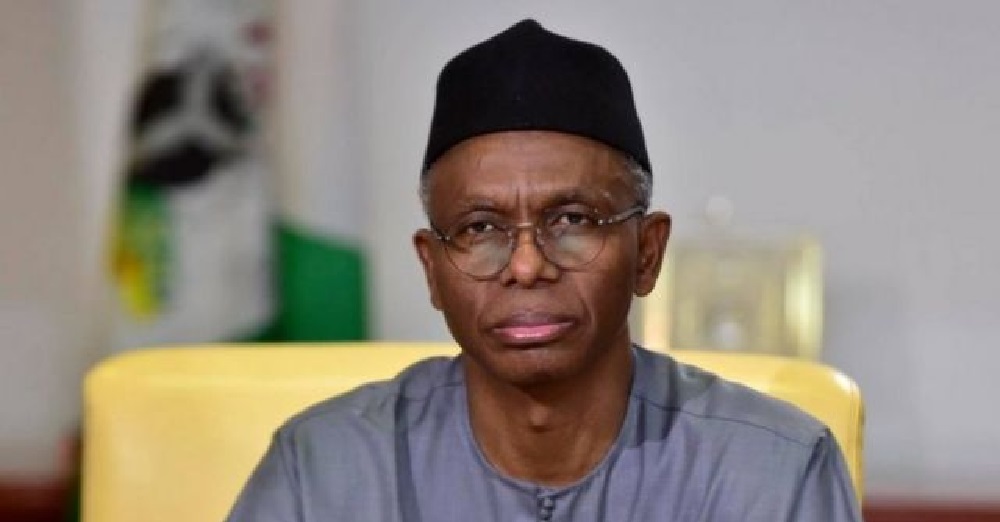
Nasir el-Rufai, former governor of Kaduna, says he will reconsider certain relationships as some friends have been silent during his trial.
The ex-minister shared his thoughts in a statement posted on X. He added that his predicament has taught him some lessons about life.
El-Rufai is facing trial over alleged money laundering and conversion of public property.
He has been in the custody of the Independent Corrupt Practices and other Related Offences Commission (ICPC) since February 19, after he was released by the Economic and Financial Crimes Commission (EFCC).
The ex-governor said “adversity has a way of illuminating relationships”, and the apparent silence from those he once helped, has elicited concerns.
“Some have expressed concern at the apparent silence, in my present circumstances, of some of my colleagues, friends and family members whom I have publicly stood by or associated closely with in the past,” he said.
“What I learn in difficult times like the past few months may lead me, quietly and without regret, to reconsider the nature of certain relationships and what those that look up to me expect of them.”
He said the decision should be seen as neither reproach nor condemnation, but as a way of seeing people and life more clearly.
El-Rufai said he always tried to support his colleagues, friends, family and others, guided by his faith, upbringing, personal values and conscience.
He said he stood by people and causes he believed in, sometimes in difficult circumstances and at considerable personal cost, without expecting praise, gratitude or reciprocity.
The former governor said those he had supported were also free to make their own choices now that circumstances have changed.
“I have no regrets about standing by people or for causes when I believed it was right to do so, and I bear no resentment towards anyone who chooses not to do the same for me,” he added.
“As for any injustice, ingratitude or injury done to me, I seek neither revenge nor retribution. Ultimate accountability belongs to Almighty Allah, and I leave that judgment to Him, in this world and in the Hereafter.”
El-Rufai said he would instead focus on remaining at peace with his conscience and his faith.
“In the end, each of us must live with the choices we make, and posterity will render whatever verdict it sees fit. My only concern is to remain at peace with my conscience and, above all, with Almighty Allah,” he said.

FG unveils online discount shop for Armed Forces personnel, veterans

Nigerian Gospel Singer Dies After Ghastly Accident And Weeks In Coma + Photo

National Assembly Commission Appoints Edith Ajah Deputy-Clerk, Senate





-

 News15 hours ago
Video: Apo-Karshi road getting required finishing touches
-
 News15 hours ago
SAD! Four Teenage Girls Die As Boat Carrying Eight Capsizes In Jigawa
-

 News15 hours ago
US firm declares America won’t allow Tinubu rig 2027 polls in Nigeria
-
 Opinion15 hours ago
OF TEEJAY YUSUF, KOGI WEST SENATORIAL DISTRICT, AND RESPONSIVE SERVANTHOOD
-

 Sports15 hours ago
FCT emerges winner of Abuja zone, book ticket to 1st Bank/Okwaraji U-16 finals
-

 Foreign15 hours ago
Iran vows to extend Middle East war to Indian ocean