By Gloria Ikibah


India has revealed that its bilateral trade with Nigeria rose to $9 billion in the 2025/2026 financial year, as it pushed for stronger cooperation in energy, healthcare, defence, technology and agriculture.
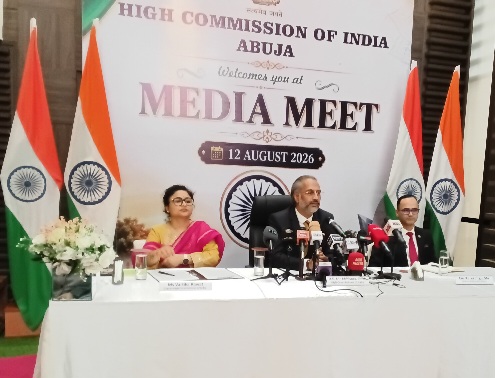
Speaking during a maiden media parley in Abuja, the Indian High Commissioner to Nigeria, Abhishek Singh, described the relationship between both countries as one of the most promising partnerships in the Global South. 
According to him, the trade volume increased from $7.13 billion in the 2024/2025 financial year to $9 billion in 2025/2026, reflecting growing economic ties between both countries.
He said: “When you talk about India-Nigeria relations, you always talk about the huge volumes of bilateral trade, the diverse basket of trade and the ever-growing interest both in India and Nigeria to increase the bilateral trade.
“Very happy to report that the trade for the financial year 25-26 stands at around US dollar 9 billion, which is up from US dollar 7.13 billion in the financial year 24-25”.
The envoy disclosed that more than 200 Indian companies are currently operating in Nigeria across sectors such as pharmaceuticals, manufacturing, power, construction, consumer goods, healthcare and services.
He noted that many of the companies had established production facilities in Nigeria, creating employment opportunities for nearly 100,000 Nigerians.
“I am told that over 200 Indian companies are active in Nigeria and they relate to sectors like pharmaceuticals, manufacturing, power, construction, consumer goods, healthcare and services.
“And a very important aspect is that they are also making in Nigeria. They are producing in Nigeria. They have set up plants in Nigeria.
“And this has translated into close to one hundred thousand brothers and sisters from Nigeria being deployed and employed by these companies. And that makes these Indian companies the second largest employer of Nigerian people after the Federal Government of Nigeria,” Singh said.
On energy cooperation, Singh said crude oil and liquefied natural gas remained important areas of engagement, while India was also interested in Nigerian investments in oil and gas, pipeline security, compressed natural gas conversion and liquefied petroleum gas infrastructure.
“We strongly believe that both our countries can mutually benefit from greater cooperation in the field of energy security.
“As you are aware, India is the most populous country in the world with 1.4 billion people, while Nigeria is the sixth largest country by population, with around 230 million people.
“So, naturally, the consumption of energy is going to be very high. All the more reason that the two great democracies, India and Nigeria, should cooperate more in the field of energy security,” he said.
The High Commissioner also highlighted growing collaboration in defence and maritime security, revealing that a Nigerian naval delegation was preparing to travel to India for bilateral discussions.
He said the partnership between both countries in the defence sector was long-standing and included support for the establishment of the National Defence Academy in Kaduna and the Naval College in Port Harcourt.
According to him, both countries share common security concerns, including terrorism, piracy, organised crime and illicit trafficking.
“This cooperation includes intelligence sharing, counter-terrorism, defence training and maritime security, especially in the Gulf of Guinea. Defence sales are also an important area of our collaboration,” Singh said.
The envoy further disclosed that India had extended concessional lines of credit worth $395 million to Nigeria while providing extensive capacity-building opportunities through the Indian Technical and Economic Cooperation (ITEC) programme.
“We have shared our strengths in affordable medicine, digital public infrastructure, agriculture, skills development and space applications.
“And these align very well with Nigeria’s priorities.
“In this line, we have extended concessional lines of credit worth US$395 million and also provided substantial training through the ITEC programme, including civilian and defence slots,” he added.
Singh noted that approximately 100 Nigerian military personnel participate annually in defence training programmes at leading Indian institutions.
He also highlighted the contributions of the estimated 60,000 Indians living in Nigeria, many of whom are second and third-generation residents.
“I want to thank Nigerian society and the government for embracing them and giving them the ecosystem and the level playing field so that they can succeed in their respective fields.
“These Indians consider India as their motherland, but they rightly also consider Nigeria as their fatherland.
“And these 60,000 Indians have acted as bridges in the educational, cultural, medical and commercial sectors and have also provided a social foundation for our relationship,” he said.
The High Commissioner also confirmed that President Bola Tinubu had been invited to attend the BRICS Summit scheduled for 12 and 13 September in New Delhi, expressing optimism that the Nigerian leader will head a high-powered delegation to the event.
“We are very hopeful that the Honourable President of Nigeria will be leading a high-powered delegation for the BRICS summit very soon.
“As Africa’s largest economy and one of the most populous nations in the world, Nigeria, as a partner country, brings immense strategic, demographic and economic weight to the BRICS bloc.
“Its participation in the earlier edition enriched the deliberations and strengthened the voice of the Global South,” he said.
Singh also announced that India had received Nigeria’s support for its bid for a non-permanent seat on the United Nations Security Council and had, in turn, endorsed Nigeria’s candidature.
Describing India-Nigeria relations as a partnership built on equality, he said: “When I talk about India-Nigeria relations, in my view, it is one of the most promising relationships of the Global South.
“It’s a win-win relationship. It’s a partnership. And when I say partnership, it means a handshake between two equal partners.
“This relationship is based on complementarities and, most importantly, on trust, understanding and mutual respect. I see a great future for India-Nigeria relations based on the progress that we have already made.”
Also speaking, the Deputy High Commissioner of India, Ms Vartika Rawat, highlighted India’s progress in healthcare and explained how the country’s public health achievements can strengthen cooperation with Nigeria.
She said India’s latest National Family Health Survey (NFHS-6), which covered 679,000 families across 719 districts, was the largest household health survey ever conducted anywhere in the world.
According to her, the survey showed that antenatal care now reaches 96 per cent of pregnant women, while institutional deliveries have risen to 90.6 per cent.
“Safer childbirth is no longer the exception in India. It is fast becoming the norm.
“Antenatal care now reaches 96 per cent of pregnant women. Institutional deliveries have climbed to 90.6 per cent, moving the country ever closer to universal coverage,” she said.
Rawat added that full immunisation among children aged 12 to 23 months had increased from 83.8 per cent to 87.1 per cent, while vaccine coverage remained above 96 per cent nationwide.
She also revealed that stunting among children under five had declined from 35.5 per cent to 29.3 per cent, representing nearly 30 million children lifted out of long-term nutritional deprivation.
On healthcare financing, she said household coverage under health insurance schemes had risen from 4.9 per cent in 2005 to 60.2 per cent, while internet usage among women had nearly doubled from 33.3 per cent to 64.3 per cent.
She stressed that India’s health achievements had direct implications for its partnership with Nigeria.
“The very achievements of the National Family Health Survey, that is expanding immunisation, affordable maternal and child care and wider financial protection in healthcare, are the same pillars on which our health partnership with Nigeria is built.
“India today supplies roughly 40 per cent of Nigeria’s pharmaceutical imports and, for certain categories of medicine, over 90 per cent.
“Our pharmaceutical exports to this country reached 315 million US dollars in the financial year 2024-2025, while Indian companies have invested heavily, around four billion US dollars, in local pharmaceutical manufacturing in Nigeria.
“This is what it means in practice for India to be the pharmacy of the world. It means not only affordable medicines reaching Nigerian homes but also manufacturing medicines in Nigeria for Nigerian homes.
“As Nigeria charts its own path towards universal health coverage, India believes the Ayushman Bharat model and other Indian policy models offer a template well worth exploring together.
“These are not two separate stories. They are one and the same story of two nations, once united in the struggle against colonialism and now united in the pursuit of health, dignity and shared prosperity for our people,” she said.