
News
FG, States, LGs Share N2.338trn From August Revenue



By Gloria Ikibah
The Federal Government, states and local government councils shared N2.338 trillion as Federation Account allocation for August 2026,
In a statement issued by Efe Ovuakporie, Head, Information and Public Relations, Federal Ministry of Finance, it stated that the allocation was approved at the September meeting of the Federation Account Allocation Committee (FAAC), chaired by the Accountant-General of the Federation, Mr Shamseeldeen Ogunjimi.
According to the communiqué issued after the meeting, the distributable revenue comprised N1.565 trillion from statutory revenue and N773.233 billion from Value Added Tax (VAT).
From the total allocation, the Federal Government received N804.897 billion, the states got N794.313 billion, while the 774 local government councils shared N555.142 billion.
The oil-producing states also received N184.388 billion as derivation revenue, representing the constitutionally prescribed 13 per cent of mineral revenue.
The figures came after deductions for the cost of revenue collection, as well as transfers, interventions and refunds.
VAT revenue rises
The gross VAT revenue for August stood at N834.843 billion, representing an increase of N40.875 billion from the N793.968 billion recorded in the preceding month.
Of the August VAT revenue, N100.545 billion was deducted as the cost of collection, while N1.184 trillion was allocated for transfers, interventions and refunds.
The balance of N733.233 billion was distributed among the three tiers of government.
The Federal Government received N77.323 billion, the states got N425.278 billion, while the local government councils received N270.632 billion.
Statutory revenue falls sharply
Gross statutory revenue, however, recorded a significant decline during the period under review.
The figure fell to N2.850 trillion in August from N4.359 trillion in July, representing a decrease of N1.509 trillion.
From the statutory revenue, N24.597 billion was deducted for the cost of collection, while N37.014 billion was allocated for transfers, interventions and refunds.
A balance of N1.565 trillion was subsequently distributed among the three tiers of government.
The Federal Government received N727.573 billion, the states got N369.035 billion, while N284.511 billion went to the local government councils.
A further N184.388 billion was distributed as derivation revenue to the mineral-producing states.
Mixed revenue performance
The FAAC communiqué showed mixed revenue performance across the various sources during August.
Revenue from Petroleum Profit Tax (PPT), Hydrocarbon Tax (HT), VAT, Customs and Excise Duties (CET) levies, and Excise Duty recorded significant increases.
However, revenue from Companies Income Tax/Capital Gains Tax (CIT/CGT), Stamp Duty Tax (SDT), Petroleum Royalties, Mineral Royalties, Gas Flared Penalty, Import Duty, Rental, Gas Flared Fee and Miscellaneous Oil Revenue declined considerably.
The Federal Ministry of Finance said the total distributable revenue for August was therefore N2.338 trillion, comprising N1.565 trillion from statutory revenue and N773.233 billion from VAT.

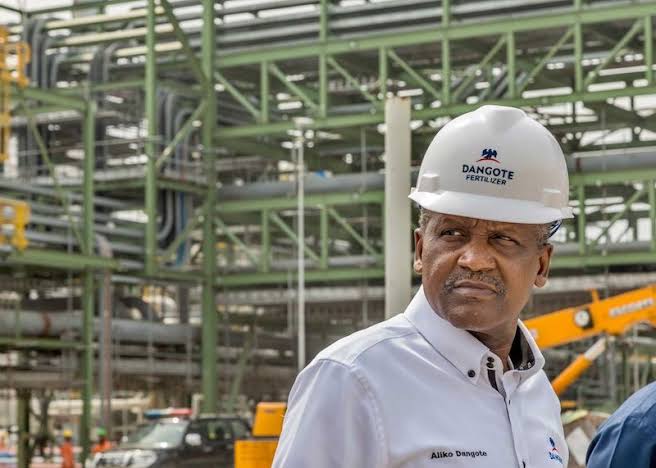
Former Central Bank Governor and the Emir of Kano, Muhammadu Sanusi II, has advised prospective investors not to use their children’s school fees or sell their homes to buy shares in Dangote Refinery.
He gave the advice on Thursday while speaking at the Dangote Refinery Initial Public Offering (IPO) investor roadshow in Kano.
He encouraged Kano residents and other interested investors to invest only money they could afford to leave untouched for some time. He suggested starting with amounts such as N10,000, N20,000 or N30,000.
He said, “Do not take your children’s school fees and put in shares; do not sell the house that you live in and put in shares.
But what you can afford, N10,000, N20,000, N30,000; what you can afford to set aside for some time, set it aside. And if you look at the fundamentals of the economy, over time you can be assured that this investment will grow, and you will not regret it.”
The Dangote Refinery IPO opened on September 14, with investor outreach activities continuing across the country.
Sanusi urged Kano residents to participate in the capital market and become shareholders in the refinery founded by Kano-born businessman Aliko Dangote.
“I speak as the Emir of Kano, I would like my people to be owners of this company.
I do not want us to be left behind in the capital markets. I do not want us to be left behind in financial inclusion. So this is the time and this is the opportunity,” he said.
He also asked union leaders and representatives of other groups to educate their members about the opportunity.
Sanusi advised investors to take a long-term approach instead of buying shares with the intention of making quick profits.
“I’m not talking about someone who will buy N5,000 shares and want to sell tomorrow and believe he will get N10,000. No, I’m talking about you have some money, put it in, leave it there for some time, and just watch your money grow.
Forget about it for some time. You’ll be surprised in five years, the N10,000 you invest today, what it will be; the N100,000 you invest, what it will be,” Sanusi said.
The Emir also said the location of the refinery should not stop Kano residents from investing, noting that ownership of a company belongs to its shareholders.
“It doesn’t matter where the refinery is located. It could be located in Lagos, or Ibadan, or on the moon. It is the shareholders who own it.
“It is the shareholders who own it; it’s the shareholders who take the return; it is the shareholders who own the profit,” he said.
Sanusi described Dangote as a son of Kano and encouraged residents to use the IPO to take a stake in the company.
“We have heard Lagos claim Aliko. I know very soon even Egypt will claim him, America will claim him. But we all know where he comes from,” he said.
The Emir also highlighted the refinery’s operations, saying potential shareholders could see its assets and activities, including the production of refined petroleum products and fertiliser.
He said the refinery was creating direct and indirect employment opportunities and had secured access to gas supplies, ports and markets.
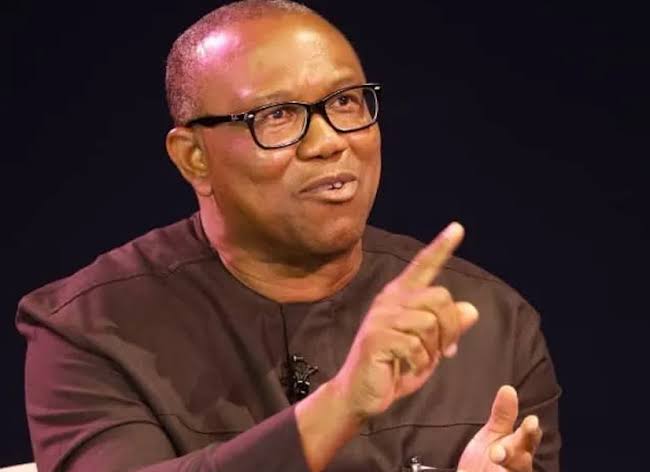
A financial handover document from former Anambra State Governor Peter Obi has resurfaced, showing that the state had a reported net balance of about N86.67 billion at the end of his administration in March 2014.
The document, dated March 17, 2014, was addressed by Obi to his successor, the late Governor Willie Obiano, and contained a summary of Anambra State’s financial position as of the close of business on March 14, 2014, which Obi described as the final working day of his administration.
The report was brought back into public attention on Wednesday by Yunusa Tanko, National Coordinator of the Obidient Movement, amid renewed debate over the loans, liabilities and other financial obligations inherited by successive administrations in the state.
Breakdown of the Figures
According to the handover document, Obi reported N27 billion in local investments and US$156 million, valued at approximately N26.5 billion, in foreign currency investments.
The report also listed N28.17 billion in certified balances belonging to the state and its Ministries, Departments and Agencies (MDAs).
In addition, it included a N10 billion Federal Government-approved refund due to the state.
Together, the assets and funds listed in the report amounted to approximately N91.67 billion.
The document, however, also identified estimated liabilities of about N5 billion. These were said to cover March salaries, pensions, gratuities and approved certificates for projects that had already been executed.
After deducting the stated liabilities, the report arrived at a net balance of approximately N86.67 billion.
What Obi Said at Handover
In the covering letter accompanying the financial statement, Obi said the figures represented the financial position of Anambra State at the close of business on March 14, 2014.
He formally presented the document to Obiano as part of the transition process ahead of the change of administration.
The resurfacing of the report comes against the backdrop of a longstanding dispute over the financial position Obi left behind and the debts subsequently inherited by the Obiano administration and later governments.
Successive Anambra administrations have continued to deal with various financial obligations, including loans and commitments dating back to earlier administrations. The precise classification and responsibility for some of those obligations have remained subjects of political and public debate.
Obi has consistently rejected allegations that his administration left behind unpaid salaries, pensions, gratuities or unpaid obligations to contractors for projects that had been duly executed and certified.
The former governor has also challenged those disputing his account of the state’s finances at the point of his departure to produce documentary evidence contradicting his position.
Why the Document Matters
The 2014 handover statement has now become a significant document in the continuing argument over Anambra’s finances at the end of Obi’s tenure.
Its figures provide a snapshot of the assets, available funds and estimated liabilities that Obi’s administration said existed as of March 14, 2014.
However, the document by itself does not resolve broader questions about loans, contractual commitments or other obligations that may have been recorded separately or inherited across different administrations.
The renewed attention on the report therefore reflects a larger debate over what Anambra inherited in 2014, what subsequent governments borrowed or committed, and how the state’s financial position evolved under successive administrations.
For now, the handover document remains one of the key records being cited in the continuing dispute over Obi’s financial legacy in Anambra State.
News
Nigeria Targets Bigger Nordic Investments as Ambassador Lola Akande Begins Sweden Mission(Photos)

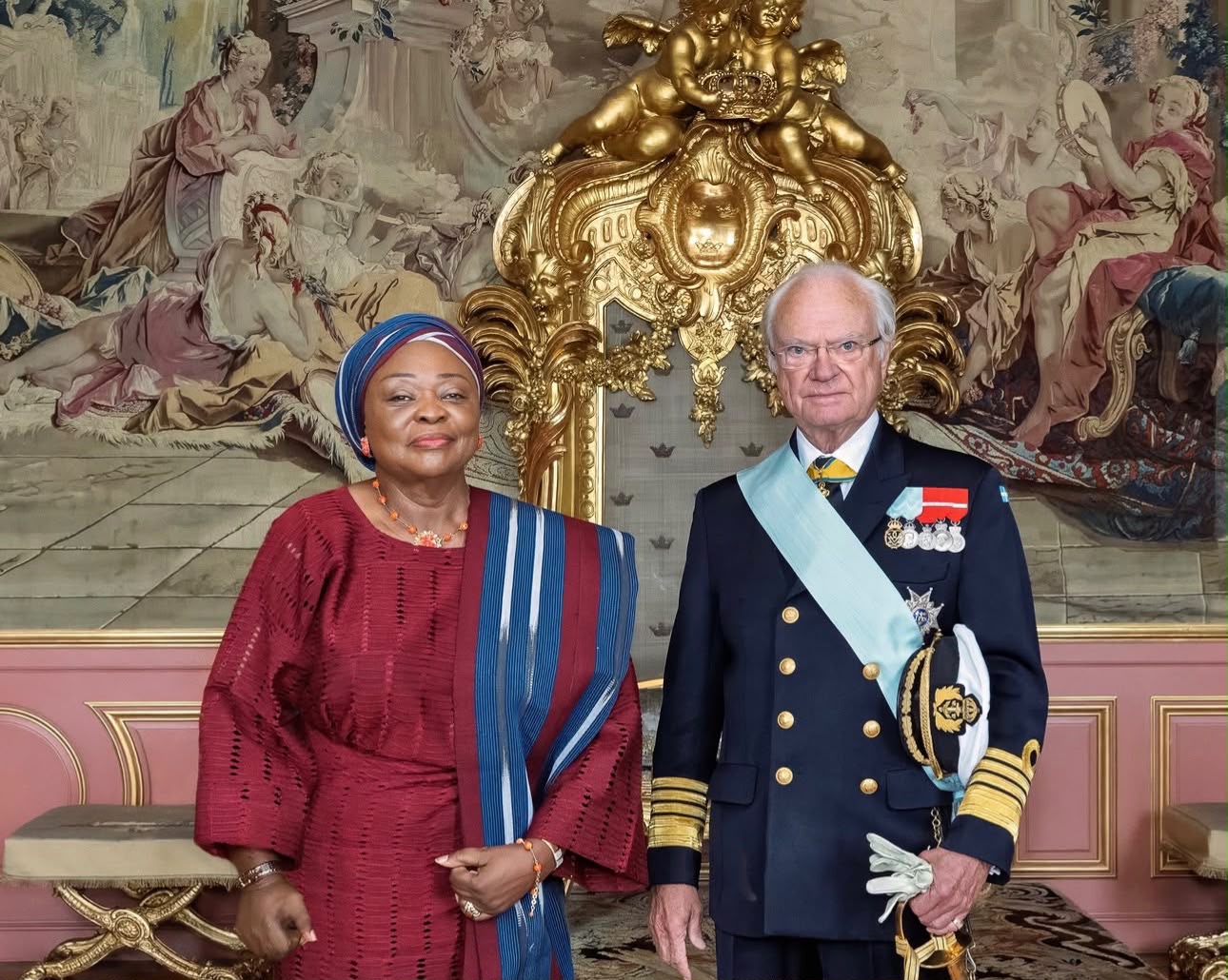
Nigeria has moved to strengthen its economic, trade, investment and innovation partnerships with Sweden and other Nordic countries following the formal presentation of Letters of Credence by Ambassador Lola Akande to King Carl XVI Gustaf of Sweden.

The ceremony in Stockholm formally marked the beginning of Akande’s diplomatic tenure in Sweden. She is also concurrently accredited to Denmark, Finland and Norway, giving her a broad mandate to advance Nigeria’s interests across the Nordic region.
Speaking at a Vin d’Honneur held at the Ambassador’s Residence in Stockholm after the credentialing ceremony, Akande expressed appreciation to President Bola Ahmed Tinubu for entrusting her with the responsibility of representing Nigeria abroad.
She also thanked the Swedish government and people for their warm reception, pledging to pursue a close, constructive and results-driven relationship between Nigeria and Sweden.
“The challenges and opportunities before our nations require purposeful partnership,” Akande said.
“Nigeria stands ready to work closely with the Government of Sweden, our fellow African missions and Nordic partners to advance shared priorities in trade, investment, innovation, sustainable development, peace and security.”
The ambassador stressed the importance of stronger cooperation between Nigeria and the Nordic countries, particularly in areas capable of driving economic growth, technology transfer, innovation and sustainable development.
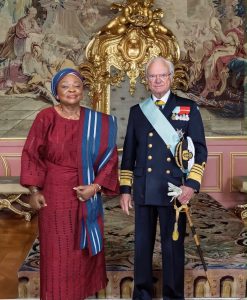
She also acknowledged Sweden’s Ministry for Foreign Affairs, the African diplomatic group, members of the Diplomatic Corps, Embassy of Nigeria officials and the Nigerian community in Sweden for their support.
Akande further emphasised the importance of African unity and collective action, saying sustainable development would be better achieved through collaboration, mutual respect and practical partnerships.
She is expected to present her Letters of Credence in Denmark, Finland and Norway in the coming weeks, opening further avenues for Nigeria to deepen its economic and institutional engagement across the Nordic region.
NNBA Backs Stronger Nigeria-Nordic Economic Engagement
The Nigeria Nordic Business Alliance (NNBA), led by its Director-General, Sir Victor Walsh Oluwafemi, KJW, welcomed the ambassador’s credentialing as an opportunity to expand structured private-sector and institutional cooperation between Nigeria and the Nordic countries.
According to the Alliance, its role is to facilitate two-way access between Nigerian and Nordic investors, businesses and institutions while supporting practical partnerships in key sectors.
These include trade and investment, technology, innovation, skills development, infrastructure, maritime development and media collaboration.
The NNBA said it would work to translate the longstanding goodwill between Nigeria and the Nordic countries into concrete and measurable opportunities for businesses, institutions and communities on both sides.
The development comes as Nigeria seeks to deepen international economic partnerships, attract investment and expand opportunities for Nigerian businesses in strategic global markets.

Do not sell properties to purchase Dangote shares- Sanusi cautions Nigerians

FG, States, LGs Share N2.338trn From August Revenue

Mutfwang’s Orange Economy Push: Turning Plateau’s Culture Into Jobs and Prosperity




-
 News13 hours ago
Anambra Govt Releases Records Of Alleged Unpaid Debts By Peter Obi During Tenure As Governor
-

 News13 hours ago
ASUU demands 26% education funding, faults FG over 15% compromise
-

 News13 hours ago
Peter Obi Weighs In On Dangote Refinery Shares
-
 News13 hours ago
2027: Atiku, Amaechi Secretly Buying Dangote Refinery Shares – APC Chieftain Claims
-
 News24 hours ago
Anambra Debt Row: Presidency Challenges Obi to Quit 2027 Race Over His ‘No Debt’ Claim
-

 News23 hours ago
REVEALED: 11 Nigerian-Born Lawyers Hit by U.S. Disciplinary Actions Over Professional Violations