



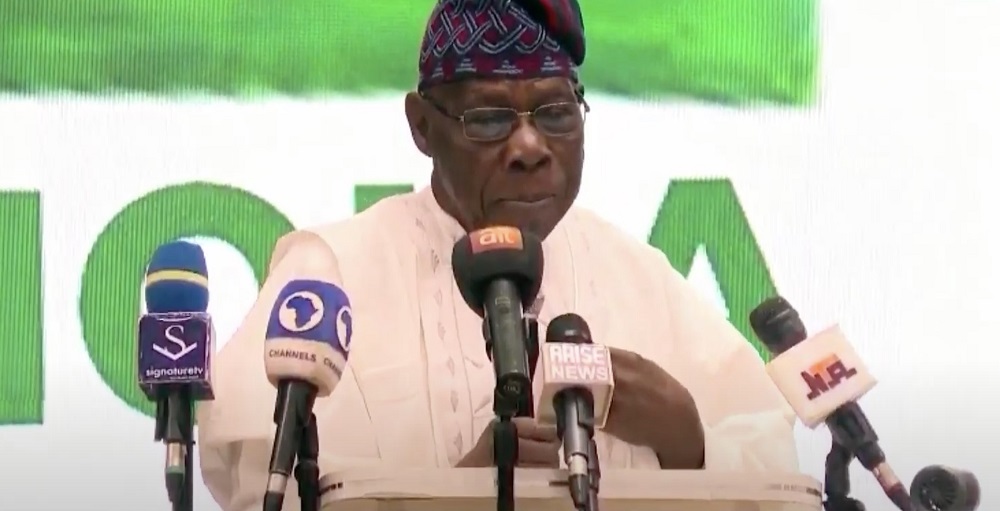


Former President Olusegun Obasanjo has warned that Nigeria cannot achieve sustainable development as long as corruption remains entrenched in the country’s institutions and society.
Obasanjo spoke on Monday in Lagos during the public presentation of Unexplained Wealth in Nigeria: Law, Prosecution and the Recovery of Illicit Assets, authored by lawyer and University of Lagos lecturer, Dr Wahab Shittu, SAN.
The former President described corruption as one of the major impediments to national development, stressing that the two cannot successfully coexist.
“One big handicap to development is corruption. Corruption and development are strange bedfellows. They can’t go together,” Obasanjo said.
He said the consequences of corruption extend beyond government and affect society broadly, with the poorest citizens often suffering the greatest impact.
According to him, corruption deepens poverty by depriving vulnerable citizens of resources and opportunities that should ordinarily improve their living conditions.
“Those who suffer most in a corrupt society are the poorest. And it makes them poorer,” he said.
Obasanjo Traces Anti-Corruption Campaign to Military Years
Obasanjo also recounted his long involvement in Nigeria’s anti-corruption efforts, tracing it to his years in the military.
He said he served at different times as a military prosecutor and as a member of a court martial that handled corruption-related cases.
According to the former President, his interest in combating corruption deepened after he left office as military head of state and returned to farming.
He recalled that during that period, he was approached by Peter Eigen, a former World Bank official who later founded Transparency International.
Obasanjo said Eigen’s experience at the World Bank exposed him to what he described as “grand corruption,” particularly the diversion of funds from international loans.
He recalled that he and Eigen subsequently became involved in the establishment of Transparency International, with Eigen serving as chairman and Obasanjo as chairman of its advisory council.
How ICPC Emerged
Obasanjo said his experience with Transparency International later influenced his approach to fighting corruption when he became Nigeria’s democratically elected President.
He explained that the organisation provided him with a model anti-corruption law, which was adapted to Nigeria and eventually formed the basis for legislation establishing the Independent Corrupt Practices and Other Related Offences Commission.
However, he said the bill encountered resistance in the National Assembly, with some lawmakers reportedly expressing concern that its passage could expose them to prosecution.
“They said to me that if they pass the bill as I gave it to them, most of them will end up in prison,” Obasanjo recalled.
He said it took about 18 months for the legislation to be passed.
Following the establishment of the ICPC, Obasanjo said his administration also created the Economic and Financial Crimes Commission to strengthen Nigeria’s institutional capacity to investigate and prosecute financial crimes.
‘Corruption Is Anti-Development’
The former President further condemned the accumulation of unexplained wealth and the movement of illicit funds, describing corruption as “antisocial,” “anti-development” and “anti-progress.”
He argued that corrupt practices undermine the collective interests of society and cannot serve as a foundation for national advancement.
“It is not in the best interest of any country or any human organisation,” he added.
The remarks were made against the backdrop of Shittu’s book, which examines Nigeria’s legal framework for tackling unexplained wealth, prosecuting financial crimes and recovering assets suspected to have been acquired through illicit means.