…invest $3m in peace support operations, anti-piracy projects
By Gloria Ikibah
As a way of fostering peace and security in Nigeria, the Ambassador of Japan to Nigeria, Matsunaga Kazuyoshi, has reiterated commitment of the government of Japan to support Nigeria’s efforts to create a safe and secured environment for all citizens.
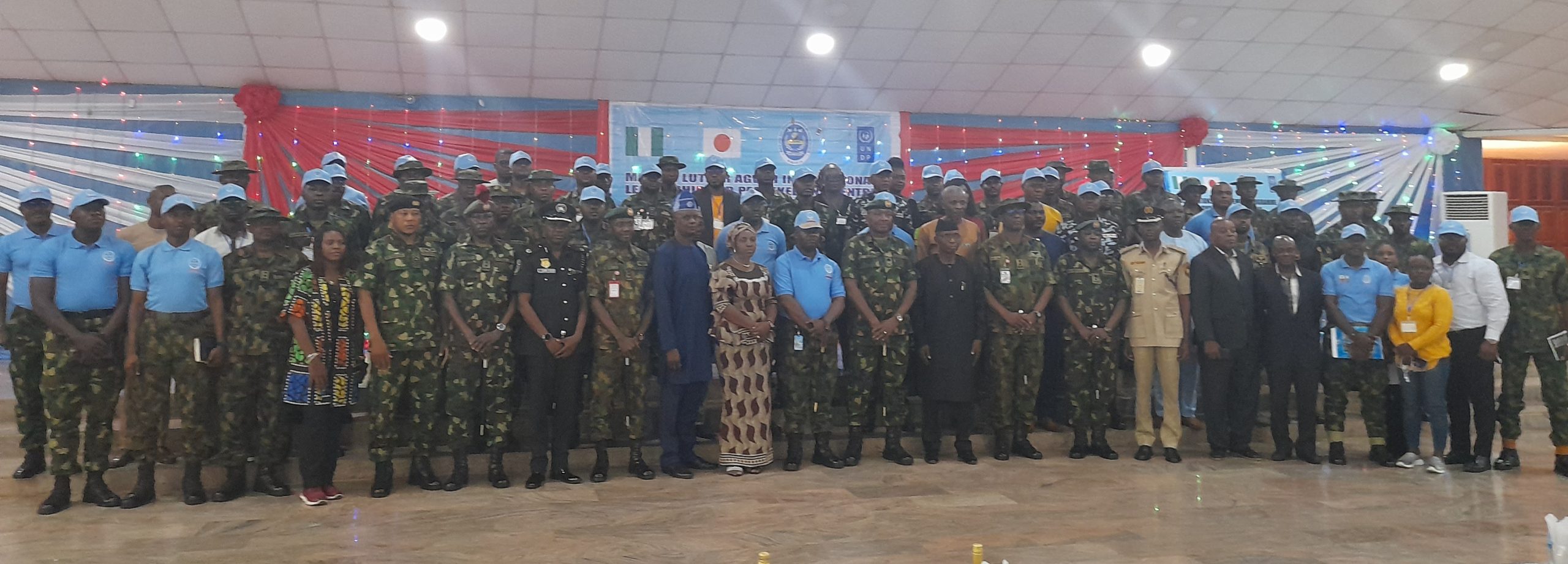
Ambassador Kazuyoshi stated in a virtual message at the official launch of the “Enhancing MLAILPKC’s Capacities for Effective Peace Support Operations in West Africa Project 24”, on Monday at the Martin Luther Agwai International Leadership and Peacekeeping Centre, in Jaji, Kaduna State, in collaboration with the government of Japan and the United Nations Development Programme.
According to the envoy, the project exemplify commitment, and will make significant contribution to achieve the goal of peace and security in the country.
He said: “One crucial aspect of building a lasting peace is ensuring the active participation of women. Women are not just victims of conflicts, they are perfect agents for peace.
“Since inception, the Martin Luther Agwai Leadership and peace Keeping Centre Kaduna, has trained over 100,000 troops on pre-deployment training and over 2200 persons on individual peace support operation courses drawn from Nigeria Armed Forces, Paramilitary organisations , government ministry, departments and agencies, civilians and allied country.
“This project consolidates the previous intervention that help to build the capability and expertise of the Centre on PSO, protection of civilians in armed conflict and anti-priority in the Gulf of Guinea. This project with technical support from the UNDP and financial support of the government of Japan has the potential y empower women, develop the new generations of female leaders who can play critical role in Nigeria peace building efforts”.
The Japanese Ambassador to Nigeria decried that for decades Nigeria has been confronted by insurgency and terrorist attacks particularly from Boko Haram in the North East, adding that these acts of violence have devastated lives and communities causing loss of lives and properties, mass displacement and significant economic loses.
He recounted his experience when he visited IDP camps and also the visit of the Japanese Foreign Minister.
“During my visit t Maiduguri on 10th March, I witnessed first hand of plight of those impacted in the IDP camp. Just recently, the Japanese foreign minister Mrs Kam Kaowa concluded her very first visit to Nigeria, during her visit she emphasized the critically importance of peace and security for Nigeria continued development and prosperity .
“This is precisely the core principle of the Women Peace and Security PPS Agenda which is the top priority for foreign minister Kami Kaowa, she even had opportunity to meet some of the top IDP women leaders primarily form North East during her visit and that is and directly listening to their stories.
“Africa is at the forefront of Japan International Cooperation efforts, this year in August, we are excited to host the ministerial meeting of the 9th Tokyo International Conference on Africa Development TICAD-9 in Tokyo, with Foreign Minister Tuggar invited to attend. Looking ahead in August 2025, Japan will host the TICAD-9 summit meeting in Yokohama, where President Bola Tinubu is expected to attend. This event underscores Japan’s unwaivering commitment to supporting Africa’s development across a wide range of area, and we look forward t the continued and fruitful partnership with Nigeria”, Ambassador Kazuyoshi stated.
In his remarks representative of the United Nations Development Programme and Team Lead, Governance, Peace & Security, Matthew Alao, disclosed that the main objective of the project is to advance democracy and national cohesion, peaceful co-existence and preserve the wellbeing of civilians in armed conflicts.
According to Alao, the project was formulated by the Martin Luther Agwai International Leadership and Peacekeeping Centre (MLAILPKC) and UNDP with funding assistance from the Government of Japan, with over $3 million invested in Peace Support Operations and anti-piracy projects having trained over 1000 personnel in 11 African countries.
He commended the Government of Japan and the Embassy of Japan, Abuja, for their sturdy partnership with UNDP Nigeria, even as he said the duo, has funded over 15 projects with a budget of over US$28 million in Nigeria in a decade.
Alao added that Nigeria is the only country in Africa that has enjoyed perpetual funding of the PSOs project from the Government of Japan since 2014.
“This event has become an annual occasion for over a decade to launch the Government of Japan’s persistence funding of Peace Support Operations (PSOs) and anti-piracy projects in Nigeria. The funding of these projects reflects the importance that the Government of Japan and UNDP attach to peace and security issues in the world, especially in West Africa. The project will complement the efforts of the West Africa Member States to curtail the spread and influence of terrorism, extremism and violence in the region.
“Distinguished Guests, Ladies & Gentlemen:
Over the last decade, the Government of Japan, in partnership with UNDP, has invested over US$3 million in PSOs and anti-piracy projects in West Africa and the Gulf of Guinea. The projects had resulted in the capacities of about 1,000 military and paramilitary officers and civilians in 11 countries of the regions built and strengthened. The institutional capacities of MLAILPKC and the learning environment improved to fulfil its mandate. The areas covered by these projects included counter-violent extremism, counterterrorism, protection of civilians in armed conflict, peace support operations, illegal migration, civil-military cooperation, anti-piracy and strengthening institutional capacities of MLAILPKC for optimal performance.
“The launch of this project today is a testimony to the level of confidence and trust that the Government of Japan and UNDP continue to repose in MLAILPKC as a reliable national partner. MLAILPKC has continually met expectations of the partners in the meticulous implementation of these projects, cultivating partners’ relationship and demonstrating excellent financial probity despite systematic reassignment of its management. The current management of the Centre took over barely a month ago and is fast solidifying its relationship with the partners. As a testament to this, we are very convinced that this project will be concluded before December 2024, thus elevating our enviable records of timely and outstanding completion of approved projects”, he added.
In his address, the representative of the Special Guest of Honour, Brigadier General O. T Olatoye, appreciated the UNDP and Government of Japan for sustaining the project over the years not only in Nigeria but across the globe, and that it is a testament to their efforts in ensuring global peace and security for all.
Olatoye asserted that the courses are crucial in addressing the complex security challenges facing Africa, as participants of these courses will be empowered to lead, protect civilians, and counter violent extremism, ultimately contributing to a more peaceful and secure Africa.
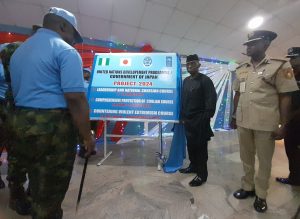
He said: “The Project covers 3 vital courses; “Leadership and National Cohesion”, “Comprehensive Protection of Civilians” and “Countering Violent Extremism”, all to be executed by MLAILPKC. This milestone marks a significant collaboration between the UNDP, Government of Japan and MLAILPKC. This project will significantly enhance the capacity of MLAILPKC to deliver world-class training and capacity-building programs, empowering military and security personnel, as well as other stakeholders, to effectively prevent, respond to, and manage emerging security challenges in Nigeria and the West African sub- region.
“The courses are crucial in addressing the complex security challenges facing Africa. Effective leadership and national cohesion, protection of civilians, and countering violent extremism are essential skills required by peacekeepers, security personnel, NGOs and selected MDAs.
“By acquiring these skills, participants of these courses will be empowered to lead, protect civilians, and counter violent extremism, ultimately contributing to a more peaceful and secure Africa. The scourge of violent extremism has indeed had a profound and devastating impact on many countries and communities around the world, causing immense human suffering, destruction, and instability. It’s important to acknowledge the severity of this issue and work towards finding solutions to prevent and counter it”.
In his welcome address, the Commandant of the MLAILPKC, Major General A. T Adedoja, said the Centre of Excellence is dedicated to promoting peace, security, and leadership development in Africa.
“To achieve our mission, we engage in capacity-building programs, research and training of prospective peacekeepers, empowering them to effectively address the continent’s complex security challenges.
“Over the years, this Centre has trained peacekeepers, security personnel, NGOs and selected MDAs as well as leaders from across Africa. Equipping them with the skills and knowledge necessary to effectively prevent and respond to conflicts, protect civilians, and promote sustainable peace and development in their respective countries.
“Our collaboration efforts with local and international partners have been instrumental in achieving our objectives. The MLAILPKC is proud to partner with esteemed organizations such as the United Nations Development Programme (UNDP), African Union (AU), and Economic Community of West African States (ECOWAS).
“The Centre appreciates the collaborative effort of the Government of Japan towards her capacity development programmes. These strategic partnerships have enabled MLAILPKC to leverage resources, expertise, and networks, enhancing our impact in Peacekeeping and conflict resolution capabilities in Nigeria and Africa. Through these partnerships, the MLAILPKC continues to strengthen the capacity to promote peace, security, and development in Africa. The Centre looks forward to deepening our collaboration to achieve even greater results.
“Today, we are here to launch three critical courses sponsored by the Government of Japan in collaboration with the UNDP. These courses include: Leadership and National Cohesion, Comprehensive Protection of Civilians, and Countering Violent Extremism. These courses represent a significant milestone in our collective efforts to build capacity for peacekeeping, conflict resolution, and sustainable development in Nigeria and African region. Our Centre is dedicated to fostering a culture of peace, leadership, and excellence, and these courses align perfectly with our mission.
“The Leadership and National Cohesion course will equip participants with the skills required to promote inclusive and effective leadership, fostering national unity and social cohesion. The Comprehensive Protection of Civilians course will enhance the capacity of peacekeepers to protect vulnerable populations from violence and human rights abuses. Similarly, the Countering Violent Extremism course will provide a deeper understanding of the root causes of violent extremism and effective strategies to prevent and respond to its threats”.