Connect with us

News

Excitement, Dance As ‘Looted Ancestral Stools’ Return To Oba Of Benin

Published

on

ADVERTISEMENT
Zoom Ad
ADVERTISEMENT
Zoom Ad

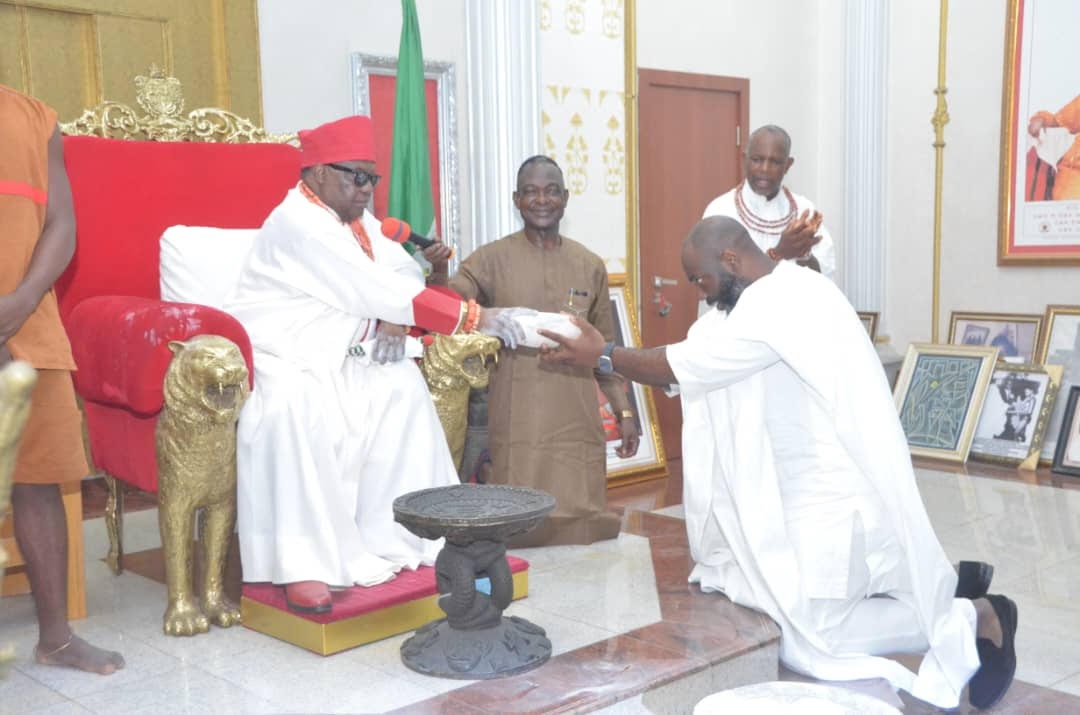
It was a moment of joy, excitement and dance at the palace of the Oba of Benin as the revered monarch, Oba Ewuare II took custody of two looted royal stools from the German government.


They were handed over to the National Commission for Museums and Monuments, NCMM on behalf of the Nigerian government by the German authorities in 2022.

The Director-General of National Commission for Museums and Monuments, Mr Olugbile Holloway made the presentation on behalf of the Federal Government on Saturday May18, 2024 in Oba of Benin Palace, Benin City.

According to history, the artefacts — Bronze and wooden Royal stools (Ekete), made during the reign of Oba Eresoyen and Oba Esigie several Centuries ago, were looted from Oba Palace during the punitive expedition in 1897.

Advertisement

Addressing the Benin Throne during the presentation of the artefacts, Mr Holloway, pledged on behalf of NCMM, to work-hand-in hand with the Benin Royal Court in uplifting and displaying Edo heritage.

He revealed that as the Benin Bronzes and other art works are gradually making their way home (Nigeria), “NCMM will join hands with the Royal Court to create a befitting destination for people around the world to come and appreciate these works”.

“What you see before us were originally taken away from the Royal family in 1897.

“We have a stool made of Bronze and a wooden stool.

Advertisement

“I speak for every member of my team, to say that we remain loyal to the Royal Court. And if there is anything we can do, we will do to support this laudable initiative.

“This heritage is not just Benin heritage, but Nigeria’s heritage.
When we speak of Benin heritage, there is nobody that doesn’t know the great works of ours.

“I appreciate you, we will always do what we can do with our powers to make His Royal Majesty lineage in memory”, he said.

After unveiling the repatriated Artefacts, Oba of Benin, who danced joyfully to Benin traditional rendition in dramatic dance steps, with excited Chiefs and members of the Royal family, offered prayers to Almighty God and his ancestors.

Advertisement

The traditional ruler, who was visibly overwhelmed with joy, appreciated the German government and the Federal Government and the NCMM leadership for their efforts.

The royal father, thereafter, in a historic move, sat in one of the royal stools (Ekete), and personally presented a chunk of white, which, according to belief, symbolizes peace and blessings to the Director-General of National Commission for Museums and Monuments, Mr Olugbile Holloway.

Oba Ewuare II also prayed for Mr Holloway and his team, accompanied by the Curator, National Museum, Benin, Mr Mark Olaitan, Director, Legal Services, NCMM, Barrister Babatunde Adebiyi on the visit where Royal Drummers gave a good account of their stewardship.
Advertisement
Continue Reading
Advertisement
Click to comment

Warning: Undefined variable $user_ID in /home/naijuinz/public_html/wp-content/themes/zox-news/comments.php on line 49

You must be logged in to post a comment Login

Leave a Reply

News

‘If You Can’t Halt Insecurity, Step Aside’ — Apostle Suleman

Published

on

ADVERTISEMENT
Zoom Ad
ADVERTISEMENT
Zoom Ad

The General Overseer of Omega Fire Ministries International, Johnson Suleman, has urged President Bola Ahmed Tinubu to consider stepping down if his administration is unable to effectively tackle the growing insecurity threatening lives and livelihoods across Nigeria.

The outspoken cleric made the remarks while addressing members of his congregation during a church service, where he expressed concern over the persistent wave of terrorism, banditry, kidnappings, and violent attacks in different parts of the country.

Suleman argued that the government’s approach to combating insecurity must shift from targeting only armed attackers to identifying and dismantling the networks of individuals allegedly financing and sustaining terrorist activities.

According to him, the true challenge facing Nigeria is not merely the criminals carrying out attacks but the powerful sponsors who provide them with resources, weapons, logistics, and financial support.

Advertisement

The preacher stressed that any serious effort to defeat terrorism must begin with exposing and prosecuting those behind the scenes who enable extremist groups to operate.

“The sponsors of terrorism are the real problem confronting the nation. The government should focus on them. If the President cannot deal decisively with those people, then he should resign and allow someone else to take over the responsibility,” Suleman declared.

He further claimed that many of the young men currently involved in violent activities are products of extremist networks that have existed for years and were allegedly allowed to expand unchecked.

According to him, some of the individuals now seen carrying sophisticated weapons were children during the early stages of insurgent activities and have since grown into active participants in criminal and terrorist operations.

Advertisement

Suleman maintained that arresting or eliminating foot soldiers alone would not end insecurity, insisting that authorities must trace and neutralize those who recruit, fund, and arm violent groups.

“The young boys carrying assault rifles today did not emerge overnight. There are people empowering them, financing them, and providing the resources that sustain their activities. Until those sponsors are identified and brought to justice, the problem will persist,” he said.

Despite his criticism of the government’s handling of the security situation, the cleric praised Nigeria’s security institutions, describing them as highly professional and capable of confronting the country’s challenges when adequately supported.

Drawing from his international travels, Suleman said he has confidence in the abilities of the Nigerian military, the police, and the Department of State Services (DSS), arguing that the country possesses competent personnel capable of delivering results.

Advertisement

“I have visited many countries around the world, and I can confidently say that the Nigerian Army, the Nigeria Police Force, and the DSS rank among some of the finest security institutions globally. The issue is not necessarily a lack of capacity but the willingness to take bold action against those driving insecurity,” he stated.

The cleric emphasized that stronger political resolve is required to dismantle criminal and terrorist networks operating across the country. He warned that insecurity would continue to worsen unless those allegedly sponsoring violence are exposed, arrested, and prosecuted under the law.Politics

His comments come at a time when many Nigerians are increasingly concerned about the security situation, particularly in regions affected by recurring kidnappings, terrorist attacks, communal violence, and banditry.

Citizens, civil society groups, religious leaders, and political stakeholders have repeatedly called on the Federal Government to intensify efforts aimed at restoring safety and public confidence.

Advertisement

Suleman’s remarks are likely to add to the growing national conversation on security and governance, as pressure mounts on the Tinubu administration to deliver lasting solutions to the country’s security challenges.

The cleric concluded by urging the government to stop treating insecurity as a routine criminal issue and instead confront what he described as the broader network allegedly sustaining terrorist operations throughout Nigeria.

Continue Reading

News

Famous US actor stabbed to death in his apartment

Published

on

ADVERTISEMENT
Zoom Ad
ADVERTISEMENT
Zoom Ad

Popular US actor James Handy, known for his roles in films including Jumanji and Top Gun: Maverick, has been stabbed to death at his home in Los Angeles, police have said.

Handy, who was 81, was found unconscious in the front garden of his home in Tarzana, California, on Wednesday with several stab wounds to the chest.

Michael Gledhill, 44, the son of Handy’s girlfriend, has been arrested on suspicion of murder, the Los Angeles Police Department said.

Officers responded to a report of “unknown trouble” after a caller dialled 911 and told police: “I am the son of man, I just killed the man of sin.”

Advertisement

Handy was born in New York and appeared in a string of films and TV shows over six decades, often as a supporting character or for a small number of episodes.

Despite rarely being the leading star, Handy racked up a long string of credits, including NYPD Blue, K-9, Law & Order, CSI: NY, Logan, Alias, Castle, NCIS, The West Wing, Arachnophobia, The X Files, and Murder, She Wrote.

His most recent film role was in 2022’s Top Gun: Maverick, in which he played Jimmy, a bartender who works with the character played by Jennifer Connelly, Tom Cruise’s love interest.

Paying tribute, entertainment writer Jay Bobbin said he was “heartbroken to learn about the passing of a superb character actor”.

Advertisement

Writer and producer Don Winslow, who created the 2001 procedural drama UC: Undercover, in which Handy appeared, described Handy as a “terrific actor”.

“We were honoured to have him on UC: Undercover in a recurring role,” Winslow said. “His performances were always special.”

Following Handy’s death, the LAPD said Gledhill “flagged down nearby responding officers, telling them he was the one they were looking for”.

“The suspect resides at the location with his mother, who is the victim’s girlfriend,” a statement added.

Advertisement

“Detectives believe this is an isolated incident and there appears to be no danger to the public.”

After his arrest, Gledhill was transported to Van Nuys Jail and booked for one count of murder, with his bail set at $2m (£1.5m).

Continue Reading

News

LEADERSHIP AND INFRASTRUCTURE DEVELOPMENT IN NIGERIA: LESSONS FOR FUTURE LEADERS

Published

on

ADVERTISEMENT
Zoom Ad
ADVERTISEMENT
Zoom Ad

Being the Convocation Lecture delivered at the 36th Convocation Ceremony of the University of Port Harcourt by His Excellency, Ezenwo Nyesom Wike, on Saturday, 6 June 2026.

Introduction
The Vice-Chancellor, Professor Owunari A. Georgewill; distinguished members of the Governing Council and Senate of the University of Port Harcourt; eminent scholars; proud parents and guardians; and, most importantly, our graduating students – the leaders of the future we are all labouring, with hope and sacrifice, to shape; distinguished ladies and gentlemen.

It is with deep humility and a profound sense of honour that I stand before you today to deliver the 36th Convocation Lecture of this great and revered institution – the University of Port Harcourt, my alma mater and one of Nigeria’s most prestigious second-generation universities. This University is not just merely a place of learning where certificates are issued; it is a citadel of knowledge, a forge of ideas, a bastion of progressive thought, and an enduring symbol of Nigeria’s intellectual courage and moral conscience. Its reputation for academic excellence, community service, and principled activism has not only shaped generations of minds but has also influenced the course of Nigeria’s political, economic, social, and developmental evolution. Indeed, its imprint on the nation’s trajectory is both undeniable and profound.
For me, therefore, this is more than a ceremonial invitation; it is a homecoming. It is a return to the very soil that nurtured my mind, sharpened my convictions, refined my character, and equipped me with both the pen and the sword – the discipline of thought and the courage of action – with which I have engaged and navigated the complex terrain of politics, governance and leadership in our country. Whatever I have become in public life, whatever impact I have made in service to our people and nation, bears the unmistakable imprint of the training, discipline, exposure, and values instilled in me within these hallowed walls.
Permit me to state without hesitation that I do not take this invitation lightly. When I read your letter of invitation, particularly the words: “Your Excellency’s distinguished record of service to our nation, your exemplary leadership, and your enduring contributions to governance, infrastructural development, and public administration stand as a testament to visionary statesmanship,” I paused and reflected deeply. These words are not mere compliments or flattering; they are weighty and invocative. They are both a recognition and a responsibility.

In a time when leadership is often trivialized and compromised, when public service is too frequently reduced to slogans, propaganda, performance without substance, and fleeting impressions, it is reassuring to know that there still exist hallowed grounds such as this where truth is pursued, where objectivity thrives over subjectivity and sentiments, where merit is acknowledged, and where national purpose still matters. That this great University found me worthy of this platform, in recognition of my commitment to good governance, infrastructural development, and transformative leadership, is both humbling and challenging. It is humbling because I am aware of the weight of expectations that comes with such recognition.
It is challenging because it reminds me – and indeed all of us – that leadership is not a privilege to be enjoyed, but a responsibility to be discharged with courage, discipline, and results.
To the graduating students, you are leaving this institution at a defining moment in our nation’s history. You are stepping into a world that is as demanding as it is uncertain. But you are also stepping into a moment of possibility – a moment that requires courage, integrity, clarity, and conviction. You are stepping into a Nigeria that desperately needs you; a Nigeria that requires not just educated and certificated citizens, but committed leaders.

And so, let me begin by placing before you a simple but uncompromising truth, the core argument of my address today: no nation rises above the quality of its leadership, and no leadership proves itself more clearly than in the infrastructure it leaves behind. This is not a slogan; it is a standard – one that history applies without sentiment. Leadership finds its truest expression not in speeches, but in structures; not in promises, but in impact. It is seen in roads that endure beyond administrations, in schools that outlive politics, in hospitals that preserve life, in water that flows, and in power that works. These are the measurable footprints of vision translated into reality. Where leadership is purposeful, infrastructure becomes the architecture of opportunity; where leadership is weak, infrastructure becomes the evidence of neglect. The bridge between promise and progress is built by leadership that plans with foresight, executes with discipline, and is accountable to the people it serves. It is within this inseparable relationship – between those who lead and what they build – that the destiny of nations is determined. This is the thrust of my message, and it demands to be confronted with honesty, patriotism, and resolve.

*Defining the Problem: Nigeria’s Development Paradox*
Before we speak of solutions and lessons for future leaders, we must have the courage to confront the truth – plainly, honestly, and without excuses. Nigeria today presents one of the most troubling paradoxes of the modern world. It is a vast and complex nation, Africa’s most populous, strategically located on the western coast of the continent at the innermost corner of the Gulf of Guinea, stretching between latitudes 4° and 14° North and longitudes 3° and 14° East, bounded by Niger and Chad to the north, Benin to the west, Cameroon to the east, and the Atlantic Ocean to the south. With a landmass of approximately 923,768 square kilometres, Nigeria is not merely a geographical expression; it is a bold and ambitious experiment in nationhood.
At independence in 1960, Nigeria stood at the threshold of greatness – confident, expectant, and richly endowed with the essential ingredients of development. It possessed a vibrant population, a promising civil service, and vast natural resources that inspired both internal and global optimism (Njoku, 2019). The discovery of petroleum in commercial quantities at Oloibiri on the eve of independence further intensified this optimism, reinforcing the belief that Nigeria’s challenge was not scarcity, but the management of abundance. Indeed, it was widely proclaimed that Nigeria’s problem was not money, but how to spend it.
In those early years, Nigeria was celebrated as Africa’s emerging giant – a nation destined to lead, inspire, and redefine postcolonial development. The euphoria of independence was captured in both official and popular imagination. As Ismail Babatunde Jose poignantly reflected on October 1, 1960, Nigeria was “a nation conceived in faith and unity,” whose birth evoked both tears and hope (Kogbara, 2010). The optimism was not misplaced; it was grounded in the belief that political independence would automatically translate into economic transformation, consistent with the nationalist philosophy of Kwame Nkrumah (first Prime Minister and President of Ghana, who had led the Gold Coast to independence in 1957) that even the worst form of self-rule was better than the best form of colonial rule (Onor, 2018).
Yet, history has delivered a far more sobering verdict. Almost seven decades after independence, Nigeria’s journey reflects not a steady ascent, but a troubling drift; from promise to paradox, and from high expectation to deepening disillusionment. Instead of consolidating its early advantages, the nation has become a theatre of contradictions: a country of immense wealth but widespread poverty; of deep religiosity but persistent moral and institutional decay; of abundant human capital but weak systemic performance.
Today, Nigeria is variously described as a “crippled giant” (Falola and Heaton, 2008), a “house that has fallen” (Maier, 2000), “the open sore of a continent” (Soyinka, 1986), “an enigma wrapped up in a puzzle” (Madubuko, 2011) and, more painfully, the “poverty capital of the world” – a tragic reversal of the optimism that once defined its independence moment. A nation once believed to be on the cusp of greatness now struggles with basic governance challenges, where over 100 million citizens live below the poverty line, and where insecurity, unemployment, and infrastructural decay have become irrefutable realities. The fundamental question therefore persists: why has Nigeria, despite her enormous human and material endowments, failed to translate promise into fulfilment? Why has the nation, more than six decades after independence, remained unable to attain the developmental aspirations of its founding fathers?
In seeking answers, scholars have offered various explanations – historical, economic, structural, and institutional. However, a dominant and recurring strand of analysis locates the heart of Nigeria’s developmental failure in one critical variable: leadership. From Chinua Achebe’s famous assertion that “the trouble with Nigeria is simply and squarely a failure of leadership” (1983), to G. A. Akinola’s insistence that leadership failure is the most decisive factor shaping Nigeria’s postcolonial condition (2009), the argument remains consistent and compelling. John C. Maxwell’s widely cited maxim – that “everything rises and falls on leadership” – further reinforces this position.
However, it is important to emphasize that while other factors – colonial legacies, global economic structures, institutional fragility, and demographic pressures, do play contributory roles, none of them explains Nigeria’s persistent underperformance more decisively than leadership. Leadership determines how resources are mobilized, how institutions function, how priorities are set, and ultimately how national aspirations are translated into tangible outcomes.
This is why the paradox persists. Nigeria is, on paper, one of the most resource-endowed nations on earth; yet in practice, it remains constrained by weak execution, inconsistent policies, abandoned projects, and infrastructural decay. The result is a nation that builds intermittently but rarely sustains; that announces progress but often fails to deliver it; and that dreams persistently, but realizes inconsistently.
It is important to state without equivocation that without functional and sustainable infrastructure, the dream of national development will remain perpetually elusive. Economic transformation is not achieved by aspiration alone, but by deliberate investment in roads, power, water, education, healthcare, and transportation systems that make productivity possible. Infrastructural development is therefore not a secondary outcome of development; it is its foundation and its visible proof. Where infrastructure is strong, economies expand, opportunities multiply, and social stability is reinforced. Where it is weak, stagnation becomes entrenched, inequality deepens, and national cohesion is threatened. Infrastructure is thus not merely physical capital; it is the material expression of leadership effectiveness and, indeed, a mirror of governance quality.
And so, we must confront the hard truth, one that is often avoided, but can no longer be deferred: Nigeria’s challenge is not primarily a lack of resources. It is a failure of leadership. Not leadership in title, but leadership in responsibility; not leadership in rhetoric, but leadership in results. For too long, we have mistaken motion for progress, activity for achievement, and announcements for accomplishment. We have tolerated delay as normal, excused inefficiency as inevitable, and accepted abandoned projects as part of governance culture. In doing so, we have institutionalized underperformance. This is the paradox we must resolve and by so doing leave appropriate lessons for future leaders. And it begins, unequivocally, with leadership, to which I now turn in greater detail.
The Meaning and Mandate of Leadership in Nation-Building
Having illuminated the paradox that defines our national experience, it becomes imperative that we now turn attention – deliberately, with intellectual honesty and moral seriousness – to the central variable in this discourse: leadership, a concept upon which the destiny of nations ultimately rests. Indeed, few subjects have so persistently dominated contemporary intellectual, public and professional discourse as leadership, and the decision to foreground it in this 36th Convocation Lecture of our “Unique UniPort” could not have been more timely. Leadership sits at the very intersection of promise and performance, vision and reality, aspiration and achievement.
What, then, is leadership? Leadership, properly understood, is the capacity to influence, inspire, and mobilize human and material resources toward the achievement of shared goals. It is the process of securing willing consent and active participation in collective endeavour. This is why John Maxwell’s oft-cited assertion – that “leadership is influence, nothing more and nothing less” – retains enduring relevance. Leadership determines not only how far a society can go, but how fast it can get there. It sets both the ceiling and the pace of development. At its highest expression, leadership is the disciplined pursuit of a vision larger than self.
Leadership, in this sense, is not an abstract ideal; it is a lived and dynamic relationship between those who lead and those who are led. It involves people – leaders and followers – bound together by purpose, expectation, and responsibility. There can be no leadership without followership, just as there can be no meaningful followership without leadership. As Dan Agbese insightfully observes, a leader leads because a group of people willingly entrusts him with a portion of their autonomy in exchange for direction, representation, and the advancement of their collective interest (Agbese, 2010). Leadership, therefore, is neither self-imposed nor self-sustaining; it is socially conferred and morally justified.
The leader, ideally, emerges through a process, one that filters competence, tests character, and elevates responsibility. And once so entrusted, leadership is neither arbitrary nor absolute. It is guided by laws, shaped by institutions, and restrained by norms that define both its reach and its limits.
Leadership is not a title bestowed; it is a burden assumed. It is not the comfort of office, but the weight of responsibility. It is not the applause of the moment, but the judgment of history. Too often, we have reduced leadership to a ceremonial possession, something to acquire, display, and defend. Yet true leadership is neither ornamental nor accidental; it is intentional, exacting, and deeply consequential (Burns, 1978; Northouse, 2019). A person may rise to high office and yet remain profoundly insignificant in impact; another may stand without formal designation and yet alter the course of events. The difference lies not in position, but in purpose; what one chooses to do with the privilege of influence.
Leadership begins with vision; not mere sight, but foresight; not wishful thinking, but a clear and compelling imagination of what ought to be. Vision is the faculty that lifts a society beyond the limitations of the present and anchors it in the possibilities of the future. It enables a leader to stand in the midst of disorder and still perceive order; to look at chaos and discern direction. Without vision, leadership becomes reactive, adrift in crisis. With vision, leadership becomes creative, shaping reality rather than merely responding to it (Bennis & Nanus, 1985; Kotter, 1996).
But vision without political will is illusion. Nations are replete with ideas that were never executed, plans that were never implemented, and promises that were never fulfilled. Political will is the stubborn determination to act, to move from intention to execution, from blueprint to building, from declaration to delivery. It is the bridge between aspiration and achievement, promise and fulfilment, the line that separates those who merely dream from those who actually deliver.
Closely related to this is discipline – the inner architecture of leadership. Discipline orders priorities, safeguards resources, and restrains excess. It ensures that leadership is not distracted by trivialities or consumed by indulgence. Nations do not decline only because of ill intentions; they often decline because of indiscipline; because leaders abandon focus, squander opportunity, and substitute convenience for commitment (Collins, 2001). Then comes accountability, the moral spine of leadership. To lead is to answer, not only to the people, but to posterity. Accountability demands transparency, responsibility, and measurable outcomes. It insists that performance must prevail over excuses. Where accountability is absent, failure multiplies without consequence, and mediocrity entrenches itself as culture. But where accountability thrives, performance becomes inevitable (Mulgan, 2000; Behn, 2001).
Many scholars and great thinkers have argued that the most defining attribute of leadership is courage, the courage to decide, the courage to act, and, above all, the courage to take unpopular but necessary decisions. Leadership is not validated by consensus, nor sustained by convenience. There are moments when the path of progress will collide with entrenched interests, when necessary reforms will provoke resistance, and when the right course of action will be the least popular. It is in such moments that leadership is either affirmed or exposed (Heifetz, 1994). Indeed, scholars and practitioners of power alike have long identified the essential attributes of effective leadership to include courage, credibility, integrity, selflessness, initiative, vision, fairness, empathy, discipline, and a strong commitment to service (Okecha, 2010). Where these qualities are absent, institutions weaken, values erode, and collective aspirations collapse.
But beyond all these elements lies a deeper, more enduring truth: leadership is service. It is not an avenue for self-glorification, but a covenant with the people. It is not a platform for accumulation, but an instrument for transformation. Leadership demands a moral reorientation, from the pursuit of power to the pursuit of impact; from self-interest to public good. The true leader does not ask, what do I gain from this office? but rather, what do the people gain from my stewardship? As Robert Greenleaf and Autry argue, the servant-leader begins with a natural desire to serve, and leadership emerges from that commitment to the growth and well-being of others (Greenleaf, 1977; Autry, 2001).
The true measure of leadership, therefore, lies not in what the leader accumulates, but in what the people become. Do they emerge stronger, richer, wiser, and more capable? Do institutions grow more efficient, resilient and enduring? Does infrastructure expand and function with efficiency, making service delivery swifter, broader, and more humane? Does society itself become more just, more functional, and more compassionate? These are the questions that matter. This is the standard by which leadership must ultimately be judged and it is precisely at this point that the tragedy and the possibility of Nigeria converge. For where leadership is anchored in service, infrastructure becomes available. Roads are built not for ceremony, but for connectivity. Schools are established not for symbolism, but for enlightenment. Hospitals are constructed not for prestige, but for the preservation of life. Water flows. Power works. In such a society, infrastructure is not incidental; it is the natural consequence of purposeful leadership. Development scholarship consistently affirms that the quality of governance directly shapes infrastructure outcomes and national development trajectories (World Bank, 1992; Acemoglu & Robinson, 2012).
But where leadership is divorced from service, infrastructure becomes a casualty. Projects are initiated but abandoned; resources are allocated but wasted; policies are announced but not implemented. What remains is not development, but the ruins of unrealized intentions. We must, therefore, return to first principles. Leadership must be reclaimed, not as privilege, but as duty; not as entitlement, but as trust; not as an opportunity for self, but as a responsibility to others.
For in the final analysis, leadership is not judged by the noise it generates, but by the legacy it leaves behind. And that legacy is written not in speeches, but in structures; not in declarations, but in development; not in intentions, but in infrastructure. If Nigeria must rise – and it must – then leadership must first be redefined, reimagined, and recommitted to its highest calling. Only then can we build not merely systems that function, but a nation that truly works.

Infrastructure as a Test of Leadership
Let me emphasize here that infrastructure is not merely about roads and bridges; it is about connecting destinies, unlocking human potential, and laying the physical and digital foundations upon which national transformation becomes possible. If leadership is the engine of progress, then infrastructure is its most visible and verifiable expression, the point at which promises are tested against performance, and vision is translated into lived reality. It is through infrastructure that governance moves from abstraction to impact: shaping how people move, how they learn, how they work, how they live, and ultimately, how they flourish. A nation’s development cannot materialize in the absence of robust infrastructure. It is the architecture of equality, where a child in rural Bori can access the same quality of education, healthcare, and opportunity as one in urban Lagos; where seamless transportation, reliable power supply, and digital connectivity are not privileges for the few, but the shared inheritance of all. In this sense, infrastructure is far more than concrete and steel; it is dignity made visible, inclusion made practical, productivity made possible, and hope made tangible.
No serious nation develops without deliberate, sustained investment in infrastructure. Roads are not just pathways; they are economic lifelines that connect farms to markets, industries to consumers, and opportunities to people. Power is not merely electricity; it is the currency of productivity, the backbone of industrialization, and the oxygen of modern economies. Schools are not just buildings; they are factories of human capital, shaping the minds that will define the future. Hospitals are not simply places of treatment; they are institutions that preserve life, dignity, and hope. Water is not a convenience; it is a fundamental necessity that underwrites public health and human survival. In this sense, infrastructure is the architecture of development, an indispensable driver of economic growth, social inclusion, and national cohesion (Calderón and Servén 2010; World Bank 1994).
Where infrastructure is strong and efficiently managed, productivity rises, inequality narrows, and the quality of life improves. It creates access, expands opportunity, and levels the playing field between the privileged and the marginalized. But where infrastructure is weak, decaying, or absent, the consequences are immediate and severe: economic stagnation, social frustration, and widening inequality. Under such conditions, development becomes uneven, opportunity becomes selective, and dignity becomes a privilege rather than a right. Infrastructure, therefore, is not just an economic necessity; it is a moral imperative.
It follows, then, that infrastructure is the ultimate ledger of leadership. Leaders may deliver eloquent speeches, craft impressive policies, and make ambitious promises, but history does not remember intentions; it remembers results and legacies. It is in the roads that endure beyond administrations, the schools that outlive politics, the hospitals that continue to save lives, the water that flows consistently, and the power that works reliably that leadership finds its truest expression. These are the enduring monuments of governance, the silent but powerful testimonies of whether leadership served its purpose or squandered its opportunity.
Indeed, across the world, the verdict of history is remarkably consistent. The United States still bears the imprint of Franklin D. Roosevelt, whose response to the Great Depression was not mere reassurance but the launching of the New Deal, which brought about the construction of dams, roads, bridges, highways, and electrification systems that transformed the nation’s productive capacity (Leuchtenburg, 1963). Post-war Germany rose from the ruins under Konrad Adenauer, who anchored recovery on industrial rebuilding and institutional infrastructure that powered the “economic miracle” (Abelshauser, 2004).
In Asia, the transformation of Singapore under Lee Kuan Yew stands as a testament to disciplined, infrastructure-led development – modern housing, efficient transport systems, and world-class urban planning that turned vulnerability into strength (Lee, 2000). China’s meteoric rise cannot be separated from the reforms of Deng Xiaoping, whose emphasis on infrastructure – special economic zones, transport networks, and industrial capacity – redefined the possibilities of national growth (Vogel, 2011).
In the Middle East, the visionary investments of Sheikh Zayed bin Sultan Al Nahyan laid the foundation for a modern state (Davidson, 2008), while the transformation of Dubai into a global city reflects the continuity of purpose between Sheikh Rashid bin Saeed Al Maktoum and his successor Sheikh Mohammed bin Rashid Al Maktoum, a leadership tradition that converted desert into destination through ports, airports, roads, and iconic urban infrastructure (Krane, 2009).
In Africa, the rebuilding of Rwanda under Paul Kagame demonstrates how deliberate investment in roads, technology, and public services can restore order and accelerate development even after profound national trauma (Booth and Golooba-Mutebi, 2012; World Bank, 2019). In South Asia, Jawaharlal Nehru captured the spirit of infrastructure-led nation-building when he described dams, steel plants, and institutions as the “temples of modern India” (Nehru, 1955).
These examples, drawn from different continents and contexts, converge on a single, undeniable lesson: leadership is remembered less for what it says than for what it builds. Words may inspire a generation, but infrastructure sustains many generations. Speeches may dominate headlines, but structures define history. Yet, this is precisely where the challenge often lies, particularly in developing contexts such as ours. Infrastructure has too frequently been entangled in the politics of appearance rather than the discipline of performance. Projects are conceived not always as instruments of development, but as symbols of political visibility. Groundbreakings are celebrated more than completions; announcements are amplified more than achievements; and publicity often substitutes for progress.
We must, therefore, draw a clear and uncompromising distinction between planning and propaganda, between execution and excuses. Planning requires foresight, technical competence, and long-term thinking. It demands that projects are properly conceptualized, costed, and aligned with national priorities. But planning alone is insufficient. Execution is where leadership is truly tested, the ability to follow through, to overcome obstacles, to ensure continuity, and to deliver results within time and budget. It is execution that transforms ideas into infrastructure and policies into progress (Flyvbjerg, 2009).
Unfortunately, one of the persistent weaknesses in our development trajectory has been the gap between intention and implementation. Around the country, too many projects are initiated but not completed; too many resources are allocated but not optimized; too many timelines are announced but not respected. In place of results, we are often offered explanations; in place of delivery, we are given justifications. This culture of excuses undermines public trust, erodes confidence in institutions, and ultimately stalls development. True leadership does not hide behind constraints; it confronts them. It does not rationalize failure; it corrects it. It does not celebrate effort; it delivers outcomes. In the final analysis, citizens do not live in policies; they live in infrastructure. They do not experience governance through speeches; they experience it through roads, power, water, schools, and hospitals.
It is against this backdrop that infrastructure remains the most honest test of leadership. It exposes the difference between those who promise and those who perform, between those who occupy office and those who transform society. It is where leadership either proves its worth or reveals its weakness. If we are to build a Nigeria that works – efficiently, inclusively, and sustainably – then we must elevate infrastructure from the realm of politics to the domain of purpose; from a tool of visibility to an instrument of transformation. This requires a committed leadership – one that plans with clarity, executes with discipline, and delivers with integrity. For in the end, leadership is not judged by the promises it makes, but by the infrastructure it builds, and, through that, by the lives it transforms. It is a test no leader escapes. This is the ultimate test of leadership, and no leader escapes its verdict.
Before I leave this section of our discourse, it is necessary to cast a brief but penetrating glance at the colonial experience, a historical episode that, despite its many contradictions and shortcomings, offers a sobering lesson on the centrality of infrastructure to any purposeful enterprise. Colonial rule in Nigeria was not driven by altruism. It was, as Frederick Lugard candidly admitted, an economic project, an arrangement designed to advance imperial interests under the guise of mutual benefit (Lugard, 1922; Onor, 2016). And yet, it is precisely because the colonial state was determined to achieve its objectives that it invested deliberately and systematically in infrastructure. It built railways to move goods, roads to penetrate the hinterland, ports to facilitate export, and communication systems to coordinate control. It developed administrative centres, introduced a monetized economy, and established schools and health institutions, not as acts of benevolence, but as instruments of efficiency (Onor, 2021).
Critics, especially within the radical tradition, have rightly described this as an “infrastructure of exploitation.” Scholars such as Walter Rodney argue that these structures were designed primarily to extract, not to empower. This critique is valid. But even within that critique lies a powerful and unavoidable truth: the colonial state could not exploit without first building the necessary infrastructure. This is why even a trenchant critic like Eskor Toyo would later observe, with a tone of regret, that post-independence Nigeria has made only marginal additions to the infrastructure inherited at independence (Toyo, 2011). The implication is as uncomfortable as it is instructive: those who came to exploit constructed the infrastructure they needed to succeed; those who came to lead have not always matched that urgency with equal resolve.
Let me be clear; this is not an argument in defence of colonialism. It is an argument for realism. It is a reminder that no enterprise – just or unjust, imperial or national, private or public, noble or ignoble – has ever succeeded without infrastructure. Infrastructure is the language through which intent is translated into outcome; it is the machinery that converts ambition into achievement. And so, the lesson for us is stark and unavoidable. If an external power, pursuing its own narrow interests, could summon the discipline to build enduring systems, then a sovereign nation seeking development has no justification for failing to do the same and even more. The path forward is clear and uncompromising. If Nigeria’s leaders are serious about transformation, if they are committed to economic growth, social stability, and national dignity, then infrastructure must cease to be treated as a political accessory and be embraced as a national imperative. For where infrastructure is built, progress becomes possible; where it is neglected, potential remains permanently unrealized. Leadership without infrastructure is merely performance without substance.

*Major Challenges to Infrastructure Development in Nigeria*
Having established that infrastructure is the most visible and verifiable expression of leadership, we must now turn, deliberately and without illusion, to the forces that have persistently undermined its development in Nigeria. For it is not enough to desire infrastructure; we must interrogate, with honesty and clarity, why it has remained elusive. The obstacles before us are neither abstract nor obscure; they are real, systemic, and, in many cases, self-inflicted.
At the forefront of these challenges is corruption and systemic leakages. Corruption is not merely the theft of funds; it is the erosion of purpose. It diverts resources from public good to private gain, inflates project costs beyond reason, compromises standards, and leaves behind a landscape of abandoned or poorly executed projects. Roads are budgeted but not completed; power projects are financed but not delivered; contracts are awarded but not fulfilled. What should have been instruments of progress become monuments of waste. It is, therefore, not surprising that corruption has been consistently recognized as a major impediment to development outcomes in Nigeria (World Bank, 2020). Every act of corruption is, in effect, an assault on infrastructure, and by extension, on the dignity and wellbeing of citizens.
Closely tied to this is the persistent problem of policy discontinuity. In Nigeria, governments often begin afresh rather than build upon the foundations laid by their predecessors. Projects are abandoned not because they are unviable, but because they are politically inconvenient. Each administration seeks to inscribe its own identity, even at the cost of progress and development. The result is a tragic cycle of waste: uncompleted roads, stalled rail lines, half-built hospitals, and neglected development plans. Development, however, is not an event; it is a continuum. Nations that succeed do so because policies outlive administrations and projects transcend political cycles (Todaro and Smith, 2015). Where continuity is absent, progress becomes episodic and fragile.
Then there is the challenge of weak institutions, arguably one of the most debilitating constraints to infrastructure development and, indeed, to national progress. Institutions are the machinery through which leadership translates intention into outcome. Where they are strong, rules are respected, processes are followed, and results are delivered. Where they are weak, systems descend into arbitrariness, enforcement becomes selective, and performance becomes inconsistent. In Nigeria, institutions are too often encumbered by capacity deficits, political interference, and a troubling lack of autonomy. Regulatory agencies fail to enforce standards; procurement processes are compromised; oversight mechanisms are weakened, leaving accountability fragile and outcomes uncertain.
This reality stands in sharp contrast to the more advanced societies we often admire, countries such as the United States, the United Kingdom, Germany, France, Japan, and South Korea, whose progress has been underwritten not merely by resources or leadership, but by the enduring strength of their institutions. It was in recognition of this foundational truth that Benjamin Disraeli (a prominent 19th-century British politician, writer, and statesman who served twice as Prime Minister of the United Kingdom, in 1868 and 1874–1880) observed that “individuals may form communities, but it is institutions alone that can create a nation.” In a similar vein, Barack Obama, addressing the Ghanaian Parliament in 2009, offered a sobering reminder that continues to resonate with profound urgency:
No country is going to create wealth if its leaders exploit the economy to enrich themselves, or police can be bought off by drug traffickers. No business wants to invest in a place where the government skims 20 per cent off the top… No person wants to live in a society where the rule of law gives way to the rule of brutality and bribery… Africa doesn’t need strong men; it needs strong institutions (http://www.sundaytimes.ik/090712/international/sundaytimes-international-03.html. accessed on 18 April, 2026).
These words capture, with striking clarity, the central dilemma confronting many developing societies. For without strong institutions, leadership becomes personal rather than systemic, governance becomes discretionary rather than rule-bound, and development becomes uncertain rather than assured. Conversely, the establishment of resilient institutions fosters a political culture anchored on justice, equity, inclusion, transparency, and accountability. It creates an environment where both leaders and citizens are guided – not by impulse or convenience – but by enduring rules and shared values. As development scholars have argued, the prosperity of nations is deeply rooted in the strength of their institutions (Acemoglu and Robinson, 2012). Without institutional integrity, even the most visionary policies are reduced to mere declarations, well-articulated, but ultimately unrealized.
Equally corrosive is political short-termism, the tendency to prioritize immediate political gains over long-term national interest. Infrastructure development, by its very nature, requires patience, continuity, and foresight. It demands investments whose benefits may not be immediately visible but are profoundly transformative over time. Yet, in a system driven by electoral cycles and the quest for quick wins, leaders are often tempted to favor projects that yield instant visibility rather than those that guarantee lasting impact. The consequence is a preference for spectacle over substance, projects that are commissioned quickly but lack depth, sustainability, or strategic value. As Francis Fukuyama (2014) observes, development suffers when governance is trapped in short-term political calculations rather than long-term planning.
Another deeply entrenched challenge is Nigeria’s poor maintenance culture. Even where infrastructure exists, it is often allowed to decay prematurely due to neglect. Roads deteriorate shortly after construction; public facilities fall into disrepair; power installations become obsolete without routine servicing. This is not merely a technical failure; it is a cultural and administrative one. Maintenance is the discipline that sustains development. Without it, investments lose value, and progress becomes temporary. The cost of neglect is often far greater than the cost of maintenance itself. Yet, as repeatedly noted in development discourse, Nigeria continues to prioritize new projects over the preservation of existing ones (World Bank, 2018). A nation that does not maintain what it builds ultimately builds in vain.
Finally, there is the pervasive issue of patronage, awarding contracts to individuals and companies without the requisite capacity. When competence is sacrificed on the altar of connection, infrastructure inevitably suffers. Contracts are given not to the most capable, but to the most connected; not to those who can deliver, but to those who can influence. The outcome is predictable – substandard work, delays, cost overruns, and, in some cases, total project failure. Infrastructure development is a technical enterprise that demands expertise, experience, and efficiency. Where merit is sidelined, mediocrity becomes institutionalized. As scholars of governance have observed, patronage systems undermine efficiency and weaken public sector performance (Rose-Ackerman, 1999).
Taken together, these challenges, alongside many others that the limits of time and space will not permit us to discuss, form a dense and constricting web that continues to impede Nigeria’s infrastructural advancement. They are not isolated deficiencies, but deeply interconnected failures – of systems, of values, and ultimately, of leadership itself. Until these challenges are confronted with honesty and addressed with resolve and discipline, the aspiration for a fully developed Nigeria, anchored on functional and reliable infrastructure, will remain little more than a mirage.

Advertisement

*Infrastructure Renewal in Contemporary Nigeria: Leadership and Development under President Bola Ahmed Tinubu*
If leadership is ultimately tested by its capacity to translate vision into tangible outcomes, then contemporary Nigeria offers a compelling arena in which this test is actively unfolding. Under the administration of President Bola Ahmed Tinubu, there has emerged a renewed and deliberate emphasis on infrastructure as a central driver of national development. This emphasis is neither incidental nor rhetorical; it reflects a conscious recognition that no nation can rise above the quality, scale, and functionality of the systems it builds.
To maintain analytical balance and situate our assessment within its proper historical context, it is important to acknowledge that not all the projects currently underway originated with the Tinubu administration; a few were conceived or initiated by preceding governments. Yet what lends the current moment its distinctive character is not merely continuity, but transformation. Under President Bola Ahmed Tinubu, these initiatives have been infused with renewed urgency, expanded in scope, and, more importantly, re-situated within a coherent and forward-looking developmental architecture. What might once have existed as fragmented or standalone efforts are now being drawn into a more integrated national vision, one that understands infrastructure not as scattered projects, but as a strategic system of interconnected investments designed to stimulate economic productivity, deepen national integration, and widen the horizons of social inclusion.
At the heart of this renewed momentum is a leadership disposition marked by decisiveness and a willingness to confront long-standing structural constraints. On assumption of office, President Tinubu took the bold step of removing fuel subsidy, an action long acknowledged as necessary but repeatedly deferred. While the immediate consequences have been complex and, in some cases, painful, the policy has expanded fiscal space for subnational governments and redirected national resources toward critical sectors, including infrastructure. It is a reminder that transformative leadership often requires the courage to choose long-term stability over short-term comfort.
Across the country, this commitment is most visibly expressed in the scale and ambition of ongoing infrastructure projects. In the realm of road development, flagship initiatives such as the Lagos–Calabar Coastal Highway and the Sokoto–Badagry Super Highway represent not merely transport corridors, but bold attempts to redraw Nigeria’s economic geography, linking regions, stimulating trade, and fostering integration. Long-delayed arteries like the Abuja–Kaduna–Zaria–Kano Road and the East–West Road in the Niger Delta are receiving renewed attention, while the expansion of access roads to the Second Niger Bridge seeks to maximize the strategic value of that critical national asset.
Rail infrastructure is similarly undergoing revitalization. Efforts to improve the efficiency and security of existing corridors, alongside the rehabilitation of the Port Harcourt–Maiduguri eastern line, signal a recognition of rail transport as indispensable to national mobility and economic transformation. The renewed push toward standard gauge expansion reflects an ambition to modernize Nigeria’s transport architecture in line with global standards.
In the power sector, long regarded as the Achilles’ heel of Nigeria’s development, there are ongoing attempts to address both structural and operational deficiencies. The acceleration of the Presidential Power Initiative (a programme aimed at improving electricity generation, transmission, and distribution), in partnership with Siemens (a global technology company that is helping the Nigerian government to upgrade the national power grid, improve electricity supply and modernize transmission systems), underscores a commitment to grid modernization and enhanced transmission capacity. Complementary efforts in rural electrification – particularly through off-grid and renewable solutions – seek to extend energy access to underserved communities, while mass metering initiatives aim to restore transparency and trust in electricity distribution.
Beyond power, the administration has also prioritized energy transition and sustainability through the Presidential Compressed Natural Gas (CNG) Initiative, designed to reduce transportation costs and dependence on petrol, while promoting cleaner energy alternatives. Similarly, the launch of the National Hydrogen Policy signals a forward-looking engagement with emerging global energy paradigms, positioning Nigeria within the evolving discourse on green industrialization.
Industrial and economic infrastructure has not been neglected. Policies enabling domestic refining capacity, expanded gas infrastructure, and the operationalization of frameworks under the Petroleum Industry Act all point toward a more integrated and self-sustaining energy economy. In parallel, the establishment of Regional Development Commissions, targeting historically underserved zones, reflects an effort to decentralize infrastructure planning and address spatial inequalities in development.
The aviation sector is witnessing gradual modernization through airport upgrades and increased private sector participation, while urban development initiatives – particularly the Renewed Hope Cities and Housing Programme – aim to confront Nigeria’s housing deficit and stimulate the construction industry as a driver of employment and growth.
In the digital domain, the administration’s commitment to broadband expansion and fibre-optic infrastructure underscores the centrality of connectivity in the 21st-century economy. The pursuit of a more robust digital ecosystem is not merely about technology; it is about enabling innovation, expanding opportunity, and integrating Nigeria into the global knowledge economy.

Equally significant are investments in security-linked infrastructure, including border surveillance systems and the upgrading of military logistics. These interventions recognize that development cannot thrive in an atmosphere of insecurity, and that infrastructure must also serve the purpose of national stability.
Education, too, has received notable attention. The establishment of the Nigeria Education Loan Fund (NELFUND) represents a landmark intervention aimed at democratizing access to higher education. By reducing financial barriers, the initiative aligns with a broader understanding of infrastructure, not only as physical structures, but as institutional mechanisms that empower human capital and expand opportunity.
Taken together, these efforts and many others suggest a leadership approach that is increasingly attentive to the structural foundations of development. Yet, it must be emphasized that the full impact of these initiatives is still emerging. Infrastructure development is, by its nature, a long-term enterprise. Its true value is measured not in announcements, but in outcomes; not in contracts awarded, but in projects completed and sustained.

What the present moment offers is a rare and defining possibility, a window in which purposeful leadership can begin, in earnest, to narrow the enduring gap between Nigeria’s vast potential and its historically uneven performance. In this regard, the evidence increasingly suggests that President Bola Ahmed Tinubu has demonstrated, beyond reasonable doubt, the courage to confront difficult choices, the capacity to mobilize national resources, and the will to pursue infrastructure as a serious instrument of transformation. The scale, direction, and momentum of current initiatives point to a leadership that understands that development is not accidental, but constructed deliberately, patiently, and persistently. If this trajectory is to be consolidated, deepened, and translated into lasting national outcomes, it requires not interruption in leadership, but continuity; not hesitation, but sustained commitment. It follows, therefore, that all who earnestly desire the progress and development of Nigeria must recognize the importance of supporting a leadership process that has shown both vision and resolve, so that the gains already made are not only preserved, but expanded, and the work of building a functional, modern, and integrated Nigeria is carried through to fruition.

*Leadership and Infrastructure in Practice: Reflections on My Experience*
At this stage in our discourse, it is necessary to move from the realm of theory to the domain of lived experience. For leadership, in the final analysis, is not validated by eloquence, but by evidence; not by the promises it makes, but by the transformations it delivers.
Permit me, therefore, not in the spirit of self-adulation, but in the interest of empirical illustration, to draw briefly from my own experience in public service – first as Governor of Rivers State, and now as Minister of the Federal Capital Territory. Not to personalize this discourse, but to establish in concrete terms, a simple, incontrovertible truth: that infrastructure development in Nigeria is possible when leadership is decisive, disciplined, and determined. Let me begin with Rivers State.
Here in Port Harcourt and the entire Rivers State, I do not need to persuade you with words. You are witnesses to the infrastructure revolution that I engineered. The evidence is all around us. It is inscribed in the physical landscape of this state and in the daily experience of our people. The transformation brought about by my administration is visible, measurable, and enduring. You drive on the roads. You pass through the multiple flyovers that have redefined mobility within Port Harcourt and its environs. Our children study in well-equipped schools and colleges. You saw the transformation happen; not in promises, not in projections, but in reality.
In a state once burdened by congestion and infrastructural decay, we undertook an aggressive programme of urban renewal. We constructed multiple flyovers, strategically located to decongest traffic and restore mobility to a growing city. Roads were not just awarded; they were completed and commissioned. Communities that had long been cut off were reconnected. Economic life, once constrained by poor access, began to breathe again.
Beyond roads and bridges, deliberate investments were made in education and healthcare infrastructure. We committed ourselves to the building of model primary, secondary and tertiary schools equipped with modern facilities, designed to give our children not just access to education, but a sense of dignity in that process. In healthcare, we established and upgraded medical facilities to ensure that access to quality care was not a privilege, but a right. Public buildings, institutions, and civic spaces were constructed to reflect the seriousness of governance and the value we place on our people.

Advertisement

What defined that period is not simply the scale of what was built, but the governing philosophy that drove it – a firm belief that projects must not be endlessly announced; they must be completed. That once a commitment is made, completion is mandatory, not optional. That governance must not be reduced to intention; it must culminate in delivery. That projects must be seen, touched, and used. And that political will – the courage to take decisions, the discipline to prioritize, and the resolve to insist on standards – is not an abstract virtue, but a practical necessity.

As many of you will recall, I came to be known as “Mr Project,” a sobriquet born not of rhetoric, but of relentless execution, and of a period when Rivers State became a veritable destination for leaders and dignitaries from across the country, drawn by the steady cadence of project commissioning that spoke, more eloquently than words, to a government committed to delivery.
Today, I have the privilege of serving in the Federal Capital Territory, and I have approached my responsibility with the same clarity of purpose. Abuja was conceived as more than a city; it was designed as a symbol, an expression of national order, discipline, and aspiration. Yet over time, that vision became increasingly compromised by encroachments on the master plan, the proliferation of illegal structures, and a gradual erosion of planning standards. Confronting this reality has demanded difficult but necessary choices – restoring planning discipline, enforcing regulations, and reasserting the primacy of the rule of law in urban development. These decisions are not always popular, but leadership is not measured by applause alone; it is defined more by responsibility and the courage to act in the long-term interest of society.

We have pursued a deliberate and renewed drive in infrastructure development; rehabilitating critical road networks, opening up new road corridors and bridges, improving connectivity within the city and its satellite towns, and upgrading key public facilities and institutions. The objective is clear and non-negotiable: the capital city of Nigeria must reflect the seriousness, order, and ambition of the nation it represents. It is fair to say that, so far, the results are inspiring and encouraging. Residents of Abuja, as well as local and international visitors, increasingly attest to a visible and radical transformation, one that many once considered impossible. There is a growing sense that the city is undergoing a genuine infrastructural renewal, marked by improved functionality, restored order, and renewed confidence in the capacity of leadership to deliver.

If I speak with any authority on this subject, it is not because I have read about it, but because I have done it. I have seen what happens when leadership refuses to be theoretical and chooses instead to be practical; when it moves from speeches to structures, from plans to projects, from intention to impact. And this is part of the message I leave with future leaders. Do not tell us what you intend to do, show us what you have done. Do not promise transformation, deliver it. Do not manage decline, build progress. For in the final analysis, leadership is not judged by the noise it makes, but by the infrastructure it leaves behind, and by the lives that infrastructure transforms.

Advertisement

*Lessons for Future Leaders*
Having reflected on the meaning of leadership and examined its expression through infrastructure, it is fitting that we distill the enduring lessons for those who will carry the burden of leadership tomorrow. For every generation inherits not only the achievements of its predecessors, but also their unfinished tasks. The question, therefore, is not merely what has been done, but what future leaders will choose to do differently, and do better.
The first lesson to internalize is that leadership, above all else, requires courage. Every society is filled with decisions that must be taken but are often avoided; decisions delayed out of fear, postponed out of convenience, or abandoned in the face of resistance. Yet progress does not wait for comfort. It requires leaders who are willing to confront difficult realities, to make hard choices, and to act even when such actions are unpopular or misunderstood. The distance between stagnation and transformation is often measured by the courage to act.
But courage alone is not enough. It must be guided by vision, and, more importantly, by execution. Ideas are abundant; intentions are countless; promises are easy. Yet without execution, they remain empty. Nations are not built on plans alone, but on projects completed, systems delivered, and results sustained. Leadership must therefore move beyond the rhetoric of possibility to the discipline of performance. For it is not what is imagined that changes society, but what is implemented.
At the heart of this responsibility lies a moral imperative: that public interest must always override personal gain. Leadership is a trust, one that demands integrity, selflesslness, and a commitment to the common good. Where personal ambition eclipses public purpose, corruption takes root, institutions weaken, and development falters. But where integrity prevails, where decisions are anchored in the collective good, societies advance with stability and purpose.

In this pursuit, continuity becomes indispensable. No nation can develop sustainably if each new administration begins by dismantling the efforts of the last. Development is cumulative; it requires that leaders build on what exists, improve what is inherited, and complete what has been started. The abandonment of projects is not merely wasteful, it is a profound breach of public trust. True leadership recognizes that progress is a relay, not a solitary sprint.

It must also be clearly understood that infrastructure is not a luxury to be pursued at convenience, but a necessity to be prioritized with urgency. It is the backbone of development, the foundation upon which productivity is enhanced, inequality reduced, and human dignity affirmed. Roads, schools, hospitals, power supply, and digital connectivity are not privileges reserved for the few; they are essential conditions for a functional society. To neglect them is to limit the possibilities of national progress.

Yet even the most ambitious efforts in infrastructure and development cannot endure without accountability. To lead is to answer to the people, to institutions, and ultimately to history. Accountability ensures that power is exercised responsibly, that resources are managed with prudence, and that outcomes are measured against clear standards. Where accountability is absent, failure multiplies without consequence. But where it is present, performance becomes not an option, but an obligation. It must also be emphasized that infrastructure is not built by policy statements alone, but by purposeful leadership. Policies may provide direction, but it is commitment that delivers results. Blueprints do not build roads; declarations do not generate power; speeches do not construct bridges. It is leadership that acts, persists, and completes that transforms ideas into infrastructure and aspirations into achievement. Perhaps the most sobering lesson of all is this: the challenge of infrastructure development in Nigeria is not one of impossibility, but of indecision. It is not beyond our reach; it is often beyond our resolve. When leadership is weak, projects stall. When leadership hesitates, systems falter. But when leadership is firm, disciplined, decisive, and committed, results inevitably follow. Progress then ceases to be a promise and becomes a reality.

Advertisement

These lessons, though simple in expression, carry profound implications. They call for a new generation of leaders, leaders who are courageous in decision making, disciplined in execution, principled in conduct, and unwavering in their commitment to the public good. The future of Nigeria will be determined not by what is said, but by what is done. And when the mantle of leadership rests upon the shoulders of future leaders, may they not merely aspire to lead, but resolve to build.

*Conclusion*
Having journeyed through the paradox of Nigeria’s development experience, examined the meaning and mandate of leadership, and reflected on infrastructure as its most visible expression, we are brought inevitably back to a simple but profound truth: the destiny of any nation is shaped at the intersection of leadership and infrastructure. Where leadership is purposeful, infrastructure becomes transformative; where leadership is weak, infrastructure becomes shambolic.
What we have said, in essence, is that leadership is not an abstract idea detached from reality. It is the force that determines whether roads are built and maintained, whether power is generated and sustained, whether schools function and inspire, and whether hospitals heal or merely symbolize neglect. Infrastructure, on the other hand, is leadership made visible, it is governance translated into concrete experience. In that sense, a nation does not rise by chance; it rises by design, and that design is leadership.
It is therefore fitting to remind ourselves that history is rarely kind to rhetoric. It does not preserve intentions; it preserves outcomes. It does not remember promises; it remembers performance. Long after speeches have faded and offices have been vacated, what endures are the structures that were built, the systems that were strengthened, and the lives that were changed. In the final analysis, history will not judge us by the eloquence of our aspirations, but by the substance of our achievements.

This is the charge that rests upon every leader in this hall, and upon every graduate who is stepping into a world that desperately needs thoughtful, courageous, and disciplined leadership. The task before you is not merely to seek positions, but to understand responsibility; not merely to occupy offices, but to deliver impact; not merely to be seen, but to be remembered for what you did with the trust placed in your hands.

Distinguished ladies and gentlemen, as we bring this discourse to a close, it is fitting to express my heartfelt gratitude and to extend warm congratulations to the graduating class of this great institution. This is, by every standard, a remarkable achievement and a bold step forward. Note that you are stepping into a world of immense challenges, but also of boundless possibilities. As you go forth, may you carry with you not only knowledge, but wisdom; not only ambition, but discipline; not only dreams, but the courage and resolve to turn those dreams into reality.

Advertisement

May you be leaders who understand that infrastructure is not merely concrete and steel, but the architecture of human dignity. May you be builders of systems that work, institutions that endure, and societies that flourish. And may your generation rise to close the gap between Nigeria’s potential and its performance. Above all, may you remember that leadership is a trust, infrastructure is its evidence, and development is its ultimate testimony.

Congratulations once again on your 36th Convocation Ceremony. May God bless “Unique Uniport” and may God bless the Federal Republic of Nigeria.

Continue Reading

Trending

Copyright © 2024 Naija Blitz News