News
Fubara: We will remain eternally grateful to Wike, says Rivers Ijaw

- /home/naijuinz/public_html/wp-content/plugins/mvp-social-buttons/mvp-social-buttons.php on line 27
https://naijablitznews.com/wp-content/uploads/2024/02/Nyesom-Wike.jpg&description=Fubara: We will remain eternally grateful to Wike, says Rivers Ijaw', 'pinterestShare', 'width=750,height=350'); return false;" title="Pin This Post">
- Share
- Tweet /home/naijuinz/public_html/wp-content/plugins/mvp-social-buttons/mvp-social-buttons.php on line 72
https://naijablitznews.com/wp-content/uploads/2024/02/Nyesom-Wike.jpg&description=Fubara: We will remain eternally grateful to Wike, says Rivers Ijaw', 'pinterestShare', 'width=750,height=350'); return false;" title="Pin This Post">


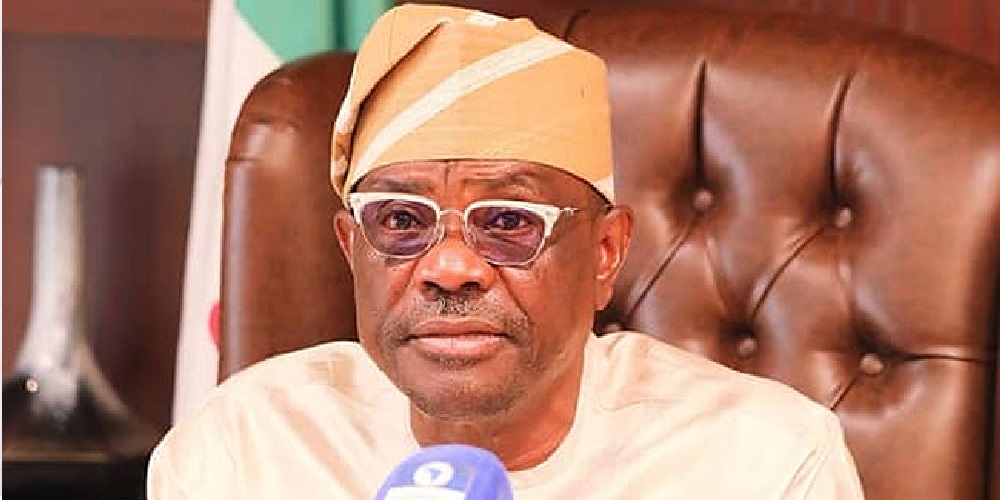
Thousands of Ijaw people from Rivers State gathered for an extraordinary meeting over the weekend, expressing their eternal gratitude to FCT Minister, Nyesom Wike for his role in making Siminalayi Fubara the governor of the state.
The event, held in Port Harcourt under the auspices of the Rivers Ijaw Peoples’ Congress (RIPC), saw leaders, women, youths, and traditional rulers from all Ijaw-speaking local government areas in attendance.
Notable figures present included George Kelly Alabo, Boma Iyayi, Igbani Owaji, Prof. Zacchaeus Adangor, Prof. Henry Ogiri, Sampson Ngeribara, Major Jack, Amb. Dame Maurine Tamuno, Rufus Godwins, and Ojukaiye Flag Amachree.
Isobo Jack, Pleasant Briggs, chairmen of local government areas from some Ijaw councils; and some members of the House of Assembly from Ijaw constituencies among others.
In a communique read by Senator George Thompson Sekibo, the stakeholders said it was the first time in the past 24 years that there was a power shift to the Ijaws of Rivers, noting that the shift was made possible through the sponsorship and support of former Governor Wike.
Sekibo, who read to the cheering of the crowd, expressed sadness over the infusion of the false narrative of ethnic colouration into issues of disagreement between Fubara and Wike, his benefactor.
The stakeholders said the governor appeared to be whipping Ijaw ethnic sentiment as though there was a raging war between Ijaw and Minister Wike
Sekibo said: “Over the centuries, the Ijaw people have been historically known for their gratitude to their benefactors and this has not changed even in the present circumstances.
“We are not unaware of the political dissension in Rivers State and how some prominent Ijaw personalities have been made to join innocently to fuel the disagreement not minding the boomerang effect of such actions on the future of our children and generations to come.
“We, therefore, call on all well-meaning Ijaw leaders in Rivers State and other neighbouring states as well as in the diaspora to join efforts with the Rivers Ijaw Peoples’ Congress as we yearn for a continued and sustained development and growth of Rivers State, the foundation of which was laid by the previous administration.
“It is worthy of recalling that in his non-discriminatory and inclusive leadership style, the Honourable Minister of Federal Capital Territory has continued to show goodwill and live to the Ijaw nation as reflected in the appointments of illustrious Ijaw sons and daughters into positions of trust at the federal level.”
Sekibo named Ijaw leaders, whose appointments were facilitated by Wike as Chief Boma Iyayi, Executive Director, Finance and Administration, NDDC; Rufus Goodwins, Federal Commissioner, Federal Civil Service; Chief George-Kelly Alabo, Director-General, Border Communities Development Agency; Amb. Maureen Tamuno, Managing Director, Abuja Investment Company, and Prof. Henry Ogiri, Commissioner, National Population Commission.
He said: “The wrong notion that Ijaw people are in disagreement with other tribes or persons over the current political impasse poses a significant danger to our Ijaw communities and people particularly regarding peaceful coexistence among themselves and with other tribes and people.
“We, therefore, condemn all acts and utterances that are inimical to fostering unity among the Ijaw people and between Ijaws and other ethnic groups in Rivers State”.
Appreciating the fatherly intervention of President Bola Ahmed Tinubu in the Rivers crisis, the stakeholders said: “We sincerely and most humbly acknowledge the intervention of the President of the Federal Republic of Nigeria. He has shown passion, interest, and fatherly care in the affairs of Rivers State.
“We are indebted to Mr. President and shall continue to support his Renewed Hope Agenda and further assure him of the safety of our national assets within the territory of Rivers State contrary to the reckless utterances of some misguided elements”.
Sekibo expressed gratitude to former President Goodluck Jonathan for recently demonstrating remarkable statesmanship and the true character of a genuine Ijaw leader in Rivers when he called for peace and mutual respect by all parties to the crisis
He said: “As a group we are not against an Ijaw son as governor of Rivers State as we were at the forefront of the clamour for an Ijaw son or daughter as governor of Rivers state. We worked assiduously and committed our time and resources to see the emergence of our son and brother, the current governor of Rivers.
“As a people, we continue to demonstrate our love and support for His Excellency, Nyesom Wike, the Minister of Federal Capital Territory whom we have always seen as our son, brother, leader, friend and lover of the Ijaw nation”.
He said while they hoped for peace and progress, all Ijaws must be circumspect in their utterances and actions and must not place greed and personal interest ahead of the collective interest of the ethnic nation.
Sekibo said while they were committed to the unity of Rivers and their brotherhood with other ethnic nationalities, their unalloyed support for Wike for his visionary, patriotic, inclusive and exemplary leadership remained intact.
Speaking at the occasion, a member of the Rivers State House of Assembly, Enemi Alabo George, said the Ijaws were not at war with anybody
George said: “The Ijaws are not at war with anyone. There is no division in the midst of the Rivers Ijaws. The event was to send a simple message to other tribes about wrong narratives that the Ijaw people of Rivers State were at war with other tribes.
“Ijaws shouldn’t be dragged into any form of discord and political misunderstanding between the Minister and one of his sons Governor Siminalayi Fubara. The Ijaws are peaceful and grateful people. We urge other tribes in Rivers State to join us in appreciating the former and Minister Nyesom Wike for giving the Ijaw son a chance to govern the people.”

Public sector unions under the aegis of the Joint National Public Service Negotiating Council, JNPSNC, have directed all federal, state and local government employees, including staff of ministries, departments and agencies, MDAs, nationwide, to begin a three-day warning strike from midnight today over the failure of the government to address their demands.
The council directed union officials in the federal, state and local government services to ensure total compliance with the industrial action, citing what it described as worsening economic and mental hardship being experienced by workers and other Nigerians.
Members of the JNPSNC include the Nigerian Civil Service Union (NCSU); Medical and Health Workers Union (M&HWU); Association of Senior Civil Servants of Nigeria (ASCSN); and National Association of Nigerian Nurses and Midwives (NANNM).
Others are the Amalgamated Union of Public Corporations, Civil Service Technical and Recreational Employees (AUPCTRE); Nigeria Union of Public Service, Reportorial, Secretarial, Data Processors and Allied Workers (NUPSRAW); National Union of Printing, Publishing and Paper Products Workers (NUPPPPROW); and National Union of Agriculture and Allied Employees (NUAEE).
Employees of federal and state government MDAs are also affected.
The warning strike followed the failure of the Federal Government to address demands contained in a letter dated September 21, 2026, to President Bola Tinubu by the national leadership of the JNPSNC.
The council explained that the action was necessary to press home its concerns over the hardship confronting workers and vulnerable Nigerians.
The council had also, on September 29, threatened a three-day warning strike should its demands for the petrol price to be cut to N500 a litre, a wage award and other measures to cushion the hardship in the country not be met or addressed by President Tinubu during his Independence Anniversary Address to the nation on October 1.
The JNPSNC leadership is disappointed that President Tinubu, in his Independence Anniversary Address, did not heed the demand for the pump price of petrol to be slashed to N500, from the current N1,400 to N2,000 per litre, depending on the location, or announce immediate measures to ameliorate the socioeconomic hardship caused by government policies.
The directive to proceed on the warning strike is contained in a circular by JNPSNC’s National Secretary (Trade Union side), Olowoyo Gbenga, dated October 1, 2026, to the national presidents and general secretaries, state chairmen and secretaries of affiliate unions to the JNPSNC, titled “Declaration of three (3) day Warning Strike; action with immediate effect”.
The circular reads: “Please, recall the position of the National leadership of Joint National Public Service Negotiating Council that if Mr President of the Federal Republic of Nigeria, Bola Ahmed Tinubu refuses to address our requests as contained in the letter to his exalted office (dated 21st September, 2026), the three day warning strike earlier scheduled shall commence immediately.
“Consequent upon the above, the strike shall start with effect from midnight of Friday 2nd October, 2026 to Sunday October 4th, 2026.“In the same vein, all Public Servants in the services of Federal, State and Local Governments are to join the warning strike because an injury to one is an injury to all, most especially all workers, their dependants, vulnerable and hapless Nigerians are groaning terribly under the present economic hardship.
“The economic and mental hardships are becoming unbearable and frustrating.
“The time to act and mobilise workers for the three days warning strike is now!!! Please, disseminate the information!!! Surely, there is victory for us!!!”
Expressing their frustration, one of the leaders of the JNPSNC told Vanguard newspapers: “We are deeply disappointed that the President’s Independence Anniversary address failed to address our legitimate demands for a reduction in the pump price of petrol and the introduction of concrete measures to alleviate the excruciating hardship confronting workers and other Nigerians.
“While the President acknowledged the severe suffering inflicted on citizens by government policies, it is deeply concerning that the speech offered no concrete relief or meaningful response to the urgent demands of Nigerian workers.
“In view of this failure to address these pressing concerns, our three-day warning strike will proceed as planned.”
Recall that the JNPSNC had, on September 21, written to President Tinubu, demanding that the price of petrol be slashed to N500, the immediate announcement of a wage award and the commencement of negotiations for a minimum wage of not less than N500,000 from 2027, among other demands.
In a statement on Tuesday, September 29, 2026, leaders of the JNPSNC warned that should the issues of fuel pump prices and the wage award not be addressed by September 30, especially during the Independence Anniversary Address by President Tinubu, public servants nationwide would commence a three-day warning strike beginning October 2, 2026.
The statement, issued by the National Secretary of the JNPSNC and General Secretary of the Nigeria Civil Service Union, Olowoyo Gbenga, said the September 30 deadline remained sacrosanct, stressing that the concerns of Nigerian workers could no longer be ignored.
According to him: “the three critical issues requiring urgent attention are as follows: Reduction of Fuel Price to N500 per Litre. The Federal Government should take urgent steps to bring down the price of Premium Motor Spirit (PMS) to N500 per litre.“This can be achieved through the provision of an intervention fund to address landing costs and support oil and gas operators.
“It is equally important for the Federal Government to ensure the sale of crude oil to the Dangote Refinery and operators of modular refineries at appropriate terms, in order to facilitate increased domestic refining and help bring down the price of petroleum products.
“The current price of PMS, ranging from N1,450 to N2,000 and, in some locations outside major communities and cities, as high as N2,500 per litre, is unacceptable to Nigerian workers.
“The Council maintains that the economic hardship occasioned by the high cost of fuel is placing the survival of Nigerian workers, their dependants and the general populace under severe pressure, making it increasingly difficult for Nigerians to live normal and dignified lives.
“The Federal Government should urgently approve a Wage Award for Nigerian workers to cushion the effects of the prevailing harsh economic conditions being experienced by workers, their dependants, and vulnerable Nigerians.
“The Council believes that urgent action on this demand will further enable public servants to consolidate their loyalty, commitment and productivity within the public service ecosystem.
“The Federal Government should urgently establish a Tripartite Committee to commence and facilitate negotiations for the new National Minimum Wage expected to become due in 2027.
“The Nigerian workers’ demand for the immediate constitution of the committee is informed by the need to avoid any administrative or procedural delay that could affect the implementation of the new National Minimum Wage once it is eventually negotiated and passed into law by the National Assembly.
“Consequently, the Council states that failure by the Federal Government to take the necessary steps to address these issues on or before 30th September 2026 will leave Nigerian workers with no option but to commence a three-day warning strike, with effect from Friday, 2nd October 2026, to press home their demands.
“It is imperative to state clearly that the Independence Day address of the President of the Federal Republic of Nigeria should adequately address these critical issues.
“Failure to address the concerns raised, according to the Council, will attract the displeasure of Nigerian workers and their dependants, as well as other vulnerable Nigerians who continue to bear the brunt of the prevailing economic hardship.”
NLC backs action
Already, the leadership of the Nigeria Labour Congress, NLC, has given its tacit backing to the industrial action as can be deduced from its statement to make the nation’s 66 Independence Anniversary celebrations.
In an Independence Day statement by its President, Joe Ajaero, on Wednesday, the NLC said rising petrol prices, inflation, stagnant wages, unemployment and insecurity had deepened the economic difficulties faced by workers and other Nigerians.
The labour centre said the real value of workers’ wages had been eroded by inflation, while rising transportation costs had triggered increases in the prices of food, school fees, rent and other essential goods and services.
It said petrol was selling for about N1,430 per litre or higher in major cities, with prices reportedly higher in some remote areas.
The NLC attributed the rising cost of living partly to the petrol price increase that followed the removal of subsidy in 2023, questioning the utilisation of savings from the policy.
“The real value of wages has been devoured by structural inflation. Petrol now sells at N1,430 per litre or higher in major cities and far more in remote areas.
“The surge in transportation costs drives up the prices of food, school fees, rent, and nearly every necessity of life, while nominal wages remain stagnant,” it said.
The union also criticised Nigeria’s continued dependence on imported refined petroleum products despite its status as a major oil-producing country, while calling for greater attention to domestic refining.
On its demands, the NLC urged the government to explore measures to immediately reduce petrol prices, describing transportation costs as a major channel through which inflation affects households.
Our demands are clear, just, and cannot be delayed any further. First, we demand that government seek ways to immediately reduce the price of petrol as transportation costs are the central transmission mechanism of inflation in Nigeria,” it said.
The NLC also demanded the immediate implementation of a nationwide wage award for workers in the federal, state and local governments.
It said the wage award should serve as an emergency measure to cushion the erosion of workers’ purchasing power.
The NLC further demanded implementation of tax relief measures it said were agreed upon during the October 2023 dialogue between the government and labour, noting that provisions contained in the Memorandum of Understanding had yet to be implemented.
It also called for immediate negotiations for a new national minimum wage ahead of 2027, arguing that the existing N70,000 minimum wage had been significantly eroded by inflation.
“We demand the immediate establishment of a tripartite committee to ensure that a new wage standard for 2027 is formulated and legislated before the year runs out,” it said.
The NLC called for a reduction in the cost of governance and greater transparency in the management of public resources.
It also urged the government to create more economic opportunities for young Nigerians, saying unemployment and poverty were contributing to desperation among the youth.
On insecurity, the labour union said the security situation was worsening economic conditions and exposing farmers, teachers and healthcare workers to danger in some parts of the country.
It cited a figure of nearly 2,000 deaths from violence in the first quarter of 2026, but did not identify the source of the figure in its statement.
“The NLC said insecurity, poverty, unemployment and inequality were interconnected challenges that required coordinated action.
As political activities intensify ahead of the 2027 general elections, the labour centre warned political actors against manipulating elections, intimidating voters and exploiting ethnic or religious divisions.
It said workers would make their political choices independently and assess political parties and candidates based on their policies and records.
“The Nigeria Labour Congress will, at the appropriate time, use our Workers’ Charter to make it clear which policies and candidates deserve the support of the working class.
“However, we will never accept any force treating workers’ organisations as dispensable electoral tools. Workers have the right to independent political thoughts, judgement, and choice,” it said.
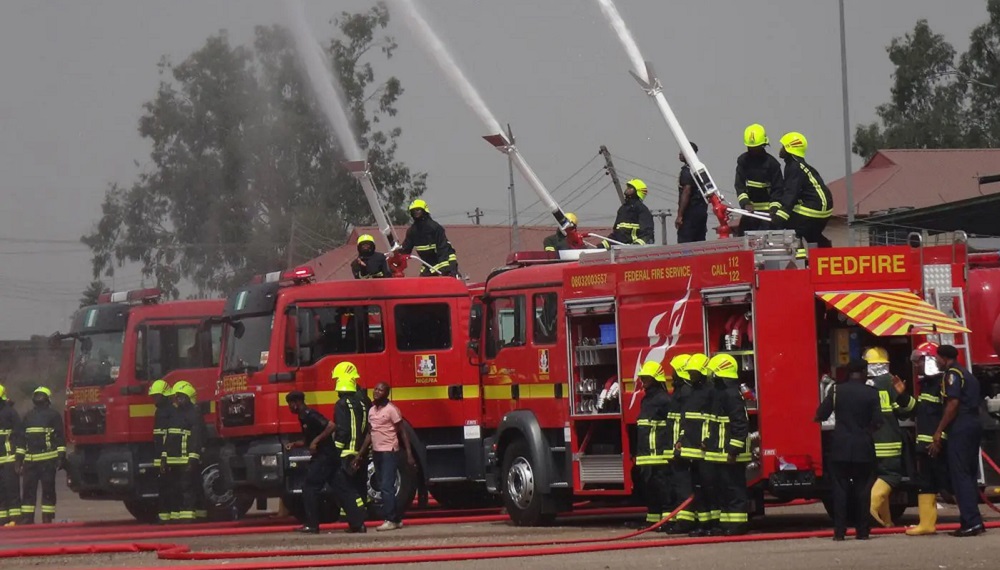
The Federal Fire Service, Gombe State Command, has disclosed that the command saved property estimated at N35m from a fire outbreak at a 15-bedroom residential flat location in Pantami Quarters, Gombe State.
Our correspondent learnt that the incident occurred behind Jiri and Brothers Filling Station in the state capital.
The Command made this disclosure in a statement signed by its Public Relations Officer, ASF Bashir Muazu, on Wednesday.
According to the statement, the fire service received a distress call and immediately deployed a Multi-Purpose Water Tender to the scene.
The vehicle, driven by ASF II Muazu Tagwai and led by ASF I Abdulwahab Abubakar, commenced firefighting operations upon arrival.
The statement added that some of the property, estimated at N17m, was, however, destroyed in the inferno.
“The timely intervention of the firefighting team ensured that property estimated at N35 million was successfully salvaged, while property valued at approximately N17 million was lost to the fire,” the statement said.
The Federal Fire Service said officers of the Gombe State Fire Service also supported the operation, contributing to the effective containment of the fire.
The Command urged residents to remain vigilant and observe basic fire-safety measures, particularly in residential buildings.
It also advised members of the public to report fire emergencies promptly to enable firefighters to respond immediately and effectively to minimise losses.

The Imo State Police Command on Thursday said security agencies have launched a swift operation that led to the rescue of 10 victims abducted by gunmen along the Owerri-Onitsha Road.
This was contained in a statement by the Police Public Relations Officer, Henry Okoye.
“The rescued victims are in safe hands and are being attended to. The exact number of persons abducted is being verified and will be made public once confirmed,” the Command said.
It said it deployed tactical teams and operational assets in a coordinated search-and-rescue operation following the abduction of National Youth Service Corps (NYSC) corps members and other passengers.
The Command said two buses carrying corps members and other passengers were attacked by suspected armed men at about 6:30 a.m. on Thursday, October 1, 2026, near Umunoha.
The development follows the reported abduction of 20 corps members along the road while travelling from Ibadan, Oyo State, to NYSC orientation camps in the South-East and South-South.
The victims were reportedly travelling in a commercial bus when they were intercepted by gunmen.
According to the Command, the two buses were conveying NYSC corps members and other passengers from Ibadan to Uyo, Akwa Ibom State, and Bende, Abia State, respectively, when they came under attack.
The Command said its tactical teams were conducting coordinated search-and-rescue operations, supported by intelligence-led tracking aimed at locating the suspected abductors and securing the release of the remaining victims.
It said that the Commissioner of Police, CP Audu Bosso, alongside other service commanders, visited the scene for an on-the-spot assessment and to provide operational direction.
The police said Bosso assured the public that the operation would continue until all victims were safely recovered and the suspects brought to justice.
“The Commissioner of Police, alongside other Service Commanders, visited the scene for an on-the-spot assessment and to give operational direction. He assured the public that the Command will sustain the operation until all victims are safely recovered and the suspects are brought to justice,” the statement read in part
The affected section of the Owerri-Onitsha Expressway has since been reopened, with traffic flowing normally, while security personnel remain deployed to protect commuters.
The Command also said it was working with the NYSC directorate to contact the families of affected corps members and keep them informed as the operation progresses.
It urged members of the public to remain calm and vigilant and provide credible information that could assist the rescue operation.
“All information will be treated in confidence,” the police said, adding that further updates would be issued as the situation progresses.
The incident comes weeks after security forces rescued 15 corps members and six others abducted in Kogi State.
The victims were rescued after a sustained, intelligence-driven operation in Egume Forest, with security forces continuing efforts to apprehend the kidnappers.

Hardship: Federal, state, LG workers begin 3-day warning strike nationwide

Fire service saves N35m property in Gombe
Court orders rapist’s name announced on radio


-

 News5 hours ago
If you elect me as your president in 2027, I will end election rigging in Nigeria — Atiku
-

 Metro5 hours ago
Gunmen Abduct 20 Corps Members In Imo
-
 Foreign5 hours ago
UK government begins freeing 5,000 prisoners due to extreme prison overcrowding
-

 News5 hours ago
Nigeria Is Now the Worst Place To Be Born — Peter Obi
-
 News5 hours ago
Nigeria at 66: ‘Tinubu made Yahoo Yahoo promise to Nigerians, he’s fake’ – Atiku
-

 News5 hours ago
Nigerian researcher Chika Onochie wins grant for male fertility study in Canada
You must be logged in to post a comment Login