
Foreign
Ukraine’s forces blast major bomb storage site in Russia

- /home/naijuinz/public_html/wp-content/plugins/mvp-social-buttons/mvp-social-buttons.php on line 27
https://naijablitznews.com/wp-content/uploads/2024/08/images-2024-08-09T143559.152.jpeg&description=Ukraine’s forces blast major bomb storage site in Russia', 'pinterestShare', 'width=750,height=350'); return false;" title="Pin This Post">
- Share
- Tweet /home/naijuinz/public_html/wp-content/plugins/mvp-social-buttons/mvp-social-buttons.php on line 72
https://naijablitznews.com/wp-content/uploads/2024/08/images-2024-08-09T143559.152.jpeg&description=Ukraine’s forces blast major bomb storage site in Russia', 'pinterestShare', 'width=750,height=350'); return false;" title="Pin This Post">


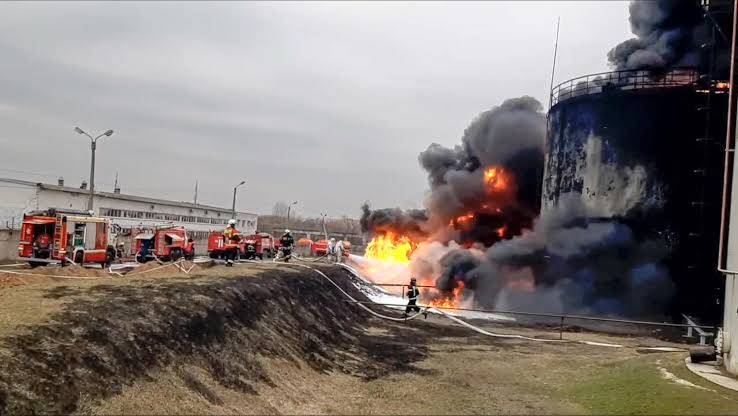
Ukrainian forces have hit a major bomb storage site and airfield deep in the heart of Russia, with ammunition stocks exploding for hours in a massive kamikaze drone strike.
According to reports, hundreds of locals were evacuated from four settlements due to,,,,the munition explosions from the devastating precision attack in Lipetsk, located more than 300km away from the Ukro-Russian border.
‘The entire airfield is on fire, look at what is going on,’ said one observer at the Syrskoye base, which was also evacuated.
Reports further revealed that nine civilian casualties were reported as power cuts resulting from the strikes and curbs on civilian movements at the four powerful explosions near the village of Oktyabrskoye. The scale of the casualties was unclear, but there were said to be significant losses.
This came as Ukraine separately staged a missile strike on a column of Russian forces in the Rylsky district of the Kursk region as Vladimir Putin’s army sought to reverse a humiliating incursion by Kyiv onto his territory.
The highway was completely blocked, with a strong fire and frequent detonations of ammunition.
However, both sides appeared to be throwing reinforcements into the fighting in the Kursk region, which saw Russians wrong-footed earlier this week after a sudden Ukrainian incursion into their territory.
Footage also showed the so-called Wild Division of Donbas, known as international brigade Pyatnashka, entering the Kursk theatre to back efforts to prevent Ukraine grabbing more Russian territory
The highway was completely blocked, with a strong fire and frequent detonations of ammunition.
However, both sides appeared to be throwing reinforcements into the fighting in the Kursk region, which saw Russians wrong-footed earlier this week after a sudden Ukrainian incursion into their territory.
Footage also showed the so-called Wild Division of Donbas, known as international brigade Pyatnashka, entering the Kursk theatre to back efforts to prevent Ukraine grabbing more Russian territory.
Russia unleashed major firepower in an attempt to stop the Ukrainian forces advancing – even bombing its own village of Darino from Su-34 warplanes with FAB-500 aerial bombs at one point.
A huge explosion is seen on video in the village reportedly occupied by Ukrainian forces.
Yet it was far from clear that Russian residents of Darino village had all been evacuated.
Separate footage showed the Russians striking a Ukrainian tank and an armoured vehicle with Lancet barrage munitions in Kursk region.
There was undisguised fury from residents of the district around border town Sudzha who made a video appeal to Putin angrily attacking his military chief of staff Valery Gerasimov for ‘lying’ in claiming that the Ukrainian advance had been halted.
‘Foreign troops with NATO equipment entered our land,’ they complained, upset that they are facing the same foreign occupation that Putin has inflicted on large regions of Ukraine.











An Egyptian court has sentenced popular television presenter, Sarah Khalifa and 11 others to death over their alleged involvement in the production and trafficking of narcotics.
Khalifa, 39, is a well-known television personality and the presenter of ‘Mission Impossible’, a programme that focuses on security and crime-related issues.
According to the state-linked Al-Ahram newspaper, a Cairo court found Khalifa and the 11 other defendants guilty of forming an organized criminal gang involved in procuring materials used to manufacture narcotics for trafficking.
The defendants were also convicted of possessing and carrying unlicensed firearms and ammunition.
The court reached the death sentence after seeking the religious opinion of Egypt’s Grand Mufti, as required by law in capital punishment cases.
However, the verdict is subject to appeal.
State-run Akhbar Al-Youm newspaper reported that the defendants were accused of producing synthetic drugs for trafficking after allegedly importing the materials needed for their manufacture from outside Egypt.
Authorities reportedly seized more than 750 kilogrammes of narcotics and raw materials during investigations into the case. They also discovered two apartments allegedly being used as drug laboratories, alongside unlicensed firearms and ammunition.
Khalifa, who also owns a plastic surgery clinic and a production company involved in organizing parties and events, was further sentenced to five years in prison with other defendants in a separate case involving the kidnapping and assault of a young man.
Egyptian law allows the death penalty for offences including premeditated murder, terrorism, certain rape cases and drug trafficking. Data from the Egyptian Commission for Rights and Freedoms showed that 541 death sentences were handed down in Egypt in 2025

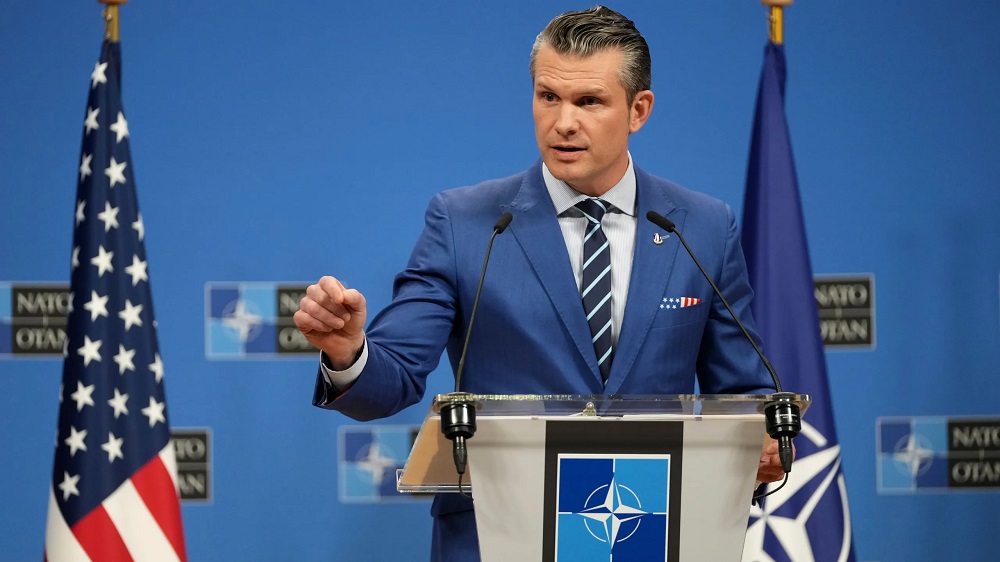
The United States has issued a fresh warning to Iran, threatening to destroy and sink Iranian oil tankers if Tehran launches further attacks against American naval vessels.
U.S. Secretary of War Pete Hegseth issued the warning on Saturday, September 5, 2026, shortly after American forces struck three Iranian oil tankers following what Washington described as ballistic-missile attacks by Iran’s Islamic Revolutionary Guard Corps (IRGC) against two U.S. Navy warships.
Hegseth, in a statement on X, said the United States would respond directly by targeting Iran’s oil fleet if American ships came under fire.
“It’s simple: if Iran shoots at U.S. ships, we will destroy (and sink) their oil tankers,” Hegseth said, adding that Iran only needed to refrain from attacking the U.S. Navy.
He further claimed that Iran’s oil tanker fleet was vulnerable because, according to him, Tehran lacked the naval and air capabilities necessary to protect the vessels.
“Iran’s oil tanker fleet is defenseless — Iran has no navy or air force. Our planes, ships & subs can strike them all,” Hegseth said, referring to areas under the U.S. Central Command and U.S. Indo-Pacific Command.
US strikes three Iranian tankers
The warning came after U.S. Central Command (CENTCOM) confirmed that American forces had struck three Iranian crude oil carriers.
CENTCOM said the action followed missile attacks by the IRGC against a U.S. aircraft carrier and a guided-missile destroyer. According to the command, both American warships successfully evaded the missiles and no U.S. personnel were injured.
The American military identified two of the vessels as M/T Downy, which was struck off Kharg Island, and M/T Stark 1, targeted near Jask.
Both vessels were described by CENTCOM as “permanently disabled.”
A third tanker, M/T Kylo, also known as Noxen, was attacked in the Gulf of Oman. CENTCOM said the crew was warned to abandon the vessel before it was destroyed.
The U.S. military said the tankers were connected to what it described as a multibillion-dollar “shadow network” allegedly used to finance Iran’s Revolutionary Guard and its regional allies.
US threatens wider action
The commander of U.S. Central Command, Admiral Brad Cooper, also warned that Washington would impose an even greater economic cost on Tehran if Iranian forces continued attacking American vessels.
“If you shoot at two of our ships, we will impose an even higher economic cost — taking out three of yours,” Cooper said.
He added that the United States would not hesitate to defend its forces and, if necessary, destroy Iran’s “limited and exposed oil fleet.”
The latest threats signal a potentially significant expansion of the maritime confrontation between Washington and Tehran, with Iranian oil shipments increasingly becoming a direct target of U.S. military pressure.
Iran condemns attacks
Iran has condemned the American strikes on its oil tankers, describing the attacks as illegal and warning that Washington and its allies would bear responsibility for the consequences of continued attacks.
Iranian authorities have also warned that further attacks on Iranian vessels could trigger retaliation against American interests in the region.
The escalation is particularly significant because it is unfolding around the Strait of Hormuz, one of the world’s most important energy shipping routes.
The waterway connects the Persian Gulf with the Gulf of Oman and is a critical route for global oil supplies. Continued attacks on commercial vessels could therefore have wider implications for international energy markets and global shipping.
With the United States now openly threatening to target Iran’s oil fleet in response to attacks on its Navy, the latest confrontation could mark a new and more dangerous phase in the ongoing U.S.-Iran conflict.
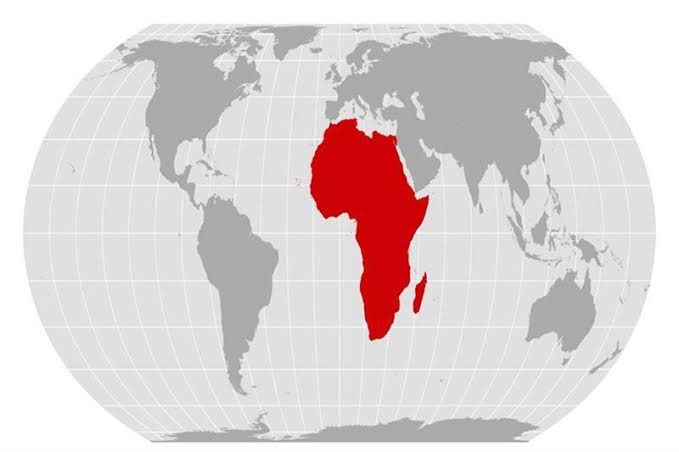
The United Nations General Assembly has overwhelmingly backed a Togo-led resolution calling for a more accurate representation of the world’s continents, particularly Africa, on global maps.
The resolution, “Correct the Map: Rebalancing Global Cartographic Representation and Promoting Equitable Representation of the World’s Regions, Particularly Africa,” was adopted on Friday, September 4, with 164 countries voting in favour, six abstaining and only the United States voting against.
The initiative promotes the gradual adoption of the Equal Earth projection, which represents the relative areas of continents more accurately than the centuries-old Mercator projection. The Mercator map, developed in 1569 primarily for navigation, significantly enlarges landmasses closer to the poles while making equatorial regions such as Africa appear disproportionately smaller.
Togo, which spearheaded the initiative with African Union backing, argued that maps are not merely geographical tools but also shape how societies perceive the world and their place in it.
The resolution is not legally binding and does not ban the Mercator projection, which remains useful for maritime navigation. Instead, it encourages governments, educational institutions and other users to consider more geographically accurate alternatives.
The vote also exposed differing political interpretations of the initiative. The United States was the sole country to oppose the resolution, arguing that the United Nations should concentrate on more pressing global challenges rather than what Washington characterised as an ideological agenda.
The measure nonetheless represents a significant diplomatic victory for African countries seeking to challenge longstanding distortions in the way the continent is visually represented on commonly used world maps.
Africa has not changed its size. The map is finally being asked to show it.

Death Be Not Proud: Publisher Dotun Oladipo and the Tolling Bell

Hartland Nigeria Completes 41 Projects, Reaffirms Commitment To Infrastructure Delivery

Three casualties, 20 injured in Osun auto crash




-

 Sports24 hours ago
Sad! Military jet crashes during airshow
-

 Economy11 hours ago
FG Can’t Account For ₦33.75 Billion Cash Transfers To Vulnerable Nigerians – Auditor-General
-

 News11 hours ago
2027: Amaechi Chose Buhari Over Jonathan, We’ll Pay Him Back – Wike
-

 News11 hours ago
At 71, Nigerian Man Enrolls at UI Law School: Here Is Why He Did It
-

 News20 hours ago
Moroccan Wife Has Been Away From Me for 11 Months — Husband Accuses Sheikh Gumi
-
 Foreign23 hours ago
UK updates list of employers allowed to sponsor Nigerian, other foreign workers
-

 News21 hours ago
Watch Wike delivering his speech at civic reception held in his honour today
-

 News11 hours ago
British-Nigerian Businessman Dies After Penis Enlargement Procedure in Thailand
Warning: Undefined variable $user_ID in /home/naijuinz/public_html/wp-content/themes/zox-news/comments.php on line 49
You must be logged in to post a comment Login