
Economy
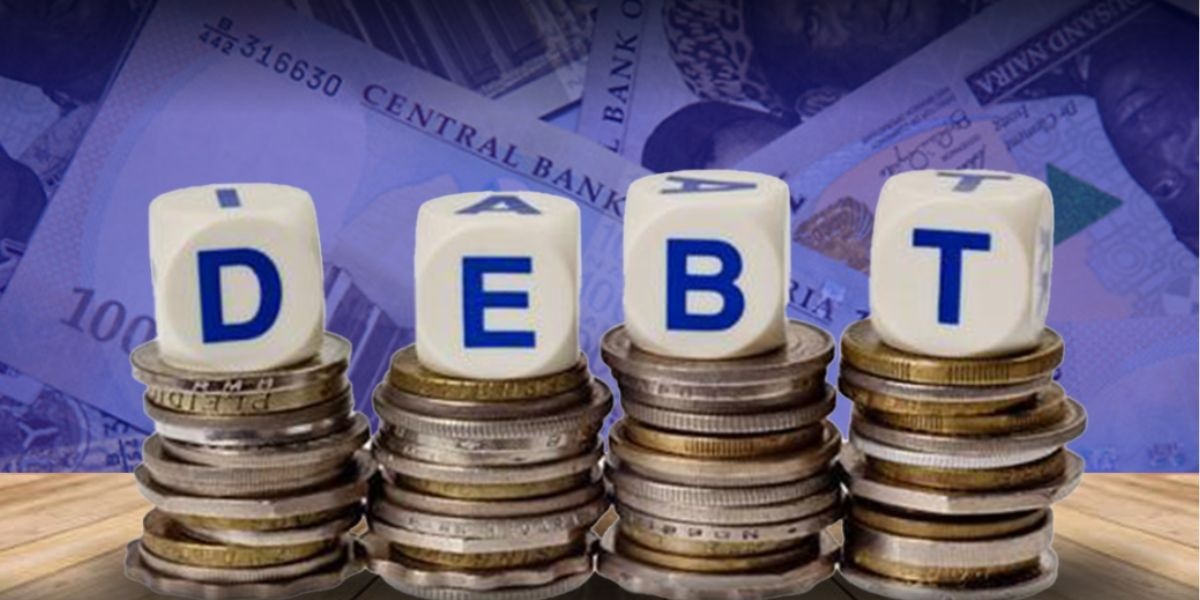
Nigeria’s debt stock surges to N142trn on weak naira

- /home/naijuinz/public_html/wp-content/plugins/mvp-social-buttons/mvp-social-buttons.php on line 27
https://naijablitznews.com/wp-content/uploads/2025/01/Debt-1000x600.jpg&description=Nigeria’s debt stock surges to N142trn on weak naira', 'pinterestShare', 'width=750,height=350'); return false;" title="Pin This Post">
- Share
- Tweet /home/naijuinz/public_html/wp-content/plugins/mvp-social-buttons/mvp-social-buttons.php on line 72
https://naijablitznews.com/wp-content/uploads/2025/01/Debt-1000x600.jpg&description=Nigeria’s debt stock surges to N142trn on weak naira', 'pinterestShare', 'width=750,height=350'); return false;" title="Pin This Post">


Nigeria’s public debt profile has yet again increased by N8.02 trillion to N142 trillion as of the end of September 30, 2024 driven by the depreciation of the naira that has continued to affect the country’s cost of external obligation.
According to data published by the Debt Management Office (DMO) on Tuesday, the spike represented a 5.97 percent increase from N134.3 trillion recorded in the second quarter of 2024.
The debt, comprising external and domestic obligations, reflects the significant impact of exchange rate depreciation on external borrowings when converted to naira terms.
With the exchange rate weakening from N1,470.19/$ in June to N1,601.03/$ by the end of September, Africa’s fourth largest economy has as much as N68.88 trillion ($43 billion) as its foreign debt, accounting for 48.4 percent of the total debt stock.
In naira terms, external debt surged by 9.22 percent, rising from N63.07 trillion to N68.89 trillion within the quarter.
A more cursory look at the data showed that the Nigerian government relied more on domestic borrowings as it accounted for 51.6 percent of total debt profile, with the FGN taking N69.2 trillion and state governments having N4.2 trillion as their debt.
Domestic debt reduced by 5.34 percent in dollar terms, falling from $48.45 billion in June to $45.87 billlion in September. In naira terms, it rose by 3.10 percent from N71.22 trillion to N73.43 trillion during the period.
The Federal Government’s external debt accounted for $38.12 billion in September, up from $38.01 billlion in June, while states and the Federal Capital Territory held $4.91 billlion in external debt, a slight increase from $4.89 billion.
For domestic debt, the Federal Government’s obligations rose from N66.96 trillion to N69.22 trillion, while states and the FCT recorded a minor reduction from N4.27 trillion to N4.21 trillion.
Overall, Nigeria’s total public debt in dollar terms fell by 2.70 percent, from $91.35 billion in June to $88.89 billlion in September.
However, Nigeria’s debt stock has grown from 78.13 percent recorded in June 2024 to 78.95 percent in September 2024, defying the DMO’s self-imposed public debt ceiling of 40 percent, as outlined in the agency’s Medium-Term Debt Management Strategy.
Although the current public debt-to-GDP ratio of about 55 percent is slightly below the IMF’s 60 percent benchmark for emerging market countries, the nation’s weak revenue profile and FX volatility risks could further escalate debt levels, straining the already strained economy.
Rising public debt means elevated debt-to-service cost. The rising debt profile, particularly in naira terms, raises concerns over debt sustainability, especially with the exchange rate volatility driving up the local currency cost of external obligations.
Analysts have expressed concerns over the rising debt levels, warning that it could trigger a debt crisis for a country that’s reeling from its worst cost of living crisis in a generation.
While the exchange rate has begun to show reduced volatility due to the various central bank’s policies, analysts believe that the proposed tax reforms, if passed, might help Nigeria boost its revenue base and lower borrowings.
Credit: Businessday NG.








The Naira yesterday appreciated to N1,387 per dollar from N1,390 in the parallel market on Monday.
Similarly, the naira appreciated to N1,322.9 per dollar in the Nigerian Foreign Exchange Market, NFEM.
Data from the Central Bank of Nigeria, CBN, showed that the indicative exchange rate for the naira fell to N1,322.9 per dollar from N1,320 per dollar on Monday, indicating N2.9 appreciation for the local currency.
Consequently, the margin between the parallel and official markets narrowed to N64.1 per dollar from N70 per dollar on Monday. The value of interbank turnover in NFEM declined by 48.07 percent to $55.6 million from $107.07 million on Monday.


The Central Bank of Nigeria (CBN) has announced that it will be paying closer attention to how banks and other financial institutions in the country are being used, or misused, to move money that could fund terrorism.
In a statement signed by Hakama Sidi-Ali, Acting Director of the apex bank’s Corporate Communications and Investor Relations Department on Tuesday, the CBN said it has made terrorism financing supervision one of its current priorities. According to the statement, this is part of the bank’s “ongoing commitment to protecting the Nigerian financial system from abuse by illicit actors.”
What this means in plain terms is that the CBN will be looking more closely at how banks identify and manage the risk of their platforms being used to fund terrorism, how well they monitor suspicious transactions linked to terrorism financing, how they carry out sanctions ordered against specific individuals or groups, and how promptly they report suspicious activity connected to terrorism financing.
The statement explained that this new push covers four broad areas: how financial institutions manage terrorism financing risk, how they monitor transactions for signs of terrorism financing, how they carry out targeted financial sanctions, and how they report suspicious transactions linked to terrorism.
The apex bank said it will not be sitting back and waiting for problems to surface on their own. Instead, it plans to use a risk-based approach, which means banks and institutions seen as more exposed to this kind of risk will attract closer attention.
This will involve both on-site inspections, where CBN officials visit institutions directly, and off-site checks, where the bank reviews reports and data from a distance.
The goal, the statement said, is to support “effective Anti-Money Laundering, Countering the Financing of Terrorism and Countering Proliferation Financing (AML/CFT/CPF) controls across the financial sector,” referring to the fight against money laundering, terrorism financing, and the financing of weapons proliferation, all of which are governed by existing Nigerian laws and regulations.
The CBN also linked this move to Nigeria’s wider efforts, both at home and internationally, to fight terrorism financing and the financing of weapons proliferation, and to protect the integrity of the country’s financial system.
The apex Bank did not name any specific institution under investigation or give a timeline for these actions, but noted that “further supervisory engagement will be undertaken as appropriate,” suggesting that more steps could follow depending on what its checks turn up.
For the ordinary Nigerian, the announcement signals that the CBN wants banks to be more careful and more accountable in how they track the movement of money through the financial system, particularly where there is any possible link to terrorism or the funding of violent groups.
It is also a reminder that financial institutions operating in Nigeria are expected to follow strict rules designed to keep the banking system safe from being used for illegal purposes.

The Federal Government has approved a new pensionable salary structure for personnel of the Nigerian Armed Forces.
The new structure affects personnel in the Nigerian Army, Nigerian Navy and Nigerian Air Force and took effect from September 1, 2026.
The approval was contained in a circular issued on September 3 by the National Salaries, Incomes and Wages Commission.
Under the new arrangement, Generals, Admirals and Air Chief Marshals occupy the highest level, with their annual pensionable salaries ranging from ₦21.9 million to ₦29.75 million, depending on their salary steps.
The highest figure works out to roughly ₦2.48 million per month when divided by 12.
Lieutenant Generals, Vice Admirals and Air Marshals will have annual pensionable salaries between ₦16.99 million and ₦25.91 million.
Major Generals, Rear Admirals and Air Vice Marshals will receive pensionable salaries ranging from about ₦14.98 million to ₦23.9 million annually.
For Brigadier Generals, Commodores and Air Commodores, the approved annual pensionable figures range from ₦13.86 million to ₦16.39 million.
Colonels, Captains and Group Captains will have annual pensionable salaries between ₦8.31 million and ₦9.49 million, while Lieutenant Colonels, Commanders and Wing Commanders will fall between ₦7.55 million and ₦8.74 million.
Majors, Lieutenant Commanders and Squadron Leaders will have pensionable salaries ranging from ₦5.99 million to ₦7.01 million annually.
Captains, Lieutenants and Flight Lieutenants will receive between ₦5.28 million and ₦6.42 million.
At the junior officer level, Second Lieutenants, Midshipmen and Pilot Officers will have annual pensionable salaries ranging from ₦4.92 million to ₦5.59 million.
The new structure also covers non-commissioned personnel.
Warrant Officers across the three services will have annual pensionable salaries between ₦4.53 million and ₦5.17 million, while Master Warrant Officers will receive between ₦3.94 million and ₦4.93 million.
Warrant Officers will have annual pensionable salaries ranging from ₦3.46 million to ₦4.35 million. Staff Sergeants, Petty Officers and Flight Sergeants will have figures between ₦2.98 million and ₦3.76 million.
Sergeants and Leading Seamen will have annual pensionable salaries ranging from ₦2.81 million to ₦3.16 million, while Corporals and Able Seamen will receive between ₦2.48 million and ₦2.73 million.
Lance Corporals and Seamen will have pensionable salaries between ₦2.32 million and ₦2.58 million annually.
Privates, Ordinary Seamen and Aircraftmen will have figures ranging from ₦2.28 million to ₦2.49 million.
The government clarified that the amounts contained in the new schedule are meant for calculating pension benefits.
They should not be treated as the actual monthly salaries or take-home pay of serving military personnel.

Sanwo-Olu appoints Badejo new LASU VC

68 Nigerians awarded U.K. Chevening, Commonwealth scholarships

Many terrorists eliminated as military airstrikes hit hideout in Zamfara




-

 Economy23 hours ago
See Dollar to Naira exchange rate today, September 9, 2026
-

 News21 hours ago
49.70kg heroin: Fugitive drug kingpin, Festus Ibewuike, arrested after years on the run+Photos
-

 News18 hours ago
Alia’s Claim Under Heavy hammer as Photos Show Benue Govt Was Informed Ahead of Obi’s Visit
-

 News23 hours ago
Kara Bridge closure cripple Lagos-Ibadan Expressway
-

 News23 hours ago
Police Arrest Woman After Vigilante Member Dies During Sex in Ile-Ife
-

 News23 hours ago
Adeboye, wife celebrate 59 years of marriage
-

 News17 hours ago
BREAKING: Heavy shake up in Nigerian Army, top officers affected
-
 News13 hours ago
Akpabio Petitions DSS Over Viral ‘Anti-North’ Statement, Demands Probe
Warning: Undefined variable $user_ID in /home/naijuinz/public_html/wp-content/themes/zox-news/comments.php on line 49
You must be logged in to post a comment Login