
Politics
Ahead 2024 Edo guber: Research discounts Edo South’s acclaimed 60 per cent voting population+Graphics

- /home/naijuinz/public_html/wp-content/plugins/mvp-social-buttons/mvp-social-buttons.php on line 27
https://naijablitznews.com/wp-content/uploads/2024/02/9729AD8C-D1B7-41D8-8E0A-AE203EC30A51.jpeg&description=Ahead 2024 Edo guber: Research discounts Edo South’s acclaimed 60 per cent voting population+Graphics', 'pinterestShare', 'width=750,height=350'); return false;" title="Pin This Post">
- Share
- Tweet /home/naijuinz/public_html/wp-content/plugins/mvp-social-buttons/mvp-social-buttons.php on line 72
https://naijablitznews.com/wp-content/uploads/2024/02/9729AD8C-D1B7-41D8-8E0A-AE203EC30A51.jpeg&description=Ahead 2024 Edo guber: Research discounts Edo South’s acclaimed 60 per cent voting population+Graphics', 'pinterestShare', 'width=750,height=350'); return false;" title="Pin This Post">


■ Findings put Edo South at 46.50 per cent, Edo North at 35.50 and Edo Central at 18 per cent
Contrary to the age-long assumptions that the majority Edo South senatorial zone accounts for about 60 per cent of Edo State’s voting population, new research by The PROVE Foundation has proved otherwise.
The research, released by the Coordinator, Omotola Ariyo, who was previously an associate at Morgan Stanley and an analyst at Goldman Sachs, delved into the voting patterns across various senatorial districts.
Ariyo said that it meticulously examined the performance of key political parties like All Progressives Congress (APC), Peoples Democratic Party (PDP), and Labour Party (LP).
According to him, “We have meticulously dissected the trends and preferences that have emerged in different zones of Edo State, providing a clear picture of the electorate’s evolving sentiments.
“Furthermore, the report goes beyond mere statistics to explore the underlying factors influencing voter behavior and election outcomes.
“This includes an assessment of socio-political dynamics, economic influences, and other critical elements that have played a pivotal role in shaping the electoral decisions of the populace.”
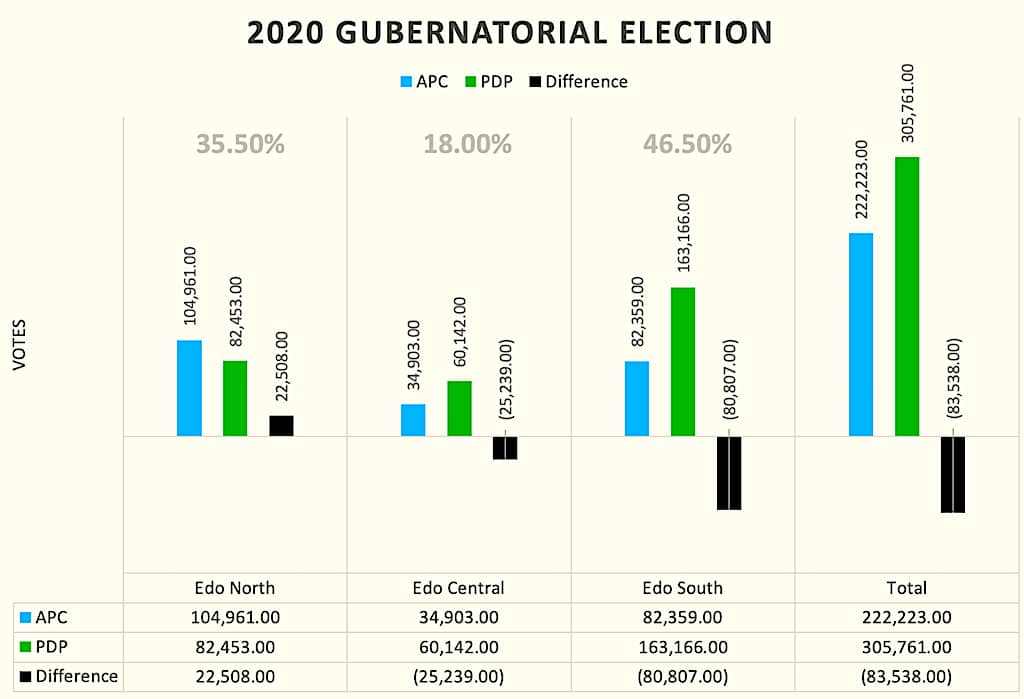
The research findings showed that the much-acclaimed majority that is usually associated with Edo South (which is always put at between 55-60 per cent voting population) was discounted in the 2020 governorship election, settling down at a contributed 46.50 per cent of the votes to the outcome of that election.
It was followed by Edo North’s 35.50 per cent and Edo Central’s 18 per cent.
There were noticeable and significant shifts in percentages of voters populations (based on turnout during elections) between the 2016 and 2020 governorship elections as well as the 2023 general elections (presidential and National Assembly and House of Assembly elections in the State)
“Our analyses indicated that the 2016 gubernatorial elections in Edo State showed that the political dynamics weighed in favour of the two major parties, APC and PDP, and this cut across the three zones.
“The APC emerged as the victor in that election with a significant margin of 66,310 votes. Analysis of the voting pattern showed a clear geographic divide in party preferences, with APC dominating in Edo North and Edo-South, while PDP was the favourite in Edo Central.
“Our analysis further showed that contrary to the commonly cited figure, Edo-South accounted for 48.37% of the votes, not the 60% often claimed, indicating a substantial but not dominating influence on the electoral outcome.
“This figure, coupled with the 32.23% from Edo North and the 19.40% from Edo Central, with a 15.85% vote difference between Edo South and Edo North, underscored the diverse political inclinations within the state.
‘However, the 2020 gubernatorial elections in Edo State marked a significant shift in political alignment, with the Peoples Democratic Party (PDP) defeating the All Progressive Congress (APC) by 83,538 votes.
“A marked decrease in overall turnout was noted, with 527,984 total votes cast, reflecting a reduction of 44,672 from the previous election. Edo North increased its contribution to 35.50%, up from 32% in 2016, while Edo South’s share decreased to 46.50% from 48%. Edo Central’s contribution also saw a decline to 18%.
“These changes narrowed the gap between Edo South and Edo North by 4.85%. Our analyses implicated factors that contributed to APC’s loss to include a lack of support from federal members and governors within the APC, perceived hypocrisy due to the party leader’s past criticism of their candidate Pastor Ize Iyamu, a united front from PDP stalwarts including Obaseki, Shaibu, Orbih, and Governor Wike, and insufficient mobilisation efforts at the grassroots level by the APC.
‘While our analysis showed that the 2023 presidential and senatorial election data cannot be used for a one-to-one comparison with the 2016 and 2020 gubernatorial data due to anomalies that do not exist in gubernatorial elections, the 2023 presidential and senatorial elections in Edo State underscored a notable realignment in voter preferences, showcasing the emergence of the Labour Party (LP) as a formidable force.
“In the presidential race, the LP achieved a striking victory, securing 331,163 votes. This figure surpassed the vote counts of the traditional political heavyweights, APC and PDP, in previous gubernatorial contests and signaled a considerable transition in the electorate’s alignment. “Despite an increase in voter engagement from the 2020 elections, participation levels did not reach the heights of the 2016 elections, indicating variable voter enthusiasm.
■ Zonal Contributions
The research findings showed that Edo South emerged as a pivotal zone, contributing 50.26% to the total vote count, clearly indicating its status as a critical battleground.
It stated that the LP’s success in this region reflected an adaptive voting pattern, where voter preferences shifted in favour of candidate attributes. Conversely, Edo North and Edo Central declined their electoral contributions, with Edo North decreasing from 35.50% in 2020 to 32.18% in 2023 and Edo Central from 18% to 17.55%.
It continued:
■ Backdrop of National Events
The backdrop of national events, including dissatisfaction with the incumbent administration’s policies and the controversial APC’s Muslim-Muslim ticket, played a significant role in shaping voter sentiment. In contrast, the LP’s candidate, perceived positively for his integrity and experience, offered a refreshing alternative to the established parties, further buoyed by support from followers of Professor Yemi Osinbajo post the APC primaries.
■ Complex Electoral Dynamics
However, the same-day 2023 senatorial elections in Edo State further reflected the complex electoral dynamics. Despite the LP’s presidential success, the party saw a 34.85% reduction in its senatorial vote share. This decline was most pronounced in Edo North, with a 66.31% decrease, followed by Edo Central at 49.82% and Edo South at 23.63%, highlighting the distinct regional responses to domestic candidates. In contrast, the APC made significant gains, particularly in Edo Central, where they achieved an unprecedented victory since 1999, indicating a possible shift in regional political alliances or the effectiveness of their senatorial campaign strategy. These results underscore the nuanced understanding and response of the electorate in Edo State to local candidates, reflecting a dynamic and region-specific voting behaviour.
II. VOTER SENTIMENT AND BEHAVIOR
From 2016 to 2023, Edo State’s electoral landscape has been marked by dynamic voter sentiment and behaviour shifts, reflecting a sophisticated electorate across its three senatorial zones: Edo South, Edo North, and Edo Central. Notably, the 2023 elections did not surpass the 2016 turnout, suggesting factors like voter apathy or socioeconomic influences impacted civic engagement. Edo North, in particular, saw a growth in voter percentage from 32% in 2016 to 35.50% in 2020, indicating an increase in political participation or demographic shifts. Approximately 330,000 voters, representing 58.87% of the electorate, were influenced by candidate attributes such as integrity and experience, signaling a shift from party loyalty to individual candidate’s qualities. This is more notable in Edo South, housing 218,984 of the 330,000 (66.36%) candidate-centric voters.
■ Local Candidates’ Influence
Local candidates profoundly affected voting in the more rural Edo Central and Edo North while having a lesser impact in the urban Edo South. This distinction suggests a form of localised voting behaviour more pronounced in rural areas. The APC, consistently victorious in Edo North, reflecting solid party structure and regional loyalty, has never lost in this zone. The data illustrates Edo South’s leading role with an average electoral contribution of 48.38% across all elections, compared to Edo North’s 33.30% and Edo-Central’s 18.32%. For gubernatorial polls, these figures adjust slightly to 47.43% for Edo-South, 33.86% for Edo North, and 18.70% for Edo Central, indicating a consistent voting strength pattern across the zones.
■ People’s Value of Result-Oriented Governance
Additionally, voter sentiments reveal that the general populace in Edo South values governance that delivers tangible results, such as better roads and schools. This sentiment aligns with the significant sway candidate attributes hold in the region. This mirrors the views of some party members who prioritise the ability to retain governorship through electoral victory as a critical consideration, resonating with the electorate’s preference for candidates who can govern effectively regardless of their origin. In the rural regions of Edo Central and Edo North, local candidates have a more pronounced impact, as evidenced by the strong sentiment of having been marginalised and the desire for it to be their ‘turn’, a reflection of a voting pattern that favours local affiliation and the promise of focused development.
■ Fidelity to APC’s Consistent Success in Edo North
The APC’s unbroken success in Edo North could be seen as a response to consistent party performance and perceived loyalty, with the electorate there showing a strong belief in rewarding the party’s commitment to the state. Edo South’s pivotal role, leading average electoral contribution, and Edo North’s loyal base contrast with Edo Central’s more localised political dynamics, where feelings of marginalisation have reinforced the importance of having a candidate from within the region. This complex interplay of regional affinities, candidate characteristics, and party dynamics indicates a politically astute electorate considering a broad spectrum of factors in electoral decisions.
■ Discerning Electorate
The sharp variations in the 2023 presidential and senatorial election results on the same day further underscore an electorate that is discerning and strategic, capable of differentiating between individual candidates and party platforms, highlighting the multifaceted nature of democracy in Edo State and the importance of candidate selection and localised campaign strategies for political success.
II. REGIONAL VOTING PATTERN BASELINE
In examining Edo State’s voting behaviour, two baselines were considered: Baseline 1 and Baseline 2, which serve as crucial analytical tools. Baseline 1, which included data from the 2016 and 2020 gubernatorial elections alongside the 2023 presidential election, was rejected due to incomplete Labour Party (LP) data for the earlier elections.
This resulted in an average falling short of 100%, rendering it an unreliable metric for comprehensive analysis. Despite its rejection, Baseline 1 underscored a significant political development: the LP’s entrance as a considerable force in the 2023 election, particularly in Edo South, with 13.02% of the vote. However, it could not compete with APC’s 56.03% lead in Edo North or PDP’s strong showing in Edo Central with 45.00%.
Baseline 2 was adopted as it provided a normalised data set, focusing solely on the APC’s and PDP’s consistent electoral presence in the 2016 and 2020 gubernatorial elections. This baseline presented a clear and reliable depiction of the electoral landscape, revealing a 19.12% advantage of APC over PDP in Edo North and an 18.94% lead of PDP over APC in Edo Central.
The electoral narratives derived from Baseline 2 offer a threefold perspective on Edo State’s regional dynamics. In Edo North, a strong preference for APC is evident, with the party receiving 59.51% of the vote, suggesting a robust party structure and significant voter allegiance. Edo Central displays a contrasting pattern, with PDP leading by a substantial 18.94%, reflecting the zone’s entrenched support for the party, signified by its 59.42% vote share.
Meanwhile, Edo South emerges as a competitive zone, indicating a more open political contest. These percentages not only highlight the historical voting patterns and emerging trends but also reflect the sentiments and priorities of the electorate, which range from a desire for effective governance and development to calls for political representation and an end to regional marginalisation. The interplay of these factors underscores the nuanced and evolving nature of democracy in Edo State.
III. IMPLICATIONS FOR FUTURE ELECTIONS
The future electoral landscape of Edo State is poised for complexity and sophistication, informed by a deep understanding of past voting behaviours, senatorial sentiments, and the established Baseline 2.
■ Edo South
With its urban diversity, Edo South is a critical swing zone where voters increasingly prioritise candidate quality over party affiliation. This signifies a departure from traditional voting patterns. Political parties must thus field candidates with solid attributes and focus on issues like integrity, governance, and development to resonate with this electorate. The challenge lies in breaking past entrenched party loyalties and addressing the multifaceted problems of a diverse voter base. Still, the opportunity to capture this segment lies in presenting candidates who epitomise capable governance.
■ Edo Central
Edo Central’s political narrative is shaped by its strong PDP loyalty and a profound sense of marginalisation, as articulated in the Esan Agenda. To secure votes here, political parties should field local candidates and actively engage with the community to address their representation concerns. The main challenge for opposition parties is dismantling deep-seated PDP loyalty by offering credible alternatives that align with local aspirations. However, the potential to change the political tide exists if parties can genuinely address the issues of marginalisation and advocate the region’s development.
■ Edo North
In Edo North, a sentiment of being the genuinely marginalised group has surfaced, creating a platform for political dialogue on equality and local representation. The path forward for the APC, which has a stronghold in the area, involves presenting candidates with strong local connections and reputable credentials. Opposition parties can gain ground by also promoting candidates with local ties and addressing the growing calls for empowerment. The risk is real for any party disconnected from these local sentiments. Nonetheless, the prospect for parties to either reinforce their position or gain new support lies in their commitment to addressing local development issues and grievances.
CONCLUSIONS
In conclusion, candidates’ ability to align local advocacy with efficient governance will significantly influence Edo State’s electoral future. Political parties must evolve, recognising that the electorate’s growing discernment will guide their electoral choices. Success in upcoming elections will hinge on presenting candidates who are locally connected and exude integrity, competence, and a compelling developmental vision. This approach will likely be the deciding factor for political entities aiming to meet Edo State’s voters’ intricate and evolving expectations.
IV. RECOMMENDATIONS TO PARTIES FOR A SUCCESSFUL 2024 ELECTION
The electoral analysis of Edo State reveals distinct voter patterns and preferences, which form the basis of strategic recommendations for parties contesting in future elections.
■ PDP
For the PDP, the suggestion is to select a candidate with significant appeal and credentials from Edo Central, tapping into the local sentiment and loyalty. This should yield a starting point of 45,931 votes and is a robust approach that could consolidate PDP’s existing strongholds while making inroads into other zones.
■ APC
For the APC, which holds sway in Edo North, the recommended strategy is to nominate a candidate from the same region with commendable attributes and a strong track record. This approach leverages the region’s kindred association and sentiments of actual marginalisation in governance representation at the federal and state level, potentially securing a base of 104,222 votes with the possibility of gaining an additional 45,909 votes, considering the LP’s loss of 66.31% of votes between the 2023 presidential and Senate elections and PDP’s internal dynamics. This strategy not only fortifies APC’s position in its stronghold but also has the potential to appeal to the swing voters of Edo South, setting a substantial foundation for a victorious campaign.
■ LP
On the other hand, the Labour Party (LP) should focus on capitalising on its recent success in Edo South by fielding a competent candidate and leveraging the momentum from the 2023 presidential election. LP can position itself as a formidable force across the state by retaining the support gained and targeting the close margins in regions like Akoko-Edo LGA, where they trailed APC by only 1,181 votes.
SUMMARY
In summary, each party’s success will likely depend on its ability to identify and promote candidates whose attributes resonate with the electorate’s regional sentiments and demands for competent governance. For APC, the focus is on reinforcing its northern base and extending its appeal southward. PDP must work on solidifying its central dominance and expanding its influence. At the same time, LP’s strategy hinges on building upon its southern inroads and narrowing the gap in the north. These tailored strategies, grounded in a thorough understanding of zonal inclinations and statewide electoral currents, provide a roadmap for securing electoral victory in Edo State’s complex political landscape.



The Nigerian Democratic Congress, NDC, Presidential Candidate for the 2027 election, Peter Obi, has advised President Bola Ahmed Tinubu to consider resigning his position, having failed woefully in discharging most of his campaign promises. And having failed to improve the standard of living of the citizens.
Reacting to the announcement of the British Prime Minister’s resignation, which is not unconnected with the complaints of British citizens about their deteriorating standard of living under his watch, Obi, in a tweet he titled “owning up to Leadership Failures and Political Responsibility”, advised Tinubu to emulate the British PM and save the country from the worsening economic situation.
Writing on his X handle, the 2023 Labour Party presidential flagbearer said, “This morning, I listened to the British Prime Minister’s speech announcing his planned resignation in July. As a keen observer of global politics, my primary interest lies in examining what successful nations do right and the structural factors that cause others to lag or struggle with governance and development.
“The Prime Minister’s planned resignation comes amid mounting public frustration over a stagnant economy, a worsening cost-of-living crisis, and a perceived failure to honour key campaign pledges.
“Looking inward in our dear country, we can recall our own situation. Before 2015, our President on several occasions championed the call for the then President Goodluck Jonathan to resign over economic hardship and insecurity affecting Nigerians. During the Chibok school kidnapping incident, he demanded the immediate resignation of President Jonathan, arguing that the government had failed in its most fundamental duty of protecting lives.
“During the 2023 election campaign, President Bola Ahmed Tinubu made several promises, including improved electricity supply. He also challenged the electorate not to vote for him for a second term if he failed to deliver on those commitments—particularly in providing stable power, fighting corruption, and improving the welfare of Nigerians.
“At present, however, these conditions have worsened. Electricity supply remains unreliable, insecurity has intensified in many areas, including kidnappings, and economic hardship has deepened rather than eased. Similar concerns are reflected across other critical sectors such as security, infrastructure, transportation, and anti-corruption efforts, all of which have regressed. We are in the worst possible condition.
“I, therefore, join Nigerians of goodwill in calling for the resignation of the President over monumental failure in governance. Such a gesture would help enthrone a political culture rooted in accountability and responsibility, rather than further entrenching impunity. It would also send a powerful message that public office is a sacred trust, not an entitlement, and help build a society in which future leaders understand that failure carries consequences. Only by ending the culture of impunity can we secure a better future for the society our children will inherit in a New Nigeria that is possible”
Chief Ikeje Asogwa, the candidate of the All Progressives Congress, APC, has emerged the winner of the June 20, 2026 Enugu North Senatorial District by-election.
Asogwa polled 162,360 votes to defeat his closest rival, Chief Nestor Ezeme of the Peoples Democratic Party, PDP, who scored 9,299 votes.
The by-election was conducted to replace late Senator Okey Ezea, who was representing the district at the time he died on November 18, 2025, at the age of 62.
Announcing the result on Sunday in Nsukka, the Returning Officer of the election, Prof Christian Ezeibe, the Dean, Department of Students Affairs at University of Nigeria Nsukka, UNN, said Asogwa scored the highest votes in the election to emerge the winner.
“Asogwa having satisfied the requirements of the law in this election is hereby declared the winner and is returned.
“I thank you all for your cooperation, support and maturity that made the by-election a success,” he said.
According to Ezeibe, the number of registered voters in Enugu North Senatorial District was 727, 340 while 184,094 were accredited in the election.
A breakdown of the result scored by five other candidates showed that Chika Idoko Emmanuel of the African Democratic Party, ADC, polled 1,676 votes while Kingsley Aneke of Boot Party, BP, got 1607 votes.
Other candidates are Ejike Simon Eze of Labour Party, LP, 1,027 votes, OssElias Okwudiri Ossai of the Nigerian Democratic Congress, NDC, 3,129 votes and Charles Ugochukwu of the Peoples Redemption Party, PRP, 667 votes.
In his acceptance speech, Asogwa, the senator elect, said the outcome reflected the overwhelming support of the residents of the six local government areas that made up the Enugu North Senatorial Zone.
He promised to give the senatorial zone quality and effective representation to justify the massive support and confidence residents had expressed through their votes.


The Independent National Electoral Commission (INEC) has announced the candidate of the All Progressives Congress (APC), Biodun Oyebanji, as the winner of the 2026 Ekiti State governorship election.
The Returning Officer for the Ekiti State governorship election, Adenike Oladiji, who declared the results at about 3:13 a.m. on Sunday, said that Oyebanji polled 319,224 votes.
Oladiji, a professor and Vice-Chancellor of the Federal University of Technology, said that the candidate of the Peoples Democratic Party (PDP), Oluwole Oluyede, scored 40,543 votes, while Dare Bejide of the African Democratic Party (ADP) polled 12,872 votes.
According to her, a total of 384,940 voters were accredited for the election, with 375,777 valid votes, 6,332 rejected votes, and total votes cast.
Voting, which began at about 8:31 a.m, ended officially at 2:30 p.m. on Saturday, with more than 300,000 voters casting their ballots.
INEC has declared Biodun Oyebanji of the APC as the winner of the 2026 Ekiti State governorship election.
The Returning Officer for the election, Professor Adenike Oladiji, said the incumbent governor polled 319,224 votes.
She also said that while the candidate of the Peoples Democratic Party (PDP), Oluwole Oluyede, scored 40,543 votes, Dare Bejide of the African Democratic Party (ADP) polled 12,872 votes.
2:25 a.m.
Following the conclusion of the collation of results from the 16 LGAs, the Returning Officer for the Ekiti State governorship election and Vice-Chancellor of the Federal University of Technology, Professor Adenike Oladiji, says that the results will be transferred to the Form EC8D.
2:22 a.m.
Moba LGA
ADC- 994
APC – 20,500
PDP – 1,572
2:19 a.m.
Ekiti East
ADC- 1,730
APC – 26,359
PDP – 2,795
2:15 a.m.
Irepodun/Ifelodun LGA
ADC- 511
APC – 29,278
PDP – 2,119
The collation officer said that the result from one of the polling units was cancelled due to over-voting.
2:08 a.m.
Ikole LGA
ADC- 812
APC – 26,508
PDP – 750
2:04 a.m.
Aiyekire (Gbonyin) LGA
ADC- 314
APC – 17,133
PDP – 1,563
1:52 a.m.
Oye LGA
ADC- 998
APC – 18,975
PDP – 2,891
1:49 a.m.
Ise/Orun LGA
ADC- 365
APC – 12,908
PDP – 1,627
1:40 a.m.
Ilejemeje LGA
ADC- 579
APC – 8,984
PDP – 1,243
1:37 a.m.
Ado Ekiti LGA
ADC- 1,054
APC – 38,026
PDP – 3,817
1:31 a.m.
Ekiti West LGA
ADC- 674
APC – 28,258
PDP – 3,644
1:26 a.m.
Ido-Osi LGA
ADC- 561
APC – 17,901
PDP – 1,449
1:22 a.m.
Ekiti South-West LGA
ADC- 1,076
APC – 14,705
PDP – 1,800
1:13 a.m.
Ikere LGA
ADC- 245
APC – 11,116
PDP – 9,892
1:12 a.m.
Ijero LGA
ADC- 2,026
APC – 25,506
PDP – 2,479
1 a.m.
Efon LGA
ADC- 201
APC – 8,742
PDP – 2051
12:59 a.m.
Emure LGA
ADC – 732
APC – 14,325
PDP – 851
12:57 a.m. The announcement of results from the LGAs has begun.
12:37 a.m. The Returning Officer for the Ekiti State governorship election is the Vice-Chancellor of the Federal University of Technology, Professor Adenike Oladiji.
12:35 a.m. INEC has begun the collation of results of the Ekiti State governorship election. The exercise is taking place in Ado Ekiti, the state capital.
11:51 p.m. As of 11:50 p.m., 97.18 per cent of the Ekiti State governorship election results have been uploaded on the INEC IReV portal. Results have been submitted from 2,376 out of 2,445 polling units.
9:27 p.m. The Resident Electoral Commissioner in Ekiti State, Bunmi Omoseyindemi, has said that the official collation of the governorship election results from the LGAs will commence at 10 p.m. on Saturday.
9:21 p.m. The Resident Electoral Commissioner, Bunmi Omoseyindemi, has explained that 19 political parties were contained in the ballot paper for the Ekiti election to avoid the financial cost of printing fresh ballot papers due to court orders.
8:32 p.m. Shogunle also says one person was arrested for ballot box snatching during the election.
8:23 p.m. Commissioner of Police in charge of security for the Ekiti State governorship election, Abayomi Shogunle, says the police have not received any report of vote buying in the exercise so far.
7:59 p.m. Yiaga Africa’s Samson Itodo says 24 incidents of violence were reported across 10 local government areas during the ongoing Ekiti State governorship election.
4:35 p.m. INEC has commenced the upload of polling unit results from the Ekiti State governorship election to its Result Viewing Portal (IReV), after the official close of voting.
As of 6p.m. on Saturday, the commission had uploaded 846 results out of the 2,445 expected polling unit results, representing 34.60 per cent of the total.
4:30 p.m. INEC says that all 2,445 PUs were successfully opened for the governorship election earlier in the day. According to the body, 2,257 PUs (92.31 per cent) opened on schedule before 8:30 a.m, while 188 PUs (7.69 per cent) experienced minor delays but commenced voting before 10:30 a.m.
4 p.m. Voting was still ongoing as of 4 p.m. at Polling Unit 006, where the PDP candidate cast his vote, as some of the voters insisted that they must exercise their civic responsibility.
3:35 p.m. Channels Television correspondent provides an update on the election as collation begins at different polling units in the state.
3:40 p.m. Chairman of the Ekiti All Progressives Congress (APC) Campaign Organisation and Governor of Kaduna State, Uba Sani, has said that the outcome of today’s governorship election will be a referendum on the performance of the President Bola Tinubu government, its acceptance, and the popularity of the party in Ekiti State.
3:13 p.m. Yiaga Africa urges citizens and stakeholders to keep a close eye on the preparedness, transparency, and neutrality in the Ekiti State governorship election.
2:43 p.m. Sorting of votes has commenced at Polling Unit 001, Ado D Ijigbo in Ado LGA. Various party agents and security agents are currently monitoring the exercise.
2:37 p.m. Sorting and counting commenced at Polling Unit 008, Ugele/Arokun ward, Ikere Local Government Area.
But the exercise became rowdy at the polling unit as party officials and members argued over the validity of ballot papers.
1:50 p.m. Social Democratic Party candidate Olugbenga Obafemi has cast his vote in Ekiti governorshjip election.
12:31 p.m. Candidate of the APC and incumbent governor Oyebanji has dismissed allegations of voter harassment and intimidation raised by the PDP’s Oluyede, describing the conduct of the election as satisfactory.
Speaking with journalists after casting his vote at Polling Unit 003, Okelele, Ikogosi-Ekiti in Ekiti West Local Government Area, the governor, who was accompanied by his wife, Olayemi, said anyone making such allegations must provide evidence to substantiate their claims.
He urged eligible voters who had yet to vote to come out and discharge their civic responsibility peacefully.
11:05 A voter and resident of Ikogosi, Fatokun Babatunde, commends INEC and security agencies for the peaceful and orderly conduct of the election process so far.
He also urges the people of Ekiti State to reject violence and uphold peace, stressing that despite political differences, they remain one people united by a common heritage and shared future.
10:19 a.m. Polling Unit 003 in Ikogosi, Ekiti West Local Government Area, awaits the arrival of the APC governorship candidate and incumbent governor, Biodun Oyebanji, who is expected to cast his ballot shortly.
Channels TV correspondent Eyitope Kuteyi reports a surging crowd at the polling unit, alongside a heavy security presence comprising personnel of the Nigerian Army and the Nigeria Security and Civil Defence Corps (NSCDC).
10:10 a.m. Africa Democratic Congress candidate Dare Bejide has cast his vote in the ongoing Ekiti State governorship election.
Bejide, however, raised concerns about alleged vote buying
10 a.m. An observer and First Vice President of the Nigerian Bar Association, Sebastian Anyia, says the election process has so far been peaceful and orderly, with voter turnout proving encouraging.
He expresses optimism that the smooth conduct witnessed will be sustained across all 16 local government areas until the conclusion of the exercise.
9:58 a.m. The PDP governorship candidate, Oluwole Oluyede, has cast his vote in the ongoing Ekiti State governorship election.
He voted in polling unit 006 in Ugele/Arokun ward, Ikere LGA.
Oluwole expressed dissatisfaction with the conduct of the exercise, saying that most voters at his polling unit had yet to cast their votes due to a problem with the BVAS.
9:56 a.m. Peoples Democratic Party candidate Oluwole Oluyede has arrived at his polling unit in Ikere LGA to ast his vote in the ongoing Ekiti State governorship election.

2026 Appropriation Act: Ilori-Diamond Unveils $25m Investment Fund, Maps Out Nigeria’s Next Wealth Corridors

Emadeb E&P Reaffirms Commitment to Host Communities Development Trust Under PIA Framework

Sokoto High Court slams death sentence on 3 men, including foreign national for terrorism , arms trafficking




-

 Foreign24 hours ago
US Targets Alleged ISIS Funding Network, Names Nigerian
-

 Metro24 hours ago
Alleged Drug Trafficking: Billionaire, Two Others Face Trial in Lagos
-

 News16 hours ago
DAY 11 of Projects Commissioning in the FCT: TInubu set to commission Kuje, Gwagwalada road today
-

 News15 hours ago
BREAKING: El-Rufai arrives in court under heavy security for trial over alleged financial crimes
-

 Sports24 hours ago
Super Eagles: Chelle, NFF Reach New Contract
-

 News23 hours ago
Benin monarch to place a curse on kidnappers, armed robbers, fixes date
-

 News16 hours ago
Photos: Police Block Truck Conveying 47 Sacks Of Camouflage & Drugs In Lagos
-

 News23 hours ago
Hajj: NAHCON concludes return of pilgrims’ airlifts