Connect with us

News

Kano Govt, Customs Raise Concern Over Sections In Tax Reform Bills

Published

on

ADVERTISEMENT
Zoom Ad
ADVERTISEMENT
Zoom Ad
…as TUC, others oppose increase in  VAT, reduced funding for TETfund, NASENI, NITDA
…as NLNG advocate Zero-rate VAT for export
By Gloria Ikibah

The Kano State Government has raised concerns over sections of the proposed tax reform bills that extend the Federal Government’s control over state and local tax agencies.


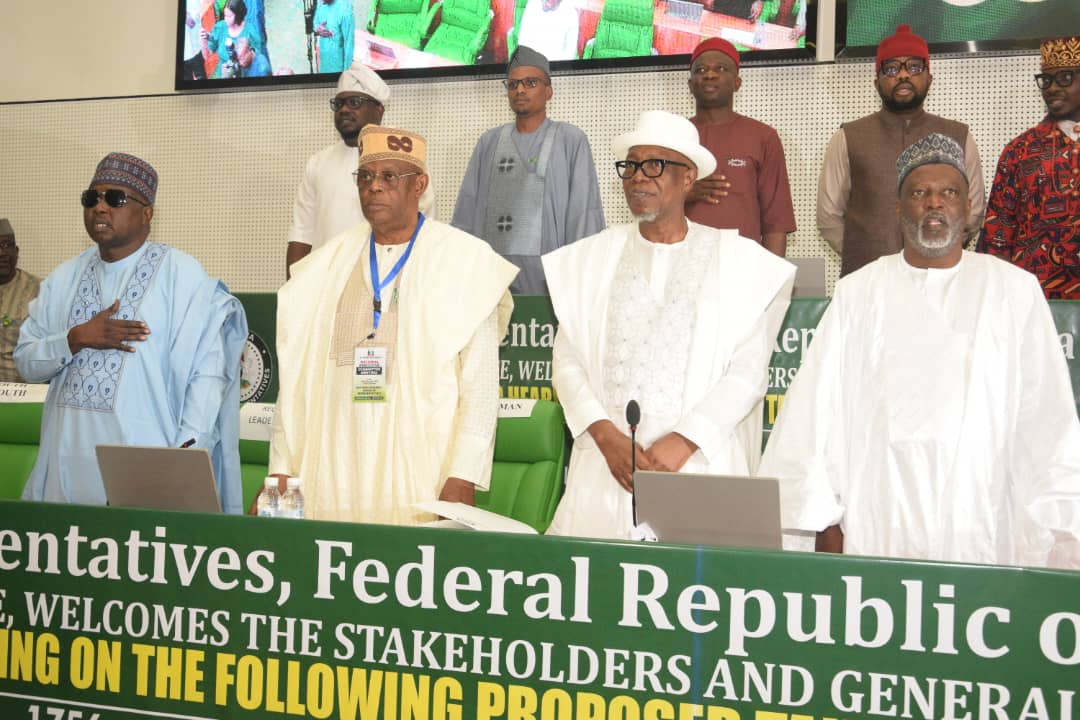
The Permanent Secretary in the Office of the Secretary to the State Government, Umar Mohammed Jalo, stated the government’s position, at a 3-day public hearing organised by the House of Representatives Committee on Finance on Wednesday in Abuja.

Jalo urged the House Committee to amend the bill by eliminating provisions that place it above other laws.

On the proposed reduction in the funding of key national agencies, like the Tertiary Education Trust Fund (TETFUND), Nigeria Information Development Agency (NITDA), and National Agency for Science and Engineering Infrastructure (NASENI), that are critical to the nation’s education, technology, and engineering sectors.

Advertisement
He said :”This clause is objectionable as it grants this bill a constitutional status similar to military rule, which cannot withstand the scrutiny of constitutional validity. The supremacy provision should be deleted.
“These provisions are substantially in breach of the Constitution of the Federal Republic of Nigeria, 1999, as the National Assembly lacks the competence to legislate on matters exclusively affecting state and local governments.
“Reducing funding to these strategic agencies will affect national interests in education, engineering, and information technology in adverse ways. TETFUND, NITDA and NASENI should continue to be funded to support the nation’s aspirations for technological advancement, prosperity, and sustainable development.”

Jalo also also expressed concerns over the planned increase in Value-Added Tax (VAT) from 7.5% to 15% by 2030, warning that such a move would worsen the hardship faced by Nigerians amid the rising cost of living. The government cautioned that higher VAT rates would further strain households and deepen economic difficulties.

As an alternative, the Kano State Government advocated for improved tax collection mechanisms rather than raising VAT.

“There is significant potential to enhance tax coverage and collection efficiency, as weak compliance remains a major challenge,” he noted.

While supporting the need for fiscal reforms, the government emphasized key concerns regarding the Federal Government’s ongoing tax restructuring. It also underscored the urgency of expanding Nigeria’s revenue base, stating that current public earnings—around 10% of GDP—are inadequate to meet the country’s growing development needs.
Advertisement
“The fiscal space needs to be enlarged,” the government noted. “Public revenues at approximately 10% of GDP are currently too small relative to the daunting challenges of development.
“A more auspicious fiscal space will provide tremendous opportunities for the governors to deliver on their promises, including achieving the Sustainable Development Goals (SDGs), reducing poverty, and rebuilding infrastructure for growth, wealth, and job creation.”
The Kano government welcomed the Federal Government’s efforts to reform the tax system, which they described as “long overdue,” and acknowledged that the current tax regime is overly complex and riddled with inefficiencies. “Despite past reforms, tax administration remains weak and plagued by inefficiency, poor governance, and corruption. Tax avoidance and evasion are prevalent and must be addressed.”
The state further praised the proposed harmonization of Nigeria’s multiple tax laws, stating, “Harmonisation will enhance clarity, compliance, and administrative efficiency. It will also ensure legislative cohesion and policy coherence.”
However, the government expressed strong reservations about the manner in which the reforms were being rushed through the National Assembly without sufficient stakeholder consultation. “The bills were apparently introduced with the utmost haste and without exhaustive stakeholder engagement,” the government stated.
“For any reform to be successful, social dialogue and effective communication are critical. The federal government should learn to consult more, to harvest ideas and diverse perspectives from its citizens.”
Kano also criticised the federal government’s failure to adequately communicate the potential benefits and costs of the reforms, and the vilification of Northern governors who opposed certain provisions of the bills.
“Northern State Governors who voiced their opposition to certain provisions of the bills were vilified and accused of ‘backward thinking’ and ‘parasitism.’ Citizens’ opposition to reforms must be addressed with civility, tact and diplomacy.”
The  Comptroller General of the Nigeria Customs Service, Adewale Adeniyi in his submission on the bill, said its purpose  was to make Nigeria more business-friendly and competitive but raised concerns about potential jurisdictional conflicts.
The Customs Boss argued that while tax is a vital revenue-generating tool, customs duties go beyond fiscal policy to promote industrialization, prevent environmental pollution, and uphold public health.
He said :”Our concerns are laid out in a 17-page document, but key areas of conflict include Section 23, 29, and 41A of the Joint Revenue Bill,” said the representative. They pointed out that Section 162 of the bill essentially “legislates the Nigerian Customs Service out of existence.
“The UK experience is instructive,” the representative continued, referencing the 2005 merger of customs and tax functions in the UK, which was later reversed due to operational inefficiencies. “In 2012, the UK separated border control functions, acknowledging the distinct nature of customs operations.”
He cited examples from African countries like Uganda and Ghana, where customs and tax authority integration initially resulted in higher tax-to-GDP ratios but later caused inefficiencies and operational complexities.
“With success stories like Morocco’s customs modernization, which increased revenue by 37% and reduced clearance times by 65%, Nigeria’s Customs Service argued for preserving its autonomy. In fact, the NCS noted that since the enactment of the NCS Act in 2023, Nigerian customs revenue had surged by 92%, and trade facilitation had markedly improved.
“We should encourage collaboration between customs and tax authorities, not abolish customs or repeal an existing law”, Adeniyi added.
The Secretary General, of the Trade Union Congress, Comrade Nuhu Toro speaking rejected the gradual increase of Value Added Tax.
He said : “The gradual increment of VAT from the current 7.5% to 15%. Mr. Chairman and respected members, the TUC unequivocally rejects this proposition.
“Our reason is simple, allowing the VAT rate to remain at 7.5% is in the best interest of the nation. Increasing it would place an additional burden on Nigerians, many of whom are already struggling with their economic challenges and realities.
“At a time when inflation is on the rise, and unemployment is becoming an ever-growing concern, higher taxes will only further strain households and businesses alike. We must be mindful, Mr. Chairman, that such measures could slow down the economy.
Speaking for the Nigeria Liquified Natural Gas (NLNG), Manager Tax and Financial Systems, Clement Okoro Efeyita, said the organisation fully support the bill, and it will be of great benefit for the committee to consider making exports from Nigeria to be zero-rated on VAT.
According to Efeyita, “That way, exporters from Nigeria will be competitive globally. Another issue is we are of the view that agreements, contracts, that are already subject to the value-added tax rules should not be subject to value-added tax.
“In a way, it creates a form of double taxation if this area is not looked into. Mr. Chairman, we also would like to advocate with regards to the currently subsisting executive orders.
“Our view on it is simple. Most of the executive orders are tied to laws that will be repealed by the time the current bill is passed into law. Our view, which we seek for this committee to take into account, is to ensure that the provisions in those executive orders are fully reflected in the Nigerian tax field.
“That way, it will take away all forms of undignity. And it will also not create a situation where investors’ confidence in the country is in any way dampened”.
Still on the Nigerian tax bill Efeyita added: “It is with regards to the far out claim of capital arms. And our advocacy is very simple. Paragraph 21, subparagraph 1 of the first schedule of the Nigerian tax bill.
Our advocacy point is very simple and straightforward. We would like the bill, as currently drafted, to give full powers to taxpayers to be able to determine how they claim capital arms. Doing so will not in any way shortchange the government.
“But rather it will create a situation where the government is able to receive, in good time, taxes that are due. So our advocacy point is one of this.
“We would also like to draw your attention to the fact that by the time the Nigerian tax bill is passed into law, the Company Income Tax Act, among several other acts, will immediately be repealed.
“Mr. Chairman, I would like to draw your attention to section 23, subsection 1 of the Company Income Tax Act. And to mention that this particular provision has not been reflected in the Nigerian tax bill. And this provision, essentially, is one that will truly benefit the Nigerian state.
“It is a provision that grants a tax waiver to companies that bring in income they’ve earned abroad. Income types such as royalty, interest, and dividend. At this critical time of our economy, when we need foreign exchange inflow, should not be the time for such a critical provision that encourages taxpayers to bring in foreign currency they’ve earned abroad to be taken out of the proposed bill.
“But not to forget the fact that going to the Nigerian Tax Administration Bill at this point in time, there is also the new provision that will be found in section 12 and section 49 of the Nigerian Tax Administration Bill. There is a new provision that seeks to subject companies that produce LNG to a tax regime similar to what is obtainable upstream.
“Our point of advocacy is simple. A situation where the majority of companies that are subject to tax under the current company income tax regime are not equally being made to pay tax instrumentally over a 12-month period creates a kind of, permit my language, discrimination. It does not bring about equity and fairness.
“We are clearly advocating that all companies that are subject to the current company income tax act at 30% as is being reflected in the Nigerian Tax Bill correctly, should be made to pay taxes in similar manner. Mr. Chairman, committee members, these are the high points of restricting the macroeconomic standards of our nation. These laws, with their challenge, improve on the objectives as set out in section 16 of the 1999 Constitution as amended”, NLNG stated.

News

Youths Flood Ondo City to Honour Akinlaja’s Birthday, Hail Him as Visionary Leader and True Democrat

Published

on

ADVERTISEMENT
Zoom Ad
ADVERTISEMENT
Zoom Ad

By Kayode Sanni-Arewa

Ondo City came alive on Monday, June 1, 2026, as a sea of jubilant youths converged on Adoc Events Centre and the residence of Hon. Joseph Iranola Akinlaja, former representative of Ondo East and West Federal Constituency, to celebrate his birthday.

Under the banner of the End Miscreants Movement, the gathering was more than a festivity—it was a tribute to Akinlaja’s enduring legacy and his contributions to the socio-economic growth of Ondo.

The youths described the septuagenarian and former General Secretary of NUPENG as a peace-loving icon, a consummate democrat, and a leader committed to youth empowerment, human capital development, and sustainable innovation.

Advertisement

They emphasized that the “End Miscreants Movement” reflects Akinlaja’s role as a stabilizing force whose interventions have curbed cultism, violent clashes, land grabbing, and other social vices in the community.

The event drew prominent figures, including former Governor Dr. Olusegun Mimiko, who praised Akinlaja as a symbol of peace, unity, and progress. Mimiko lauded his maturity and sacrifice in advancing excellence.

Other dignitaries present were Speaker of the Ondo State House of Assembly Rt. Hon. Olamide Adesanmi Oladiji, Hon. Biola Makinde, Hon. Moyinoluwa Ogunwunmiju, and Hon. Abiola Oladapo, Akin Akinbobola, Eni Akinshola, editor in chief and publisher of Veracity Desk (veracitydesk.com), Emmanuel Ajibulu etc, all of whom extolled Akinlaja’s virtues.

The Chairman of Lagos Zone of Petroleum Tanker Drivers (PTD) Branch of NUPENG, Comrade Gbolahan Saheed Adigun who was unavoidably absent was represented by Israel Okougbo, Comrade Samuel Owolabi, Adekunle Akinlaja and Comrade Timothy Iseoluwa.

Advertisement

The atmosphere was electrified by live music from five different professional musicians, with youths chanting solidarity slogans and dancing in contagious but peaceful jubilation.

In his remarks, Akinlaja thanked the youths for their support, urging them to prepare for a prosperous future. He highlighted the achievements of Dr. Mimiko (fondly called Iroko), noting his enduring legacies in governance and innovation.

“Our youths must remain steadfast as ambassadors of excellence, shaping a brighter future for Nigeria,” Akinlaja declared, challenging them to actively participate in the electoral process to ensure credible and peaceful elections.

Speaking on behalf of the youths, Aseyege Ayoola, popularly known as Spender, hailed Akinlaja as a unifying figure whose temperament and experience are vital for Nigeria’s progress.

Advertisement

He commended fellow youths for making the event successful and acknowledged contributors such as Kayode Folajogun, Adijath Wonuola, Akin Fadayomi, Lawrence Adefolaju, Lukas Famakinwa, and Akinpelumi.

Continue Reading

News

Fire security chiefs if insecurity persists in next 90 days– Adeboye urges FG

Published

on

ADVERTISEMENT
Zoom Ad
ADVERTISEMENT
Zoom Ad

The General Overseer of the Redeemed Christian Church of God, Pastor Enoch Adeboye, has advised the federal government to give Nigeria’s security chiefs a 90-day deadline to eliminate terrorists across the country or resign from office.

Adeboye made the call in a video shared on X on Tuesday where he expressed concern over the country’s security situation and urged authorities to act swiftly against those responsible for the violence.

Addressing the government, the cleric said security chiefs should be held accountable for delivering results in the fight against terrorism.

“If I were asked to make suggestions, I would say quietly to our government, ‘Move fast and tell our security chiefs, get rid of these terrorists within 90 days or resign,” he said.

Advertisement

The cleric also called on the government to go beyond targeting terrorists and focus on those financing and supporting their activities.

“When giving orders to the service chiefs this time around, we should make it clear to them that they are not only to eliminate the terrorists; they should eliminate their sponsors, no matter how influential they may be,” he added.

Adeboye recalled advising a former Nigerian president to issue a similar ultimatum to security chiefs in the past, noting that although the directive was given, it was not fully enforced when the deadline elapsed.

According to him, the experience underscored the need for stronger political will and strict enforcement of directives aimed at ending insecurity.

Advertisement

The cleric’s remarks come amid renewed concerns over terrorist attacks, banditry and kidnappings in several parts of the country, with calls mounting for more decisive measures to tackle the security challenges.

Continue Reading

News

Reps Demand Swift Action Over Abduction of 42 Pupils in Borno

Published

on

ADVERTISEMENT
Zoom Ad
ADVERTISEMENT
Zoom Ad

…seek tougher protection measures for schools in high-risk communities

By Gloria Ikibah

The House of Representatives has called for the immediate rescue of 42 schoolchildren abducted from Mussa Ward in Askira-Uba Local Government Area of Borno State, as lawmakers renewed demands for stronger security around schools across Nigeria.

The resolution was sequel to the adoption of a Motion of Urgent Public Importance sponsored by Rep. Midala Balami during Tuesday’s plenary session.

Advertisement

Debating the motion, Rep. Balami described the abduction as a disturbing reminder of the persistent insecurity confronting communities in Borno State and other parts of the country. He emphasised that safeguarding students, teachers and educational institutions remains a core responsibility of government and warned that repeated attacks on schools continue to threaten access to education and undermine public confidence in security efforts.

The lawmaker recalled a series of high-profile abductions in the state, including the Chibok schoolgirls kidnapping, in which many of the victims are yet to be reunited with their families. He also referenced the mass abduction of more than 400 adults and children from Ngoshe, as well as several kidnappings reported along the Biu-Buratai Road and surrounding communities.

According to Balami, the recurring attacks have left families traumatised, disrupted livelihoods and contributed to declining school enrolment and attendance in vulnerable areas, as many parents fear for the safety of their children.

He argued that urgent and coordinated action is needed to secure the release of those still in captivity, restore public confidence and reassure communities that their safety remains a priority.

Advertisement

The lawmaker also noted growing frustration among residents who increasingly expect concrete results in the fight against insecurity rather than repeated promises.

Following deliberations, the House urged the Federal Government and security agencies to intensify efforts to rescue the 42 abducted pupils and all other victims currently being held by kidnappers or insurgents, with a view to reuniting them with their families as quickly as possible.

Lawmakers further called for enhanced protection of schools in Borno State and other vulnerable regions through increased deployment of security personnel, improved intelligence gathering and more effective rapid-response mechanisms.

The House maintained that ensuring the safety of children and protecting access to education must remain a national priority, particularly in communities that continue to face threats from criminal and insurgent groups.

Advertisement

In addition, the House encouraged the expansion of school protection initiatives, including early warning systems, community-based security arrangements, security awareness programmes and improved surveillance infrastructure around educational institutions.

The House further mandated its Committees on National Security, Defence, Basic Education and Legislative Compliance to engage with relevant security agencies and report back on measures being taken to secure the release of abductees and improve security around schools nationwide.

Lawmakers also urged the Federal Government to develop and implement a comprehensive Safe Schools Security Framework aimed at protecting students, teachers and educational institutions from future attacks.

Advertisement
Continue Reading

Trending

Copyright © 2024 Naija Blitz News