Entertainment
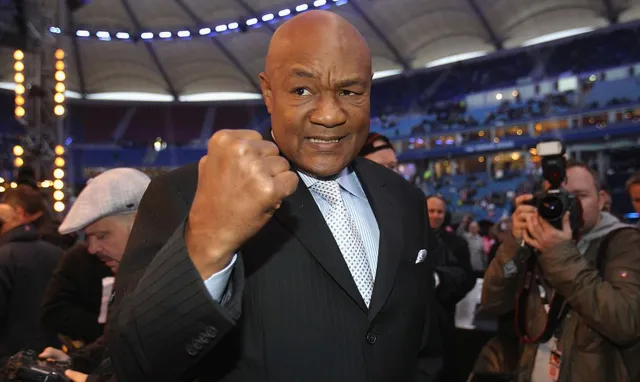
George Foreman: Life and times of true Heavyweight boxing legend
- /home/naijuinz/public_html/wp-content/plugins/mvp-social-buttons/mvp-social-buttons.php on line 27
https://naijablitznews.com/wp-content/uploads/2025/03/934075f0-06c3-11f0-88b7-5556e7b55c5e.jpg.webp&description=George Foreman: Life and times of true Heavyweight boxing legend', 'pinterestShare', 'width=750,height=350'); return false;" title="Pin This Post">
- Share
- Tweet /home/naijuinz/public_html/wp-content/plugins/mvp-social-buttons/mvp-social-buttons.php on line 72
https://naijablitznews.com/wp-content/uploads/2025/03/934075f0-06c3-11f0-88b7-5556e7b55c5e.jpg.webp&description=George Foreman: Life and times of true Heavyweight boxing legend', 'pinterestShare', 'width=750,height=350'); return false;" title="Pin This Post">
George Foreman, the two-time world heavyweight champion whose remarkable career saw him go from feared knockout artist to beloved elder statesman of boxing, has died at the age of 76.

He passed on almost nine years after Muhammad Ali died in 2016.
A ferocious puncher in his youth, Foreman is best remembered for his legendary 1974 showdown with Muhammad Ali in the Rumble in the Jungle, in which he suffered his first professional defeat. He would later stage one of the most extraordinary sporting comebacks of all time, returning to the ring a decade after retiring and reclaiming the world title at the age of 45 – becoming the oldest heavyweight champion in history.

Outside the ring, Foreman achieved global fame as the face of the George Foreman Grill, which sold over 100 million units and transformed him into one of the wealthiest ex-athletes of all time.
George Edward Foreman was born on 10 January 1949 in Marshall, Texas, and grew up in Houston’s tough Fifth Ward. By his own admission, he was a troubled child who dropped out of school at 15 and engaged in petty crime before seeking work as a carpenter and bricklayer. His life changed when he discovered boxing at 16, joining the Job Corps, a US government programme that helped young people learn trades.
A quick learner with natural power, Foreman rose rapidly through the amateur ranks and won a gold medal at the 1968 Olympics in Mexico City, stopping Soviet fighter Jonas Čepulis in the second round. Celebrating his victory, he famously waved a small American flag in the ring, a gesture that divided opinion during a time of political turbulence in the US.
Foreman turned professional in 1969, quickly establishing himself as a wrecking ball of a fighter. He ploughed through the heavyweight division with a series of brutal knockouts, setting up a title fight with undefeated champion Joe Frazier in 1973. Foreman was the underdog, but he stunned the world by demolishing Frazier, knocking him down six times in two rounds before the referee waved it off. “Down goes Frazier! Down goes Frazier!” roared commentator Howard Cosell in one of the most famous calls in boxing history.
Foreman defended his title twice before facing Ali in The Rumble in the Jungle in Kinshasa, Zaire (now the Democratic Republic of Congo) in October 1974. Widely expected to overpower Ali, Foreman instead fell victim to his opponent’s now-legendary ‘rope-a-dope’ tactic. Ali absorbed Foreman’s early onslaught, allowing the younger man to punch himself out, before stopping him in the eighth round.
It was a defining moment in boxing history – Foreman, the unstoppable force, brought down by Ali’s intelligence, resilience, and psychological warfare. The defeat devastated Foreman, who later admitted it left him questioning everything he believed about himself.
Boxing Rumble in the Jungle Anniversary
open image in gallery
Boxing Rumble in the Jungle Anniversary (AP1974)
Foreman fought five more times, including a second knockout of Frazier, but suffered another loss to Jimmy Young in 1977. After the fight, he claimed to have had a near-death religious experience in his dressing room, which led him to retire and become an ordained minister.
For a decade, Foreman was absent from boxing, instead preaching, working with troubled youths, and struggling financially. But in 1987, at the age of 38, he shocked the sporting world by announcing his return to the ring. Overweight and with a more jovial persona than in his first career, many assumed he would be a mere sideshow. Instead, he proved he was still a force to be reckoned with, racking up 24 straight wins – including 23 knockouts – to earn a shot at the heavyweight title.
In 1991, he challenged undisputed champion Evander Holyfield in a valiant effort, losing on points but gaining widespread admiration for his heart and toughness. He lost another title fight to Tommy Morrison in 1993, but his dream of reclaiming the belt was not over yet.
In November 1994, at the age of 45, Foreman stepped into the ring against reigning WBA and IBF champion Michael Moorer in Las Vegas. Outboxed for most of the fight, he landed a single thunderous right hand in the tenth round to knock out Moorer and reclaim the world title.
Former world heavyweight champions (left to right) Joe Frazier, Ali and George Foreman, pictured in October 1989 (PA)
Former world heavyweight champions (left to right) Joe Frazier, Ali and George Foreman, pictured in October 1989 (PA) (PA Archive)
Wearing the same trunks he had worn against Ali 20 years earlier, Foreman slumped to his knees in prayer as the arena erupted. It was a moment of redemption and history in equal measure – he had become the oldest world heavyweight champion ever.
Foreman defended the title three times before losing a controversial decision to Shannon Briggs in 1997, after which he finally retired for good. His record stood at 76 wins (68 by knockout) and five defeats.
For all his success in the ring, it was the George Foreman Grill that made him a fortune. The electric grill, designed by Michael Boehm and Robert Johnson, was launched in 1994 with Foreman as its spokesman. His affable persona and enthusiastic promotion turned it into a household staple, selling over 100 million units worldwide.
Although the exact amount he earned is unknown, Foreman reportedly received $138 million in 1999 from manufacturer Salton for the right to use his name, on top of a lucrative share of profits that once netted him an estimated $4.5 million per month.
Foreman after knocking down Michael Moorer in their fight in 1994
open image in gallery
Foreman after knocking down Michael Moorer in their fight in 1994 (Getty Images)
Foreman was married five times, most recently to Mary Joan Martelly, whom he wed in 1985. He had 12 children, including five sons all named George. “I say to them, ‘If one of us goes up, then we all go up together, and if one goes down, we all go down together!’” he once said.
His daughter Freeda Foreman followed him into boxing, compiling a 5-1 professional record before retiring in 2001. She died in 2019 at the age of 42.
Foreman’s life was a story of transformation – from feared knockout artist to preacher, from punchline to champion, and from retired athlete to business mogul. His journey captivated fans around the world, and his impact on boxing and beyond remains unparalleled.
He leaves behind a towering legacy in sport, business, and popular culture – a true heavyweight in every sense.

Entertainment
Sad! American Jazz Singer Cassandra Wilson Dies At 70
Grammy Award-winning American jazz singer Cassandra Wilson died on Wednesday in her hometown of Jackson, Mississippi, her manager said. She was 70.
“Cassandra Wilson transitioned peacefully at home, surrounded by family, close friends, and her manager,” Robert Torre wrote in a statement, hailing her as a “legendary jazz artist.”
The statement did not disclose a cause of death. Wilson’s family and close friends asked for privacy, Torre said.
A singer-songwriter and producer, Wilson was celebrated for her rich, expressive contralto voice in a career spanning three decades.
In 1997, the singer received the Grammy for Best Jazz Vocal Performance with “New Moon Daughter,” and “Loverly” won the award for Best Jazz Vocal Album in 2009.
Four Wedding Guests Killed, 50 Wounded In Fresh US Attacks Against Iran›
Oil Price Jumps As Iran Retaliates Against Latest US Attacks›
Wilson performed in a leading role in “Blood on the Fields,” a 1997 oratorio by Wynton Marsalis which became the first jazz work to win a Pulitzer Prize.
She also collaborated with saxophonists Steve Coleman, Greg Osby and hip-hop group The Roots.
“I learned so much from her, and I am so sad she has passed away,” musician Jon Batiste wrote in a tribute on social media.
“She had an unmistakable vocal tone, phrasing, and her approach of weaving folkloric, R&B, and diasporic music together with experimental and popular genres had a major impact on me.
“She sounded like the South.”
AFP
Entertainment
Angry Davido Blasts Erigga Over Family Wealth Debate
Afrobeats superstar David Adeleke, popularly known as Davido, has taken a Nigerian rapper Erhiga Agarivbie, better known as Erigga, to the dustbin following a disagreement over whether musicians from wealthy backgrounds deserve recognition for their success.
The exchange began after Erigga took to X to celebrate artistes who did not come from privileged families and had to build their careers without financial support from their parents.
The rapper wrote: “Shoutout to all the musicians who don’t come from family money and had to grind for every single dollar they earn.”
His post quickly attracted Davido’s attention, with the Afrobeats star challenging the idea that musicians from wealthy families should receive less recognition simply because they had financial support while growing up.
Davido argued that having wealthy parents does not automatically eliminate the hard work, talent and determination required to establish a successful career in the highly competitive entertainment industry.
The singer, who himself comes from a wealthy Nigerian family, appeared to take the post personally and responded with a strongly worded message.
He wrote: “No be we say make your pops no guard o. Shoutout to the ones that came from family money and still grind to the top. Comot here with that your useless motivation … imbecile.
“No worry o, I go soon leave their music for una. GO MAKE MY BILLIONS … then that shit gonna be boring AF. Deep down who like poverty? Nonsense.”
Davido’s response reflects a long-running debate within the entertainment industry about privilege, parental wealth and the extent to which an artiste’s background contributes to their success.
While some believe musicians who emerge from humble backgrounds deserve special recognition for overcoming financial challenges, others argue that coming from a wealthy family should not invalidate an artiste’s achievements.
Davido has frequently spoken about his privileged upbringing while also maintaining that he has worked to establish his own identity and career in the global music industry.
The singer’s latest reaction has consequently reignited discussions about the role of family wealth in the Nigerian entertainment industry, with fans and social media users expected to take sides over the exchange.
Social Media Debate Intensifies
The disagreement between the two artistes has generated attention because of the contrasting perspectives expressed by both musicians.
Erigga’s original message appeared to celebrate artistes who had to struggle financially before achieving success, bb while Davido interpreted it as an unnecessary attempt to diminish musicians who had the advantage of coming from wealthy families.
At the centre of the argument is whether an artiste’s background should influence how their achievements are judged.
The exchange has also revived broader conversations about privilege in Nigeria, where access to family resources, education, connections and financial support can significantly influence opportunities available to young people.
Despite their disagreement, neither artiste indicated that the exchange would develop into a broader personal conflict. However, Davido’s strongly worded response has already generated considerable discussion among music fans and social media users.
Entertainment
Headies dismiss claims of sidelining gospel artistes
Organisers of The Headies have refuted allegations that gospel and inspirational musicians are excluded from the award’s major categories.
In a statement released on Monday via its official Instagram page, the organisers said the claim does not reflect the award’s history.
They cited previous winners such as Lara George, Kefee, Nikki Laoye and Timi Dakolo as gospel artistes who have won mainstream honours at The Headies.
The statement also noted that the Inspirational Single category was created to recognise songs that promote faith, hope and positive values.
The clarification followed an open letter from Afrogospel artiste Gaise Baba, who raised concerns about the treatment of gospel music at the awards.
Gaise Baba argued that songs should be judged on quality, sound and impact, rather than the message in the lyrics.
“A rap record is a rap record,” he wrote in part.
The singer further questioned whether commercially successful gospel songs like ‘Favour’ and his collaboration with Lawrence Oyor, ‘No Turning Back II’, receive the same consideration as mainstream Nigerian songs.
Gaise Baba also recalled his experience as a nominee, stating that the Inspirational Music category was not presented during the main ceremony at one edition.
He said nominees commit time and resources to the process and deserve proper recognition.
-
Foreign18 hours agoI’ve Come To My Senses – Katie Price Ends Marriage After Discovering Husband’s Crypto Wallet Had Just £2.22 And Not £37million He Had Claimed
-
News18 hours ago‘I’ve been unable to access my salary for two years’ – Police corporal tenders resignation
-
Metro18 hours agoBandits impose N40m levy on Sokoto community, threaten attack
-
Economy18 hours agoSee Photos As US Releases $1 Coins Featuring President Trump
-
Economy18 hours agoIran’s Currency Crashes Past 2.2 Million Against one Dollar as Military Strikes Intensify
-
News24 hours agoFake Agency: Reps Trace 58 Bank Accounts, 12 Entities to Adeyemi Over Alleged PFIPC
-
News18 hours agoHardship: Tinubu Feels your Pain, APC Gov tells Nigerians
-
Foreign18 hours agoLike Mother, Like Daughter? Brigitte Macron’s 42-Year-Old Daughter Dating 22-Year-Old Man

Warning: Undefined variable $user_ID in /home/naijuinz/public_html/wp-content/themes/zox-news/comments.php on line 49
You must be logged in to post a comment Login