Connect with us

News

Tinubu Urges Robust Legal Framework for Enhanced Security Agency Collaboration

Published

on

ADVERTISEMENT
Zoom Ad
ADVERTISEMENT
Zoom Ad

…as Speaker Abbas want urgent review of existing laws

By Gloria Ikibah

Nigeria’s President Bola Tinubu has called for a robust legal framework to enhance collaboration and intelligence sharing among security agencies.

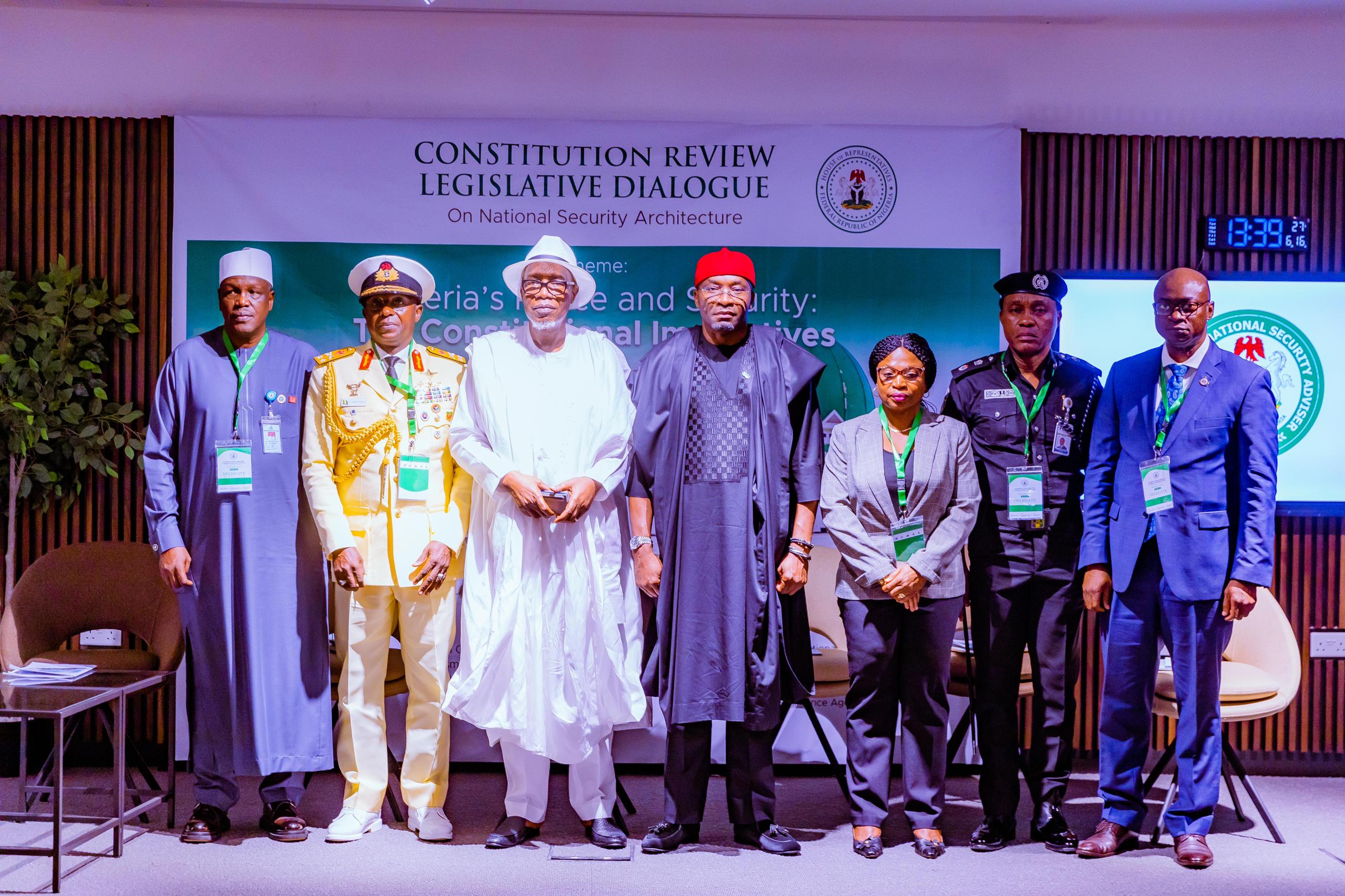
President Tinubu stated this at a one-day Legislative Dialogue on Constitutional Review and National Security Architecture, organized by the House of Representatives Committee on Constitution Review in collaboration with the Office of the National Security Adviser, on Monday in Abuja.

Advertisement

Represented by the Minister of Defence, Mohammed Badaru Abubakar, the President emphasised the need for a multi-pronged approach to tackling Nigeria’s evolving security challenges.

According to him, it is time to align Nigeria’s security framework with present-day realities, warning that neither full centralization nor outright fragmentation can sufficiently guarantee the nation’s safety.
He said: “The growing calls for state police, the challenges of cybercrime and cybersecurity, and the urgent need for improved intelligence sharing demand a more adaptive and cooperative security architecture”.
The President drew attention to various threats from terrorism in the Northeast and banditry in the Northwest, to farmer-herder clashes in the Middle Belt and separatist agitations in the Southeast—as issues that transcend the capacity of any single agency.
According to him, the government’s integrated security strategy characterized by intelligence fusion, joint task force operations, and synchronized offensives—has yielded significant results, including the dismantling of separatist cells in the Southeast and the disruption of criminal networks in the Northwest.
“These efforts have led to a reduction in high-profile kidnappings and improved responses to cross-border threats, demonstrating the effectiveness of a whole-of-government strategy,” he said.
The President also cited strides under the Renewed Hope Agenda, including the establishment of the National Safe Schools Response Coordination Centre, the procurement of surveillance drones and mine-resistant vehicles, and the adoption of a community policing framework to foster public trust.
He further emphasised the importance of addressing Nigeria’s porous borders, advocating for constitutional clarity on federal and sub-national roles in frontier security.
Earlier in his remarks, Speaker Tajudeen Abbas said the dialogue was timely, given the urgent need to review and update existing laws to address current and emerging security threats.
He said Nigeria’s complex security landscape demands strategies that are “multi-dimensional, inclusive, technology-driven, and adaptable,” anchored in a solid legal and institutional framework.
“The goal is to reposition the security architecture to effectively confront insecurity. This dialogue also allows us to refine proposed security-related bills, including the one seeking to establish state police,” Abbas said.
He highlighted the prevalence of terrorism, banditry, piracy, militancy, and oil theft across regions, stressing that the House is committed to taking practical legislative steps beyond motions and bills to support the government’s anti-insecurity efforts.
The Deputy Speaker and Chairman of the Constitution Review Committee, Rep. Benjamin Kalu, described the dialogue as a necessary diagnostic process.
He said previous legislation on security was often developed without adequate input from those directly involved in frontline operations.
“As legislators, we must base our reforms on accurate diagnoses. We are here to listen to those who wear the shoes and know where it pinches,” Kalu said.
Also speaking, Chief of Defence Staff, Gen. Christopher Musa, also called for urgent legal and constitutional reforms to address emerging threats like cyber warfare, hybrid threats, and insurgency.
Musa described the current legal framework as increasingly inadequate and highlighted operational ambiguities such as unclear command authority and detention procedures that hamper effectiveness during internal operations.
He proposed key reforms including: Amending the Armed Forces Act and relevant constitutional provisions;
Establishing field and standing court martials in all military commands;
Constitutionally recognizing court-martial as superior courts of record;
Empowering the military to investigate and detain suspects during internal operations; Authorizing the Nigerian Navy to collaborate with Customs and Immigration on inland waterways to combat piracy and smuggling;
Introducing a merit-based nomination process for the appointment of service chiefs.
He also advocated for legal provisions to enable court-martials to try individuals captured in acts of terrorism or insurrection under martial law conditions.
“Security is not just about military hardware; it’s about legal clarity, institutional strength, and public trust,” Gen. Musa stated.
National Security Adviser, Nuhu Ribadu, said security and constitutional order are deeply intertwined.
Ribadu, represented by the National Coordinator, National Centre for Anti-Counter Terrorism, Maj.Gen Adamu Laka, emphasized that a responsive, inclusive, and forward-looking constitution is essential for fostering national unity and addressing the root causes of insecurity.
“The Constitution must evolve to reflect the hopes and challenges of Nigerians. Addressing grievances, protecting rights, and fostering trust between citizens and the state are all constitutional imperatives,” Ribadu said.
He commended the National Assembly for initiating the dialogue and called for constitutional reforms that decentralize service delivery, strengthen institutions, and promote more effective governance.
“As we deliberate today, let us remember that constitutional reform is not just about structure—it’s about the survival, stability, and sovereignty of our Republic,” he added.
Continue Reading
Advertisement
Click to comment

Warning: Undefined variable $user_ID in /home/naijuinz/public_html/wp-content/themes/zox-news/comments.php on line 49

You must be logged in to post a comment Login

Leave a Reply

News

EU Denies Rejecting 2027 Nigeria Polls, Confirms Electoral Expert Mission

Published

on

ADVERTISEMENT
Zoom Ad
ADVERTISEMENT
Zoom Ad

…as Ambassador Mignot say reports citing insecurity and hostility towards EU observers as reasons are “pure speculations”

By Gloria Ikibah

The European Union (EU) Delegation to Nigeria and ECOWAS has dismissed reports that it rejected an invitation from the Independent National Electoral Commission (INEC) to observe Nigeria’s 2027 general elections, describing the reports as inaccurate and speculative.

The EU Ambassador to Nigeria and ECOWAS, Gautier Mignot, said the delegation had accepted an invitation from INEC and will deploy an Electoral Expert Mission (EEM) comprising between two and four independent experts to the country for the elections.

Advertisement

Mignot, in a statement issued in Abuja on Monday, said the EU received a formal invitation from INEC dated April 17, 2026, to deploy observers for the 2027 general elections.

He explained that the EU responded to the invitation on July 28, thanking INEC and confirming its decision to send an Electoral Expert Mission.

The clarification followed reports claiming that the EU had declined INEC’s invitation because of the deteriorating security situation in the country and alleged hostile treatment of its observers and officials following the publication of its final report on the 2023 general election.

Mignot, however, said neither of the reasons cited in the reports was contained in the EU’s response to INEC.

Advertisement

“The EU Delegation further underlines that the two alleged reasons mentioned in the press reports do not appear in the letter: these are pure speculations,” he said.

The ambassador explained that the EU’s Electoral Expert Mission will be formally accredited as observers by INEC and will assess the electoral process against Nigeria’s international, regional and national obligations relating to democratic elections.

“An EEM, like an Electoral Observation Mission, assesses whether the electoral process is conducted in line with international, regional and national obligations and commitments on the conduct of democratic elections to which the country has subscribed,” Mignot added.

He noted that the mission will submit a final report containing recommendations on ways to strengthen Nigeria’s electoral framework and future electoral processes.

Advertisement

“The EEM submits a final report with recommendations on how to improve the electoral framework and future electoral processes, the report will be shared with the government, and if they agree, it can also be released to the wider public,” he said.

Mignot explained that the EU reviews requests from partner countries each year before deciding whether to deploy an electoral mission and determining the appropriate type of mission based on the circumstances of each country and available resources.

He emphasised that the decision to deploy the expert mission will not affect the EU’s wider support for democratic governance and electoral development in Nigeria.

“It is on this basis that the decision to conduct an EEM in Nigeria has been taken and will be further consulted with the relevant Nigerian authorities for its implementation.

Advertisement

“This decision does not affect in any way the continuation of the implementation of the EU-funded project ‘Support to Democratic Governance in Nigeria’ including its dimension of support to the electoral process,” Mignot stated.

The EU envoy also urged journalists and media organisations to verify information concerning the position of the European Union directly with its delegation before publication.

“The EU Delegation respectfully reminds members of the esteemed media community that, to avoid issuing such misleading information about positions or statements of the EU, they can simply check their accuracy with the press and communication office of the EU Delegation,” he said.

The clarification comes as Nigeria’s electoral authorities and political stakeholders intensify preparations for the 2027 general elections, with international partners expected to play a role in supporting democratic governance and electoral processes.

Advertisement
Continue Reading

News

Turn AI Boom Into Solutions, DBI Boss Tells Nigerian Youths

Published

on

ADVERTISEMENT
Zoom Ad
ADVERTISEMENT
Zoom Ad

…urge young innovators to combine digital skills with ethics and responsible technology

By Gloria Ikibah

The President and Chief Executive Officer of Digital Bridge Institute (DBI), David Daser, has charged young Nigerians to seize the opportunities presented by the rapid growth of Artificial Intelligence (AI) to develop technology-based solutions to some of the country’s most pressing challenges.

Daser gave the charge on Monday while delivering a keynote address titled “Future Ready Mind: Artificial Intelligence, Digital Intelligence and Responsible Innovation” at the 2026 Rotary Youth Leadership Academy (RYLA), organised by the Rotary International District 9127, held at the British Nigerian School, Prince and Princess Estate, Abuja.

Advertisement

The DBI boss, who was represented by the Institute’s Head of Learning and Development, Emeka Nzeih, told the young leaders that technical skills alone will not be enough to thrive in an increasingly digital economy.

He urged them to develop what he described as digital intelligence, combining technical knowledge with the ability to understand, assess and responsibly use digital technologies.

“Digital intelligence encompasses not only the ability to use digital tools effectively, but also the capacity to understand, evaluate, and apply digital information in meaningful ways,” he said.

Daser noted that technologies such as AI, Big Data and the Internet of Things (IoT) were already reshaping industries around the world, making digital intelligence increasingly important to innovation, productivity and inclusive economic growth.

Advertisement

He therefore encouraged participants to look beyond seeking jobs and instead consider how technology can be used to solve problems and create opportunities for themselves and others.

Citing Nigerian technology companies such as Moniepoint, Interswitch, Andela, OPay and Flutterwave, Daser said many successful businesses in the country’s technology ecosystem started with simple ideas aimed at addressing specific challenges.

According to him, Nigeria’s large youthful population also provides a substantial market for innovative products and services capable of responding to everyday needs.

He challenged young Nigerians to identify problems around them and explore how technology could provide practical and scalable solutions.

Advertisement

Daser, however, cautioned that the rush to embrace new technologies must not come at the expense of ethics and accountability.

“Digital intelligence is about navigating technology wisely; responsible innovation is about building and deploying technology ethically,” he added.

He urged the young leaders to see themselves not only as technology users but also as ethical innovators whose decisions could affect individuals and society.

Daser challenged participants to ask five questions before launching any new application, idea or digital content: “Who benefits from this solution? Who could be harmed by it? Is it truthful? Is it fair? Would I be comfortable if my name were permanently attached to it?”

Advertisement

He said answering those questions honestly can help young innovators avoid developing technologies that might cause harm, spread misinformation or undermine public trust.

The DBI chief executive also urged the participants to take cybersecurity and online safety seriously, warning that their activities online could have lasting consequences.

He encouraged them to build positive digital footprints, practise responsible digital citizenship and remain conscious of how their use of technology could affect their personal and professional futures.

Daser said the rapid pace of technological change meant young people needed to remain curious, adaptable and willing to continuously learn.

Advertisement

He expressed confidence that Nigerian youths can play a major role in shaping the country’s digital future if they combined innovation with responsibility and a clear understanding of the problems they sought to solve.

The Rotary Youth Leadership Academy is an annual initiative of Rotary International aimed at equipping young people with leadership, innovation and civic responsibility skills to prepare them for meaningful contributions to national development.

Continue Reading

News

Delta Govt Suspends Commissioner For Works(Highway and Urban Roads) Hon.Izeze Indefinitely

Published

on

ADVERTISEMENT
Zoom Ad
ADVERTISEMENT
Zoom Ad


The Delta State Government has announced the indefinite suspension of Hon.Izeze Rume Yakubu Reuben, Commissioner for Works (Highway and Urban Roads) with immediate effect.

According to a statement signed by the Secretary to the State Government (SSG), Dr Kingsley Eze Emu, the suspension is to enable the Security Agencies carry out an unbiased investigation of allegations associating him with the assault on the Senior Special Assistant on Protocol, Mr. Simon Mudi also known as (Temple) at the Petroleum Training Institute(PTI) Effurun,recently.

The statement added that the State Government remains committed to the maintenance of public safety in all circumstances which guarantees law and order and the sanctity of lives.This position is upheld even when institutions of state are involved.

Advertisement
Continue Reading

Trending

Copyright © 2024 Naija Blitz News