
Foreign
Full details of What to know about US strikes on Iran’s nuclear facilities

- /home/naijuinz/public_html/wp-content/plugins/mvp-social-buttons/mvp-social-buttons.php on line 27
https://naijablitznews.com/wp-content/uploads/2025/06/rgrre-1000x600.jpg&description=Full details of What to know about US strikes on Iran’s nuclear facilities', 'pinterestShare', 'width=750,height=350'); return false;" title="Pin This Post">
- Share
- Tweet /home/naijuinz/public_html/wp-content/plugins/mvp-social-buttons/mvp-social-buttons.php on line 72
https://naijablitznews.com/wp-content/uploads/2025/06/rgrre-1000x600.jpg&description=Full details of What to know about US strikes on Iran’s nuclear facilities', 'pinterestShare', 'width=750,height=350'); return false;" title="Pin This Post">


President Donald Trump says the US has carried out a “successful” bombing attack on three nuclear sites in Iran and they have been “obliterated”.
On Sunday, the Pentagon said it will take time to fully assess the effect of the attack though it appears all the sites sustained “extremely severe damage”.
Israel says they were in “full co-ordination” with the US in planning the strikes. Iranian officials have confirmed the facilities were struck but denied it had suffered a major blow.
The strikes mark a significant escalation in the ongoing war between Iran and Israel.
Here’s what we know.
What has the US bombed, and what weapons did it use?
US Gen Dan Caine, chairman of the joint chiefs of staff, said Operation Midnight Hammer involved 125 US military aircraft including seven B-2 stealth bombers.
Three nuclear facilities were targeted – Fordo, Natanz and Isfahan, the US said.
During a Pentagon briefing, Caine said bombers set off from the US on an 18-hour flight, with some heading west into the Pacific as a “decoy”, while the main strike package made up of the seven B-2 bombers proceeded into Iran.
Just before the aircraft entered Iranian airspace, more than two dozen Tomahawk cruise missiles were launched from a US submarine at targets at the Isfahan site, he said.
As the bombers entered Iranian airspace, the US deployed “several deception tactics, including decoys,” with fighter jets clearing the airspace ahead of them, checking for enemy aircraft and surface-to-air missiles, Caine said.
The lead B-2 then dropped two GBU-57 Massive Ordnance Penetrators (MOPs) – also known as “bunker buster” bombs – on the nuclear site at Fordo. Caine said a total of 14 MOPs were dropped on two target areas.
All three Iranian nuclear infrastructure targets were hit between 18:40 Eastern time (23:40 BST) and 19:05 Eastern time (00:05 BST), Caine said.
The bombers then exited Iranian airspace and began their return to the US.
“Iran’s fighters did not fly, and it appears that Iran’s surface-to-air missile systems did not see us,” Caine said.
Speaking at the same briefing, Defence Secretary Pete Hegseth said the operation did not target Iranian troops or the Iranian people.
He added that the mission “was not, and has not been about regime change”.
The defence secretary said he recognised “our allies in Israel” for the support given, adding that the operations took months and weeks of planning.
Hidden away in a remote mountainside, Fordo nuclear site includes a uranium enrichment plant that is vital to Iran’s nuclear ambitions.
Located south of Tehran, it is believed to be deeper underground than the Channel Tunnel connecting the UK and France.
Due to Fordo’s depth below ground only the US has the kind of “bunker buster” bomb big enough to penetrate the site.
It weighs 13,000kg (30,000lb) and is able to drop through about 18m (60ft) of concrete or 61m (200ft) of earth before exploding, according to experts.
Due to the depths of Fordo’s tunnels, the MOP is not guaranteed to be successful, but it is the only bomb that could come close.
Caine confirmed that between the seven B-2 Spirit bombers, 14 MOP bombs were among “75 precision-guided weapons” used in the strikes against Iran.
What is known about the impact of the attacks?
Gen Caine has said it will take some time to fully assess the extent of the damage caused by the US attack.
But, he said, “an initial battle damage assessment indicates that all three sites sustained extremely severe damage and destruction”.
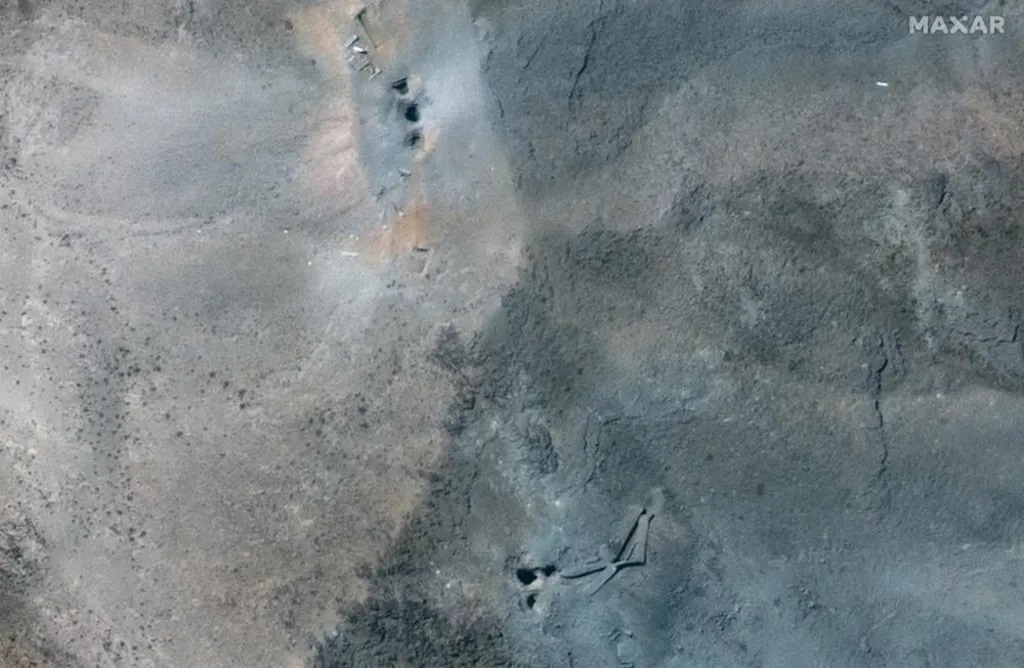
New satellite imagery taken on 22 June shows six fresh craters at the Fordo nuclear site, likely the entry points for US munitions, as well as grey dust and debris scattered down the mountainside.
Following the US’s confirmation that MOPs were used in the attack, senior imagery analyst at McKenzie Intelligence Services, Stu Ray, told BBC Verify: “You will not see a huge blast effect at the entry point as it is not designed to detonate on entry but deeper down into the facility.”
He added that it looks like three separate munitions were dropped on two separate impact points, and that the grey colouration on the ground appears to show concrete debris blown out by the explosions.
Mr Ray also said the tunnel entrances appear to have been blocked off. As there are no visible craters or impact points near them, he suggests this may have been an Iranian attempt to “mitigate against deliberate targeting of the entrances by aerial bombardment”.
The Iranian Atomic Energy Organization said the bombing of the three nuclear sites was a “barbaric violation” of international law.
Both Saudi Arabia and the UN’s nuclear watchdog the International Atomic Energy Agency (IAEA) say there has been no increase in radiation levels after the attack.
The deputy political director of Iran’s state broadcaster, Hassan Abedini, said Iran had evacuated these three nuclear sites a “while ago”. Appearing on state-run TV, he said Iran “didn’t suffer a major blow because the materials had already been taken out”.
How might Iran retaliate?
Within the hours of the US bombing, Iran launched a fresh barrage of missiles which hit parts of Tel Aviv and Haifa. At least 86 people were injured, officials said.
On Sunday, Iranian President Masoud Pezeshkian said the US “must receive a response for their aggression”.
“We have always stated that we are ready to engage and negotiate within the framework of international law, but instead of accepting logic, the other side has demanded the surrender of the Iranian nation,” he said in a statement.
BBC security correspondent Frank Gardner says Iran must now choose between three strategic courses of action in response to the US attack overnight:
Do nothing. This could spare it from further US attacks. It could even choose the diplomatic route and re-join negotiations with the US. But doing nothing makes the Iranian regime look weak, especially after all its warnings of dire repercussions if the US did attack. It may decide the risk of weakening its grip on its population outweighs the cost of further US attacks
Retaliate hard and fast. Iran still has a substantial arsenal of ballistic missiles after manufacturing and hiding these away for years. It has a target list of around 20 US bases to choose from in the broader Middle East. It could also launch “swarm attacks” on US Navy warships using drones and fast torpedo boats
Retaliate later at a time of its own choosing. This would mean waiting until the current tension has subsided and launching a surprise attack when US bases were no longer on maximum alert
What did Donald Trump say and how have US politicians reacted?
Posting on his Truth Social platform at 19:50 Eastern time (00:50 BST), Trump confirmed the strikes on Fordo, Natanz and Isfahan.
Just over two hours later and flanked by Vice-President JD Vance, Secretary of State Marco Rubio and Hegseth, Trump made a televised address.
He said that future attacks would be “far greater” unless Iran reached a diplomatic solution.
“Remember, there are many targets left,” he added.
Trump says Iran must make peace or face future attacks after US strikes
Several of Trump’s fellow Republicans have posted statements in support of the move, including Texas Senator Ted Cruz, who “commended” the president.
Senator Mitch McConnell, an establishment Republican who has occasionally been highly critical of Trump, called it “a prudent response to the warmongers in Tehran”.
Not every Republican was so supportive, with Georgia congresswoman Marjorie Taylor Greene, usually a Trump stalwart, saying “this is not our fight”.
Republican congressman Thomas Massie, who earlier this week introduced a bill that would block Trump from attacking Iran without lawmakers’ approval, took to X to call the strikes “not constitutional”. In a social media post, Trump called Massie a “pathetic loser”.
Article I of the US Constitution places the power to declare war in the hands of Congress, that is, lawmakers elected in the House of Representatives and the Senate.
But Article II states the president is commander in chief of the armed forces and grants him authority to order military force to defend the US against actual or anticipated attacks.
Leading US Democrat Hakeem Jeffries said Trump risked US “entanglement in a potentially disastrous war in the Middle East”, while others accused him of bypassing Congress to launch a new war.
How have world leaders reacted?
The UK, France and Germany have called on Iran to avoid taking any action that could further “destabilise” the Middle East.
In a joint statement, British Prime Minister Sir Keir Starmer, French President Emmanuel Macron and German Chancellor Friedrich Merz said they had been “consistently clear that Iran can never have a nuclear weapon” and they supported the security of Israel.
UN Secretary General António Guterres said the US air strikes were a dangerous escalation, while European Union foreign policy chief Kaja Kallas urged all sides to step back and return to the negotiating table.
Saudi Arabia has voiced “great concern” while Oman condemned the strikes and called for de-escalation.
Indian Prime Minister Narendra Modi said he had spoken to Iranian President Masoud Pezeshkian and called for “dialogue and diplomacy as the way forward”.
Russian politician Dmitry Medvedev, an ally of President Vladimir Putin, said: “Trump, who came in as a peacemaker president, has started a new war for the US.
“With this kind of success, Trump won’t win the Nobel Peace Prize.”
How did this start?
Israel launched a surprise attack on dozens of Iranian nuclear and military targets on 13 June. It said its ambition was to dismantle its nuclear programme, which Prime Minister Benjamin Netanyahu said would soon be able to produce a nuclear bomb.
Iran insists its nuclear ambitions are peaceful. In retaliation, Tehran launched hundreds of rockets and drones at Israel. The two countries have continued exchanging strikes since, in an air war which has now lasted more than a week.
Trump has long said that he is opposed to Iran possessing a nuclear weapon. Israel is widely believed to have them, although it neither confirms nor denies this.
In March, US national intelligence director Tulsi Gabbard said that while Iran had increased its uranium stockpile to unprecedented levels, it was not building a nuclear weapon – an assessment Trump recently said was “wrong”.
On the campaign trail, Trump had criticised past US administrations for engaging in “stupid endless wars” in the Middle East, and he vowed to keep America out of foreign conflicts.
The US and Iran were in nuclear talks at the time of Israel’s surprise attack. Only two days ago, Trump said he would give Iran two weeks to enter into substantial negotiations before striking – but that timeline turned out to be much shorter.
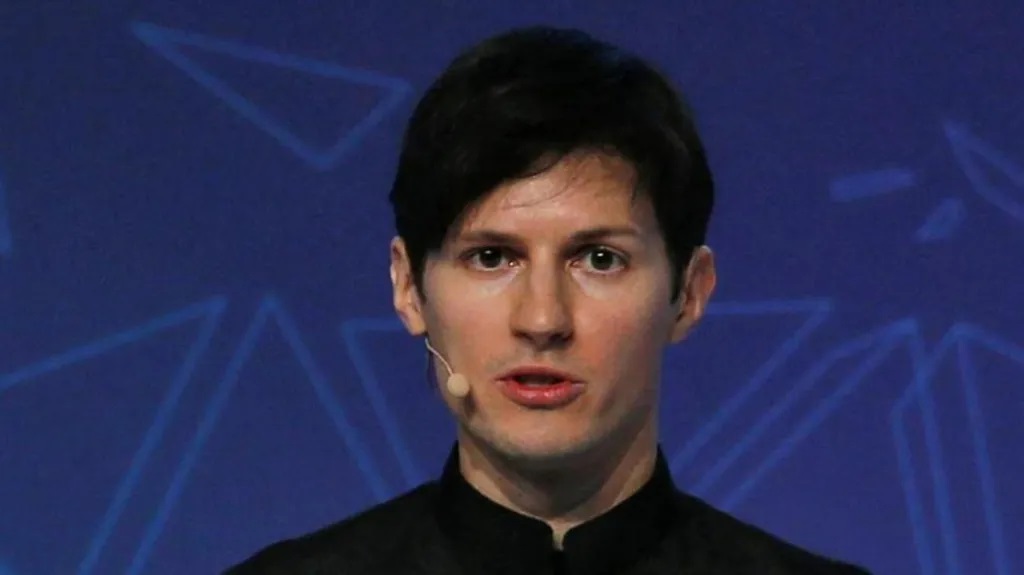
Russia has charged Telegram’s founder Pavel Durov with facilitating terrorism over allegations the messenger app has been used for recruitment by Ukrainian secret services.
The FSB – Russia’s domestic security service – said Telegram had been used “to prepare and co-ordinate acts of sabotage and terror” inside Russia and had failed to remove channels, chats and bots used by Ukraine.
An international arrest warrant has been issued for the Russian-born Durov, who lives abroad.
Shortly after the charge was announced, Telegram’s account on X posted an image showing Durov holding up his middle finger. He has previously accused Russian authorities of “fabricating new pretexts to restrict Russians’ access to Telegram”.
Telegram is popular in Russia and is used by tens of millions of people, although authorities have been restricting access as part of a wider crackdown on internet freedom. The app is also popular in Ukraine.
Multi-billionaire Durov, 41, has lived outside of Russia for many years and holds French and United Arab Emirates (UAE) passports.
It is unclear whether other countries or authorities would comply with an arrest warrant issued by Russia.
Durov left Russia in 2014 after refusing to comply with government demands to shut down opposition communities on the platform. He had previously founded popular Russian social media company VKontakte – dubbed the “Facebook of Russia”.
Telegram is used by around 950 million people worldwide and has previously positioned itself as an app focussed on its users’ privacy, rather than the normal policies prioritised by other global social media companies.
The platform has previously faced criticism of its app moderation, but has denied having insufficient practices.
Durov was arrested and placed under formal investigation in France in 2024 over allegations of failure to properly moderate the app to reduce criminality. He was allowed to go home months later, with the investigation continuing.
Foreign
Iran cautions, says Middle East war will expand geographically If US falls for zionists deception

Iran’s army has warned that the conflict in the Middle East could expand further if the United States launches additional attacks on the Islamic Republic, ahead of Israeli Prime Minister Benjamin Netanyahu’s visit to Washington this week.
Army spokesman Mohammad Akraminia issued the warning during an interview with Iranian state television on Sunday, July 26, saying any renewed US military action would widen the geographical scope of the conflict.
“I believe that if the Americans once again fall for the Zionists’ deception, or move in line with them, and insist on continuing the war, particularly through air strikes, geographically this will expand further,” he said.
Akraminia claimed the conflict had already spread to the Bab al-Mandab Strait at the entrance to the Red Sea, referring to the recent escalation involving Yemen’s Iran-backed Houthi movement and Saudi Arabia. “The scope of our operations now encompasses the entire region, from US bases in Jordan to the countries along the Persian Gulf,” he said.
He added that the United States now faced an increasingly unstable security environment in the Middle East and suggested Washington was reassessing its approach. “The situation in the Middle East for the United States is difficult and unsettled,” he said, adding that the US was looking “for a new strategy.” “We are prepared for each of the options and scenarios that appear likely.” The comments come ahead of Netanyahu’s scheduled meeting with US President Donald Trump at the White House on Tuesday.
According to the Israeli prime minister’s office, Netanyahu will depart for Washington on Monday before meeting Trump and attending the funeral service of Senator Lindsey Graham, whom the statement described as “a friend of Israel.” Since Trump’s return to office last year, the two leaders have met six times, most recently in Washington on February 11.
While Trump and Netanyahu initially presented a united front following the launch of military operations against Iran in late February, reports suggest differences have since emerged over whether to continue military action or pursue diplomatic efforts.
Netanyahu has previously described Trump as “the greatest friend” Israel has ever had in the White House. Earlier this month, Trump also spoke about their relationship during an interview with Axios. “We get along very good. (Netanyahu) knows who the boss is,” Trump said.
Relations between the two leaders reportedly came under strain during ceasefire negotiations between the United States and Iran in April. The ceasefire has since collapsed.
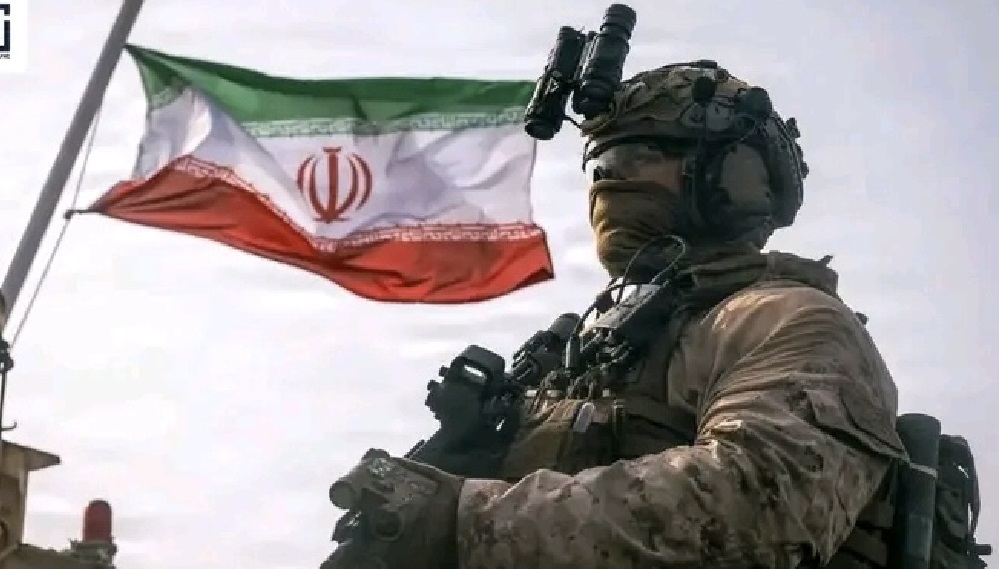
A senior Iranian military commander has threatened that one US soldier would be killed for every Iranian citizen killed in US attacks, marking a sharp escalation in rhetoric as tensions between Tehran and Washington continue to intensify.
Ali Abdollahi, commander of Iran’s Khatam al-Anbiya Headquarters, said on Friday that what he described as a principle previously demonstrated on the battlefield would now become an official equation governing Iran’s response.
According to Abdollahi, any US attack resulting in the death of an Iranian citizen would trigger a direct response against American forces.
“For every martyr from the proud people of the Islamic Republic of Iran, one American force will be eliminated,” he said.
He concluded his message with a strongly worded warning directed at US forces, saying they had been issued what he described as “a one-way ticket to hell.”
The remarks come as military tensions between Tehran and Washington continue across the region, with both sides exchanging threats amid the ongoing conflict.
Separately, Iranian Foreign Minister Abbas Araghchi said Tehran would not accept a temporary ceasefire under any circumstances unless its demands regarding the Strait of Hormuz are met.
Araghchi said the current dispute with Washington is not the result of a lack of mediators, noting that Pakistan and Qatar continue to play mediation roles. Instead, he argued that the core issue lies in US policies, which he said must change.
Responding to a question about discussions with counterparts from Russia, China, Ukraine, and Pakistan, Araghchi said Iran maintains continuous and organized consultations with Moscow and Beijing and engages in dialogue whenever opportunities arise.
He added that recent meetings with Chinese Foreign Minister Wang Yi and Russian Foreign Minister Sergey Lavrov provided an opportunity to discuss the conflict in greater detail.
Regarding Pakistan, Araghchi said it was natural to discuss mediation initiatives and proposals with Islamabad but reiterated that the fundamental problem between Tehran and Washington is not the absence of mediators but US policy.
Araghchi also stressed that Iran would not yield to what he described as American pressure or intimidation.
“Iran has shown that it will not bow to US coercion. We do not respond to the language of force, pressure, or threats. We are not afraid of threats, we do not submit to pressure, and we do not accept the language of intimidation,” he said.
He reaffirmed that protecting the Iranian people and safeguarding Iran’s interests in the Strait of Hormuz remain fundamental and non-negotiable principles for Tehran, adding that Iran would maintain its current position until what he described as the legitimate demands of the Iranian people are achieved.

Photos/Video: Senator pays working visit to FERMA boss Agbasi over failed Gashaka Saldana federal road

Reps Probe Lingering Bille Gas Leak, Demand Swift Action as Regulators Confirm Emissions Continue

Video of Deltans scooping fuel from Tanker in Asaba surfaces online




-

 News22 hours ago
2027: Peter Obi Meets Obasanjo (PHOTOS)
-

 News12 hours ago
Photos: Over 10 Houses Swallowed By Erosion, Scores Dislodged In Bende, Abia State, as Deputy Speaker, Ecological Funds Officials Assess Sites
-
 News19 hours ago
Video: New FCT CBD Bus terminal set to begin operations in September
-

 Sports22 hours ago
Entire Ethiopian youth football team disappears in Sweden after Gothia Cup tournament
-
 News17 hours ago
Europe on fire: Over 300,000 dislocated from their homes
-
 News22 hours ago
US To Discontinue Visa Services In Abuja
-

 News12 hours ago
Video: Six months from now Abuja residents can now link Lugbe from Nile varsity
-

 News11 hours ago
Varsity don slams Alaafin over three-hour delay, lack of apology at event
Warning: Undefined variable $user_ID in /home/naijuinz/public_html/wp-content/themes/zox-news/comments.php on line 49
You must be logged in to post a comment Login