
News
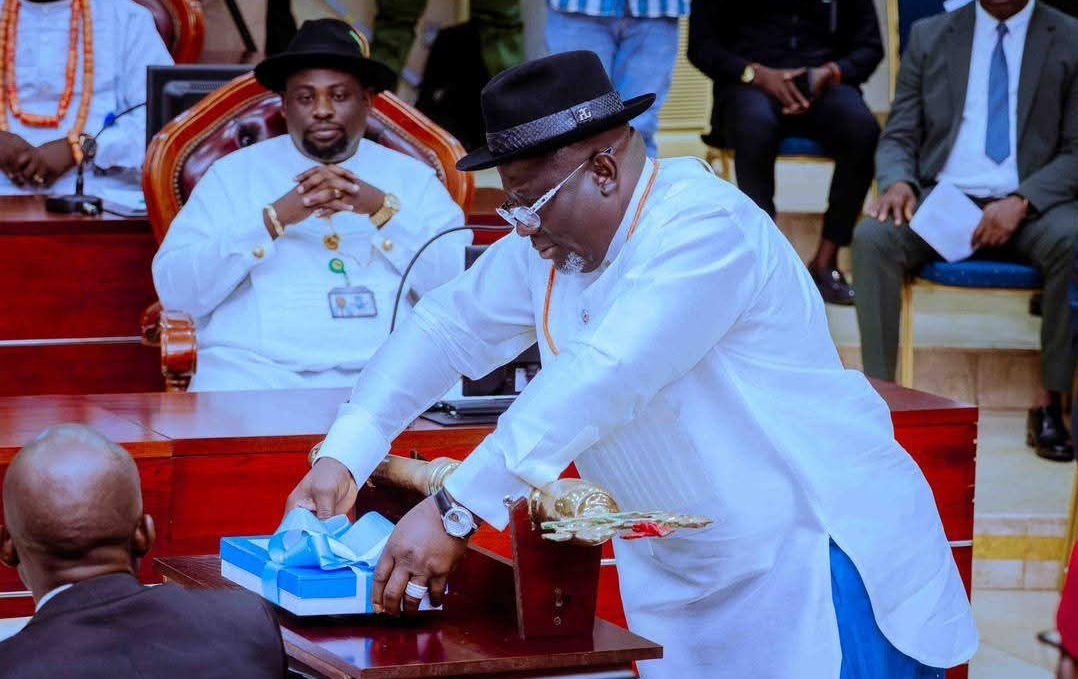
Oborevwori presents N1.664tr 2026 budget to Delta Assembly for approval

- /home/naijuinz/public_html/wp-content/plugins/mvp-social-buttons/mvp-social-buttons.php on line 27
https://naijablitznews.com/wp-content/uploads/2025/11/Oborevwori-presents-1000x600.jpg&description=Oborevwori presents N1.664tr 2026 budget to Delta Assembly for approval', 'pinterestShare', 'width=750,height=350'); return false;" title="Pin This Post">
- Share
- Tweet /home/naijuinz/public_html/wp-content/plugins/mvp-social-buttons/mvp-social-buttons.php on line 72
https://naijablitznews.com/wp-content/uploads/2025/11/Oborevwori-presents-1000x600.jpg&description=Oborevwori presents N1.664tr 2026 budget to Delta Assembly for approval', 'pinterestShare', 'width=750,height=350'); return false;" title="Pin This Post">


Delta State Governor, Rt. Hon. Sheriff Oborevwori, on Wednesday, presented a budget proposal of N1.664 trillion for the 2026 fiscal year to the State House of Assembly for consideration and approval.
Giving the breakdown of the budget christened, ‘Budget of Accelerating the MORE Agenda,’ Oborevwori said N499 billion, representing 30 per cent of the total budget, was for recurrent expenditure, adding that N1.165 trillion, representing 70 per cent of the total budget, was for capital expenditure.
He disclosed that the 2026 budget size indicated an increase of N685bn or 70 per cent over the 2025 Appropriation.
He pointed out that the budget as proposed would be mainly funded from Statutory Allocation, Internally Generated Revenue, Mineral Derivation, Value Added Tax, Other Capital Receipts and Savings, and Oil Revenue Recoveries.
The Governor disclosed that N720 billion, or 43.28 per cent of total projected revenue, was expected from statutory allocation, which, he said, was boosted by post-subsidy FAAC inflows and improved oil production stability in the Niger Delta, adding that Internally Generated Revenue was projected at N250 billion, representing an 86.5 per cent increase over 2025.
While saying that the projected increase in the state’s IGR was driven by ongoing reforms to plug leakages and widen the tax net, he pointed out that VAT receipts were expected to rise sharply to N120 billion, buoyed by improved federal administration of the tax.
The Governor said: “Capital receipts, however, have been deliberately cut down to N25 billion, a 73 per cent reduction as the government pushes toward a zero-borrowing fiscal strategy.
“Savings and oil revenue recoveries are projected to contribute N489 billion. This is a testament to prudent and disciplined financial management.”
According to him, the proposed recurrent expenditure estimates for 2026 of N499 billion is made up of personnel costs of N185 billion, representing 37 per cent of the proposed recurrent budget, stressing that N204 billion, representing approximately 41 percent, was earmarked for overheads.
He pointed out that the balance 22 per cent or N110 billion was accounted for by social contributions, benefits, and grants, emphasising that the personnel cost of N185 billion anticipates the annual increments and allowances, while the overhead cost mirrors the inflationary trend in the country.
Giving insights into the proposed capital expenditure estimate of N1.165 trillion, Governor Oborevwori noted that the proposal was N535 billion, or 85 per cent higher than the 2025 capital budget of N630 billion.
“This is largely accounted for by the larger budget size of one trillion, six hundred and sixty-four billion naira (N1.664Trillion), as against the nine hundred and seventy-nine billion, two hundred million naira (979.2Billion) of 2025,” the Governor said.
Highlighting the priority sectors of the budget, the Governor said N450 billion was budgeted for road infrastructure, N105.086 billion for education, N50.067 billion for health, N20 billion for the Delta State Capital Territory Development Agency, and N20 billion for the Warri, Uvwie, and Environs Development Agency.
According to him, N16 billion was budgeted for Power and Energy, N10 billion for Agriculture, and N20 billion for Social Protection, adding that the sum of N100 billion was budgeted for local government intervention in the 25 local government areas in the state (N4 billion per local government).
Reviewing the performance of the 2025 Budget themed, “Budget of Fiscal Consolidation,” where ₦979,228,818,719 was approved for funding both capital and recurrent expenditures, the Governor said the performance of the budget was encouraging.
“From January to October 2025, the actual revenue receipts from the Federation Account Allocation Committee and Internally Generated Revenue stood at Seven Hundred and Thirty-Eight billion, Six Hundred and Forty million naira only (N738.640 billion), representing 90.5 per cent of the proportionate budget of eight hundred and sixteen billion, twenty-four million, fifteen thousand, five hundred and ninety-nine naira only (N816,024,015,599).
“The recurrent expenditure for the period under review was three hundred and forty billion, five hundred and fifty-four million, six thousand, four hundred and forty-eight naira only (N340,554,006,448), as against a proportionate amount of two hundred and ninety billion, six hundred and thirty-nine million, seven hundred and ninety-eight thousand, eight hundred and sixty-three-naira, fifty kobo only (N290,639,798,863.50), representing 117 per cent performance.
“The sum of five hundred and nine billion, seven hundred and eighty million, three hundred and thirty-six thousand, three hundred and seventy naira only (N509, 780, 336,370) was expended during the period under review, as against a proportionate amount of five hundred and twenty-five billion, three hundred and eighty-four million, two hundred and sixteen thousand, seven hundred and thirty-six naira only (N525, 384, 216, 736), representing 97 per cent performance.
“It is pertinent to appreciate this stellar performance. It is also gladdening to note that the bold and reformist policies of the Federal Government have started to yield the desired result and the country is beginning to turn the corner,” the Governor added.
While highlighting the importance of peace and security in promoting sustainable development, he said his administration had worked closely with security agencies to tackle crime, including kidnapping and cultism, with a view to ensuring sustainable peace and security in communities across the state.
“We will continue to strengthen the security architecture in the state to better protect our citizens from all threats. This administration has invested heavily in security infrastructure upgrades and will continue to do so for enhanced peace and security.
“We are looking at deploying cutting-edge technology, including drones and sophisticated intelligence gathering capabilities, and surveillance equipment. All these are in addition to the prompt payment of personnel emoluments and allowances, as well as the provision of covert logistics.
“Mr Speaker, as I conclude this Budget Address, let me say that we are proud of the progress that we have made so far. However, there is still a lot more to do, and the journey to a more prosperous, secure, and stronger Delta will take the concerted efforts of all arms of government.”
Earlier in his welcome address, the Speaker, Rt. Hon. Emomotimi Guwor, who lauded Oborevwori’s administration for the steady strides it had recorded under the Renewed Hope for MORE Agenda, said sustained investments in critical infrastructure, impactful social interventions, prudent fiscal management of resources, and strategic initiatives aimed at promoting peace, security, and economic stability across the State have been witnessed over the past year.
“Your Excellency, it is indisputable that your leadership has ensured the continuation of key legacy projects, expansion of road networks, ongoing construction of five strategic flyovers, improvement of healthcare facilities, empowerment programmes for youth and women, and the strengthening of the educational system.
“These interventions have not only elevated the quality of life for our people but have also reaffirmed the State’s position as a sub-national model of development,” the Speaker said while thanking the Governor for the approval and payment of the Consolidated Legislative Salary Structure (CONLESS) to staff of the House and Assembly Service Commission.
He noted that the projections in the Fiscal Strategy Paper (FSP) for 2026, 2027, and 2028 approved by the House reflected national, regional, and global economic dynamics, even as he assured the Governor that the 2026 Appropriation Bill presented to the House would be considered with a view to passing the Bill.

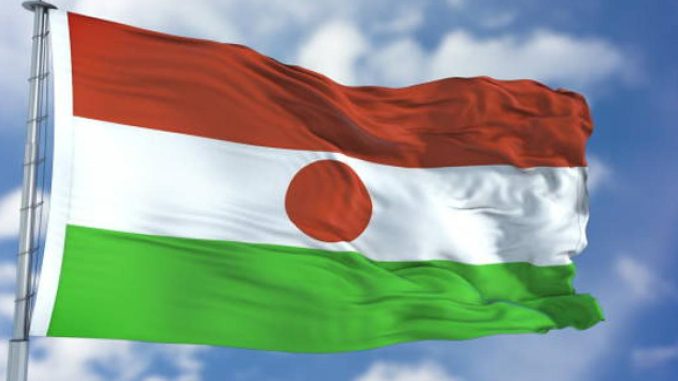
Panic as gunshots and explosions were heard in parts of Niamey, Niger’s capital, early Saturday, with reports of heavy shooting around a military base near the city’s international airport.
The source of the attack remained unclear as of Saturday morning, while Nigerien authorities had yet to issue an official statement on the incident.
A resident told AFP that heavy gunfire and explosions were heard around Air Force Base 101, located within the airport complex.
Several other witnesses reportedly confirmed hearing the sounds, with the first shots beginning at about 1am local time (0000 GMT) and continuing until daybreak.
Video footage shared by a local journalist showed activity around the airport area during the early morning hours.
Another resident in western Niamey said sporadic small-arms fire was heard at about 5am.
Reports on social media also pointed to gunfire and explosions in other parts of the capital, including the administrative district where the presidential palace and national television station are located.
Videos circulating online showed armoured vehicles being deployed around neighbourhoods close to the airport.
The incident comes after Niamey’s airport was targeted twice by jihadist groups earlier this year.
The Islamic State in the Sahel (EIS) claimed responsibility for an attack in January, while the Group for the Support of Islam and Muslims (JNIM), the Sahel branch of al-Qaeda, carried out another assault in June.
The two groups are rivals and have been competing for influence across the Sahel, particularly in Niger, while also carrying out attacks against civilians and government forces.
During the January attack, Nigerien authorities said 20 attackers were killed and four soldiers wounded.
In June, the country’s defence ministry said at least 11 soldiers and two civilians were killed, alongside 22 attackers, during another assault on the airport.
The military said both attacks were repelled.
Strategic military base
Air Force Base 101 is considered a highly sensitive military facility because it sits within the international airport complex.
The base also houses the headquarters of Russian Africa Corps personnel in Niger, as well as the command of the joint force established by the Alliance of Sahel States, comprising Niger, Burkina Faso and Mali.
Niger has been ruled by a military junta led by General Abdourahamane Tiani since the July 2023 coup that ousted President Mohamed Bazoum.
The junta has struggled to contain jihadist violence that has plagued the country for years.
Following the January airport attack, Tiani acknowledged security weaknesses that had allowed the assault to take place, saying the attackers had sought to destroy the army’s air capabilities.
Jihadist violence persists despite shift to Russia
Niger, Burkina Faso and Mali have all experienced military coups and subsequently moved away from their traditional Western security partners, particularly France.
The three countries also withdrew from the Economic Community of West African States (ECOWAS) and formed closer security and political ties with Russia.
However, the shift has yet to end the jihadist insurgency, with Islamic State and al-Qaeda-linked groups continuing to operate across the region.
The latest gunfire in Niamey has raised fresh concerns over security in the capital, particularly around strategic military and government installations.
Authorities had not publicly confirmed who was responsible for Saturday’s shooting or whether there were casualties as of the latest reports.

Lagos State Police Command rescued two abducted Colombian women in Lagos.
The Force Public Relations Officer, CSP Ani Iniedu, disclosed this in a statement released on Saturday.
According to the statement, the two women were “fraudulently lured to Nigeria, held against their will, and had their travel documents confiscated” by some Chinese nationals, who are currently at large.
The statement said the police launched a covert tracking operation immediately after receiving the intelligence.
It added that the operatives located the hideout in Lagos and rescued the victims “on the same day.”
The statement read in part, “Upon receipt of the intelligence, police operatives promptly launched a covert tracking operation, locating the hideout in Lagos where both victims were safely rescued on the same day.”
According to the police, the suspects fled the location when they noticed the approaching operatives.
“The fleeing suspects abandoned the location upon sighting the approaching team, and efforts have been intensified to track down and arrest all members of the syndicate,” the statement said.
The police said the rescued Colombian nationals were currently in safe custody and receiving necessary support.
“The rescued victims are currently in safe custody and receiving necessary support,” the statement added.
The statement further disclosed that the Colombian Embassy in Accra was collaborating with the National Central Bureau to facilitate the victims’ return to their country.
“The Colombian Embassy in Accra is working in close collaboration with the Bureau to secure hotel accommodations for the victims and arrange emergency travel documents to ensure their safe return to Bogotá,” it said.
The Inspector-General of Police, Olatunji Disu, reaffirmed the commitment of the police to protecting residents and strengthening international cooperation against transnational crimes.
The statement said Disu “reaffirms the unwavering commitment of the Nigeria Police Force to safeguarding the lives and property of all residents within the country, while deepening collaboration with international law enforcement partners to combat cross-border crimes.”
The police said efforts had been intensified to arrest the fleeing suspects and dismantle the trafficking network.
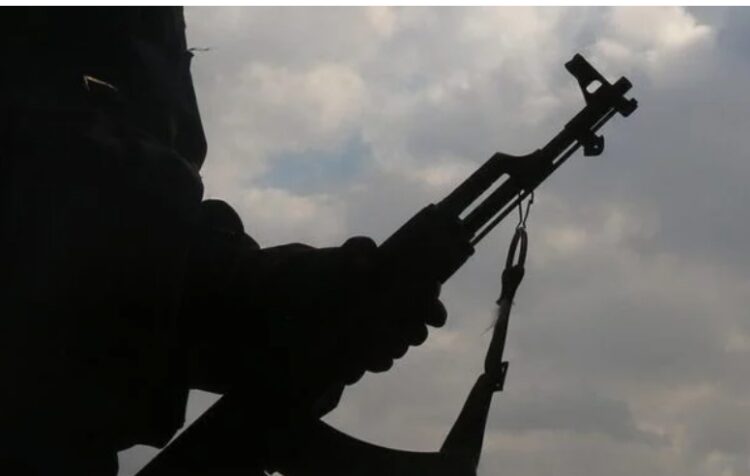
More than 100 communities in Southern Kaduna have reportedly been deserted by residents following repeated attacks by armed groups, with some affected settlements allegedly resorting to negotiations with the assailants to survive.
The affected communities are spread across parts of Kachia, Kajuru, Kagarko, Chikun and Birnin Gwari local government areas of Kaduna State, according to findings by Saturday PUNCH.
The National President of the Southern Kaduna Peoples’ Union, Tabara Kato, said over 100 communities had been displaced, while the former spokesman of the group, Luka Binniyat, claimed that the figure was as high as 245.
Kato also said about 35,402 people had been displaced across the state, adding that many of the affected residents were now living in Internally Displaced Persons camps under difficult conditions.
The latest major attack cited by the community leaders occurred on July 26 in Naridon, Kamaru Ward, Kauru Local Government Area, where at least 30 residents, including eight children, were reportedly killed during an attack that lasted about three hours.
Kato attributed the persistent attacks largely to alleged land grabbing and the quest for control of natural resources, claiming that some communities had been taken over after their residents were forced to flee.
He said, “So far, more than 100 communities have been displaced. Some of the victims are now living in IDP camps. They are living from hand to mouth and at the mercy of the weather, and human and natural hazards.”
Kato called on the Federal Government and security agencies to investigate the alleged financiers of the attacks, arguing that arresting perpetrators without identifying their sponsors would not bring lasting peace.
Binniyat, who is also the spokesman of the Middle Belt Forum, gave a higher estimate, alleging that about 245 communities had been sacked across Southern Kaduna as of June 2026.
He said the prolonged displacement had created what he described as “a dangerous security vacuum,” which he alleged was being exploited by kidnappers and armed groups.
According to Binniyat, communities in Kachia, Kajuru, Kagarko and Chikun, as well as some Gbagyi settlements in Birnin Gwari, were among those most affected.
He urged the Federal Government to undertake a coordinated security operation to reclaim occupied communities, dismantle armed camps and create conditions for displaced residents to return safely.
Meanwhile, residents told Saturday PUNCH that insecurity had forced some communities in Kachia to enter into informal agreements with armed groups in an attempt to reduce attacks.
The residents alleged that the arrangements had, in some cases, evolved into systems of control, with demands reportedly including money, restrictions on movement, compulsory farm work and other forms of coercion.
A resident of Mai-Ido Kufai, Jessy Francis, said some community leaders entered into negotiations with the armed groups because they hoped it would enable residents to return home and live without fear.
“We believed that if we reached an understanding with them, we would be able to return to our homes and continue our lives peacefully,” Francis said.
He, however, alleged that the arrangement failed to provide lasting peace, claiming that residents in some areas continued to face violence and other forms of intimidation.
Another displaced resident, Danjuma Sunday, said he fled Mai-Goro in 2021 after surviving repeated attacks. He said he now lives in Kachia with his family but occasionally returns to his farm despite the security risks.
Sunday alleged that security personnel sometimes visited affected communities, but the armed groups reportedly returned after the troops withdrew.
However, the Village Head of Ariko, Jashua Doka, said his community had rejected pressure to negotiate with the armed groups.
“People kept telling us to negotiate with them, but I refused. If I negotiate with criminals and God calls me tomorrow, what explanation will I give? I fear God,” Doka said.
The state Commissioner for Internal Security and Home Affairs, Dr Suleiman Shuaibu, said he was unaware of the alleged arrangements when contacted.
“I am just hearing this from you. Can you allow me some time to verify the claims and get back to you?” he said.
Efforts to obtain the reaction of the Kaduna State Police Command were unsuccessful, as its spokesman, Mansir Hassan, did not respond to calls or a text message sent to him before the report was filed.
Binniyat urged the Federal and Kaduna State governments to prioritise the reconstruction of affected communities and the rehabilitation of displaced residents, warning that continued occupation of the areas could further worsen insecurity in the region.

See Black Market Dollar To Naira Exchange Rate Today 29th August 2026

Confusion in Niger as gunfire, explosions rock presidential palace, airport

Police rescue two abducted Colombian women in Lagos




-

 Metro6 hours ago
Police Parade Doctors, Others Over Alleged Organ Trafficking In Nasarawa
-

 News6 hours ago
NYSC sets September 7 for 2026 batch C registration
-
 News6 hours ago
Ugandan King Who Became Monarch At Age 3 Di£s Aged 34
-
 News22 hours ago
NDLEA starts nationwide training of counselors on standard rehab guidelines(Photos)
-
 News6 hours ago
FG moves to harmonise salaries of federal government workers
-
 News6 hours ago
Police-Led Joint Team Arrests Nine, Recovers Three AK-47 Rifles, Pump-Action Gun in Anambra
-

 News6 hours ago
‘Law profession no longer noble’ — VeryDarkMan
-
 News23 hours ago
Gusau : N12bn NFF intervention fund probe ongoing, says EFCC