Foreign
Trump threatens 100% tariff on Canada over China trade deal




US President Donald Trump on Saturday warned Canada that if it concludes a trade deal with China, he will impose a 100 per cent tariff on all goods coming over the border.
Relations between the United States and its northern neighbor have been rocky since Trump returned to the White House a year ago, with spats over trade and Canadian Prime Minister Mark Carney decrying a ‘rupture’ in the US-led global order.
During a visit to Beijing last week, Carney hailed a ‘new strategic partnership’ with China that resulted in a ‘preliminary but landmark trade agreement’ to reduce tariffs but Trump warned of serious consequences should that deal be realised.
If Carney ‘thinks he is going to make Canada a ‘Drop Off Port’ for China to send goods and products into the United States, he is sorely mistaken’, Trump wrote on his Truth Social platform.
‘China will eat Canada alive, completely devour it, including the destruction of their businesses, social fabric, and general way of life’, he said.
‘If Canada makes a deal with China, it will immediately be hit with a 100% Tariff against all Canadian goods and products coming into the USA’.
Trump insulted Carney by calling him ‘Governor’ – a swipe referring to the US president’s repeated insistence that Canada should be the 51st US state.
Trump this week posted an image on social media of a map with Canada — as well as Greenland and Venezuela — covered by the American flag.
The two leaders have sharpened their rhetorical knives in recent days, beginning with Carney’s speech on Tuesday at the World Economic Forum in Davos, where he earned a standing ovation for his frank assessment of a ‘rupture’ in the US-led global order.
His comment was widely viewed as a reference to Trump’s disruptive influence on international affairs, although the US leader was not mentioned by name.
Trump fired back at Carney a day later in his own speech, and then withdrew an invitation for the Canadian prime minister to join his ‘Board of Peace’— his self-styled body for resolving global conflict.
Initially designed to oversee the situation in postwar Gaza, the body appears now to have a far wider scope, sparking concerns that Trump wants to create a rival to the United Nations.
‘Canada lives because of the United States. Remember that, Mark, the next time you make your statements’, Trump said.
Carney fired back on Thursday: ‘Canada doesn’t live because of the United States. Canada thrives because we are Canadian’. He nevertheless acknowledged the ‘remarkable partnership’, between the two nations.
Canada is heavily reliant on trade with the United States, the destination for more than three quarters of Canadian exports.
Key Canadian sectors like auto, aluminum and steel have been hit hard by Trump’s global sectoral tariffs, but the impacts of the levies have been muted by the president’s broad adherence to an existing North American free trade agreement.
Negotiations on revising that deal are set for early this year, and Trump has repeatedly insisted the United States doesn’t need access to any Canadian products — which would have sweeping consequences for its northern neighbor.
The two nations, along with Mexico, are set to host the World Cup later this year.

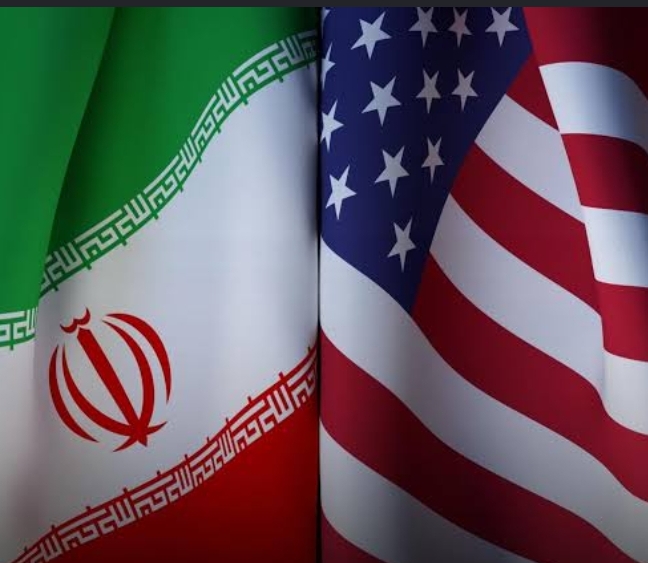
Iranian airlines are facing mounting international restrictions after new US sanctions disrupted flights to several neighbouring countries, while fresh Houthi missile attacks on Saudi Arabia sent global oil prices sharply higher.
The United Arab Emirates on Thursday suspended all flights operated by Iranian airlines until further notice, citing the impact of new US sanctions targeting Iran’s aviation sector. Oman also moved to restrict Iranian flights, while services to destinations including Georgia, Azerbaijan and Baghdad were reported to have been disrupted.
The measures followed a September 23 deadline set by Washington under which companies and service providers around the world could face sanctions for continuing to do business with Iranian airlines.
The US campaign is aimed at extending sanctions pressure beyond Iran by targeting companies in third countries that continue providing services to Iranian carriers.
Iran’s aviation network has already been affected, although international flights have not been completely halted. Flight-tracking data and airport schedules showed Iranian carriers continuing to operate some routes, including services to countries such as China, Afghanistan and Turkey.
Iran has reacted angrily to the restrictions, warning that countries cooperating with the US campaign could face consequences.
A senior Iranian official threatened that airports in countries blocking Iranian flights could eventually become “unusable”, escalating concerns over the potential impact of the sanctions on regional air travel.
Oil prices surge after Saudi missile attacks
The aviation restrictions came as escalating military tensions in the region continued to unsettle global energy markets.
Oil prices jumped on Thursday after Yemen’s Iran-aligned Houthi movement launched missile and drone attacks against targets in Saudi Arabia.
Saudi authorities said their air defences intercepted six ballistic missiles fired towards Taif and Yanbu, two cities in western Saudi Arabia. The Houthis separately claimed attacks on targets in Riyadh and facilities belonging to Saudi Aramco in Yanbu.
The attacks renewed concerns about possible disruptions to Saudi oil exports and major shipping routes in the region, particularly because Yanbu is an important Red Sea outlet for Saudi crude.
Brent crude futures settled at $106.60 per barrel, up $3.52, or 3.4 per cent, while US West Texas Intermediate crude gained $2.45, or 2.7 per cent, to close at $94.61.
Both benchmarks had risen by about five per cent at their session highs before retreating as reports emerged of possible diplomatic efforts between Washington and Tehran.
Strait of Hormuz remains key to oil markets
The possibility of negotiations between the US and Iran also helped limit the rise in crude prices.
Reports indicated that Washington and Tehran were exploring a possible phased arrangement that could involve reopening the Strait of Hormuz in exchange for a relaxation of some US economic restrictions.
The waterway is one of the world’s most important oil transit routes, making any prolonged disruption a major concern for global energy markets.
Saudi Arabia has also been relying on its East-West pipeline to move crude towards the Red Sea as disruptions affect traditional Gulf shipping routes.
The latest developments have therefore placed oil markets under competing pressures: further military escalation around energy infrastructure and shipping routes could increase supply fears, while progress in US-Iran diplomacy and improved access through the Strait of Hormuz could ease those concerns.
For Iran, meanwhile, the new US measures threaten to further isolate its aviation industry and reduce the country’s already limited international air connections.
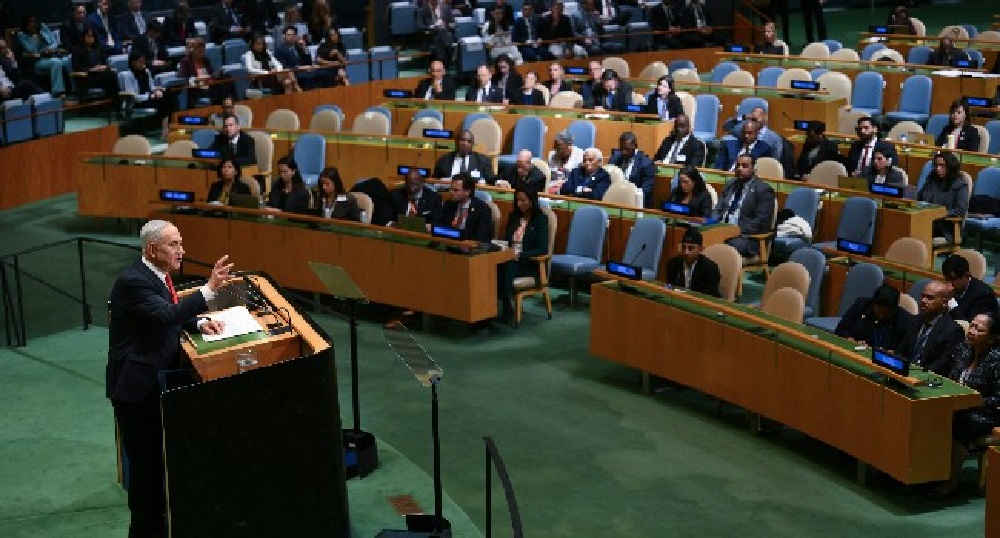
Dozens of envoys from across the world walked out of Prime Minister Benjamin Netanyahu’s speech to the UN on Thursday in protest at the Israeli leader.
Delegates jeered and booed, while Netanyahu’s own team stood and applauded, and the speaker of the session shouted for order.
“If there are any other moral cowards who haven’t left this hall, please do so now,” Netanyahu said.
Some attendees and delegation members walk out as Israel’s Prime Minister Benjamin Netanyahu speaks during the 81st United Nations General Assembly at the United Nations Headquarters in New York, on September 24, 2026. (Photo by TIMOTHY A. CLARY / AFP)
The hall, sparsely filled earlier in the session, gradually filled up before Netanyahu’s speech.
The Palestinian delegation had called in a memo for other missions to join their own act of protest.
Netanyahu called the Israeli youths who target Palestinian communities in the occupied West Bank “juvenile delinquents” during a speech Thursday to the United Nations.
“What (the media) cover is a handful of young juvenile delinquents, about 150 in number, who go or throw stones, who chop down olive trees,” Netanyahu said.
“I can’t stand that. I won’t stand for vigilantism.”
Israeli Prime Minister Benjamin Netanyahu addresses the 81st United Nations General Assembly at UN headquarters in New York on September 24, 2026. (Photo by ANGELA WEISS / AFP)
He called Turkey’s President Recep Tayyip Erdogan a “tyrant” during a speech at the UN on Thursday, accusing Ankara of harboring Hamas militant leaders.
“The latest country to become a super spreader of antisemitic lies (is Turkey)… Erdogan is a tyrant. He also hosts the Hamas terror chiefs,” he said.
The Prime Minister also claimed that “many Jews” no longer feel safe in New York since leftist Mayor Zohran Mamdani’s election.
“Since you were elected mayor of this city, many Jews no longer feel safe in New York,” he said.
“You falsely, repeatedly accuse Israel of genocide.”
AFP

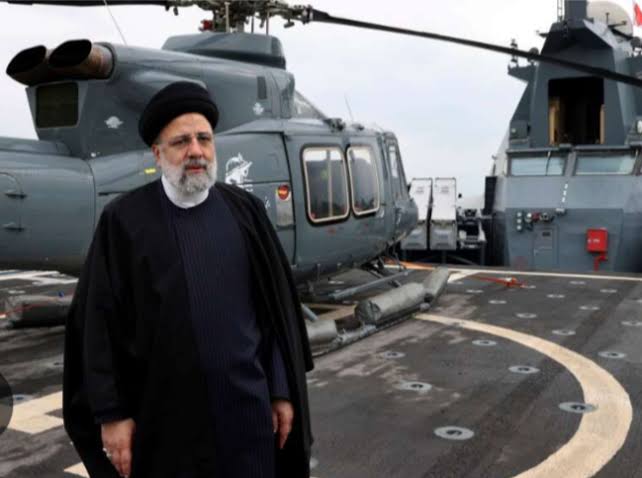
An adviser to Iran’s Supreme Leader, Mojtaba Khamenei, has warned that Tehran could expand the ongoing Middle East conflict to the Indian Ocean if the United States launches further attacks.
Yahya Rahim Safavi, a senior adviser to the Iranian leader, issued the warning on Thursday in a video released by Iran’s Fars news agency.
“Since the conflict has spread from the Persian Gulf and Strait of Hormuz to the Red Sea, it is possible that, in response to more war, the front will expand even further, reaching the Indian Ocean and perhaps beyond,” Safavi said.
The warning comes amid heightened tensions around strategic waterways in the region.
Yemen’s Houthis, who are fighting Saudi-backed government forces, recently took control of the Red Sea coastline, strengthening their hold around the strategic Bab al-Mandab Strait, which connects Asia and Europe through the Suez Canal.
Iran has long provided military support to the Houthis but has denied any direct involvement in the Yemen conflict.
The Islamic Republic has also closed the Strait of Hormuz, off its southern coast, in retaliation for US-Israeli strikes that triggered the current Middle East war at the end of February.
Iran and the United States are now contesting control of the strategic waterway, through which a substantial portion of the world’s oil and gas supplies passed before the conflict began.
Iranian officials had previously warned that the geographic scope of the conflict could be widened if US strikes against Tehran resumed.
However, Thursday’s statement is the first time an adviser to Iran’s Supreme Leader has explicitly mentioned the Indian Ocean as a potential new theatre of the conflict.
The Indian Ocean is home to the strategic US-British military base at Diego Garcia, located nearly 4,000 kilometres from Iran.
Meanwhile, Iranian and US officials held talks in New York this week on the sidelines of the United Nations General Assembly as part of efforts to bring the conflict to an end.

Six inmates die in one week amid suspected cholera outbreak in Kano prison

Painful: Blessing CEO Loses Son While Still In Kirikiri Prison

SAD: Pastor Chris Oyakhilome’s mother is dead


-

 News11 hours ago
How AI Could Cause the catastrophic death of a Billion people — Billionaire Bill Gates Warns
-

 Sports11 hours ago
AFCON Qualifier: Nigeria Defeats Madagascar
-
 News19 hours ago
Soludo Govt Admits: ‘Peter Obi Did Well as Anambra Gov Amid Financial Records Dispute
-
 News21 hours ago
Nigeria @66: Tinubu Urges Citizens to Keep Faith, Says ‘Light At End of Tunnel
-
 News11 hours ago
Police Arrest Officer Who Said Igbo Man Can Never Be President
-

 News21 hours ago
Pope Leo XIV Warns Against AI Risks, Urges World to Protect Human Dignity