News
Oyetola laments inadequate funding, seeks N10.5bn 2026 Marine and Blue Economy Budget
- /home/naijuinz/public_html/wp-content/plugins/mvp-social-buttons/mvp-social-buttons.php on line 27
https://naijablitznews.com/wp-content/uploads/2026/02/961b260c-ff87-42d9-b95d-2c229c9e5746-1000x600.jpeg&description=Oyetola laments inadequate funding, seeks N10.5bn 2026 Marine and Blue Economy Budget', 'pinterestShare', 'width=750,height=350'); return false;" title="Pin This Post">
- Share
- Tweet /home/naijuinz/public_html/wp-content/plugins/mvp-social-buttons/mvp-social-buttons.php on line 72
https://naijablitznews.com/wp-content/uploads/2026/02/961b260c-ff87-42d9-b95d-2c229c9e5746-1000x600.jpeg&description=Oyetola laments inadequate funding, seeks N10.5bn 2026 Marine and Blue Economy Budget', 'pinterestShare', 'width=750,height=350'); return false;" title="Pin This Post">
The Minister of Marine and Blue Economy, Dr. Adegboyega Oyetola, on Tuesday presented a ₦10,499,984,667.10 budget proposal for the Federal Ministry of Marine and Blue Economy for the 2026 fiscal year, lamenting that the allocation was grossly insufficient to effectively execute the ministry’s wide-ranging mandate critical to Nigeria’s trade, transport efficiency and food security.

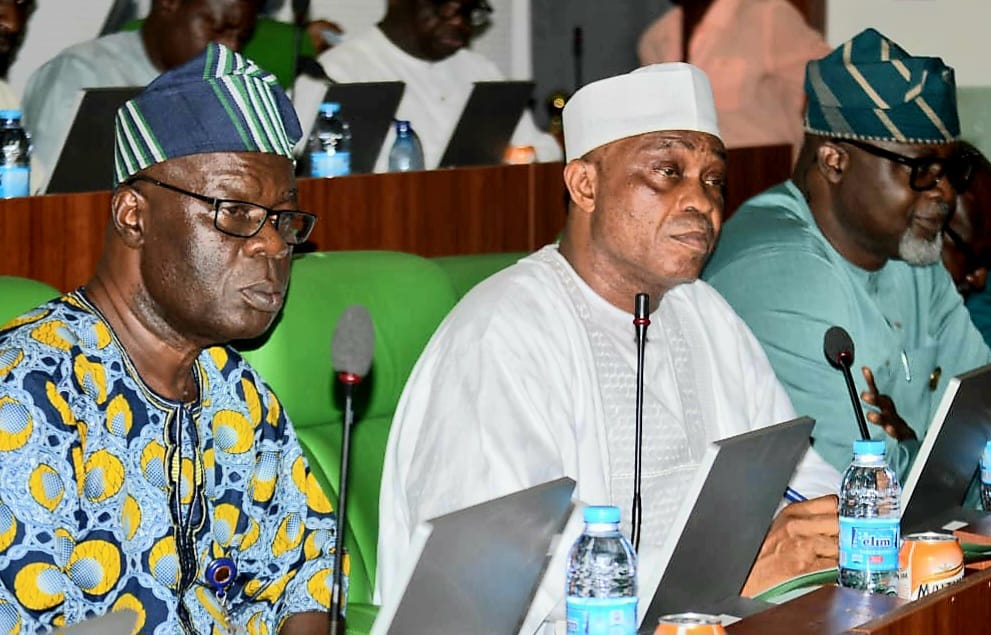
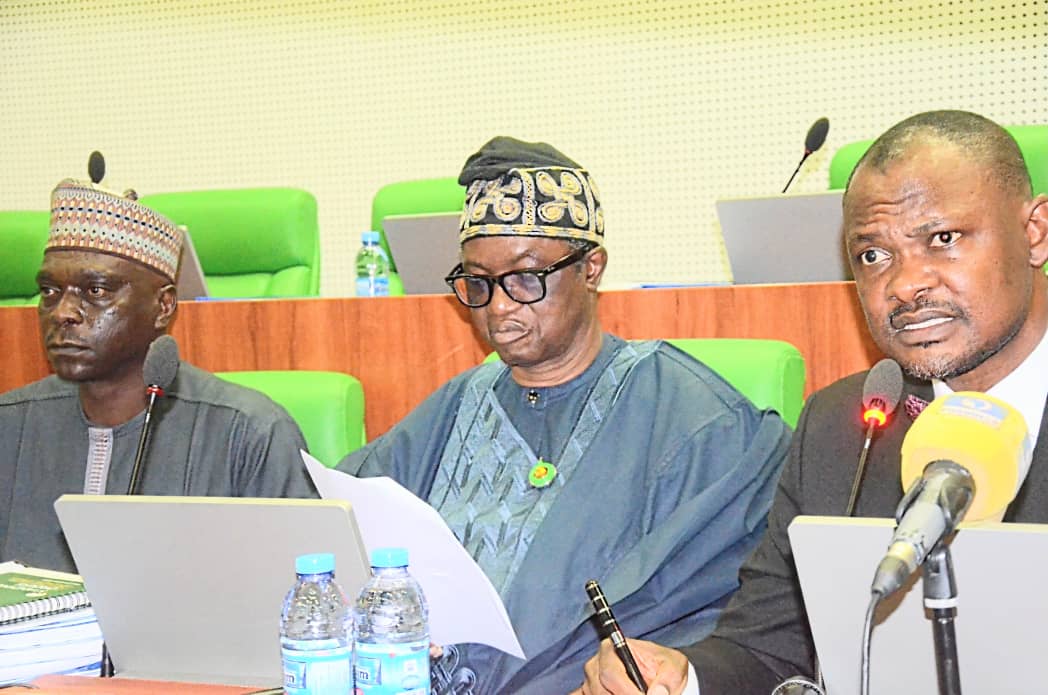
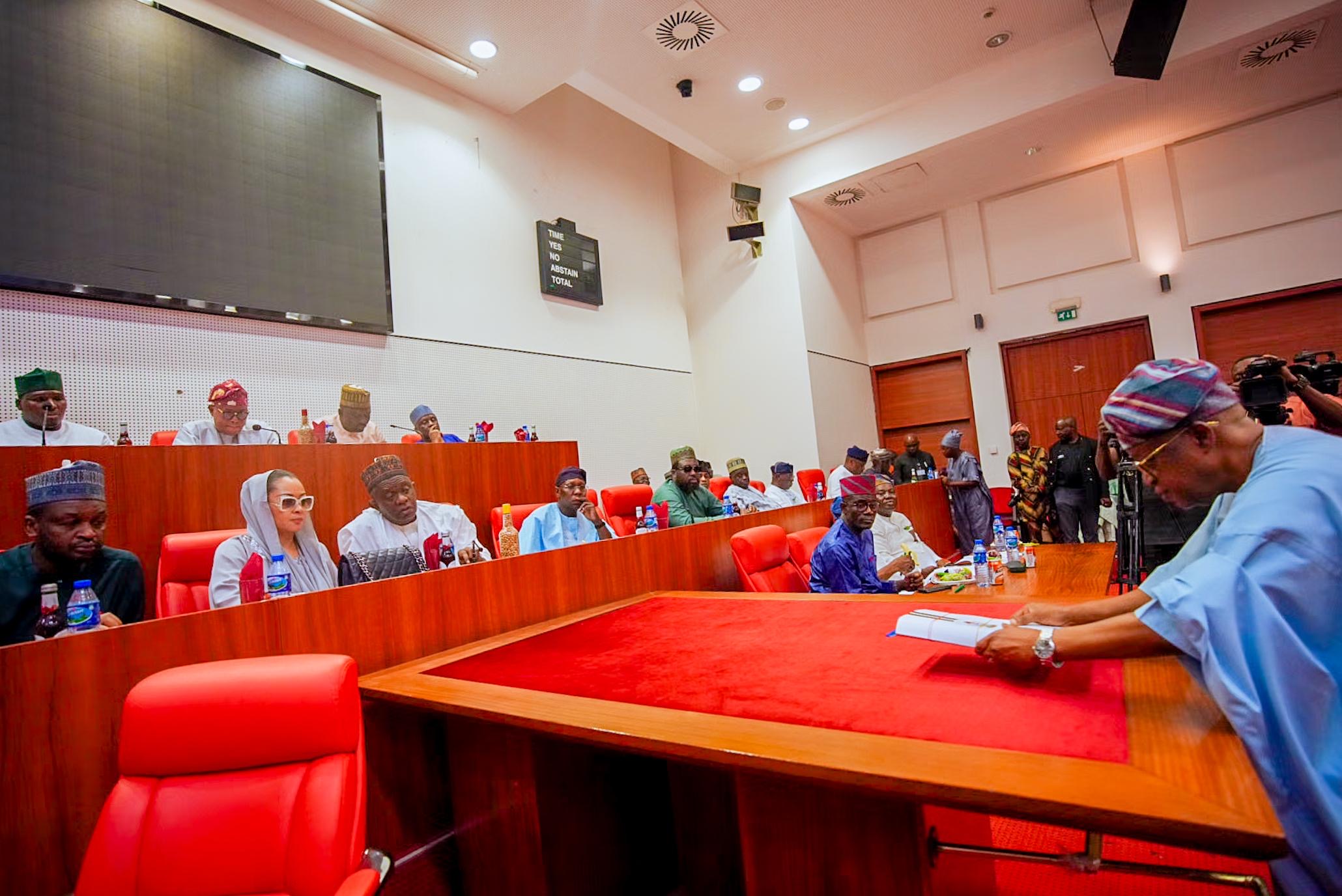
Oyetola made this known while defending the ministry’s budget before a joint sitting of the Senate Committee on Marine Transport and the House of Representatives committees on Ports and Harbours; Maritime Safety, Education and Administration; Shipping Services; Inland Waterways; and Ocean and Fisheries.
He said the proposed budget, which comprises ₦8.24 billion for capital expenditure, ₦453.86 million for overheads and ₦1.81 billion for personnel costs, would only sustain minimal operational continuity rather than deliver meaningful reforms or sectoral growth.

The minister explained that the ministry oversees interconnected subsectors including ports, shipping, inland waterways, fisheries and aquaculture, which collectively handle over 90 per cent of Nigeria’s international trade by volume, national food and nutrition security, and economic competitiveness. He noted that while agencies such as the Nigerian Ports Authority, Nigerian Maritime Administration and Safety Agency and Nigerian Shippers’ Council were self-funding and made significant remittances to the Consolidated Revenue Fund, their operations were being severely constrained by excessive deductions at source by the Office of the Accountant-General of the Federation.
According to him, these deductions had weakened liquidity and reduced the operational flexibility of key agencies responsible for maritime safety, port efficiency and regulatory oversight, with far-reaching consequences including port congestion, higher logistics costs, delayed cargo movement, revenue losses and inflationary pressures. He stressed that what appeared to be an accounting issue had become a national economic concern.
Oyetola also said that the 2026 budget of the Council for the Regulation of Freight Forwarding in Nigeria (CRFFN) was wrongly placed by the Budget Office under the Federal Ministry of Transportation despite the fact that it is an agency under the Federal Ministry of Marine and Blue Economy, saying the misalignment undermined clarity in oversight and policy coherence within the maritime logistics value chain.
On inland waterways, the Minister appealed for increased funding to curb accidents and loss of lives. He said water transport is globally recognised as significantly cheaper than road transport. He noted that Nigeria’s heavy reliance on road haulage for over 80 per cent of freight movement had worsened road deterioration and increased the cost of goods, arguing that safer and more efficient inland waterways would ease pressure on roads and lower logistics costs.
On fisheries and aquaculture, Oyetola said Nigeria’s annual fish demand of over 3.6 million metric tonnes far exceeded domestic production of about 1.4 million metric tonnes, sustaining imports valued at more than one billion dollars annually. He added that post-harvest losses of up to 30 per cent further reduced supply, despite fish being one of the most affordable sources of animal protein for Nigerian households. He assured that the Ministry is working hard to increase local fish production and reduce importation.
The minister disclosed that in 2025, the ministry’s revised capital budget of ₦3.53 billion recorded an actual cash release of just ₦202.47 million, representing about 1.7 per cent, while overhead releases stood at 35 per cent.
He said engagements were ongoing with the Ministry of Budget and Economic Planning to address the funding gaps in line with the Federal Government’s drive to diversify the economy through the marine and blue economy.
The Chairman of the Senate Committee on Marine Transport, Senator Wasiu Eshilokun, assured that the National Assembly would carefully examine the proposals, noting the strategic importance of the marine and blue economy to national development and economic resilience.
News
Perm Sec calls for stronger partnerships to advance Nigeria’s economic transformation
The Permanent Secretary, Special Duties, Federal Ministry of Finance, Mr. Mohammed Sanusi Danjuma, has called for deeper collaboration between government and professional institutions as Nigeria intensifies efforts to build a more resilient, competitive, and robust sustainable economy.
Speaking during a meeting with the leadership of the Nigerian Institute of Architects International Integrated Research for Development Conference Programmes (NIA IINFRADCO) in Abuja, Mr. Danjuma said the Federal Government recognises that achieving sustainable economic growth requires purposeful partnerships that harnesses professional expertise, innovation, and institutional capacity.
He noted that professional bodies have an important role to play in shaping policies, strengthening human capital, encouraging innovation, and supporting infrastructure development that delivers lasting value to Nigerians.
The Permanent Secretary described NIA IINFRADCO as a forward looking institution whose work in research, capacity development, and professional excellence aligns with the Federal Government’s drive to diversify the economy, improve productivity, and create opportunities for inclusive growth.
He stressed that the Ministry of Finance will continue to support meaningful engagement with institutions whose programmes contribute practical solutions to national development priorities.
Mr. Danjuma urged the Institute to sustain its commitment to innovation and professional development while strengthening collaboration with government and other stakeholders to unlock new opportunities for investment, enterprise, job creation, and sustainable infrastructure development.
He reaffirmed that strategic partnerships remain indispensable to building an economy that is stronger, more competitive, and better positioned to meet the aspirations of present and future generations.
Earlier, the Chairman of NIA IINFRADCO, Arc. M. B. Bello, said the Institute is committed to promoting professional excellence through research, capacity development, executive education, consultancy, and innovation to support sustainable national development.
He explained that the Institute seeks to bridge the gap between academic knowledge and professional practice while equipping architects and other built environment professionals with the skills needed to respond to emerging industry demands.
Adding that stronger collaboration between government, the private sector, academic institutions, and development partners is essential to achieving sustainable infrastructure and economic growth.
Arc. Bello noted that the Institute is positioning itself as a centre of excellence in architectural education, research, and professional development, with programmes focused on certification, policy advocacy, executive training, and consultancy to strengthen the built environment sector.
He expressed confidence that sustained collaboration with the Federal Government and other stakeholders would enhance innovation, improve infrastructure delivery, and contribute meaningfully to Nigeria’s long term economic development.
News
Sad: Ex-Nigerian Finance Minister, Ex-High Commissioner To UK, Alhaji Abubakar Alhaji Dies
Ex- Nigerian Minister of Finance and Sardauna of Sokoto, Alhaji Abubakar Alhaji, has died at the age of 88.
According to Daily Trust, family sources confirmed that the elder statesman died on Thursday morning at a hospital in Abuja, Federal Capital Territory, after a brief illness.
Alhaji served as Minister of National Planning and later Minister of Finance during the military administration of General Ibrahim Babangida. In 1992, he was appointed Nigeria’s High Commissioner to the United Kingdom after leaving the Finance Ministry. He served in London until mid-1996, when the military government of General Sani Abacha replaced him with Ambassador Uche Okeke.
A direct descendant of Shehu Usmanu Danfodiyo, Alhaji began his public service career in 1964 as an Assistant Secretary in the Federal Ministry of Finance. By 1975, he had risen to the position of Permanent Secretary in the Federal Ministry of Trade before returning to the Ministry of Finance as Permanent Secretary in 1979.
As Permanent Secretary, he managed Nigeria’s relations with external creditors and served on the country’s negotiating team for the Lomé II Agreement. His reputation for administrative competence earned him appointment as Minister of State for Budget and Planning in 1988 under the Babangida administration.
He served as Minister of Finance between 1990 and 1991, a period marked by the implementation of structural adjustment policies and Nigeria’s engagement with international financial institutions.
Following his ministerial service, he represented Nigeria as High Commissioner to the United Kingdom, where he was widely regarded for his measured diplomatic approach.
Beyond public office, Alhaji held one of Northern Nigeria’s most prestigious traditional titles.
He was turbaned Sardauna of Sokoto in 1990, succeeding to the revered title once held by the late Sir Ahmadu Bello, the Premier of Northern Nigeria who was assassinated in 1966.
As Sardauna, he was regarded as a custodian of the values and heritage of the Sokoto Caliphate.
News
Deregistration order: Judge Lifu’s conduct is a serious breach of judicial hierarchy-ADC Legal Adviser, Osunbor
…confirms NJC has party’s petition already
The African Democratic Congress (ADC) has said it has petitioned the National Judicial Council (NJC) against Justice Peter Lifu of the Federal High Court, Abuja, over his handling of the suit in which he ordered the deregistration of the party and four others.
ADC National Legal Adviser and ex- Edo State Governor, Senator Oserheimen Osunbor, revealed this during an appearance on Channels Television’s Politics Today on Wednesday, declaring that the judge’s conduct is a serious breach of judicial hierarchy.
“We had actually petitioned Justice Lifu to the NJC. We already have a petition against him, and we are pursuing it. This is even an additional reason for us to pursue it because it is incumbent on all of us to ensure that we have a sanitised judiciary in Nigeria,” Osunbor said.
The professor of law accused the judge of deliberately disregarding an order of the Court of Appeal directing him to stay proceedings in the matter.
“How flagrant can a violation be, more than what Lifu did? To say to the Court of Appeal, ‘Yes, I am aware; I have seen; I have received and acknowledged your stay of proceedings, but I will not obey it because you do not have any power to arrest my judgement.’ That is disturbing. For a lower court to completely disregard the order of a superior court is unprecedented. The rule of law thrives on obedience to court orders,” he added
Responding to questions about the possibility of further litigation, Osunbor expressed confidence that the Supreme Court would uphold the principle of obedience to court orders.
“The Supreme Court has repeatedly held that it will not tolerate the violation of court orders. No matter how perverse a court order may appear, it is not for anyone to disobey it. The court will come down very hard on anyone who violates a valid court order,” he said.
Osunbor also criticised recent moves to deregister opposition parties, noting that many Nigerians initially believed the Independent National Electoral Commission (INEC) was working in concert with those seeking to weaken the opposition.
His remarks came a day after the Court of Appeal in Abuja nullified the Federal High Court judgement directing INEC to deregister the ADC, Action Peoples Party (APP), Action Alliance (AA), Accord Party (AP), and Zenith Labour Party (ZLP).
In a unanimous judgement delivered on Tuesday, a three-member panel of the appellate court held that the June 15 decision of the Federal High Court was a nullity because it was founded on an incompetent suit filed by the National Forum of Former Legislators (NFFL), a body the court held lacked the legal capacity to institute the action.
Justice Abba Mohammed, who delivered the lead judgement, ruled that the trial court wrongly assumed jurisdiction and ignored evidence showing that the affected political parties had won elective positions in previous elections.
The appellate court also faulted Justice Lifu for proceeding with the case despite an earlier order directing him to stay proceedings pending the determination of an appeal.
The court described the trial judge’s action as “a form of judicial impertinence”, noting that the Supreme Court had previously held that a judge who disregards a superior court’s order could be considered “unfit for the bench”, describing such conduct as “judicial rascality.”
The appellate court consequently set aside the deregistration order, restored the legal status of the five political parties, and awarded costs against the NFFL, which had instituted the suit.
Justice Lifu had earlier ruled that the parties failed to satisfy the constitutional requirements for continued registration under Section 225A of the 1999 Constitution (as amended), citing their alleged poor electoral performance in the 2023 general elections and subsequent by-elections. He had also restrained INEC from recognising the parties or accepting candidates nominated by them for the 2027 general elections.
However, the Court of Appeal held that the trial court lacked jurisdiction to entertain the suit and ruled that all the affected political parties remain duly registered.
-
Sports21 hours agoJust in: Neymar Jr finally Confirms Retirement From Brazil Duty
-
News22 hours agoWe Are Already Campaigning With Performance, Elections Won’t Slow Projects, Says Wike(Photos)
-
News21 hours agoFinally, FG endorses herbal medicines to treat cancers, hepatitis B, others
-
News22 hours agoFake Presidential Council: HCSF Reveals Establishment Act Submitted is Fake
-
News21 hours agoJust in: Tinubu’s govt exceeds borrowing target as new debt jumps to N12.62tn
-
News21 hours agoPolice nab father-in-law of widow being harassed 8 days after her husband’s d*ath
-
News21 hours agoNigerian among three k!lled in UK fatal auto crash
-
News21 hours agoPFIPC Probe: Head of Civil Service finally admits due diligence failed, accepts responsibility