
News
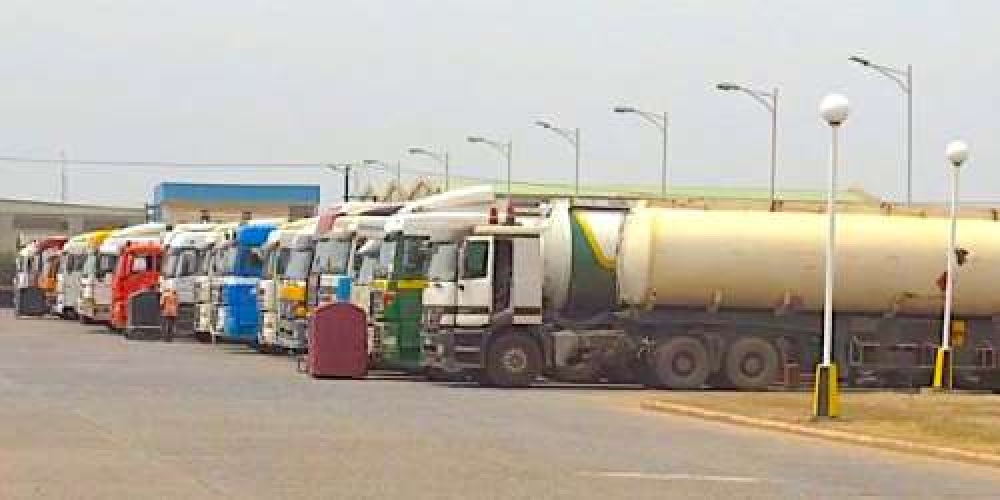
Tanker drivers threaten to stop petrol lifting Monday

- /home/naijuinz/public_html/wp-content/plugins/mvp-social-buttons/mvp-social-buttons.php on line 27
https://naijablitznews.com/wp-content/uploads/2024/02/Tanker-drivers.jpg&description=Tanker drivers threaten to stop petrol lifting Monday', 'pinterestShare', 'width=750,height=350'); return false;" title="Pin This Post">
- Share
- Tweet /home/naijuinz/public_html/wp-content/plugins/mvp-social-buttons/mvp-social-buttons.php on line 72
https://naijablitznews.com/wp-content/uploads/2024/02/Tanker-drivers.jpg&description=Tanker drivers threaten to stop petrol lifting Monday', 'pinterestShare', 'width=750,height=350'); return false;" title="Pin This Post">


Nigeria may witness another round of fuel scarcity as the Nigerian Association of Road Transport Owners, on Thursday, vowed to stop lifting petroleum products beginning from next week Monday due to the high cost of operations.
NARTO members have repeatedly raised concern over the high cost of diesel required to power their trucks for the transportation of petroleum products across the country.
Oil marketers told our correspondent on Thursday that diesel price is between N1,250 to N1,400/litre depending on the area of purchase.
NARTO’s President, Yusuf Othman, in a statement he issued in Abuja on Thursday, said the statement was an official announcement from the association’s headquarters that members of the group would park their trucks from Monday.
“Why? It is because what we spend on operations is more than what we get in total, both in local and bridging,” he stated.
Othman said NARTO members had being operating at a loss and it was no longer sustainable for them to endure the losses.
“We will have to suspend operations latest from now till on Monday. We cannot continue to operate at a loss. Most people have parked. A lot more are going to park. But from the point of the association itself, we are going to suspend operations on Monday,” he stated.
He said NARTO’s efforts to get the intervention of key stakeholders, the Federal Government and industry operators had not yielded positive results.
The NARTO president said the association had written letters on the unbearable cost of operations to the Chief of Staff to President Bola Tinubu; Minister of Petroleum Resources; Department of State Services; Nigerian Midstream and Downstream Regulatory Authority; Nigerian National Petroleum Company Limited; and oil marketers.
“We have written letters up to the level of the Chief of Staff to the President. We have written to the Minister of Petroleum Resources (Oil). We have written to the Director-General of SSS. We have written to NNPC’s boss. We have written to the NMDPRA. We have written to the major marketers,” Othman stated.
He stressed that despite the letters, there has been “no response.”
Analysing the market situation, which the members have endured for several months, he stated that the same freight rate that applied when former President Muhammadu Buhari was in ruling, was still subsisting.
“The Lagos to Abuja freight rate that was implemented when the dollar was N650 is still retained now that dollar is N1,615. Everybody is aware that all our consumables in terms of operation are not produced in the country.
“So, by virtue of the rate of dollars, every consumables has increased. But the freight they are paying us has been the same since Buhari’s time. So how is that feasible? During Buhari’s time, one dollar was N650. Today, dollar is N1,615. The average freight from Lagos to Abuja is N32,” he stated.
Othman further explained that “what I mean by local is that when you load in Lagos, you discharge in Lagos. And bridging means that when you load from Lagos, you come to Abuja. Lagos to Lagos, we are paid N120,000.
“AGO (diesel) alone to distribute fuel within Lagos is N140,000 because it is N1,400/litre. So, they give you N120,000 and you spend N140,000. So how do you want to operate? You’ve not talked about the cost of vehicles, cost of loading, driver’s allowance. That is for local.”
He stated that the cost of moving products out of Lagos or Warri to other states was far higher than what the government was paying to tanker drivers as bridging claims.
The government pays an agreed sum to transporters of petroleum products as bridging claims in order to ensure equality in the pump prices of these products across states, though this has not been the case.
NARTO is the umbrella organisation for commercial vehicle owners in Nigeria. The association represents the interests of those involved in haulage of petroleum products, general cargoes and passenger movement within the country and the West African sub-region.
NARTO has expressed several concerns regarding transporting petroleum products in Nigeria, impacting both their members and the overall efficiency of the process.
It has complained of poor road conditions, as frequent potholes, dilapidated bridges, and lack of proper maintenance lead to increased wear and tear on vehicles, higher running costs and longer journey times.
The association has also raised concern about traffic congestion, particularly around ports and depots, as this adds significantly to delivery delays and further increases operational costs.
On inadequate parking facilities, NARTO had stated that the lack of safe and designated parking areas often forced drivers to park in unsafe locations, leading to security risks and fatigue.
It had also raised concerns about the multiple checkpoints in Nigeria, as numerous security checkpoints could cause unnecessary delays and harassment for drivers.
Another issue is delayed payments, as late payments from oil marketers create cash flow problems for transporters.
Also the association has called for safety, because the theft of petroleum products, pipeline vandalism and other security threats create risks for drivers and equipment.
On policy and regulatory concerns, NARTO had observed that some depots limit access to specific transporters, impacting competition and efficiency.
It had stated that inconsistent or ambiguous regulations could lead to confusion and enforcement challenges, adding that transporters often struggled to access affordable financing for vehicle maintenance and upgrades.



Tragedy truck in Wula, in Eastern Boki, Boki local government area of Cross River state when a pastor allegedly beat a 14-year-old girl, Nancy Peter to death.
The incident sparked outrage after allegations that she was first beaten by her mother and later flogged by a pastor over claims of theft.
In a statement by the Cross River State Police Relations Officer, ASP Sunday Eitokpah, he disclosed that preliminary findings indicate that the victim, identified as Miss Nancy Peter, was first assaulted by her mother, Mrs. Agnes Peter, 45, before being taken to Pastor Samson Roman Dago, 43, who allegedly subjected her to further corporal punishment with a cane.
He said a full-scale investigation has begun to really establish the exact circumstances surrounding the incident and determine the involvement of all those linked to the tragedy.
The command also dismissed, for now, social media claims that the girl was sexually assaulted, saying no evidence had been found to support such allegations.
It added that medical examinations and other investigative steps were ongoing.
Some village sources said the teenager became unconscious after the beating and was rushed to a medical facility in Wula Community, where doctors confirmed her dead on arrival.
Vanguard gathered that the community has now been left in shock, as the death has revived painful concerns about the dangers of corporal punishment and the need for greater child protection.
A child rights advocates, James Ibor esq, and principal Counsel at Basic Rights Counsel Initiative, ( BRCI)said that physical punishment does not correct children; it scars them, deepens fear, and can lead to irreversible harm.
“It is reprehensible and heartbreaking , that in 2026 this kind of barbaric act will still be happening, after the child rights act was passed since 2023.
“I’m calling on the Commissioner for police not to allow this girl’s murder to go unpunished , neither should it be forgotten like other murders of this nature.
“A child should never be disciplined to the point of collapse. This is a tragedy that should never have happened, the police must do everything possible to ensure the girl get’s justice , it is a sad development, ibor said.

President Bola Tinubu returned to Abuja on Tuesday evening after spending the Eid-el-Kabir holiday in Lagos, where he carried out a string of political and official engagements, the Special Adviser on Information and Strategy, Bayo Onanuga, said in a statement.
The President’s aircraft touched down at the Presidential Wing of Nnamdi Azikiwe International Airport at 5:17 p.m., and he was received by senior government officials, including the Minister of the Federal Capital Territory, Nyesom Wike; Chief of Staff, Femi Gbajabiamila; National Security Adviser, Nuhu Ribadu; and Inspector General of Police, Tunji Disu.
During the holiday period, Tinubu received Vice-President Kashim Shettima and other visitors during the traditional Sallah homage from several political leaders. “I thank all those who came to observe the Sallah rites with me,” the President was quoted to have said in the statement, noting the visits by top legislators and party leaders.
The President also hosted the leadership of the Senate, led by Senate President Godswill Akpabio, and welcomed members of the Nigeria Governors’ Forum under the chairmanship of Kwara State Governor, AbdulRahman AbdulRazaq. APC stakeholders from Oyo State—including the party’s governorship candidate, Sharafadeen Alli—and the party’s House of Representatives and State Assembly candidates from Lagos were among those who visited the President during the holiday.
On Monday, Tinubu attended the International Fleet Review at Eko Atlantic City Waterfront, an event marking the 70th anniversary of the Nigerian Navy. There he commissioned three naval vessels—NNS Oloibiri, NNS Mambila, and NNS Gurara—underscoring his administration’s focus on maritime security. “The commissioning of these vessels is a step toward protecting our maritime domain and supporting national security,” the President said.
Also on Monday, President Tinubu met with the President of the Republic of Benin, Romuald Wadagni, in what the statement said “reinforced the longstanding bond of friendship, regional cooperation, and economic partnership between the neighbouring countries.”
The statement added that before the holiday, the President participated in the All Progressives Congress (APC) primaries in Lagos, voting in his own primary and receiving the party’s endorsement.
The statement reiterated that President Tinubu was endorsed nationwide by close to 11 million voters as the APC’s flagbearer for the 2027 presidential election.
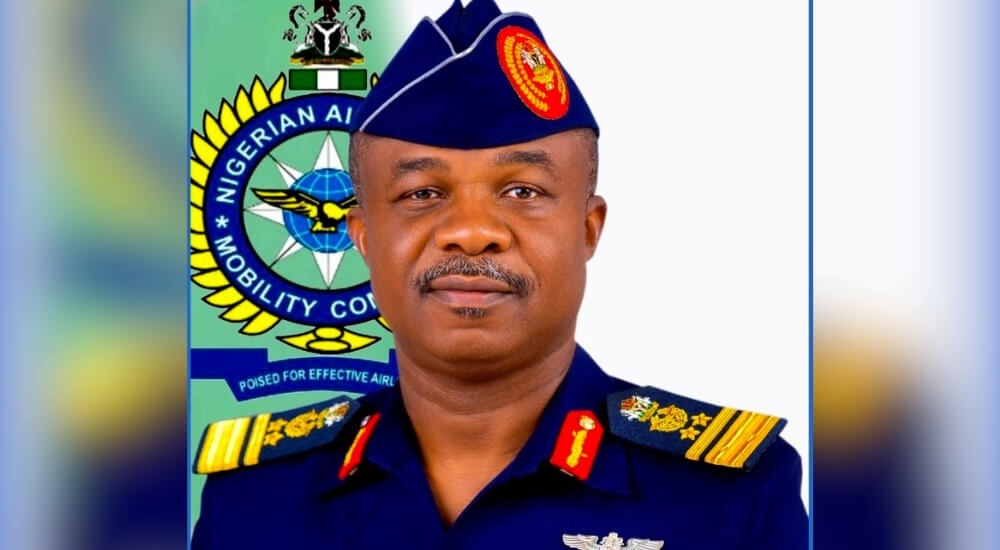
The Chief of the Air Staff (CAS), Air Marshal Sunday Aneke, has again reaffirmed the commitment of the Nigerian Air Force (NAF) to conducting professional, responsible, and people-centred air operations in its ongoing counter-terrorism and other security operations across the country.
Aneke also assured that the commitment of the NAF remains steadfast in its resolve to institutionalise Civilian Harm Mitigation and Response (CHMR) across all levels of operations as part of its commitment to global best practices.
The CAS made this known while declaring open the maiden NAF Seminar on Civilian Harm Mitigation and Response for strategic-level officers.
The one-day seminar, which was held at the MD Umar Blue Room, Headquarters Nigerian Air Force in Abuja, brought together an array of senior military officers, security stakeholders, policy experts, civil society representatives, journalists, and subject-matter experts to deepen institutional understanding of civilian protection considerations in contemporary military operations.
In his address at the seminar, Air Marshal Sunday Kelvin Aneke, who described the initiative as a significant milestone in the NAF’s continuous efforts to strengthen professionalism, accountability, and operational effectiveness, noted that the evolving security environment requires military leaders to balance mission accomplishment with the protection of civilian lives and property, stressing that strategic-level officers play a critical role in shaping operational decisions, institutional responses, and public narratives.
While noting that the NAF remains steadfast in its resolve to institutionalise Civilian Harm Mitigation and Response across all levels of operations as part of its commitment to global best practices, the CAS said maintaining public trust and confidence is essential to achieving lasting operational success.
He said, “Civilian Harm Mitigation and Response is not a constraint on our operational effectiveness; rather, it is a framework that enhances precision, improves decision-making, and ultimately preserves strategic legitimacy.”
He further stressed that civilian protection considerations enhance mission effectiveness by promoting informed decision-making, accountability, and operational discipline.
Earlier, in his welcome address, the Chief of Civil-Military Relations (CCMR), Air Vice Marshal Edward Gabkwet, described the seminar as a landmark initiative in the Nigerian Air Force’s ongoing efforts to strengthen professionalism, accountability, and civilian protection in military operations.
He noted that modern military operations demand a careful balance between mission accomplishment and humanitarian considerations, particularly in complex operational environments where civilians are often present.
According to the CCMR, “Operational success is not defined solely by tactical achievements, but by the ability to conduct operations with precision, discipline, restraint, and utmost regard for the safety, dignity, and wellbeing of civilian populations within areas of operation.”
Air Vice Marshal Gabkwet further highlighted the NAF’s deliberate efforts to strengthen Civilian Harm Mitigation and Response through doctrine development, training, and capacity-building initiatives. He noted that the seminar was organised at the directive of the Chief of the Air Staff to enhance strategic-level understanding of CHMR principles and equip senior leaders with practical tools for balanced, objective, and timely decision-making. He added that effective civilian harm mitigation requires collaboration among military, paramilitary, and civilian stakeholders, making the broad participation at the seminar both timely and essential.
The seminar featured presentations and discussions by renowned experts in civilian protection, human rights, and military operations, providing participants with a platform for constructive dialogue on best practices, operational lessons, and practical approaches to minimising civilian harm while maintaining operational effectiveness.
The Chief of the Air Staff expressed confidence that the outcomes of the engagement would further strengthen the Nigerian Air Force’s commitment to professionalism, operational excellence, and accountability while reinforcing its determination to protect civilians and uphold the highest standards in the conduct of air operations.

C’River: Pastor allegedly beats 14-yr old girl to death over claims of theft

Tinubu back to Abuja after Eid-el-Kabir break

Boko Haram: NAF Chief assures of people-centred air operations




-

 News16 hours ago
Wike Assures Protesting Teachers of Rescue Efforts, Warns Against Politicising Insecurity
-

 News22 hours ago
Six members of same family shot dead during domestic dispute in US
-

 News15 hours ago
BETNLAFF New Betting Platform Set To Hit Nigerian Markets
-
 News20 hours ago
FG stops three-month Pre-retirement leave for civil servants
-
 News16 hours ago
Defection Storm Rocks Reps as 13 Lawmakers Switch Parties, Chinda Quits Minority Leader Role
-
 News22 hours ago
Sad: Gunmen attack Soludo’s Chief of Staff Convoy, two policemen killed
-
News13 hours ago
Lawmakers Raise Alarm Over Ebola Risk, Demand Emergency Funds Support for NCDC
-
 News20 hours ago
Reps Gives MREIF Boss Final One-Week Reprieve Over Housing Fund Probe