…as Sesay say no child in ECOWAS region should be left without protection


By Gloria Ikibah
Speaker of Sierra Leone’s Parliament, Rt. Hon. Segepoh Solomon Thomas, has sounded a stark warning over the rising number of children living on the streets across West Africa, describing the trend as evidence of deep-rooted systemic failures. 
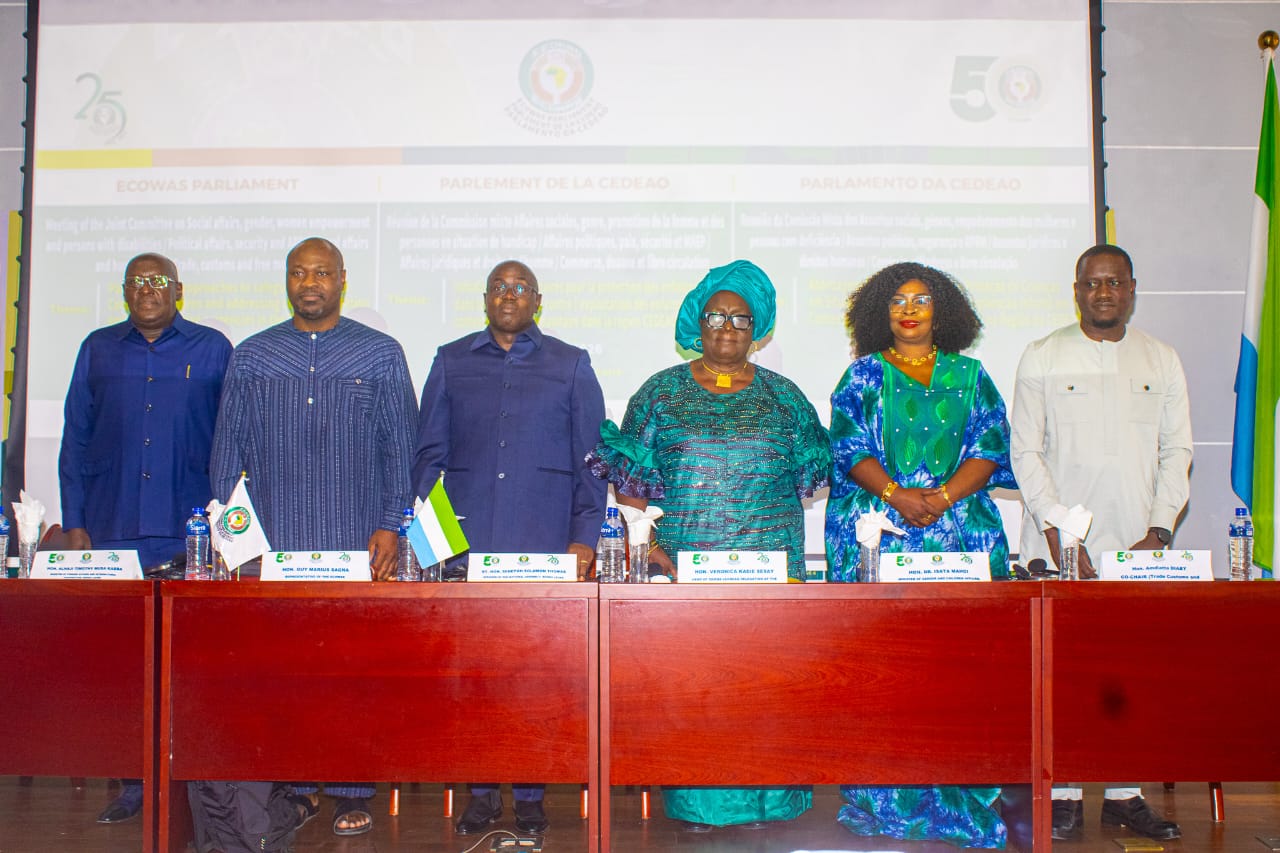
Speaking at the ECOWAS Parliament Joint Committee meeting in Freetown, he cast the situation as a defining moment for regional leadership, urging lawmakers to respond with urgency and resolve.
He welcomed the opportunity to take part in the session, which centres on protecting children in street situations, but stressed that the scale of the challenge requires more than routine engagement.
According to him, the region is approaching a critical juncture that calls for decisive, coordinated action from governments and parliaments alike.
He drew attention to the vulnerability of children forced onto the streets, noting that they remain among the most neglected groups, often exposed to exploitation, abuse and limited access to basic services.
The Speaker’s intervention adds to growing concern among policymakers that without stronger systems and sustained commitment, the crisis could deepen further across the sub-region.
He said: “We assemble at a time when our sub-region stands at a critical juncture—one that calls for moral clarity, legislative courage, and coordinated action. The theme of this meeting, ‘Parliamentary Approaches to Safeguarding Children in Street Situations and Addressing Child Exploitation in the ECOWAS Region’, is not only timely but speaks directly to the conscience of our collective humanity.
“The Moral Imperative Children in street situations represent one of the most vulnerable and marginalized populations in our societies. Their presence in our urban and peri-urban spaces is not merely a social anomaly; but a reflection of systemic gaps-economic inequality, family disintegration, weak social protection systems, and, in some cases, the enduring consequences of conflict and instability.
“As legislators and representatives of our people, we must recognize that the plight of these children is not just an isolated welfare issue. It is intrinsically linked to broader questions of human rights, sustainable development, public security, and social justice. Every child forced into the streets is a silent indictment of our governance systems-and a call to action.,” he noted.
Reflecting on Sierra Leone’s experience, he pointed to steady progress while conceding that serious hurdles still lie ahead.
He stressed that tackling the issue requires a well-rounded and coordinated approach, drawing on lessons learned over time.
“In Sierra Leone, we have emerged from a difficult past marked by civil conflict, yet we have remained steadfast in our commitment to rebuilding institutions that protect the dignity and rights of all citizens.
“We have learned that responses must be multidimensional—combining legislative oversight, community engagement, social services expansion, and partnerships”, he said.
Turning to the role of legislators, he made it clear that passing laws alone is not enough, insisting that parliaments must ensure those laws deliver tangible results.
He also called for stricter enforcement of existing legal frameworks and more rigorous monitoring of public spending on social protection programmes.
“The role of Parliament in addressing this challenge cannot be overstated. Our responsibilities extend beyond law-making; they encompass oversight, representation, and advocacy.
“Through Legislative Strengthening, we must ensure that our legal frameworks are robust, harmonized with international conventions, and responsive to emerging forms of exploitation. Laws must not only exist-they must be enforceable and enforced.
“Through Oversight and the effective use of Accountability mechanisms, Parliaments must rigorously oversee the implementation of child protection policies. Budgetary allocations for social welfare, education, and rehabilitation programs must be scrutinized to ensure they meet the scale of the challenge. With strong Advocacy and Public Engagements, we must use our platforms to shift societal attitudes. Children in street situations must not be stigmatized-they must be protected, rehabilitated, and reintegrated.
“Additionally, Regional Cooperation is a critical approach that must be advanced. Child exploitation often transcends national borders. Trafficking networks, for instance, operate across jurisdictions. This necessitates stronger legislative alignment and intelligence-sharing among ECOWAS Member States.,” he said.
Thomas outlined key proposals for a coordinated regional response, including a shared legislative framework, stronger cross-border enforcement, and improved monitoring systems. He also stressed the need for better data to guide policy decisions.
In one of the most striking moments of his address, he sought to reframe the narrative around vulnerable children.
“Children are not the problem; they are the promise,” he declared, adding that their situation reflects failures in governance rather than individual circumstances.
He urged leaders to move from reactive measures to prevention.
“We must therefore move from a paradigm of reaction to one of prevention—addressing the structural drivers that push children onto the streets,” he said.
“The children we speak about today cannot wait for incremental change; they require urgent, decisive, and sustained intervention.
“We have the moral responsibility to act now and address the exploitation of vulnerable children in the street,” he said, invoking Nelson Mandela’s words: “The true character of a society is revealed in how it treats its Children.
“Together, let us build a region where no child is left to survive on the streets, and where every child is afforded the dignity, protection, and opportunity they deserve.”
In her welcome address, Hon. Veronica Sesay described the gathering as both timely and necessary, extending a warm reception on behalf of the country’s leadership and people.
Turning to the substance of the meeting, she warned that the region faces a pressing child protection crisis.
“It is a great honour and a profound privilege for me to warmly welcome you all to Freetown for this important Delocalized Meeting of the Joint Committee of the ECOWAS Parliament,” she said.
Sesay who is also the Chairman of the Committee on Social Affairs, Gender, Women Empowerment and Persons with Disabilities explained that the theme of the meeting “Approaches to Safeguarding Children in Street Situations and Addressing Child Exploitation in the ECOWAS Region” speaks directly to the urgent responsibility placed upon us as legislators and policymakers.
According to her, “It underscores the need for strengthened legal frameworks, effective oversight, and enhanced cooperation among Member States to ensure that the rights and dignity of every child are protected.
“This gathering provides an important platform for reflection, dialogue, and peer learning among our parliaments. Over the coming days, we will examine existing regional and national frameworks, explore the structural and socio-economic factors that contribute to children living in street situations, and identify practical strategies for strengthening child protection systems across the region.
“This meeting comes at a very critical moment for our sub -region. Across ECOWAS Member States, children living and working in street situations remain among the most vulnerable members of our societies. They face heightened exposure to exploitation, violence, hazardous labour, substance abuse, and limited access to essential social protection services. These realities demand our collective attention, strong legislative action, and coordinated regional responses”.
Sesay also pointed to Sierra Leone’s recent legislative strides as evidence of what is possible.
“Our country has, in recent years, demonstrated how a responsive and people-centered legislative process can drive meaningful social transformation. Through the work of Parliament of Sierra Leone from policy conception, stakeholder consultations, committee scrutiny, and plenary debate, to eventual enactment-Parliament continues to serve as a vital instrument for safeguarding the rights of our citizens.
“It is within this legislative tradition that Sierra Leone has enacted landmark laws aimed at protecting children and advancing gender equality. Notably, the Child Rights Act 2025 reinforces the protection framework for children, aligning national standards with international obligations and addressing emerging vulnerabilities, including children in street situations. Similarly, the Prohibition of Child Marriage Act stands as a firm legislative commitment to ending harmful practices and ensuring that every girl child is protected from early and forced marriage, thereby preserving her dignity, health, and future opportunities.
“In further strengthening the protection of women and girls, the Gender Equality and Women’s Empowerment Act represents a progressive step in guaranteeing the freedoms, rights, and inclusive participation of women in governance and national development.
“Together, these legislative measures reflect not only political will, but also the deliberate use of parliamentary processes to expand freedoms and protect the liberties of women and the girl child in Sierra Leone. These achievements remind us that legislation is not merely an exercise in lawmaking, but a powerful tool for social justice, inclusion, and human dignity”, she added.
She urged that the deliberations must translate into concrete recommendations and actionable steps that strengthen protection systems.
Sesay called for unity and resolve across the region, pleading for the meeting to reinforce the Parliament’s collective resolve to ensure that no child in the ECOWAS region is left without protection, opportunity, and hope for a better future.