News
Labour shifts ground on N1m minimum wage as panel meets Today
- /home/naijuinz/public_html/wp-content/plugins/mvp-social-buttons/mvp-social-buttons.php on line 27
https://naijablitznews.com/wp-content/uploads/2024/02/NLC.jpg&description=Labour shifts ground on N1m minimum wage as panel meets Today', 'pinterestShare', 'width=750,height=350'); return false;" title="Pin This Post">
- Share
- Tweet /home/naijuinz/public_html/wp-content/plugins/mvp-social-buttons/mvp-social-buttons.php on line 72
https://naijablitznews.com/wp-content/uploads/2024/02/NLC.jpg&description=Labour shifts ground on N1m minimum wage as panel meets Today', 'pinterestShare', 'width=750,height=350'); return false;" title="Pin This Post">
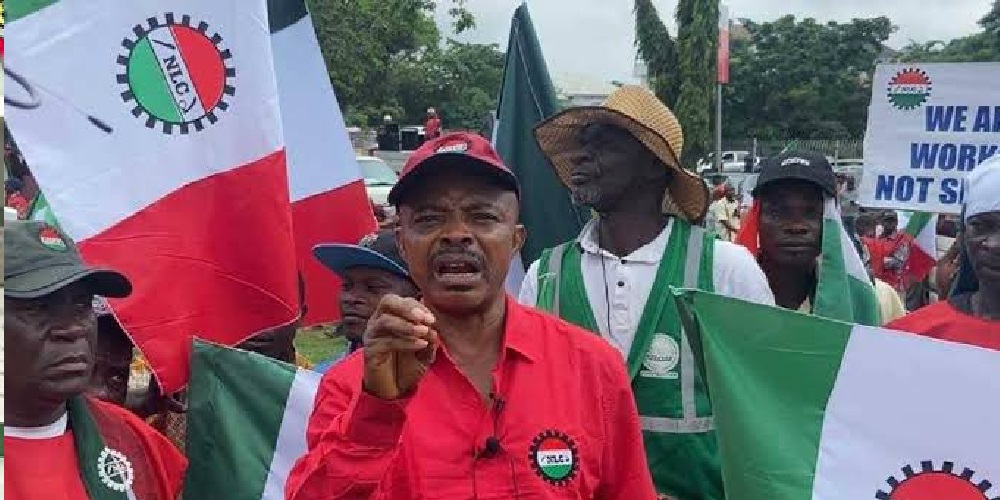
Indications have emerged that the organised labour is prepared to lower its demand for N1m minimum wage for workers in the country in line with realities on the ground. The shift in position will likely be communicated to the Federal Government during the second meeting of the tripartite committee on the minimum wage on Monday and Tuesday.

Gatherings confirmed that the meeting would enhance deliberations between all parties involved in negotiations to allow for the announcement of a new minimum wage on or before April 1 following the expiration of the current N30,000 minimum wage as provided by the law.
President Bola Tinubu, through his deputy, Kashim Shettima, had on January 30, 2024, inaugurated a 37-member panel on the new minimum wage at the Council Chamber of the State House in Abuja.

With its membership cutting across the federal and state governments, the private sector, and organised labour, the panel is to recommend a new national minimum wage for the country.
In his opening address at the inauguration, Shettima urged members to “speedily” arrive at a resolution and submit a report early as the current N30,000 minimum wage expires at the end of next month.
“The timely submission (of the report) is crucial to ensure the emergence of a new minimum wage,” Shettima said.
He also urged good faith in collective bargaining, emphasising contract adherence and encouraging consultations outside the committee.
In May 2017, the House of Representatives moved to amend the National Minimum Wage Act for a compulsory review of workers’ remuneration every five years.
The Minimum Wage Act of 2019 signed by former President Muhammadu Buhari empowers the committee to deliberate and come up with an agreed wage, which will be eventually ratified by the National Assembly after due legislative scrutiny.
Buhari had also signed the Minimum Wage Act that approved N30,000 for both federal and state workers in the same year.
However, President Bola Tinubu announced the discontinuance of fuel subsidy on May 29, 2023, which triggered a sharp rise in the general cost of living.
Although the administration approved an additional N35,000 wage award for six months starting from September 2023 to alleviate the impact of the subsidy removal, the organised labour maintained that this was only a provisional solution and called for a complete review of the minimum wage.
Chairing the panel is a former Head of the Civil Service of the Federation, Bukar Aji, who at the inauguration affirmed that its members would come up with a “fair, practical, implementable and sustainable” minimum wage.
The inauguration of the committee follows months of agitation from the organised labour, which expressed concerns over the Federal Government’s failure to inaugurate the new national minimum wage committee as promised during negotiations last October.
On the government’s side, members include the Minister of State, Labour and Employment, Nkeiruka Onyejeocha, representing the Minister of Labour and Employment; Minister of Finance and Coordinating Minister of the Economy, Mr Wale Edun, who was represented by the ministry’s Permanent Secretary, Mrs Lydia Jafiya.
Others are the Minister of Budget Economic Planning, Atiku Bagudu; Head of the Civil Service of the Federation, Dr Yemi Esan; Permanent Secretary, GSO OSGF, Dr Nnamdi Mbaeri; and Chairman/CEO, NSIWC – member/Secretary, Ekpo Nta.
Representing the Nigerian Governors’ Forum are Mohammed Bago of Niger State (North-Central); Senator Bala Mohammed, Bauchi State (North-East); Umar Dikko Radda, Katsina State, (North-West); Prof Chukwuma Soludo, Anambra State (South-East); Senator Ademola Adeleke, Osun State (South-West); and Otu Bassey, Cross River State (South-South).
From the Nigeria Employers’ Consultative Association, Adewale-Smatt Oyerinde, Director-General, NECA; Mr Chuma Nwankwo and Mr Thompson Akpabio; representing the Nigeria Association of Chambers of Commerce, Industry, Mines and Agriculture are Asiwaju Michael Olawale-Cole, National President; Ahmed Rabiu, National Vice-President; and Chief Humphrey Ngonadi, National Life President.
Representatives of the National Association of Small and Medium Enterprises are Dr Abdulrashid Yerima, President and Chairman of Council; Theophilus Okwuchukwu, private sector representative; Dr Muhammed Nura Bello, Zonal Vice-President, North-West; and also from the Manufacturers Association of Nigeria are Mrs Grace Omo-Lamai, Human Resource Director, Nigerian Breweries; Segun Ajayi-Kadir, Director-General, MAN; Lady Ada Chukwudozie, Managing Director, Dozzy Oil and Gas Limited.
From the organised labour are Joe Ajaero, President, Nigeria Labour Congress; Emmanuel Ugboaja; Prince Adeyanju Adewale; Ambali Akeem; Benjamin Anthony and Prof Theophilus Ndukuba.
From the Trade Union Congress of Nigeria are Festus Osifo, President, TUC; Tommy Etim Okon, Deputy President I; Kayode Surajudeen Alakija, Deputy President II; Jimoh Oyibo, Deputy President III; Nuhu Toro, Secretary-General; and Hafusatu Shuaib, Chairperson Women Comm.
Speaking with our correspondent on the deliberations of the committee following the announcement by the President of the NLC, Joe Ajaero, that rising inflation in the country might push the organised labour to demand N1m as minimum wage, a representative of the NLC, who is also a member of the committee, Akeem Ambali, said one of the principles of collective bargaining allowed all parties to look into all factors before an amount would be agreed on.
“The principle of collective bargaining allows compromise once the parties look at all factors to ensure an agreeable amount is reached,” he stated.
Speaking on the next sitting of the committee, Ambali said, “The second meeting of the minimum wage committee has been slated for Monday and Tuesday.
“On the timeline of March for the expiration of the current minimum wage, we hope that the committee, the Presidency, and the National Assembly will expedite action to ensure that the new Minimum Wage Act would have come to replace the old one by April 1, 2024.”
Ambali also expressed shock at the N500m approved by the President for the committee.
A leaked memo had disclosed the request for N1.8bn for the inauguration of the committee. The memo, signed by the Secretary to the Government of the Federation, Senator George Akume, and dated January 18, 2024, was addressed to President Bola Tinubu.
It underscored the committee’s need for substantial funds to kick-start its operations. The document sought approval for the release of N1bn, with the inauguration set for January 26, 2024. The memo also emphasized the legal requirement to establish a new minimum wage by April 1, 2023.
President Tinubu, in response to the memo, approved N500m for the committee’s inauguration, while acknowledging the importance of the committee’s work, and also highlighted the necessity of efficient resource management.
Commenting on the amount, Ambali said, “On the purported allocation of funds to the committee, it is unbelievable because we were never informed or given a kobo. We will unravel the fact behind this soon.”
The Deputy President of the Trade Union Congress, Tommy Etim, who also confirmed Monday and Tuesday’s meeting of the committee, stated that the N1m proposed minimum wage was reflective of the country’s economic realities.
He said it was unfortunate that a Nigerian worker was not earning up to N1m monthly but members of the National Assembly were being paid humongous amounts and acquiring luxury vehicles at the nation’s expense.
“How many months did those in the National Assembly put in that each of them is going home with huge amounts and they have vehicles worth N250m each?” he queried.
Etim told journalists that with the removal of the fuel subsidy, the cost of living had increased, causing the workers to lose hope.
The TUC deputy president added, “How much is for accommodation now? How much is food? By right, civil servants on Level 17 are supposed to be entitled to a two-bedroom flat. Now, a two-bedroom flat costs about N3.5m to rent in Abuja.
“Have you looked at the cost of cement and building materials now? Have you taken time to look at the cost of transportation? So, if you think that the workers cannot earn N1 m, and politicians are earning N3.5m in a month; who is fooling who?
“If the government cannot pay the N1m minimum wage; what the NLC has put forward is a proposal to let them come out to say what they can pay and let it be justifiable in line with the cost of living.”
Etim noted, “If insecurity does not allow people to go to the farm, what will they eat? It is like what the Bible describes as ‘to eat and die’. Have you taken time to look at the cost of a loaf of bread?
“Is it not because of the increase in the cost of bread that led to the revolution in Sudan in 1980? So, if Nigerians have been patient with the government, they need to pay.”
On food hoarding, he said, “If you have the advantage of having food, do not hoard it. Hunger does not recognise food hoarding, and it can turn into a crisis. Hoarding of food is a recipe for revolution.
“My advice is that those in privileged positions to have food should release it to those who need it rather than hoarding it. If you continue hoarding it, it is going to spoil.
“There is hunger in the country and the President is aware of it. That is why he had a meeting with the governors to let them know there is hunger in the country, so that they will release money and pay the necessary salaries they are supposed to pay, and should let people have access to money to reduce poverty.”
‘FG will consult’
Reacting to the N1m minimum wage demand by the organised labour, the Federal Government said it would prefer to wait for the final decision of the 37-man committee.
The Minister of Information, Idris Mohammed, told one of our correspondents that the government would take a reasonable position that would take account of the interest of the people after due consideration of Nigeria’s resources and other factors.
“It (N1m demand) is a proposal but the Federal Government will not pre-empt the work of the 37-man committee that includes labour itself. The government will do what is right in the interest of the nation as a whole, taking into account our resources and other factors.”
On whether the payment of N1m is sustainable by both federal and state governments in the face of the rising inflation, the minister said he would “leave Nigerians to imagine that.”
‘Tread with caution’
A developmental economist and financial expert, Dr Segun Ajayi, said the Federal Government must tread with caution in negotiating with the TUC and the NLC over their demands.
“N1m in this economy is not a lot of money, but the problem is that I am sure the government will say they cannot afford it. From the current economic realities, it is also obvious that the government cannot pay workers N1m as minimum wage. But, in negotiations, it is a good point to always start big. So, by the time it is beaten down and subtractions are made, the workers would have something substantial to bank on,” he said.
Another senior economist, Dr Ade Dayo, said, “The government and the Organised Labour must be reasonable. Nigeria cannot afford to enter into a recession. The country can also not afford another industrial action. The economy is at its lowest ebb. We have never had it this bad in more than 20 years.
“It is true that the N30,000 minimum wage is too meagre to take any worker through the month. The government must understand that. Labour, too, must also understand what the government can afford at this time. But, I believe that everything will melt at the negotiation table; compromises will be made and things will be fixed amicably.”
Also commenting, a senior lecturer at the Department of Political Science, Nnamdi Azikiwe University, Awka, Anambra State, Dr Ugwueze Emmanuel, said the government should consider the plight of Nigerian workers and respond speedily to their requests to increase the minimum wage to “something reasonable.”
He stated that N1m was not too much to ask for, adding that some politicians with little or no qualifications “earn much higher while doing so little.”
“The government people should not act like they are not in the country. How can a worker take home N30,000 as a monthly salary in this economy? How much is bread? How much is garri or rice? The government must also learn to see things from the lenses of the people,” he added.
News
UK Court acquits ex-Prtroleum minister, Diezani of all six bribery charges
Ex-Nigerian Minister of Petroleum Resources, Diezani Alison-Madueke, has been found not guilty by a London jury of six bribery charges following a rare corruption trial involving a former high-ranking energy official.
Alison-Madueke, who served as petroleum minister between 2010 and 2015 under former President Goodluck Jonathan, faced five counts of accepting bribes and one count of conspiracy to commit bribery. She denied all the allegations.
Prosecutors alleged that the 65-year-old former minister enjoyed “a life of luxury” in London, allegedly funded by oil and gas industry figures seeking lucrative contracts in Nigeria, a country long challenged by corruption and mismanagement in its oil sector.
However, Alison-Madueke maintained that she never received any bribes and insisted she had no control over the awarding of government contracts.
After proceedings at Southwark Crown Court, the jury returned not guilty verdicts on all six charges after more than 46 hours of deliberation, according to Reuters.
The acquittal marks a setback for British authorities, who had pursued the case for over a decade following corruption allegations against the former minister.
She was tried alongside oil industry executive Olatimbo Ayinde, 54, who faced one count of bribery related to Alison-Madueke and another count of bribery of a foreign public official.
Her brother, Doye Agama, 69, was also charged with conspiracy to commit bribery in relation to payments allegedly made to a church connected to him.
Both Ayinde and Agama denied the allegations and were likewise acquitted by the jury.
News
Judicial Independence Requires Security, Dignity for Judges — Tinubu
President Bola Ahmed Tinubu on Wednesday said judicial independence cannot be guaranteed without providing judges with adequate security, dignity and a conducive environment to discharge their constitutional responsibilities.
Tinubu stated this while commissioning 10 residential quarters for Justices of the Federal High Court in Katampe District, Abuja, a ceremony performed on his behalf by Vice President Kashim Shettima.
The President described the project as a strategic investment in the judiciary and a demonstration of his administration’s commitment to strengthening democratic institutions and the rule of law.
According to him, the provision of quality accommodation for judicial officers goes beyond infrastructure development and reflects government’s resolve to reinforce one of the most critical pillars of democracy.
“We are not just opening houses. We are reinforcing a key pillar of our democracy: the Judiciary. This is what vision and political will can deliver,” Tinubu said.
He noted that the commissioning came a day after the inauguration of similar residential quarters for Justices of the Court of Appeal, stressing that the projects were part of deliberate efforts to rebuild trust in public institutions under the Renewed Hope Agenda.
“Judicial independence is not an abstract idea. It requires a secure and dignified environment. We cannot ask judges to deliver justice without fear or favour if their safety and peace of mind are uncertain,” the President stated.
He added that the new quarters would provide security, comfort and dignity for judges while reaffirming government’s recognition of the vital role they play in interpreting the nation’s laws.
“By providing these modern quarters, we give our Justices security, comfort and dignity. This is our statement that Nigeria values those who interpret her laws,” he said.
Tinubu commended the Minister of the Federal Capital Territory, FCT, Nyesom Wike, for driving key infrastructure projects across Abuja and delivering on the mandate to transform the nation’s capital.
“When I gave you the task of making Abuja a world-class capital, I knew you would deliver. You have not disappointed me. From roads to projects like this, you have shown that performance is what counts in public service,” he added.
The President also appreciated the leadership of the judiciary for its collaboration with the executive arm, describing the relationship as beneficial to national development.
He charged the beneficiaries of the quarters to remain committed to fairness, transparency and integrity in the administration of justice.
“As we provide these homes, we ask for your continued commitment to swift, fair and transparent justice. Let these quarters be places of reflection and integrity. Let your judgments strengthen our democracy,” Tinubu said.
Earlier, the Minister of the Federal Capital Territory, Nyesom Wike, said the provision of modern accommodation for judges was a practical demonstration of government’s commitment to judicial independence and the rule of law.
Wike disclosed that after the completion of housing projects for Court of Appeal and Federal High Court Justices, the FCT Administration would on July 7 commission 22 residential quarters for judges of the FCT High Court.
“Yesterday, we commissioned 10 quarters for Court of Appeal Justices. Today, we are commissioning 10 quarters for Federal High Court judges. On July 7, we will commission 22 units for the FCT High Court, all built to the same standard,” he said.
The minister further revealed that construction of residential quarters for judges of the National Industrial Court and members of the Code of Conduct Tribunal had commenced and would be completed by January 2027.
According to him, judicial independence cannot be discussed in isolation from the welfare and working conditions of judicial officers.
“It cannot be independent when you cannot talk about giving them an efficient environment to work and improving their welfare. These are things that will make independence of the judiciary and uphold the rule of law,” Wike said.
He disclosed that the Katampe area was being developed as a dedicated judicial district, with plans for additional security infrastructure, including a police station, to guarantee the safety of judges.
Wike also urged beneficiaries to maintain the facilities and preserve the quality of the estate.
Chief Judge of the Federal High Court, Justice John Tsoho, noted that the long-standing accommodation challenges facing judges have been a matter of deep concern for decades, noting that the steps to address them were met with mixed reactions in the media.
Tsoho commended Tinubu and Wike for the bold steps taken despite critics in the media to provide befitting accommodation to judges and improve the welfare of judicial officers.
“As judges, while we shape the legal direction of society on a daily basis through the pronouncements we make in the courtroom, we seldom have the occasion to speak publicly without courting controversy or being misunderstood.
“It is deeply encouraging and gives immense hope to the judiciary and the nation at large to see that the welfare of career professionals is being taken seriously.
“This commitment allows our judicial officers to find peace and stability in their vital roles,” he said.
In her remarks, Minister of State for the FCT, Dr. Mariya Mahmoud, described the project as a significant investment in the administration of justice and the consolidation of democratic institutions.
She said the judges’ quarters reflected the Federal Government’s commitment to providing the judiciary with the infrastructure required to operate with dignity, independence and excellence.
Mahmoud commended President Tinubu for his visionary leadership and unwavering support for initiatives aimed at strengthening key institutions of governance.
She also praised Wike for his commitment to delivering transformative infrastructure projects across the Federal Capital Territory.
According to her, the newly commissioned quarters would enhance the welfare of judicial officers, strengthen justice delivery and serve as enduring symbols of government’s commitment to the rule of law and institutional excellence.
News
Nigeria positioned to lead Africa’s digital and creative transformation, EU Ambassador says
Nigeria is well positioned to lead Africa’s digital and creative transformation, Ambassador Gautier Mignot, European Union Ambassador to Nigeria and ECOWAS, said at the third edition of the Omniverse Africa Summit in Lagos.Speaking at the opening of the summit, Ambassador Mignot said Nigeria’s youthful population, entrepreneurial energy and growing innovation ecosystem provide a strong foundation for digital transformation, innovation and economic growth.“The new economy, digital and creative, offers a fantastic opportunity,” he said, noting that young Nigerians are uniquely positioned to drive innovation because they are part of a generation that has grown up with digital tools and technologies.
The summit brought together innovators, entrepreneurs, policymakers, researchers, investors, creatives and development partners from across Africa and beyond to explore how technology, innovation and collaboration can accelerate economic growth and create opportunities for young people.
Ambassador Mignot said the European Union and Nigeria have identified the digital and creative sectors as a strategic priority within their partnership and highlighted ongoing investments aimed at supporting the country’s digital transformation.“In Nigeria, the EU supports the entire digital value chain, from governance to infrastructure, from skills to entrepreneurship,” he said.He highlighted several ongoing initiatives, including a recently signed €45 million agreement between the European Union and Nigeria on digital development, support for the rollout of 90,000 kilometres of fibre-optic infrastructure across the country, the European Union’s contribution to Nigeria’s digital public infrastructure agenda, and support for the Three Million Technical Talent initiative.The Ambassador also pointed to programmes that support entrepreneurship, innovation and skills development, including the Digital Transformation Centre Nigeria, co-funded by the European Union and the German Government and implemented by GIZ.
The programme supports digital innovation, entrepreneurship and technology adoption among young Nigerians and businesses.He also highlighted the Nigeria Jubilee Fellows Programme, funded by the European Union and implemented by the United Nations Development Programme in partnership with the Federal Government of Nigeria, which helps connect young graduates with workplace opportunities and practical experience.German Ambassador to Nigeria, Annett Günther, said: “The future will not be built in silos. It will be built through cooperation across sectors, institutions and borders.
The future will be connected.”She described Nigeria as home to one of Africa’s most dynamic innovation ecosystems and said Nigerian entrepreneurs are increasingly shaping global trends in areas ranging from financial technology and artificial intelligence to agribusiness, health innovation, manufacturing and the creative industries.“Nigerian innovators are not simply adapting to global trends.
They are shaping them,” she said.Ambassador Mignot said one of the strengths of Omniverse Africa is its ability to bring together the full innovation ecosystem in a single space.“Policymakers, founders, investors, creatives, researchers, development partners and business leaders are all here, all together,” he said.“Because Nigeria’s digital future will not be built in silos. Technology, creative industries, finance, education, manufacturing, agriculture and public services are no longer separate worlds.
They are converging.”He said the summit provides an opportunity to transform conversations into partnerships and ideas into practical solutions that can support inclusive and sustainable growth.“The future is connected, but connection must be turned into impact,” Ambassador Mignot said.“Let us connect innovators with investors, policy with practice, creativity with technology, and Nigerian talent with global opportunities.”The summit featured discussions on digital transformation, artificial intelligence, entrepreneurship, green technology, future skills, research collaboration and innovation financing, highlighting the growing role of partnerships in shaping Africa’s economic future.The European Union partnered with Omniverse Africa as part of its broader commitment to supporting innovation, entrepreneurship, digital transformation and youth opportunities in Nigeria and across the continent.
-
Politics22 hours agoPDP Sweeps Adamawa LG Elections, Wins All 21 Councils, 226 Wards
-
News22 hours agoAkpabio Confident of APC Victory at Saturday’s Ekiti Governorship Poll
-
Entertainment22 hours agoWhy I Took Decision To Marry Myself On My 45th Birthday-Denrele Edun
-
News22 hours agoOshiomhole makes a U-turn over Natasha suspension forgery claim
-
News22 hours agoForget evidence, I clearly won 2023 presidential election – Peter Obi
-
Entertainment22 hours agoJudy Austin Breaks Silence, Threatens Legal Action Against Ex-Husband Over Podcast Allegations
-
Foreign22 hours agoUK imposes 70 new sanctions on Russia
-
Sports22 hours agoWorld Cup: Mbappe Bags Brace As France Beat Senegal