Foreign
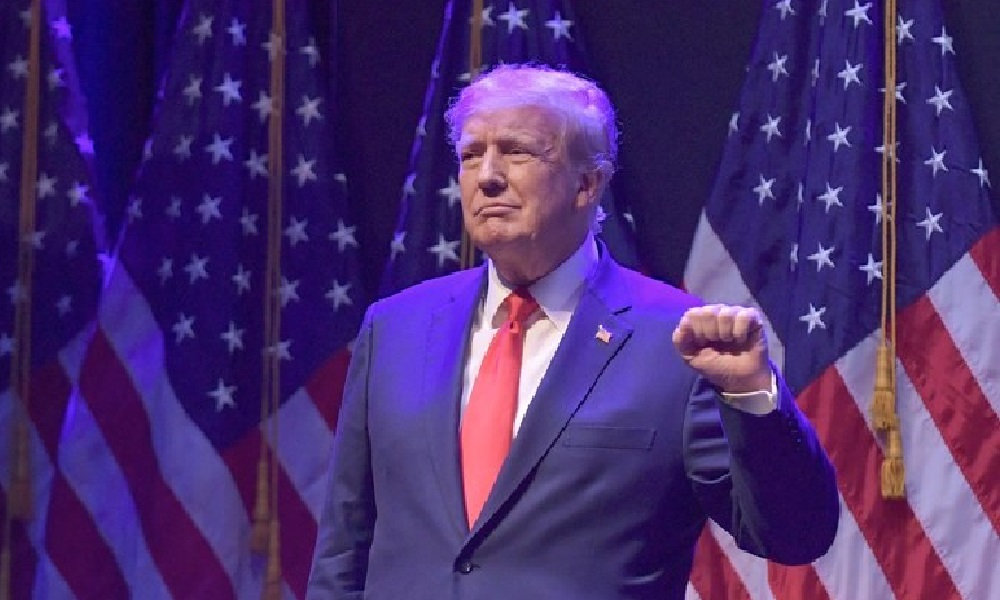
JUST IN: US Supreme Court restores Trump to ballot
- /home/naijuinz/public_html/wp-content/plugins/mvp-social-buttons/mvp-social-buttons.php on line 27
https://naijablitznews.com/wp-content/uploads/2024/03/Donald-Trump-1.jpg&description=JUST IN: US Supreme Court restores Trump to ballot', 'pinterestShare', 'width=750,height=350'); return false;" title="Pin This Post">
- Share
- Tweet /home/naijuinz/public_html/wp-content/plugins/mvp-social-buttons/mvp-social-buttons.php on line 72
https://naijablitznews.com/wp-content/uploads/2024/03/Donald-Trump-1.jpg&description=JUST IN: US Supreme Court restores Trump to ballot', 'pinterestShare', 'width=750,height=350'); return false;" title="Pin This Post">
…reject state attempts to ban him over Capitol attack

The Supreme Court on Monday unanimously restored Donald Trump to 2024 presidential primary ballots, rejecting state attempts to ban the Republican former president over the Capitol riot.
The justices ruled a day before the Super Tuesday primaries that states cannot invoke a post-Civil War constitutional provision to keep presidential candidates from appearing on ballots. That power resides with Congress, the court wrote in an unsigned opinion.

Trump posted on his social media network shortly after the decision was released: “BIG WIN FOR AMERICA!!!”
The outcome ends efforts in Colorado, Illinois, Maine and elsewhere to kick Trump, the front-runner for his party’s nomination, off the ballot because of his attempts to undo his loss in the 2020 election to Democrat Joe Biden, culminating in the Jan. 6, 2021, attack on the Capitol.
Colorado Secretary of State Jena Griswold expressed disappointment in the court’s decision as she acknowledged that “Donald Trump is an eligible candidate on Colorado’s 2024 Presidential Primary.”
Trump’s case was the first at the Supreme Court dealing with a provision of the 14th Amendment that was adopted after the Civil War to prevent former officeholders who “engaged in insurrection” from holding office again.
Colorado’s Supreme Court, in a first-of-its-kind ruling, had decided that the provision, Section 3, could be applied to Trump, who that court found incited the Capitol attack. No court before had applied Section 3 to a presidential candidate.
Donald Trump is facing four criminal indictments, and a civil lawsuit.
The justices sidestepped the politically fraught issue of insurrection in their opinions Monday.
The court held that states may bar candidates from state office. “But States have no power under the Constitution to enforce Section 3 with respect to federal offices, especially the Presidency,” the court wrote.
While all nine justices agreed that Trump should be on the ballot, there was sharp disagreement from the three liberal members of the court and a milder disagreement from conservative Justice Amy Coney Barrett that their colleagues went too far in determining what Congress must do to disqualify someone from federal office.
Justices Sonia Sotomayor, Elena Kagan and Ketanji Brown Jackson said they agreed that allowing the Colorado decision to stand could create a “chaotic state by state patchwork” but said they disagreed with the majority’s finding a disqualification for insurrection can only happen when Congress enacts legislation. “Today, the majority goes beyond the necessities of this case to limit how Section 3 can bar an oathbreaking insurrectionist from becoming President,” the three justices wrote in a joint opinion.
It’s unclear whether the ruling leaves open the possibility that Congress could refuse to certify the election of Trump or any other presidential candidate it sees as having violated Section 3.
Derek Muller, a law professor at Notre Dame University, said “it seems no,” noting that the liberals complained that the majority ruling forecloses any other ways for Congress to enforce the provision. Rick Hasen, a law professor at the University of California-Los Angeles, wrote that it’s frustratingly unclear what the bounds might be on Congress.
Hasen was among those urging the court to settle the issue so there wasn’t the risk of Congress rejecting Trump under Section 3 when it counts electoral votes on Jan. 6, 2025.
“We may well have a nasty, nasty post-election period in which Congress tries to disqualify Trump but the Supreme Court says Congress exceeded its powers,” he wrote.
Both sides had requested fast work by the court, which heard arguments less than a month ago, on Feb. 8. The justices seemed poised then to rule in Trump’s favor.
Trump had been kicked off the ballots in Colorado, Maine and Illinois, but all three rulings were on hold awaiting the Supreme Court’s decision.
The case is the court’s most direct involvement in a presidential election since Bush v. Gore, a decision delivered a quarter-century ago that effectively handed the 2000 election to Republican George W. Bush. And it’s just one of several cases involving Trump directly or that could affect his chances of becoming president again, including a case scheduled for arguments in late April about whether he can be criminally prosecuted on election interference charges, including his role in the Jan. 6 Capitol attack. The timing of the high court’s intervention has raised questions about whether Trump will be tried before the November election.
The arguments in February were the first time the high court had heard a case involving Section 3. The two-sentence provision, intended to keep some Confederates from holding office again, says that those who violate oaths to support the Constitution are barred from various positions including congressional offices or serving as presidential electors. But it does not specifically mention the presidency.
Conservative and liberal justices questioned the case against Trump. Their main concern was whether Congress must act before states can invoke the 14th Amendment. There also were questions about whether the president is covered by the provision.
The lawyers for Republican and independent voters who sued to remove Trump’s name from the Colorado ballot had argued that there is ample evidence that the events of Jan. 6 constituted an insurrection and that it was incited by Trump, who had exhorted a crowd of his supporters at a rally outside the White House to “fight like hell.” They said it would be absurd to apply Section 3 to everything but the presidency or that Trump is somehow exempt. And the provision needs no enabling legislation, they argued.
Trump’s lawyers mounted several arguments for why the amendment can’t be used to keep him off the ballot. They contended the Jan. 6 riot wasn’t an insurrection and, even if it was, Trump did not go to the Capitol or join the rioters. The wording of the amendment also excludes the presidency and candidates running for president, they said. Even if all those arguments failed, they said, Congress must pass legislation to reinvigorate Section 3.
The case was decided by a court that includes three justices appointed by Trump when he was president. They have considered many Trump-related cases in recent years, declining to embrace his bogus claims of fraud in the 2020 election and refusing to shield tax records from Congress and prosecutors in New York.
The 5-4 decision in Bush v. Gore case more than 23 years ago was the last time the court was so deeply involved in presidential politics. Justice Clarence Thomas is the only member of the court who was on the bench then.
Thomas has ignored calls by some Democratic lawmakers to step aside from the Trump case because his wife, Ginni, supported Trump’s effort to overturn the 2020 election results and attended the rally that preceded the storming of the Capitol by Trump supporters.
Foreign
Drug trafficking: Court sentences popular tv presenter, 11 others to death
An Egyptian court has sentenced popular television presenter, Sarah Khalifa and 11 others to death over their alleged involvement in the production and trafficking of narcotics.
Khalifa, 39, is a well-known television personality and the presenter of ‘Mission Impossible’, a programme that focuses on security and crime-related issues.
According to the state-linked Al-Ahram newspaper, a Cairo court found Khalifa and the 11 other defendants guilty of forming an organized criminal gang involved in procuring materials used to manufacture narcotics for trafficking.
The defendants were also convicted of possessing and carrying unlicensed firearms and ammunition.
The court reached the death sentence after seeking the religious opinion of Egypt’s Grand Mufti, as required by law in capital punishment cases.
However, the verdict is subject to appeal.
State-run Akhbar Al-Youm newspaper reported that the defendants were accused of producing synthetic drugs for trafficking after allegedly importing the materials needed for their manufacture from outside Egypt.
Authorities reportedly seized more than 750 kilogrammes of narcotics and raw materials during investigations into the case. They also discovered two apartments allegedly being used as drug laboratories, alongside unlicensed firearms and ammunition.
Khalifa, who also owns a plastic surgery clinic and a production company involved in organizing parties and events, was further sentenced to five years in prison with other defendants in a separate case involving the kidnapping and assault of a young man.
Egyptian law allows the death penalty for offences including premeditated murder, terrorism, certain rape cases and drug trafficking. Data from the Egyptian Commission for Rights and Freedoms showed that 541 death sentences were handed down in Egypt in 2025
Foreign
US Will Destroy Oil Tankers If American Ships Are Attacked – Hegseth Warns Iran
The United States has issued a fresh warning to Iran, threatening to destroy and sink Iranian oil tankers if Tehran launches further attacks against American naval vessels.
U.S. Secretary of War Pete Hegseth issued the warning on Saturday, September 5, 2026, shortly after American forces struck three Iranian oil tankers following what Washington described as ballistic-missile attacks by Iran’s Islamic Revolutionary Guard Corps (IRGC) against two U.S. Navy warships.
Hegseth, in a statement on X, said the United States would respond directly by targeting Iran’s oil fleet if American ships came under fire.
“It’s simple: if Iran shoots at U.S. ships, we will destroy (and sink) their oil tankers,” Hegseth said, adding that Iran only needed to refrain from attacking the U.S. Navy.
He further claimed that Iran’s oil tanker fleet was vulnerable because, according to him, Tehran lacked the naval and air capabilities necessary to protect the vessels.
“Iran’s oil tanker fleet is defenseless — Iran has no navy or air force. Our planes, ships & subs can strike them all,” Hegseth said, referring to areas under the U.S. Central Command and U.S. Indo-Pacific Command.
US strikes three Iranian tankers
The warning came after U.S. Central Command (CENTCOM) confirmed that American forces had struck three Iranian crude oil carriers.
CENTCOM said the action followed missile attacks by the IRGC against a U.S. aircraft carrier and a guided-missile destroyer. According to the command, both American warships successfully evaded the missiles and no U.S. personnel were injured.
The American military identified two of the vessels as M/T Downy, which was struck off Kharg Island, and M/T Stark 1, targeted near Jask.
Both vessels were described by CENTCOM as “permanently disabled.”
A third tanker, M/T Kylo, also known as Noxen, was attacked in the Gulf of Oman. CENTCOM said the crew was warned to abandon the vessel before it was destroyed.
The U.S. military said the tankers were connected to what it described as a multibillion-dollar “shadow network” allegedly used to finance Iran’s Revolutionary Guard and its regional allies.
US threatens wider action
The commander of U.S. Central Command, Admiral Brad Cooper, also warned that Washington would impose an even greater economic cost on Tehran if Iranian forces continued attacking American vessels.
“If you shoot at two of our ships, we will impose an even higher economic cost — taking out three of yours,” Cooper said.
He added that the United States would not hesitate to defend its forces and, if necessary, destroy Iran’s “limited and exposed oil fleet.”
The latest threats signal a potentially significant expansion of the maritime confrontation between Washington and Tehran, with Iranian oil shipments increasingly becoming a direct target of U.S. military pressure.
Iran condemns attacks
Iran has condemned the American strikes on its oil tankers, describing the attacks as illegal and warning that Washington and its allies would bear responsibility for the consequences of continued attacks.
Iranian authorities have also warned that further attacks on Iranian vessels could trigger retaliation against American interests in the region.
The escalation is particularly significant because it is unfolding around the Strait of Hormuz, one of the world’s most important energy shipping routes.
The waterway connects the Persian Gulf with the Gulf of Oman and is a critical route for global oil supplies. Continued attacks on commercial vessels could therefore have wider implications for international energy markets and global shipping.
With the United States now openly threatening to target Iran’s oil fleet in response to attacks on its Navy, the latest confrontation could mark a new and more dangerous phase in the ongoing U.S.-Iran conflict.
Foreign
UN Backs New World Map To Correct Africa’s Distorted Size
The United Nations General Assembly has overwhelmingly backed a Togo-led resolution calling for a more accurate representation of the world’s continents, particularly Africa, on global maps.
The resolution, “Correct the Map: Rebalancing Global Cartographic Representation and Promoting Equitable Representation of the World’s Regions, Particularly Africa,” was adopted on Friday, September 4, with 164 countries voting in favour, six abstaining and only the United States voting against.
The initiative promotes the gradual adoption of the Equal Earth projection, which represents the relative areas of continents more accurately than the centuries-old Mercator projection. The Mercator map, developed in 1569 primarily for navigation, significantly enlarges landmasses closer to the poles while making equatorial regions such as Africa appear disproportionately smaller.
Togo, which spearheaded the initiative with African Union backing, argued that maps are not merely geographical tools but also shape how societies perceive the world and their place in it.
The resolution is not legally binding and does not ban the Mercator projection, which remains useful for maritime navigation. Instead, it encourages governments, educational institutions and other users to consider more geographically accurate alternatives.
The vote also exposed differing political interpretations of the initiative. The United States was the sole country to oppose the resolution, arguing that the United Nations should concentrate on more pressing global challenges rather than what Washington characterised as an ideological agenda.
The measure nonetheless represents a significant diplomatic victory for African countries seeking to challenge longstanding distortions in the way the continent is visually represented on commonly used world maps.
Africa has not changed its size. The map is finally being asked to show it.
-
News21 hours ago‘Provide Evidence El-Rufai Paid Bandits To Kill Kaduna People’ – Ex-Gen Queries Defence Minister
-
News23 hours agoCourt of Appeal Upholds Order Against Mark-Led ADC Congresses, Declares Exercises Null and Void
-
News22 hours agoTwo Policemen fired over death of UNIPORT graduate in Port Harcourt
-
News23 hours agoPopular Journalist, Gloria Steinem Dies At 92
-
News21 hours agoStop empowering Nigerians with okada, Defense minister tells govs
-
Sports19 hours agoSad! Military jet crashes during airshow
-
Sports22 hours agoWilliams sisters lose in thrilling return to US Open doubles
-
News22 hours ago15 minors sold for N2m each rescued by NSCDC men