
News
Nigeria not alone in SIM card registration


- /home/naijuinz/public_html/wp-content/plugins/mvp-social-buttons/mvp-social-buttons.php on line 27
https://naijablitznews.com/wp-content/uploads/2024/03/images-34.jpeg&description=Nigeria not alone in SIM card registration', 'pinterestShare', 'width=750,height=350'); return false;" title="Pin This Post">
- Share
- Tweet /home/naijuinz/public_html/wp-content/plugins/mvp-social-buttons/mvp-social-buttons.php on line 72
https://naijablitznews.com/wp-content/uploads/2024/03/images-34.jpeg&description=Nigeria not alone in SIM card registration', 'pinterestShare', 'width=750,height=350'); return false;" title="Pin This Post">


By Sonny Aragba-Akpore
While some Nigerians bicker and are uncomfortable with the Subscriber Identification Module (SIM) card registration,and integration with the National Identity Numbers (NINs)it should be noted that the country is not alone in this exercise even when it appears to be a late comer.
Indeed,Nigeria is a late starter in this regard.
Although,we must admit that there have been bottlenecks and complexities dogged by inconveniences dotting the process,the exercise is for the general good of the people.
But victims of barred SIM cards seem to have limited understanding as to why the exercise was introduced at all.
In reality,government has advanced several reasons for the exercise primarily linked to security challenges and activities of criminal elements in the society.
Financial crimes through SIM swap underlines why government imposes SIM registration to protect consumers .Kidnappings for ransom,banditry and threats to lives via telephone are also strong reasons for the exercise.
It is also means of verifying the identity of a SIM user and safeguarding both the user’s identity and mobile line from SIM related crimes .
Besides curtailing crimes,the sim reg strengthens capacity of Law Enforcement Agencies to tackle criminal use of mobile phones by checkmating activities of criminals.
This equally helps in identity verification process and thus enables more secured transactions and interactions using mobile devices to boost confidence and participation in the digital economy.
Nigeria took a decision to go beyond just the SIM card registration but to link such SIM cards to their National Identity Numbers (NINs).
In December 2023,the regulator,Nigerian Communications Commission( NCC) ordered Mobile Network Operators(MNOs) to disconnect and bar Subscribers whose SIM cards were not linked to their NINs by February 28,2024.
By that date,no fewer than 42million subscribers were disconnected and barred from their various networks.
Government took the decision of this linkage in order to minimize criminal activities and other vices perpetrated via telecommunications networks.
The country occupies an unenviable cybercrime
position in global crime index.
So in order to curtail and address all of these challenges,government said,register your SIM card so we know who owns which line especially now that terrorism and kidnapping for ransom have become a major revenue avenue for alleged criminals..
Barring improperly registered SIM cards was a long route taken by the Nigerian Communications Commission (NCC).
Through several deadline extensions,the integration of SIM card to NIN data began in December 2020 and was officially closed on April 4, 2022 after which MNOs were consequently directed to suspend services through one way barring to SIMs not associated with NIN with effect from that date.
An official explained that “In this regard, SIMs not associated with NINs were partially barred
for outgoing calls and subsequently removed after integrating them to their NINs.”
And under the Know Your Customer (KYC) drive,quite a number of subscribers NINs were unverified against the KYC records associated with the SIM and require regularisation
including subscribers with over 100 SIMs (and in some cases more than 10,000) associated with NINs that are unverified and as such the identities of the actual SIMs users cannot be ascertained.
“This has grave national security implications, necessitating the robust verification requirements and subsequent barring of these SIMs to ensure as may be required and cleanup of the sim registration database “ another official explained.
Elsewhere in the world ,no one gets connected to any network on arrrival without proper documentation including biometrics,passport photos,fingerprints and others.
For instance,in major economies like the United Kingdom,the United states,Canada,Japan .China and others,no visitor gets connected to any network without proper documentation including biometric identification.
So Nigeria is not alone in the quest for proper identification of subscribers and users of telecommunications services.
African countries with mandatory SIM registration laws include Algeria, Angola, Benin, Botswana, Burkina Faso, Burundi, Cameroon, Central African Republic, Chad, Congo, Côte d’Ivoire, Democratic Republic of Congo, Egypt, Equatorial Guinea, Eritrea, Ethiopia, Gabon, Gambia, Ghana, Guinea, Guinea-Bissau, Kenya, Lesotho, Liberia, Libya, Madagascar, Malawi, Mali, Mauritania, Mauritius, Morocco, Mozambique, Niger, Nigeria, Rwanda, Sao Tome and Principe, Senegal, Seychelles, Sierra Leone, Somalia, South Africa, South Sudan, Sudan, Swaziland, Tanzania, Togo, Tunisia, Uganda, Zambia, and Zimbabwe.
Amidst the widespread adoption of this law on the continent, critics have challenged the strategy especially because it has not adequately curbed the challenges that it intends to tackle stating that the risks of SIM card registration, outweigh any possible benefits.
In South Africa, the Right2Know Campaign took telecom operators—MTN, Cell C and Telkom— to court on the transparency in handling data provided during SIM registrations. Pre-paid SIM cards are preferred by many mobile phone users.Even at that,Mobile Network Operators have adopted the Know Your Customers (KYCs) module in many African countries.
And the government of Nigeria has gone beyond the KYC by Insisting that all subscribers link their SIM card to the National Identification Number (NIN).
Is there any problem with this?
Many Nigerians think there is but this writer has a different opinion.
The NCC been in the process of SIM registration since 2011 but Some subscribers thought it was an huge joke until the NCC came hard on barring nearly 42million unconnected subscribers,to verified NINs ,after which everyone saw the regulator as serious.
And today,the recalcitrant subscribers remain disconnected from their various networks.
They have between March 29 and April 15,2024 to link their SIM cards to their NINs.
During the course of weeding the system to be sure that the barring exercise is done correctly without hurting innocent subscribers,the NCC found out that there were situations where one single subscriber had 10,000 SIM cards in his name.Apart from multiple pre-registrations ,there were also situations where people even had multiple National Identification Numbers (NINs) and it became even more complicated to observe.
As the cases and different scenarios turned out,the NCC had no choice but to barr those SIM cards based on these discrepancies.
So while affected victims bare their fangs on the regulator and Mobile Network Operators (MNOS),the blame rests squarely on the subscribers who probably never believed nothing would happen afterwards until it happened.They were cut off from the various networks.
Although the NCC thinks it had done its utmost based on the extant laws and regulations,operators are worried about the number of subscribers lost and by implication,revenue losses too.
They think critically too that it will not be out of place to extend the time line for the SIM and NIN linkage.
To some operators,the process should be Work In Progress to enable those beleaguered subscribers time to do the right thing.
Aside the turbulence experienced by the regulator in the weeding exercise,operators have had to contend too with threats from subscribers who are victims of the exercise.
Workers in various locations and operators outlets have had to contend with these visible threats from the subscribers who felt peeved by the exercise blaming everybody else except themselves for the disconnected SIM cards.
But there is another angle to the crisis.
The National Identity Management Commission (NIMC),the custodian,author and finisher of NIN has not lived up to its billings despite huge funding by government and some MNOs who went outside their financial plans to create possibilities for ease of NIN registration exercise.
Nigerians believe that the registration process for NIN has been clumsy and sloppy and NIMC has not helped matters as it maintains sealed lips over its inefficiencies.
Essentially,understaffed NIMC,s resort to the use of registration agents has not helped the situation either as there have been alleged under the counter transactions that have left many registrations incomplete and so not captured in the database.
Besides,there are millions of would be registrations that were captured but not located anywhere.
Indeed some of the SIM and NIN linkage victims were believed to have been traced to the inability of NIMC to be at home to its responsibilities thus standing out as a weak link in the whole exercise.
Despite the reported investments on equipment by some MNOs to facilitate the registration of NIN by NIMC,there is very little improvement in that regard.
That is why the MNOs plead with the NCC for extension of time to allow their subscribers to link their SIM cards to the NIN.
The disconnection and barring of subscribers had been phased by the NCC .
The first phase ended on February 28,2024 with over 40million subscribers barred.
The second phase is due for March 29,2024 with another category of subscribers to be disconnected and barred while the third phase will be on April 15,2024 whereby subscribers with more than four SIM cards linked to a single NIN will be barred.
Describing the next phases of disconnections are massive,NCC officials said this will be done based on the anomalies discovered on the networks showing massive duplications of SIM cards and NINS traced to single individuals,and some instances where single individual could register as many as 1,000 SIM cards with multiple NINs, and thereby negating the security architecture of the country.
The March 29 disconnection exercise will focus on subscribers that have more than five registered SIM cards that are attached to unverified NIN, while the April 15 disconnection exercise will address subscribers that have less than five registered SIM cards that are attached to unverified NINs.
Worried by manifest revenue losses experienced as a result of the massive disconnections,MNOs are pressing for extension of the March 29 and April 15,2024 deadlines for more disconnections.
“This extension will cushion huge revenue losses suffered after the February 28 disconnection exercise, where several SIM cards belonging to our valued customers were barred” according to an official of one of the MNOs .
Although the NCC is not averse to the extension being sought by the operators,”they must present empirical evidence to justify this extension.Data of losses incurred and how this has affected their operations should be presented to the Commission,”an NCC official volunteered to this writer.
NCC said it was aware of some of the hindrances encountered by subscribers who have not been able to link their SIM cards to their NIN, despite the efforts to do so, but encountered some network problems experienced on the NIMC platforms but the network providers have a role to play especially in terms of advocacy to educate embattled subscribers on the way forward.
The advocacy should also focus on the online registration and linkage like banks do for customers linking their accounts to their Bank Verification Numbers( BVNs).
MNOs have been austere in information dissemination to guide as possible on what to do so they know what to do and how to go about it.
In addition to these,the operators apathy to the plights of subscribers may have added to the frustration of subscribers.
#####
…as NDLEA nabs kingpins
. Recovers 401 military grade ammunition concealed in palm oil kegs, others in Kaduna, Katsina; seizes UK-bound tramadol consignment in black soup containers
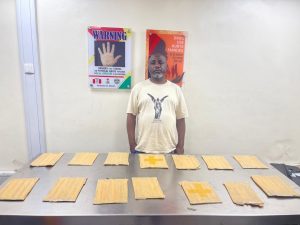
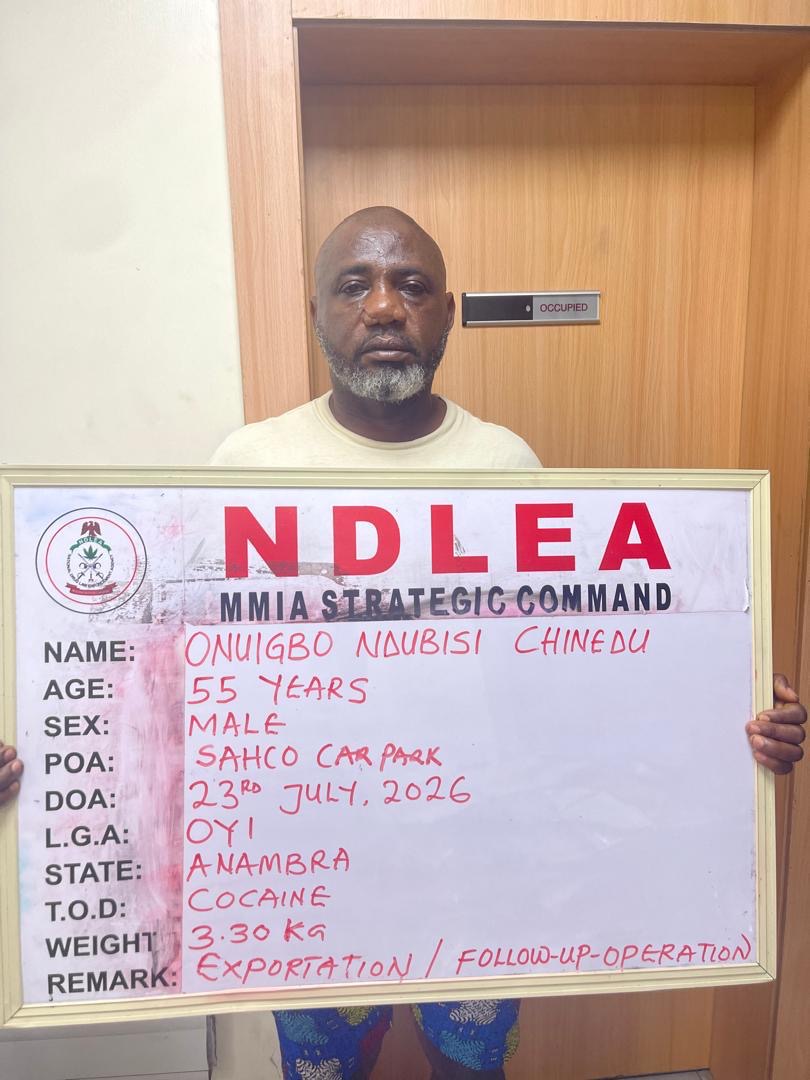
A 55-year-old businessman, Onuigbo Ndubisi Chinedu who deals in clothing at the popular Balogun market, Lagos Island, has been arrested by operatives of the National Drug Law Enforcement Agency (NDLEA) over attempt to export 3.30 kilograms of cocaine concealed in walls of cartons used to package foodstuffs going to the United kingdom.
Onuigbo was arrested on Thursday 23rd July 2026 following the interception of his cocaine consignment at the export shed of the Lagos airport the previous day, Wednesday 22nd July by NDLEA operatives. In the course of investigation, three cargo agents: Nkwor Onyekachukwu Justina; Adeleke Abiola Taoheed; and Ukanwa Grace Pilgrim, who handled the shipment were initially arrested leading to the arrest Kenneth Okakpu who delivered the consignment to the cargo agents for shipment to the UK.
Okakpu’s arrest provided the lead to identifying Onuigbo as the kingpin behind the syndicate and his eventually arrest while attempting to send another consignment of cocaine to the UK.
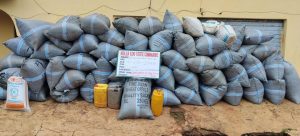
A 31-year-old entrepreneur Emmanuella Chukwu-Edo also involved in illicit drug trafficking was on Tuesday 21st July arrested at her Surulere Lagos residence by NDLEA operatives following the seizure of her consignment of 2.80kg Loud, a synthetic strain of cannabis, which arrived from the United States aboard a United Airlines flight on Monday 20th July.
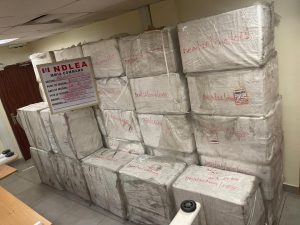
In another interdiction operation at the Lagos airport, a total of Two Million Two Hundred and Forty (2,240,000,000) pills of Tapentadol 250mg worth over N2.2 billion in street value were recovered from a shipment from India aboard an Air Maroc flight during a joint examination of the cargo on Friday 24th July. The exercise was based on an intelligence received and processed by NDLEA. This came on the heels of the seizure of a consignment of tramadol buried in containers of black soap heading to the UK. The shipment was intercepted by NDLEA operatives at a courier firm in Lagos on Wednesday 22nd July.

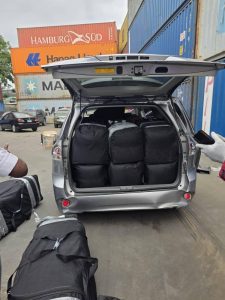
At the Apapa seaport in Lagos, a container of three vehicles used to conceal a total number of 4,777 sachets of Canadian Loud weighing 2,388.5kg worth over N7.1 billion in street value, was uncovered during a joint examination of the shipment on Monday 20th July.
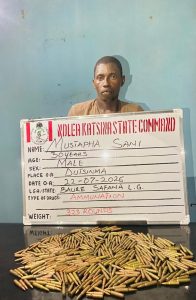
A suspect Mustapha Sani, 30, was on Wednesday 22nd July nabbed by NDLEA operatives
on patrol operation at Baure, Safana LGA, Katsina state where he was found with 323 rounds of military grade ammunition consisting of 200 pieces of 7.62mm and 123 rounds of 7.6mm neatly concealed.
Another suspect, Abubakar Amadu, 30, was arrested by NDLEA officers on stop and search operation at Jere, along Abuja-Kaduna expressway where he was found with 73 RLA, 7.62mm ammunition hidden in kegs of red oil. Both suspects have been handed over to the relevant security agency for further investigation.
In Edo state, raid operations at Ilushi community, Esan South East LGA, on Sunday 19th July led to the seizure of 1,286kg cannabis and 86kg cannabis seeds from a warehouse while Ojore Onweze, 45, was caught with 60kg skunk and George Agwumede, 30, nabbed with 13kg of the same substance.
With the same vigour, Commands and formations of the Agency across the country continued their War Against Drug Abuse (WADA) sensitization activities to schools, worship centres, work places and communities among others in the past week. These include: WADA sensitization lecture to students and staff of Government Day Secondary School, Sabon Wuse, Niger state; Government Girls Secondary School, Shekara, Kano; and Otto Primary School, Ebute Metta, Lagos state, among others.
While commending the officers and men of DOGI, MMIA, Apapa, Edo, Kaduna, and Katsina Commands for the various successful operations, Chairman/Chief Executive Officer of NDLEA, Brig. Gen. Mohamed Buba Marwa (rtd) enjoined them and their colleagues across the country to continue with the ongoing balanced approach to the drug control efforts of the Agency.


The Management of Confluence University of Science and Technology, Osara, has expelled two students for alleged involvement in gay practice and rusticated four others for one academic session over a campus fight.
According to a statement issued on Friday by the university’s Information and Protocol Unit, the sanctions were ratified during the 31st Regular Meeting of the University Senate following recommendations from the Students’ Disciplinary Committee.
The statement read, “The Management of Confluence University of Science and Technology (CUSTECH), Osara, has approved the expulsion of two students for involvement in gay practice and the rustication of four others for one academic session over acts of fighting on campus.”
The affected students were notified in letters signed by the Deputy Registrar, Academics, Eli Gbadafu, copies of which were made available to the Information, Public Relations and Protocol Unit of the university.
The statement further read, “The institution stated that the disciplinary actions were taken in accordance with the provisions of the Students’ Handbook, Second Edition, as amended in 2025.”
Onumoko Hamza of the Biology Education department and Abdulazeez Eneji of the Mining Engineering department were expelled over gay practice.
Four other students were rusticated for one academic session over fighting. They are Favor Akowe of the Microbiology department, Simbiat Babamuharuna of the Biology department, Zainab Omayoza of the Biochemistry department, and Sukura Bukola, also of the Biochemistry department.
The statement read, “The University Management reiterated its commitment to maintaining discipline, order and a conducive environment for teaching and learning.”
It added, “Management warned that it would not hesitate to take decisive disciplinary action against any student found guilty of violating the rules and regulations of the University.”
The statement read further, “Students are therefore advised to familiarise themselves with the provisions of the Students’ Handbook and conduct themselves in accordance with the established rules and regulations of the University.”

The Christian Association of Nigeria (CAN) in the South-West region has appealed to President Bola Ahmed Tinubu to withhold assent to the proposed Federal Road Safety Corps (FRSC) Act (Amendment) Bill, 2026.
The Senate had passed an amendment to the FRSC Act, proposing tougher penalties for a range of traffic offences as part of efforts to improve road safety and strengthen compliance with traffic regulations.
One of the major provisions of the amendment bill introduces a N100,000 fine for motorists who fail to obey traffic lights, road signs, road markings, or other traffic control devices.
In a statement signed by its Chairman, Bishop Dr. Barnabas Tunde Akinsanya, CAN said it supports the Federal government’s efforts to improve road safety and reduce accidents.
It explained that it is concerned about the provisions prescribing sanctions for preaching in commercial buses and prohibiting hawking in such vehicles.
The association further argued that the measures could also infringe on the constitutional rights to freedom of thought, conscience, religion and expression.
According to the association, although the government has a responsibility to protect lives and ensure public safety, it must also uphold the fundamental rights guaranteed under the Constitution.
“We therefore respectfully appeal to the President of the Federal Republic of Nigeria to withhold assent to the Bill in its present form and encourage further consultation with relevant stakeholders, including religious bodies, civil society organisations, legal experts, transport unions, and road safety professionals.
“Such dialogue will help produce legislation that effectively promotes road safety while preserving the constitutional rights and dignity of every Nigerian,” the statement said.
The association also warned that an outright ban on hawking in commercial buses could worsen the economic hardship facing many Nigerians who rely on informal trading for their daily livelihood.
Rather than introducing measures that could further reduce people’s means of survival, CAN urged the government to focus on creating employment opportunities, reducing poverty, improving public transportation, strengthening security and enhancing citizens’ welfare.
The Christian body appealed to President Tinubu to decline assent to the bill in its current form and instead facilitate broader consultations involving religious organisations, civil society groups, legal experts, transport unions and road safety professionals.
It maintained that such engagement would help produce legislation that enhances road safety without undermining the constitutional rights and dignity of Nigerians.
CAN stressed that Nigeria needs laws that promote national unity, safeguard lives without unnecessarily restricting fundamental freedoms, and strengthen public confidence in democratic governance.
The association, however, reaffirmed its commitment to constructive engagement with government to advance justice, peace, constitutional democracy and national development.

Heavy haul: N10bn Cocaine, Loud, opioids intercepted at Lagos ports(PHOTOS)

Kogi varsity expels two students over gay practice, rusticates four for fighting

Bandits abduct Zamfara LG chairman, kill four




-

 News18 hours ago
‘One of my outstanding ministers’ – Tinubu hails Umahi at 63
-

 News18 hours ago
Obi is a man of integrity, nobody should doubt his one term promise- Kwankwaso
-

 Entertainment8 hours ago
Nigeria’s Education Threshold Should Be Beyond Akara & Kuli Kuli – Seyi Awolowo
-

 News7 hours ago
Gumi Questions Why No One Has Visited Boko Haram, Bandits to Negotiate Peace
-

 Metro7 hours ago
Police Return Stolen Toyota Highlander to Owner 5 Years After Theft
-

 Foreign7 hours ago
Iranian Commander Issues “One-for-One” Threat to US Over Citizen Deaths
-

 Sports18 hours ago
Arsenal in surprise drive for Vinícius Jr. amid Real Madrid contract uncertainty
-

 Sports21 hours ago
Just in: 23m support petition to ban Argentina from World Cup as FIFA pushes back