Connect with us

News

Shettima Leads Tributes For Late Ezeife, Lauds Ex-Governor’s Visionary Leadership Says He Was A Man Of Exceptional Intellect, Pillar Of Nationhood

Published

on

ADVERTISEMENT
Zoom Ad
ADVERTISEMENT
Zoom Ad

Vice President Kashim Shettima @officialSKSM led the nation in mourning of the late first civilian Governor of Anambra State, Dr. Chukwuemeka Ezeife, describing him as a visionary leader and a man of exceptional intellect.


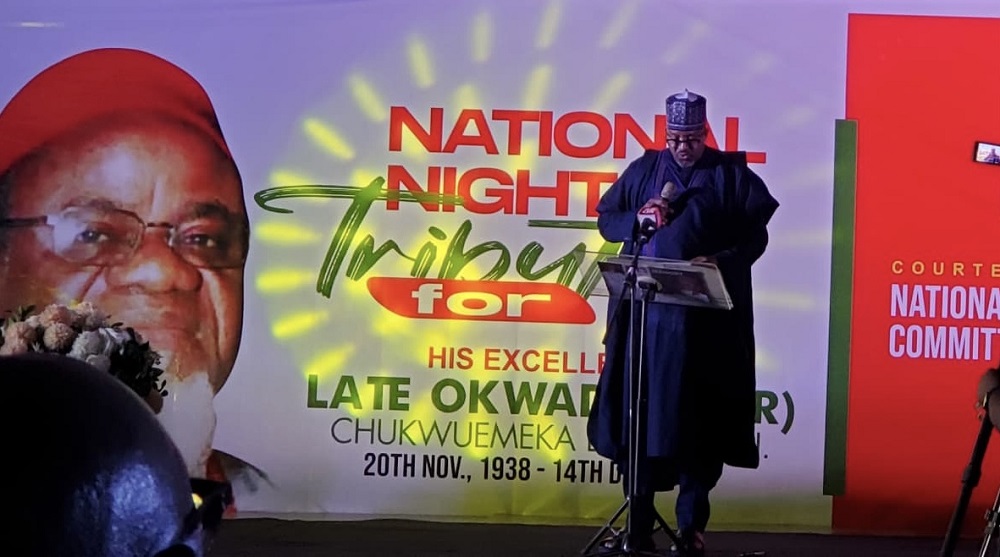
In his solemn tribute during a National Night of Tribute held in honour of the late elder statesman at the grand arena of the ThisDay Dome in Abuja last night, VP Shettima in a statement issued by his spokesman, Stanley Nkwocha, hailed Dr. Ezeife as a “national colossus and a pillar of nationhood.”

Represented by Special Adviser to the President on General Duties (Office of The Vice President) and former Minister of the Federal Capital Territory, Dr Aliyu Modibbo Umar @alimodibbo, the Vice President commended Dr. Ezeife’s exceptional journey, highlighting his rise from someone with no formal secondary education to a Ph.D. holder in Economics from Harvard.

While eulogizing his statesmanship, Senator Shettima lauded Dr. Ezeife’s leadership qualities, both in the civil service and as Anambra’s first civilian governor.

Advertisement

He acknowledged Dr. Ezeife’s focus on long-term planning for sustainable growth, even if it meant prioritizing future development over immediate needs.

“Dr. Ezeife, fondly known as ‘Okwadike,’ was a true giant among men,” the Vice President said, even as he recognized his unwavering advocacy for the Igbo people.

The VP credited Dr. Ezeife with igniting a spirit of self-belief within the Igbo community and championing their development through political and socio-cultural efforts.

He also described the late elder statesman as a man of exceptional intellect and wit, known for his profound quotes and insightful analysis, saying “he was a mentor to many, and always willing to share his knowledge and inspire the next generation.”

Advertisement

Dr. Ezeife’s life, the Vice President noted, “was a testament to the power of resilience and an unwavering belief in the potential of our great nation,” adding that his legacy “will be a beacon of hope, guiding us through the challenges that lie ahead.”

Earlier, the Senate @NGRSenate President @SPNigeria, Godswill Akpabio @Senator_Akpabio, noted that it was with a sense of grief but dignity in his heart that he was paying tribute to Dr. Ezeife, a man he said has done so much for Nigeria.

“He was a chief advocate of a federal Nigeria to achieve unity and national cohesion. He advocated for effective governance at the grassroots,” Akpabio said.

Represented by his Chief of Staff, Sylvester Okonkwo @SylvesterSO23, the Senate President said Ezeife believed that constructive engagement and mutual respect were essential for national unity, stating that the late former Governor of Anambra State was a bridge builder.

Advertisement

“His ideas continue to influence decisions on how to structure Nigeria’s federal system. He prioritized education. We cannot forget him in a hurry. It is a personal loss. I send my condolences to his wife and members of his immediate family,” Akpabio added.

Dignitaries who also spoke at the National Night of Tributes included the Senator representing the Imo North Senatorial District, Chiwuba Patrick Ndubueze @NdubuezePatricC; Senator representing Imo West Senatorial District, Osita Bonaventure Izunaso @ositaBizunaso; the member representing Oshodi/Isolo Constituency II at the House of Representatives, Hon. Okey-Joe Onuakalusi, and member representing Njikoka/Dunukofia/Anaocha Federal Constituency, Hon Ozodinobi George Ibezimako.

Others were former Presidents of the Senate, Adolphus Wabara and Anyim Pius Anyim @AnyimPiusA; former Governors of Imo State, Achike Udenwa, Rochas Okorocha @realRochas and Emeka Ihedioha @EmekaIhedioha; former Governor of Ebonyi State, Dr. Sam Egwu; former Governor of Ogun State, Olusegun Osoba; a representative of the Deputy Speaker of the House of Representatives, Benjamin Kalu @OfficialBenKalu; a representative of Bishop Matthew Hassan Kukah of the Catholic Diocese of Sokoto, and former President/CEO of Transnational Corp of Nigeria, Valentine Ozigbo @valentineozigbo, among many others.
Advertisement
Continue Reading
Advertisement
Click to comment

Warning: Undefined variable $user_ID in /home/naijuinz/public_html/wp-content/themes/zox-news/comments.php on line 49

You must be logged in to post a comment Login

Leave a Reply

News

Don’t let us die, abducted Oyo principal begs Tinubu, Makinde

Published

on

By

ADVERTISEMENT
Zoom Ad
ADVERTISEMENT
Zoom Ad

The abducted principal of Community Grammar School, Esinele, Mrs Folawe Alamu, has appealed to President Bola Tinubu and Oyo State governor, Seyi Makinde, to adopt dialogue rather than force in efforts to secure her release and other victims still held by abductors.

In a video posted on Instagram on Friday by social media influencer Temilola Sobola, a visibly distressed Alamu said she and other captives, including children, had spent 13 days in the bush under harsh weather conditions.

“We are in the cold, we are under the sun, we are under the rain, the children and the adults as well. Please, we are begging you, don’t let them waste our lives,” she said.

She also appealed to the Nigeria Union of Teachers (NUT) and the Christian Association of Nigeria (CAN) to intervene, warning that any attempt to use force could endanger the lives of the captives.

Advertisement

“The force they used yesterday has cost us so much. It has added to our problems. In fact, someone among us has been picked, and they are going to kill him because the government tried to rescue us by force.
“We don’t need force. All they have to do is negotiate with them and secure our release. Please, just negotiate with them and dialogue with them,” she added.

The appeal comes nearly two weeks after gunmen attacked three schools — Community High School, Ahoro-Esinele; Baptist Nursery and Primary School, Yawota; and L.A. Primary School, Alawusa — and abducted seven teachers and 39 students on May 15, 2026.

During the attack, a mathematics teacher, Michael Oyedokun, was reportedly killed by the gunmen while in captivity.

A motorcyclist was also killed, while a security operative died after reportedly stepping on an improvised explosive device planted by the abductors during early rescue operations.

Advertisement

Sources said the abductors later opened communication with the state government but refused to speak directly with families of the victims, insisting on negotiating only with the governor.

Oyo State governor Seyi Makinde, while receiving visitors during the Eid-el-Kabir celebration in Ibadan, assured residents that efforts were ongoing to secure the safe return of the abducted victims.

The Inspector-General of Police, Tunji Disu, also said additional detectives had been deployed from Force Headquarters in Abuja to support the rescue operation, while the Defence Headquarters said troops had made contact with the abductors and were working toward securing the release of the victims.

Advertisement
Continue Reading

News

The Politics Of Maturity: Why Rivers May Need Healing More Than Victory

Published

on

By

ADVERTISEMENT
Zoom Ad
ADVERTISEMENT
Zoom Ad

Politics in Rivers State has always behaved like the Bonny River during heavy rainfall – restless, unpredictable, and capable of swallowing even the strongest boats if caution is thrown overboard. But after three turbulent years of political hostilities, bruised alliances, and deep ethnic anxieties, many residents now appear exhausted by the sound of war drums.

That fatigue explains why the conversation following the withdrawal of Governor Siminalayi Fubara from the governorship primary election of the All Progressives Congress (APC), and the emergence of Rep. Kingsley Chinda as candidate, has quickly shifted beyond ordinary politics into the emotionally charged territory of identity, equity, and ethnic balancing.

For some ethnic advocates, particularly within sections of the riverine bloc, the argument is simple: Governor Fubara should have completed two full terms before power rotates elsewhere. To them, the issue is not merely politics but fairness and historical inclusion.

Yet, while the sentiments are understandable, Rivers State now stands at a delicate crossroads where anger must not be allowed to mature into division.

Advertisement

The truth is that Rivers has bled too long from political bitterness.

Communities have watched friendships collapse under partisan pressure. Political camps have behaved like rival oil blocs drilling suspicion instead of trust. Every statement is analysed through tribal lenses; every handshake is treated like a conspiracy. Meanwhile, ordinary citizens – traders, fishermen, civil servants, transport workers, students, widows, and struggling families – continue to ask one quiet question:

Who will help Rivers breathe again?

That is why many observers believe the next political movement in Rivers cannot afford to be built on ethnic triumphalism or revenge politics. The state needs a bridge, not another battlefield.

Advertisement

And this is where the candidacy of Kingsley Chinda is beginning to attract unusual attention across political and ethnic lines.

In a state famous for loud political combatants, Chinda has built a reputation around restraint, legislative precision, and methodical engagement. He is not known for theatrical speeches or combustible rhetoric. Even within the National Assembly, colleagues often describe him as a lawmaker more interested in delivery than performance.

That quiet style may now become politically valuable in a state desperately searching for emotional de-escalation.

The challenge before Rivers is no longer merely about “whose turn” it is. The larger question is whether the state can recover enough stability to resume development.

Advertisement

Roads do not respond to tribal slogans. Investors do not inject capital into political minefields. Youth employment cannot grow in an atmosphere poisoned by endless hostility. Peace remains the first infrastructure every serious society must build before prosperity can stand.

This is why the emerging political language around Chinda appears carefully calibrated toward reconciliation rather than conquest.

“One Rivers, One Future.”

Simple words. But in a tense political climate, they carry strategic meaning.

Advertisement

The phrase subtly redirects public conversation away from ethnic camps toward shared destiny. It neither insults zoning advocates nor dismisses concerns about equity. Instead, it proposes a broader political argument: that competence, peace, inclusion, and stability must also matter in moments of crisis.

That distinction is important.

Because Rivers State is not a collection of isolated tribes occupying oil fields. It is a complicated political family tied together by commerce, history, intermarriage, waterways, and collective survival.

The riverine fisherman and the upland farmer ultimately depend on the same peace.

Advertisement

Chinda’s political movement is built around listening to every voice, pursuing sincere and genuine reconciliation, and engaging in wide-ranging consultations with traditional rulers, youth groups, clergy, women’s organisations, ex-militant stakeholders, market associations, and professionals across ethnic lines – all in the collective interest of Rivers State.

The message appears intentional and measured:

“I have come to listen, not impose.”

In today’s Rivers, that may prove to be wiser politics than chest-thumping bravado.

Advertisement

Observers also note that Chinda’s political appeal extends beyond his legislative record into years of grassroots interventions through his “I Win, U Win” initiative in Obio/Akpor Federal Constituency. Over the years, the programme has sponsored skills acquisition, healthcare support, ICT training, scholarships, women empowerment schemes, teacher training, welding, shoemaking, agro-allied programmes, and educational assistance for both indigenes and non-indigenes.

Supporters argue that such programmes reveal a politician who sees governance less as patronage and more as social investment.

Critics may disagree politically – and democracy permits that – but even opponents rarely accuse Chinda of ethnic extremism or inflammatory politics.

That moderation could become critical.

Advertisement

Because the greatest danger before Rivers today is not political competition itself. Democracy thrives on competition. The real danger is allowing political disagreements to harden into ethnic suspicion so deep that future generations inherit resentment instead of progress.

Rivers people have seen enough political fires to understand one painful truth: no tribe wins when the entire state burns.

The coming election, therefore, may offer something larger than a contest for power. It may become a referendum on whether Rivers chooses escalation or healing.

And perhaps that is why a growing number of citizens now insist that the debate must gradually move from:

Advertisement

“Whose turn is it?”

to:

“Who can unite and stabilise Rivers State?”

In the end, the state may discover that peace itself is the real zoning formula everyone has been searching for.

Advertisement
Continue Reading

News

NCoS denies stealing inmates’ valuables in Kuje raid

Published

on

By

ADVERTISEMENT
Zoom Ad
ADVERTISEMENT
Zoom Ad

The Nigerian Correctional Service has denied allegations that its officers stole valuables belonging to inmates during a routine search operation at the Medium Security Custodial Centre, Kuje, Abuja.

The Service described the reports as false, misleading and inconsistent with established custodial procedures, insisting that the operation was conducted professionally and in line with Standard Operating Procedures.

In a statement issued on Friday by the Service Public Relations Officer, Jane Osuji, the NCoS said the exercise was a routine security search aimed at maintaining order, discipline and security within the facility, adding that all recovered prohibited items were duly processed and documented.

It also dismissed claims that inmates were robbed of valuables reportedly worth over N120m, saying the allegations were not supported by official records.

Advertisement

“The Service wishes to categorically state that the allegation is false, misleading, and inconsistent with the operational realities and established procedures governing custodial facilities in the country,” the statement said.

According to the NCoS, inmates are not permitted to keep unauthorised items or large sums of money in custody, noting that all personal belongings declared at the point of admission are documented and safely kept until lawful release.

It further stated that records from the custodial centre did not show that any of the items mentioned in the reports were declared by inmates, nor were such items found or recorded during the search operation.

“For the avoidance of doubt, what took place at the Custodial Centre in Kuje was a routine security search carried out within the facility, and all recovered prohibited items were duly processed and documented. The exercise was conducted professionally and in line with extant Standard Operating Procedures aimed at maintaining security, order, discipline and the integrity of custodial operations.

Advertisement

“The Nigerian Correctional Service operates under clearly defined regulations which prohibit inmates from keeping personal unauthorised items and large sums of money while in custody,” the statement said.

The Service also said no complaint of theft or loss had been filed through any official channel by inmates or any other persons within the facility.

“The Medium Security Custodial Centre, Kuje, is calm, peaceful and secure,” the statement added.

The response comes amid a report by SaharaReporters alleging that some high-profile inmates were affected during the search operation at the facility.

Advertisement

According to the report, former Skye Bank Chairman, Tunde Ayeni, was allegedly robbed of a wedding ring and wristwatch valued at over N120m during the operation.

The report also claimed that suspended Deputy Commissioner of Police, Abba Kyari, lost about N2m.

It further alleged that the operation was carried out by senior correctional officers accompanied by operatives and DSS dogs, causing panic within the facility, and that valuables were confiscated without proper documentation.

However, the NCoS dismissed the claims in their entirety, maintaining that the search was lawful and that no evidence supports the allegations.

Advertisement

The Service urged the public and media organisations to verify information through official channels before publication, warning against the spread of unverified claims capable of undermining confidence in public institutions.

The NCoS reaffirmed its commitment to transparency, professionalism and ongoing reforms aimed at strengthening security and accountability across custodial centres nationwide.

Continue Reading

Trending

Copyright © 2024 Naija Blitz News