
News
Latest on 2024 Hajj Airlift and the National Medical Team

- /home/naijuinz/public_html/wp-content/plugins/mvp-social-buttons/mvp-social-buttons.php on line 27
https://naijablitznews.com/wp-content/uploads/2024/05/Screenshot_20240513-131733.png&description=Latest on 2024 Hajj Airlift and the National Medical Team', 'pinterestShare', 'width=750,height=350'); return false;" title="Pin This Post">
- Share
- Tweet /home/naijuinz/public_html/wp-content/plugins/mvp-social-buttons/mvp-social-buttons.php on line 72
https://naijablitznews.com/wp-content/uploads/2024/05/Screenshot_20240513-131733.png&description=Latest on 2024 Hajj Airlift and the National Medical Team', 'pinterestShare', 'width=750,height=350'); return false;" title="Pin This Post">


By Kayode Sanni-Arewa
By 15th of May 2024, the outcome of preparations for the year’s Hajj season would manifest with the planned take-off of 428 passengers on FlyNas airline to Saudi Arabia.
The inaugural flight is scheduled to take-off with Kebbi state pilgrims from the Sir Ahmadu Bello International Airport (SABIA) in Birnin Kebbi, the state capital.
To witness the occasion are diplomats, members of the Hajj industry with the Vice President, His Excellency Sen. Kashim Shettima as Special Guest of Honour. An advance team of officials comprising medical personnel from the National Medical Team (NMT), media staff, accommodation officials, few feeding committee members, select members of the Central Security Committee members as well as the National Reception Team departed Nigeria on Sunday 12th to receive the pilgrims. The onward airlift to Saudi Arabia will last until 10th day of June or hopefully earlier. Pilgrims will travel in groups of 45 according to Saudi Arabia’s guidelines; missing out from the group could come with consequences as stated by the host country.
Two other flights are scheduled to take-off on same day of the inaugural flight with pilgrims of Nasarawa and Federal Capital Territory (FCT) from the Abuja International Airport.
Subsequently, two flights would take-off each day in the days following the inaugural flight to gradually increase to five flights daily. 15 Airports have been designated for the 2024 Hajj exercise. About 65,047 pilgrims from both public and private sectors are expected to participate in the 2024 Hajj.
While all Hajj operational committees are critical to the success of every Hajj, the NMT is one of the most sensitive after the Aviation Sector. Composition of the team attracts interest of the pilgrims as well as prospective personnel. Hence, on the 12th of February 2024 The National Hajj Commission of Nigeria (NAHCON) launched the National Medical Team (NMT) portal inviting interested candidates willing to volunteer their medical services for the 2024 Hajj pilgrims to register on the portal within two weeks. By the end of the registration deadline, 19,832 had applied. Out of this total only 7,532 scaled the first screening test of submitting duly completed e-forms.
It would be recalled that at the time of inviting interested candidates, the following criteria were clearly spelt out as yardsticks for qualification into the medical team. That:
i. Doctors and Pharmacists should be between the ages of 28 to 60 while nurses and Environmental / Community Health Workers should be between 22 to 60
ii. Applicants must not have participated in the last three NMT operations vis-à-vis, 2019, 2022 and 2023.
The only exceptions to this category are principal officers selected to lead the team from the onset as well as few regular members from the past teams who were recognized for excellence. Their selection is automatic.
iii. Must be in active service at the time of application
iv. Must be ready to work for 28 days and stay in KSA for 45 days.
The Medical Team, led by Dr Abubakar Adamu Ismaila from the Federal Min of Health and Social Welfare (FMH&SW) as Head of Medical Mission, along side selected staff of NAHCON in the NMT Committee conducted the assessment of applications. Other Principal Officers entrusted with the task are Pharmacist Ibrahim Babashehu (Registrar, Pharmacists Council of Nigeria) as Head of Pharmacists; Dr Saidu Ahmed Dumbulwa, Institutional Representative of FMOH & SW on NAHCON’s 5th Board, Matron Zainab Garba Mamu (Retired Director FMOH& SW) holds the position of Head of Nurses and Dr Zaiyad Garba Habib (University of Abuja Teaching Hospital) is Head of Doctors.
At the end of the exercise, out of the 7532 correctly submitted applications, 1295 applicants were dropped for selecting payment option for their medical services instead of volunteerism as requested, while another five where similarly dropped for failure to indicate their choice of whether volunteerism or for a fee. Another 1,307 applicants were disqualified after indicating that they had participated in the medical team within the last three Hajj seasons. On the other hand, NAHCON’s data revealed another 175 applicants who either concealed the fact of their participation in the previous years or gave false information on that claim. A breakdown showed 37 of them participated in the 2019 NMT, 60
Those who participated in the 2022 medical team and 78 were members from 2023 National Medical Team.
They were eliminated. Another 135 were also eliminated based on age while 43 were rejected for submitting multiple applications. In total, only 4861 eventually scaled the second round of screening.
Interestingly, out of these 4861 successful candidates, only 140 would be shortlisted according to official medical quota allocated to the country by Saudi Arabia. In the past, it used to be one medical personnel to 1000 pilgrims.Nevertheless, because the Commission understands the peculiarity of Nigerian pilgrims for health care demand, NAHCON supports additional medical personnel among its overall quota to supplement Saudi’s formal allocation. Despite this gesture, overwhelming medical attention persists among Nigerian pilgrims while in the Kingdom.
The reader is invited to kindly take note that the overall NMT is constituted of 60% workforce selected and presented by the various states’ pilgrims’ welfare boards from the state level.NAHCON contributes only 40% of the medical staff.
Though of recent, the reverse is almost the case due to financial weaknesses of some state governments that rendered them incapable of sponsoring medical staff in the NMT. The Commission would not relent in augmenting critical services for the welfare of Nigerian pilgrims thus bears the brunt.
To meet its own 40% medical staff support, NAHCON conducts random balloting to select members of the NMT.
Thus, by the end of the balloting and collation, out of the 140 that were successfully shortlisted, three more were dropped for failing pregnancy tests, they have since been replaced.Hence, notification has been sent to successful candidates to serve as members of the 2024 Hajj National Medical Team.The team will be working under three major clinics in Makkah and one in Madinah which is located on Quran street. In Makkah, the Main Office is in Masfala Kudei where most pilgrims are accommodated. The two other major clinics are in Al-Tayseer and Masfala Shari Hijr. Medical
Personnel are not posted to individual state accommodations because the Saudi authority does not recognize state boards running individual clinics. NAHCON thus establishes few outpost stations to decongest the three main clinics. Erecting the outpost stations depends on certain factors that can only be determined while in the Kingdom of Saudi Arabia. About 50% of the medical personnel will be provided with portable first aid kits to move around with for timely medical intervention.
During the five days of Hajj rites, NAHCON would run one clinic in each of the 15 pilgrims’ field offices in Muna. In addition, the Commission will run mobile clinics in Masha’ir while ambulances belonging to state welfare boards shall be deployed to the sites as back-up.
The Commission’s deep desire to guarantee welfare of pilgrims gave impetus to the exhaustive efforts put in place for success of the Hajj season.
Usara is Assistant Director, Public Affairs and writes from NAHCON
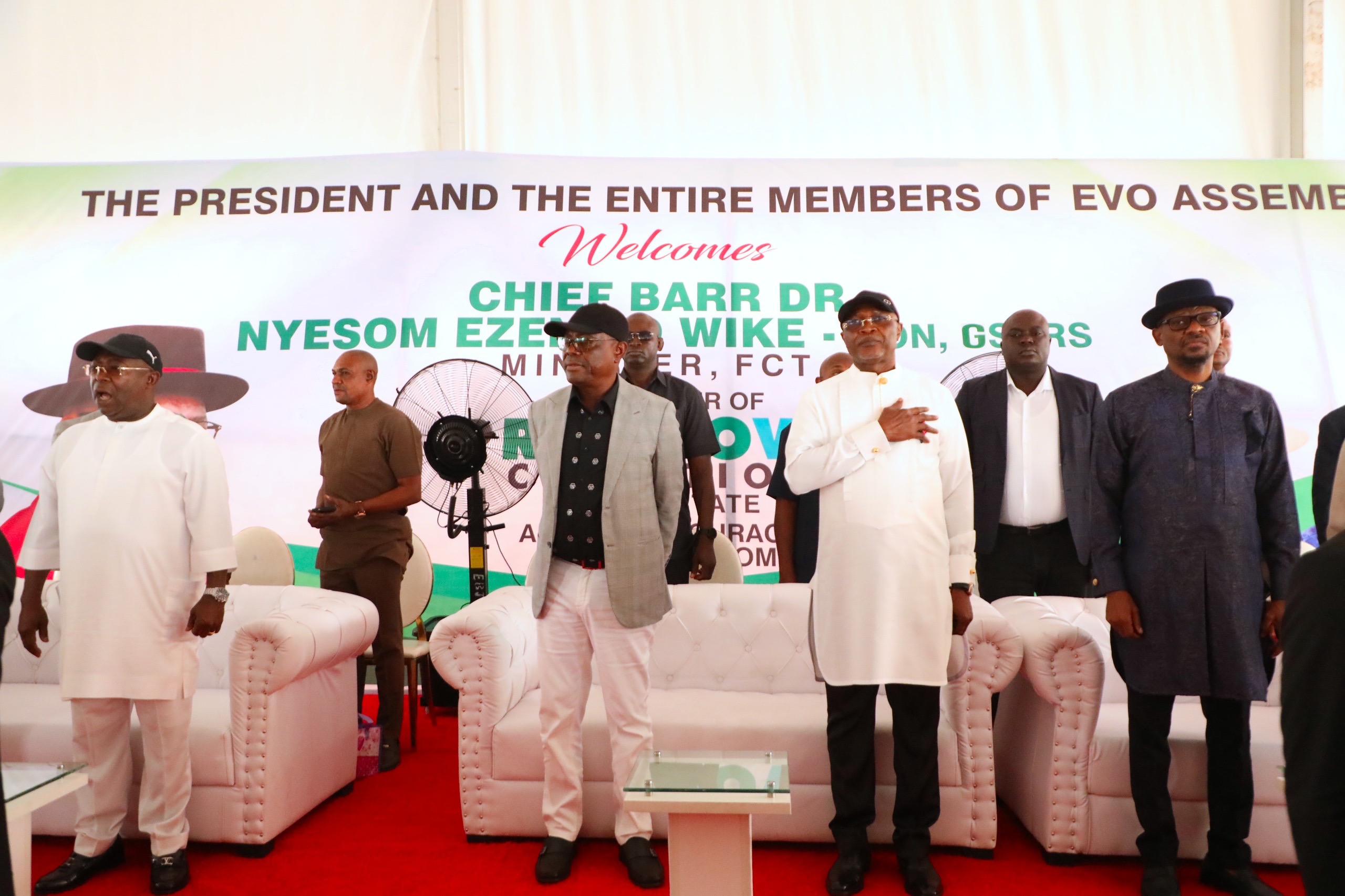
… Reaffirms loyalty to President Bola Tinubu, vows to continue building sustainable leadership
Former Governor of Rivers State and Minister of the Federal Capital Territory (FCT), Chief Nyesom Wike, has challenged the people of Evo Kingdom to point to any tangible development or political empowerment attracted to their land by his predecessor, Chibuike Rotimi Amaechi, despite holding top political offices as Speaker, Governor, and Minister for 24 years.
Speaking during an interactive session with leaders and stakeholders of Evo Kingdom in Obio-Akpor Local Government Area, Wike declared that unlike past leaders who used their elevation to pull down others and monopolize power, his political philosophy centers on human capacity development, divine gratitude, and uplifting his people.
Wike questioned the moral right of those who spent decades in high offices without leaving behind a legacy of leadership or infrastructure in the area, warning against selfish politics that crumbles once the leader passes on.
”Because how will I answer before God if these people could take that kind of risk, and opportunity came up for you to help, for you to uplift them? But because of your greed, because of your selfishness, you don’t want anybody to reach the level you are,” Wike said.
He said; “You don’t want anybody in Obio-Akpor to be governor again because you have become governor. God will not be happy with me”.
Taking direct aim at Amaechi’s 24-year tenure across various arms of government, Wike challenged the kingdom to present evidence of what was attracted to the land under his rival’s reign.
”Someone was Speaker of the House of Assembly for eight years, Governor for eight years, and Minister for eight years—that is 24 years in top leadership positions! What can anybody point to that he attracted to Evo Kingdom or Rivers State in all those 24 years? Nothing! Not one single thing!
”I was a Minister of State for Education, and as I sit here, I can count the projects I brought to Rivers State and my people. But somebody was Speaker, Governor, and headed a very lucrative ministry as a full Minister for eight years, yet brought nothing back home! How can someone who spent 24 years in power without empowering his people or raising new leaders now turn around to tell you he loves you?” Wike queried.
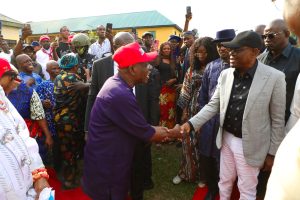
Highlighting his political trajectory and contentment with his achievements under the administration of President Bola Ahmed Tinubu, the FCT Minister stressed that he has no further personal political ambitions other than serving as a vessel for his people.
”After all, what do I want that God has not given to me? Nothing! Nothing! Nothing! The only thing I ask from God today is to continue to give me long life,” he said.
“I can’t be a governor again. I’ve been a minister two times. I cannot be chairman of council again. So I am happy. I don’t have anything to lose”.
He continued: “What leadership, as you are leaving, what’s the leadership you have kept behind to continue with where you have stopped? Because our problem here is that you just want only yourself. When you die, everything crumbles. That is not our own case.”
Addressing political uncertainties and betrayal, the Minister reiterated his firm trust in God rather than human promises.
”As a politician, I know that the only person who will not disappoint is God,” Wike declared.
“So, don’t ever believe that a human being will not disappoint you. No matter the love you have, do the best you can do. If the person disappoints you, don’t kill yourself. God will right the wrong”, he said.
Wike also recounted how his administration restructured the chieftaincy institution to give Evo Kingdom adequate representation in the Rivers State Council of Traditional Rulers, dismissing claims that traditional politics or native charms could intimidate him.
Political leaders and traditional rulers like Eze Temple Ejekwu
and Elder Peter Chinwo, President of Evo Assembly assured the FCT Minister of victory for the President and other candidates endorsed by the Rainbow Coalition.
News
Nigeria’s Ambassador to Hungary, Abass Ogwime, Selected to Commission Hungarian-African House in Budapest

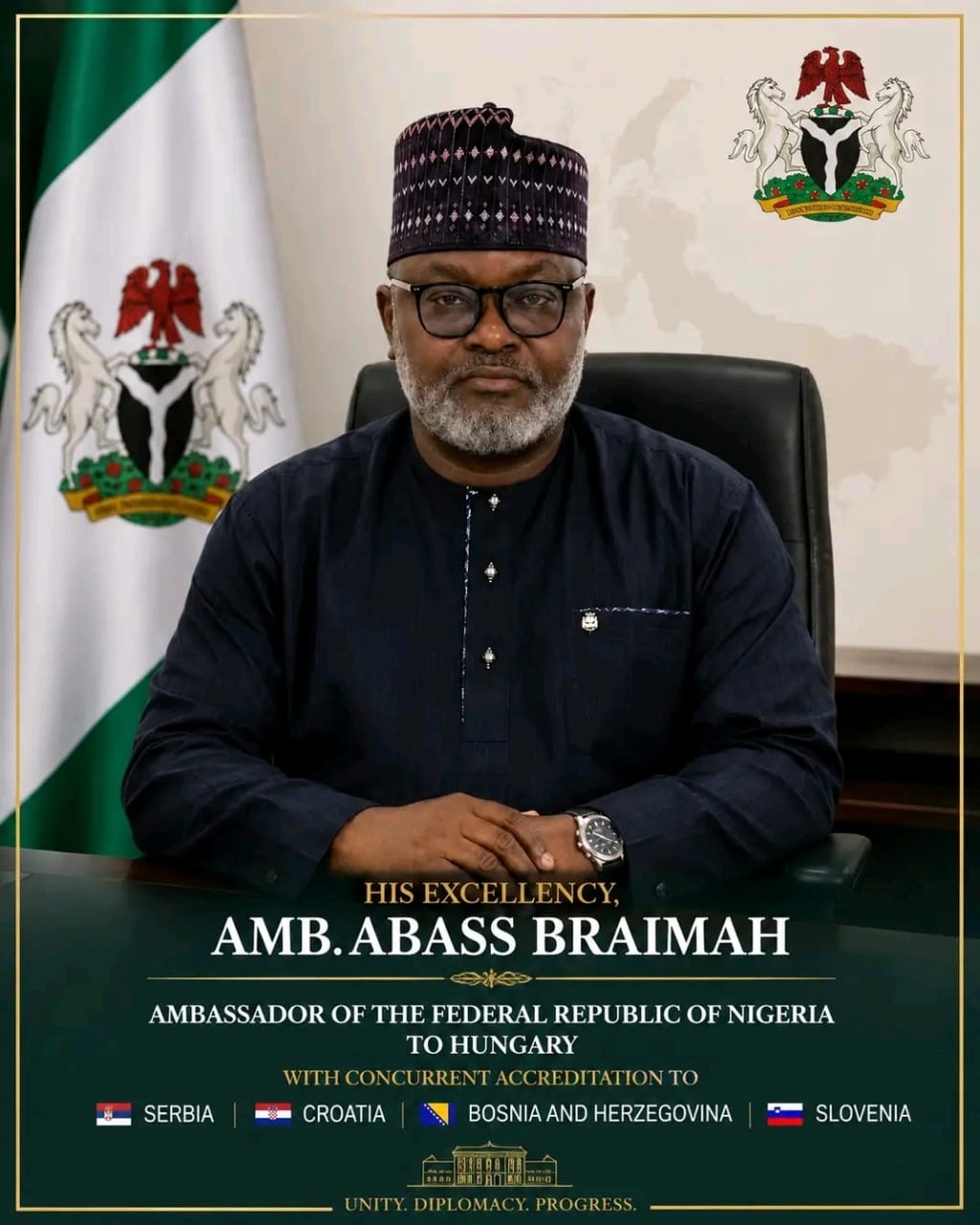
Nigeria’s Ambassador to Hungary, Abass Braimah Ogwime, has been selected among African ambassadors accredited to Hungary to officially commission the newly established Hungarian-African House in Budapest.
Ogwime, who also serves as Nigeria’s ambassador to Serbia, Croatia, Bosnia and Herzegovina, and Slovenia, was the guest speaker at the inauguration ceremony held in Budapest on October 2, 2026.
The event attracted members of the diplomatic community, Hungarian government representatives, African heads of mission, business executives, investors, members of the African diaspora and other stakeholders seeking to strengthen economic, cultural and diplomatic relations between Hungary and African countries.
The Hungarian-African House, known locally as Magyar-Afrika Ház, is an initiative of the Foundation for Africa. The facility is designed to serve as a permanent platform for dialogue, business development, cultural exchange and cooperation between Hungary and African nations.
The initiative is expected to provide a meeting point for Hungarian and African businesses, investors, academic institutions and government representatives to explore investment opportunities, establish strategic partnerships and develop practical areas of collaboration.
Ogwime’s selection as one of the African ambassadors chosen for the commissioning underscores Nigeria’s participation in diplomatic engagements aimed at expanding cooperation between African countries and Hungary.
The Nigerian Embassy in Budapest reaffirmed its commitment to strengthening diplomatic ties, promoting economic partnerships and supporting initiatives that encourage collaboration between Nigerian, African and Hungarian institutions and communities.
The establishment of the Hungarian-African House comes amid broader efforts to deepen Africa-Europe engagement through trade, investment, cultural diplomacy and institutional partnerships.
The new facility is expected to provide a dedicated space for advancing these objectives and fostering long-term relationships between Hungary and African countries.

Hundreds of youths on Thursday staged a peaceful protest in Potiskum Local Government Area of Yobe State, demanding an end to President Bola Tinubu’s administration over worsening economic hardship, insecurity and unemployment.
The demonstration, tagged “Tinubu Must Go”, coincided with Nigeria’s 66th Independence Anniversary on October 1.
The protesters marched through the Tsohowar Kasuwa area of Potiskum, carrying placards and flags of the African Democratic Congress (ADC), while expressing dissatisfaction with the state of the country.
They said President Tinubu’s Independence Day broadcast failed to address their concerns, particularly the rising cost of living, poverty, unemployment, insecurity and what they described as poor governance since the administration assumed office in 2023.
Speaking to journalists on condition of anonymity, one of the protesters said the demonstration was an exercise of their fundamental rights and a call for urgent action to address the country’s challenges.
“We came out today to express our fundamental rights, freedom of speech. We are suffering from this government, people are dying due to insecurity, poverty and unemployment in the land,” the protester said.
Another demonstrator, who identified with the opposition, expressed concern over the country’s economic situation and the state of the education sector.
He said the youths were dissatisfied with the government’s handling of issues affecting ordinary Nigerians.
Similarly, a protester identified as Malam Gambo said the demonstration was organised to draw attention to hunger, insecurity and what the participants described as bad governance.
Eyewitnesses reported that the protest remained peaceful and orderly, with young men and women making up the bulk of the demonstrators.
Some participants were seen carrying ADC flags as they marched through parts of Potiskum to express their grievances against the Tinubu administration.

Wike fires Amaechi: You failed as Speaker, Governor and Minister For 24 Years(Photos)

Nigeria’s Ambassador to Hungary, Abass Ogwime, Selected to Commission Hungarian-African House in Budapest

‘Tinubu Must Go’: Yobe Youths Protest Economic Hardship, Insecurity



-

 News18 hours ago
Independence Day: NNPCL Slashes Petrol Price With N66 Discount for Nigerians
-

 Metro17 hours ago
‘I Hit Her With a Pistol, Hacked Her With Machete’ — Suspect Confesses to Killing Girlfriend in Enugu
-
 News20 hours ago
Nigeria Bids Farewell to Reverend Okoye, Ex-Aso Villa Chaplain
-

 News15 hours ago
2027: Wike rallies support for Tinubu In Akpor kingdom, Insists He’II resign as Minister should president lose FCT, Rivers(Photos)
-

 News17 hours ago
Watch moment, traditional rulers present kola to FCT minister Wike at ongoing town hall meeting in Akpor kingdom, Obio/Akpor LGA
-
 Sports17 hours ago
AFCON 2027: Chelle Vows Super Eagles Will Bounce Back, Targets Tanzania Double
You must be logged in to post a comment Login