Connect with us

Foreign

Over 2,000 people feared buried in Papua New Guinea landslide

Published

on

ADVERTISEMENT
Zoom Ad
ADVERTISEMENT
Zoom Ad

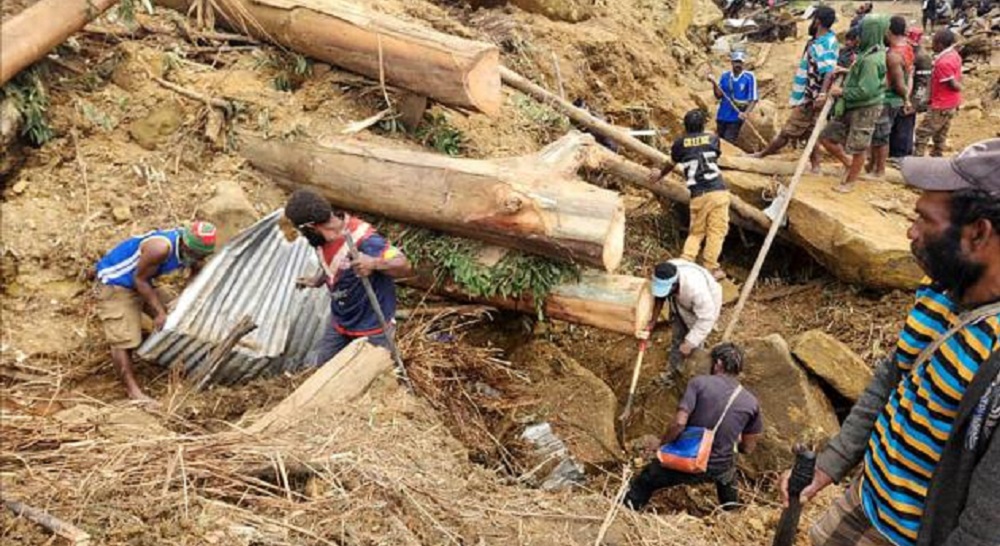
More than 2,000 people are feared buried in a Papua New Guinea landslide that destroyed a remote highland village, the government said yesterday , as it pleaded for international help in the rescue effort.


The once-bustling hillside community in Enga province was almost wiped out when a chunk of Mount Mungalo collapsed in the early hours of Friday morning, smothering scores of homes and the people sleeping inside them.

“The landslide buried more than 2,000 people alive and caused major destruction to buildings, food gardens and caused major impact on the economic lifeline of the country,” Papua New Guinea’s national disaster centre said in a letter to the United Nations obtained by AFP.

The main highway to the large Porgera gold mine was “completely blocked”, it told the UN resident coordinator’s office in the capital Port Moresby.

Advertisement

The landslip was continuing to “shift slowly, posing ongoing danger to both the rescue teams and survivors alike”, the disaster centre said.

The scale of the catastrophe required “immediate and collaborative actions from all players”, it added, including the army, and national and provincial responders.“The centre also called on the United Nations to inform Papua New Guinea’s development partners “and other international friends” of the crisis.“


 

Advertisement
Continue Reading
Advertisement
Click to comment

Warning: Undefined variable $user_ID in /home/naijuinz/public_html/wp-content/themes/zox-news/comments.php on line 49

You must be logged in to post a comment Login

Leave a Reply

Foreign

UN Backs New World Map To Correct Africa’s Distorted Size

Published

on

ADVERTISEMENT
Zoom Ad
ADVERTISEMENT
Zoom Ad


The United Nations General Assembly has overwhelmingly backed a Togo-led resolution calling for a more accurate representation of the world’s continents, particularly Africa, on global maps.

The resolution, “Correct the Map: Rebalancing Global Cartographic Representation and Promoting Equitable Representation of the World’s Regions, Particularly Africa,” was adopted on Friday, September 4, with 164 countries voting in favour, six abstaining and only the United States voting against.

The initiative promotes the gradual adoption of the Equal Earth projection, which represents the relative areas of continents more accurately than the centuries-old Mercator projection. The Mercator map, developed in 1569 primarily for navigation, significantly enlarges landmasses closer to the poles while making equatorial regions such as Africa appear disproportionately smaller.

Advertisement

Togo, which spearheaded the initiative with African Union backing, argued that maps are not merely geographical tools but also shape how societies perceive the world and their place in it.

The resolution is not legally binding and does not ban the Mercator projection, which remains useful for maritime navigation. Instead, it encourages governments, educational institutions and other users to consider more geographically accurate alternatives.

The vote also exposed differing political interpretations of the initiative. The United States was the sole country to oppose the resolution, arguing that the United Nations should concentrate on more pressing global challenges rather than what Washington characterised as an ideological agenda.

The measure nonetheless represents a significant diplomatic victory for African countries seeking to challenge longstanding distortions in the way the continent is visually represented on commonly used world maps.

Advertisement

Africa has not changed its size. The map is finally being asked to show it.

Continue Reading

Foreign

UK updates list of employers allowed to sponsor Nigerian, other foreign workers

Published

on

ADVERTISEMENT
Zoom Ad
ADVERTISEMENT
Zoom Ad


The UK Government has updated its official list of employers licensed to sponsor foreign workers, providing jobseekers with a current resource for identifying organisations that may be able to sponsor eligible workers.

The Register of Licensed Sponsors: Workers, published on GOV.UK, contains organisations authorised to sponsor workers under the UK’s Worker and Temporary Worker immigration routes.

The latest version of the register was updated on September 4, 2026, according to the UK Government.

Advertisement

The register can be useful for people outside the UK who are searching for jobs that could potentially lead to visa sponsorship, allowing them to research licensed employers before applying for vacancies.

Rather than applying to employers at random, jobseekers can use the register to identify organisations that hold a valid sponsor licence and then check whether they have suitable vacancies.

The list can help applicants to:

* Identify potential sponsoring employers

Advertisement

Research organisations before submitting applications

* Monitor companies for suitable job openings

* Make their UK job search more targeted

* Confirm whether an organisation is included on the official sponsor register

Advertisement

However, being included on the register does not mean that every job advertised by an organisation comes with visa sponsorship.

A sponsor licence means an employer is authorised to sponsor eligible workers, but whether sponsorship is offered for a particular vacancy depends on factors including the job, the applicant’s eligibility and the employer’s decision.

Jobseekers should therefore treat the register as a starting point for research rather than confirmation that sponsorship is available.

After finding an employer on the list, applicants should carefully review the specific vacancy and check the job title, responsibilities, required qualifications and experience, salary, location and eligibility conditions.

Advertisement

They should also look for any information provided by the employer about visa sponsorship and determine whether the position is eligible under the relevant immigration route.

The UK Government’s sponsor register is updated periodically, meaning people actively looking for sponsored employment should check the latest version rather than relying on older copies.

The official Register of Licensed Sponsors: Workers is available on the UK Government’s website.

For jobseekers hoping to work in the UK, using the sponsor register can make the search more focused. However, applicants should always check the individual vacancy and the latest immigration requirements before applying, as being listed as a licensed sponsor does not guarantee sponsorship for a particular job.

Advertisement
Continue Reading

Foreign

Nigerians react as UK permits foreign workers to change employers

Published

on

ADVERTISEMENT
Zoom Ad
ADVERTISEMENT
Zoom Ad


Nigerians and other foreign workers in the UK have welcomed a new immigration policy allowing recognised victims of modern slavery on Skilled Worker visas to leave exploitative employers and take up new jobs without putting their immigration status at risk.

The UK Home Office announced the change on Thursday, saying workers who have been formally recognised as victims of modern slavery should not be forced to remain with abusive employers because of their immigration status.

“No victim of modern slavery should be trapped with an exploitative employer because of their immigration status,” the Home Office said in a post on its official X account.

Advertisement

It added that recognised victims on Skilled Worker visas would now be able to leave abusive employers and work elsewhere without risking their immigration status.

The development has attracted positive reactions online, particularly from Nigerians who work in or are familiar with the UK’s care and support sector.

An X user, @daddyhope, described the announcement as “good news for care workers”, saying the policy could remove the fear of deportation allegedly used by some exploitative employers to control sponsored workers.

“From today, care workers and other Skilled Worker visa holders who are formally recognised as victims of modern slavery will be allowed to leave abusive employers and work elsewhere without risking their immigration status,” the user wrote.

Advertisement

Another user, @JajaPhD, welcomed the policy but sought clarification on who qualifies as a recognised victim.

“Sounds like progress. What’s a recognised victim though?” the user asked, pointing to concerns among some care and support workers who may feel trapped in exploitative workplaces because they fear losing their sponsorship and livelihoods if they report abuse.

Similarly, @MzHorlabc11 described the development as “a step in the right direction”, while calling for more clarity on how the new arrangement would operate in practice.

Other users expressed stronger support for the move.

Advertisement

@Unfilteredxrp8 described the announcement as “fantastic news”, saying it would provide relief to many skilled workers living in the UK.

@Prestigious_Gt also welcomed the development, suggesting that the change could encourage employers to improve their treatment of sponsored workers.

“Some employers deserve this news. They will be calmer and more respectful moving forward,” the user wrote.

Another X user, @RealMrKay, expressed optimism that the policy would encourage employers to treat sponsored workers more fairly.

Advertisement

The user said they knew people who were unhappy with their sponsors over what they considered unfair treatment compared with workers who did not require sponsorship.

The UK Government’s move provides an important safeguard for people who have been formally recognised as victims of modern slavery and whose immigration status is linked to their employment.

However, reactions online also highlighted the need for greater public understanding of the process through which a worker becomes formally recognised as a victim of modern slavery.

The change is particularly relevant to care workers and other sponsored employees, who have previously faced restrictions linked to their employer-sponsored immigration status when attempting to leave abusive or exploitative workplaces.

Advertisement
Continue Reading

Trending

Copyright © 2024 Naija Blitz News