Foreign
Why India’s Modi failed to win outright majority
- /home/naijuinz/public_html/wp-content/plugins/mvp-social-buttons/mvp-social-buttons.php on line 27
https://naijablitznews.com/wp-content/uploads/2024/06/Narendra-Modi-1000x576.jpg&description=Why India’s Modi failed to win outright majority', 'pinterestShare', 'width=750,height=350'); return false;" title="Pin This Post">
- Share
- Tweet /home/naijuinz/public_html/wp-content/plugins/mvp-social-buttons/mvp-social-buttons.php on line 72
https://naijablitznews.com/wp-content/uploads/2024/06/Narendra-Modi-1000x576.jpg&description=Why India’s Modi failed to win outright majority', 'pinterestShare', 'width=750,height=350'); return false;" title="Pin This Post">
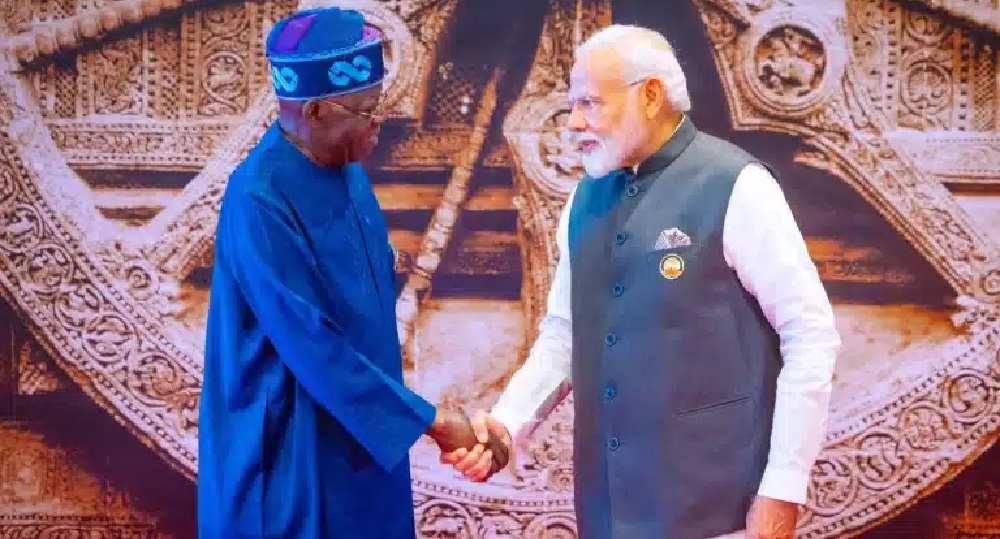
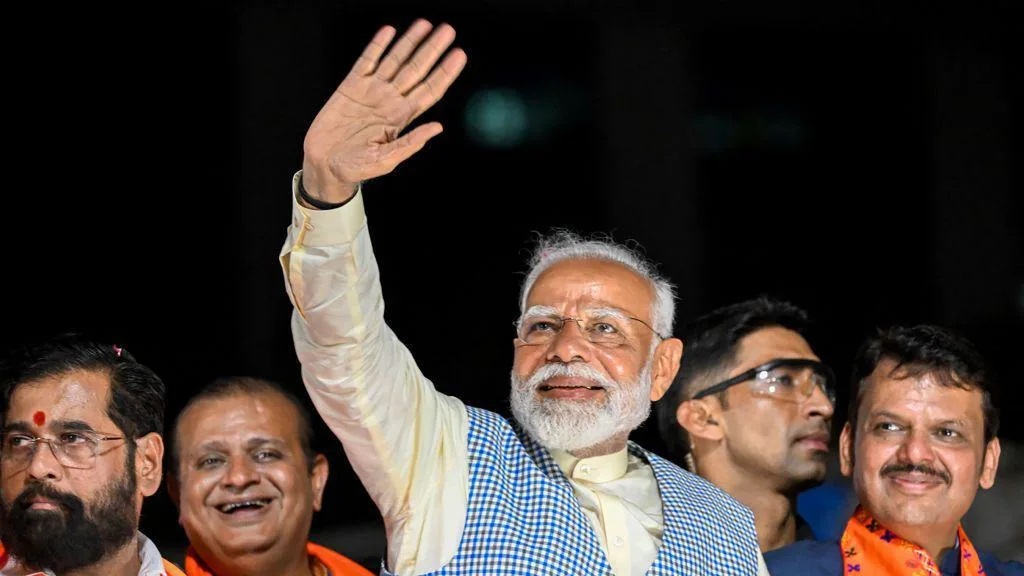
Indian PM Narendra Modi has won a third consecutive term in a much tighter general election than anticipated.

His Bharatiya Janata Party (BJP) looks set to fall short of a majority and is leading in the 543-seat parliament, below the required 272 seats. However its coalition partners have gained additional seats.
The results are a personal blow to Mr Modi, who has always secured majorities in elections as both chief minister of Gujarat state and India’s prime minister, and dominated the country’s politics for a decade.

The verdict marks a surprising revival for the Congress Party-led INDIA opposition alliance, defying earlier predictions of its decline, and sharply diverging from both exit polls and pre-election surveys.
More than 640 million people voted in a marathon seven-week election, hailed as a “world record” by election authorities. Nearly half of the voters were women.
Many world leaders have crawled across the finishing line in their third term elections and Mr Modi is no exception. The BJP remains India’s single largest party by seats, and if Mr Modi secures a third term with his allies, the prime minister matches the record of Jawaharlal Nehru, India’s first premier.
But the significant loss of seats for his party – more than 50 – dims the allure of a third term, especially given Mr Modi’s campaign targeting 400 coalition seats, making anything less seem like an under-achievement.
This has led to jubilation in the Congress camp and some despair in BJP quarters. Despite the BJP emerging as the single largest party, the burden of hype and expectations has left many of their supporters disheartened.
Mr Modi’s supporters believe securing a third term can be attributed to several factors: a record of stable governance, the appeal of continuity, efficient welfare programmes, and the perception that he has enhanced India’s global image.
To his Hindu nationalist base, Mr Modi delivered on key manifesto promises: revoking the autonomy of Indian-administered Kashmir, building the Ram temple in Ayodhya and implementing a controversial citizenship law. Many BJP-ruled states have implemented laws tightening regulations on interfaith marriages.
The BJP’s significant drop in seats may be linked to joblessness, rising prices, growing inequality and a controversial army recruitment reform, among other things. Mr Modi’s harsh and divisive campaign, particularly targeting Muslims, could also have alienated voters in some regions.
His ambitious slogan “Ab ki baar, 400 paar,” aiming for more than 400 seats for his NDA alliance, may have backfired, with such a massive majority raising fears of constitutional changes among the poor.
Mr Modi’s party faced its largest setback in Uttar Pradesh (UP), a state larger than the United Kingdom and three times as populous. With 80 parliamentary seats, UP holds significant sway in national politics – many consider it the gateway to Delhi. Both Mr Modi and Rahul Gandhi hold seats there.
So what are the main takeaways of this election?
A dent of Brand Modi
Mr Modi’s popularity has been also attributed to his mastery of branding, transforming routine events into spectacles and astute messaging. A weak opposition and a largely friendly media also helped him build his brand.
The election results show that Brand Modi has lost some of its shine, indicating that even Mr Modi is susceptible to anti-incumbency. In other words, he is not as invincible as many of his supporters believed. This offers renewed hope to the opposition.
A return to coalition politics
India has a history of chaotic coalition governments, although some in the early 1990s and 2000s played a significant role in implementing economic reforms.
If the BJP forms the government, it will be dependent on allies and will need to adopt a more consultative and deliberative approach.
This dependency makes it vulnerable to collapse if allies feel neglected. The party, once perceived as all-powerful, is now reliant on allies, unlike in 2014 and 2019.
A jolt to the dominant BJP
Mr Modi’s uninterrupted decade-long reign at the top has underscored India’s embrace of what some political scientists term the one-party dominant system.
This has five key traits: a charismatic leader, unrivaled control over resources and communication, unmatched organisational machinery, and an opposition in disarray. Shrinking freedoms also characterise a one-party dominant system.
Mr Modi’s BJP is not the first party to dominate Indian politics. For many years after Independence the Congress ruled without a break. Tuesday’s result has restored India to what many consider “normal politics”, with a range of parties sharing and competing for power.
A resurgent opposition
The results will energise the much-criticised Congress-led opposition.
In February, the diverse coalition known as INDIA, short for Indian National Developmental Inclusive Alliance, faced turmoil when one of its key leaders, Nitish Kumar, exited – only to later rejoin the BJP.
But led by Rahul Gandhi, the opposition ran a spirited campaign and narrowed the gap, in the face of a partisan media and despite fewer resources.
There is more hope for them ahead. The BJP holds about a third of India’s 4,000- plus state assembly seats and has lost to regional parties before. Over the next 14 months, five states are set for elections – all could be keenly contested.
With contests in Maharashtra, Jharkhand, and Haryana this year, the BJP could face substantial competition. Delhi’s upcoming election may pose challenges, while Bihar in October presents a regional hurdle.
So what could a potential third term for Mr Modi mean?
India needs much more work and some healing.
The economy, fueled by government spending, is on the upswing. Yet inequality is rising. Private investment and consumption must increase, and the poor and the middle class will need more money in their pockets to spend more.
That will not happen if there are not enough jobs. In a country bristling with ambition and frustration, younger voters are likely to drift from the BJP – around two-fifths of India’s billion-plus people are under 25.
Mr Modi has drawn criticism for marginalising Muslims, India’s largest minority, who have borne the brunt of violence. His government faces accusations of stifling dissent, with leading opposition figures jailed on what they say are trumped-up charges.
But third terms have often proved to be rocky for many leaders, with unforeseen and unpredictable events blowing governments and their plans off course.

Foreign
Nigerians react as UK permits foreign workers to change employers
Nigerians and other foreign workers in the UK have welcomed a new immigration policy allowing recognised victims of modern slavery on Skilled Worker visas to leave exploitative employers and take up new jobs without putting their immigration status at risk.
The UK Home Office announced the change on Thursday, saying workers who have been formally recognised as victims of modern slavery should not be forced to remain with abusive employers because of their immigration status.
“No victim of modern slavery should be trapped with an exploitative employer because of their immigration status,” the Home Office said in a post on its official X account.
It added that recognised victims on Skilled Worker visas would now be able to leave abusive employers and work elsewhere without risking their immigration status.
The development has attracted positive reactions online, particularly from Nigerians who work in or are familiar with the UK’s care and support sector.
An X user, @daddyhope, described the announcement as “good news for care workers”, saying the policy could remove the fear of deportation allegedly used by some exploitative employers to control sponsored workers.
“From today, care workers and other Skilled Worker visa holders who are formally recognised as victims of modern slavery will be allowed to leave abusive employers and work elsewhere without risking their immigration status,” the user wrote.
Another user, @JajaPhD, welcomed the policy but sought clarification on who qualifies as a recognised victim.
“Sounds like progress. What’s a recognised victim though?” the user asked, pointing to concerns among some care and support workers who may feel trapped in exploitative workplaces because they fear losing their sponsorship and livelihoods if they report abuse.
Similarly, @MzHorlabc11 described the development as “a step in the right direction”, while calling for more clarity on how the new arrangement would operate in practice.
Other users expressed stronger support for the move.
@Unfilteredxrp8 described the announcement as “fantastic news”, saying it would provide relief to many skilled workers living in the UK.
@Prestigious_Gt also welcomed the development, suggesting that the change could encourage employers to improve their treatment of sponsored workers.
“Some employers deserve this news. They will be calmer and more respectful moving forward,” the user wrote.
Another X user, @RealMrKay, expressed optimism that the policy would encourage employers to treat sponsored workers more fairly.
The user said they knew people who were unhappy with their sponsors over what they considered unfair treatment compared with workers who did not require sponsorship.
The UK Government’s move provides an important safeguard for people who have been formally recognised as victims of modern slavery and whose immigration status is linked to their employment.
However, reactions online also highlighted the need for greater public understanding of the process through which a worker becomes formally recognised as a victim of modern slavery.
The change is particularly relevant to care workers and other sponsored employees, who have previously faced restrictions linked to their employer-sponsored immigration status when attempting to leave abusive or exploitative workplaces.
Foreign
Nepal flood: Death toll hits 1,222, 4,875 missing
The death toll from last week’s devastating flash floods in Nepal has risen to 1,222, with 4,875 people still missing as rescuers continue to search through debris and isolated communities a week after the disaster.
According to The Hindu, citing Nepal Police and the National Disaster Risk Reduction and Management Authority, bodies have been recovered across eight districts, with Chitawan recording the highest number at 348, followed by Nawalparasi East with 218 and Nawalparasi West with 208.
Nuwakot has recorded 155 deaths, while 127 bodies have been recovered in Rasuwa, 69 in Gorkha, 60 in Dhading and 38 in Tanahu.
The scale of the disaster has also complicated the search for missing people, 583 of whom are foreigners, while thousands remain unaccounted for in areas where roads, bridges and communication networks were swept away.
The joint security operation involving the Nepal Army and other security agencies has so far rescued 11,993 people by helicopter and land routes. About 21,314 security personnel have been deployed for search and rescue operations.
The humanitarian crisis was underscored on Wednesday in Bidur, where survivors were forced to use a temporary cable crossing over the swollen Trishuli River after floodwaters destroyed roads and bridges.
The Nepal Army installed the roughly 250-metre cable, which residents and soldiers have been using to move people across the river, including those needing medical treatment, medicines, food and other essential supplies.
The disaster has also spread across the Nepal-China border. In Tibet’s Gyirong county, where flooding struck near the Nepal border, 21 people have died, and 541 remain missing, according to Chinese authorities cited by The Hindu.
China reopened the highway leading to the Gyirong border crossing on Wednesday after floodwaters destroyed sections of the route, allowing heavy rescue equipment to reach the disaster zone.
Reuters reported that search teams equipped with life-detection devices and dogs were subsequently deployed.
India has also stepped up its response, with a fifth aircraft arriving in Nepal carrying an 11-member rescue team, specialised equipment and 5.5 tonnes of essential medicines, according to India’s Ministry of External Affairs.
The disaster has meanwhile renewed scrutiny of development and environmental practices in the Himalayan region. Environmentalist Sunita Narain said the scale of the flooding was linked to decades of treating rivers and mountains as though they could be continually re-engineered, particularly through extensive hydropower development.
The continuing recovery operation comes as authorities confront the destruction of transport links and the large number of people still missing, leaving the final human cost of the disaster uncertain.
Foreign
Popular Champion Golfer, Tiger Woods, Loses Driver’s License Over Reckless Driving
Tiger Woods has been fined and suspended from driving for five years after entering a plea agreement to a reckless driving charge, following March’s rollover car crash in Florida.
The 15-time major champion was arrested in March and spent eight hours in jail before being bailed, after the Land Rover he was driving rolled over in a collision with a pick-up truck towing a trailer.
Woods previously entered a written plea of not guilty via his lawyers to charges of driving under the influence, property damage and a refusal to submit to testing.
The former world No 1 attended a plea conference hearing at Martin County Courthouse in Florida on Wednesday, where he pleaded guilty to a lesser charge of reckless driving and the refusal to submit an unlawful test.
Judge Darren Steele accepted the plea agreement, which amended the original DUI charge and resolved the refusal to submit a test charge, while Woods also entered a plea to a careless driving citation.
On the reckless driving second offence charge, Woods received a $1,000 (£748) fine and a five-year driving suspension.
On the second count, the refusal to submit to a lawful test, he received a $500 (£370) fine.
“There are no exceptions. If you were to drive for any reason at all, you would go immediately back to jail,” Steele told the court.
Woods was ordered to pay the minimum fine for the careless driving citation, which also carries a five-year driving ban to run concurrently with the suspension on the reckless driving charge.
The 50-year-old said little during the hearing. He arrived at the courthouse with Vanessa Trump, his girlfriend and President Donald Trump’s former daughter-in-law, who sat behind him during a hearing that lasted under 10 minutes.
He was also fined court costs, according to court documents. A no-contest plea is not an admission of guilt, but means the accused will offer no defense.
The plea is treated as a conviction in the criminal justice system.
The police report from the March 27 crash said deputies found two hydrocone pills – used to treat pain – in his pocket, and he showed signs of impairment.
It described Woods’ movements as slow and lethargic when speaking to deputies at the scene.
The report also said Woods appeared to be sweating, his eyes looked glassy, and his pupils were dilated.
Woods managed to crawl out of his car without any injuries and told a deputy he was looking down at his phone and changing the radio station when he hit the truck.
Woods has not featured in a professional golf event since missing the cut at The Open in July 2024.
He made his first public appearance since returning from treatment in Switzerland on June 23, when he introduced the PGA Tour’s plans to revamp its schedule for 2028.
Woods remained as chairman of the PGA Tour’s Future Competition Committee after his arrest.
-
News15 hours agoJust in: Massive Explosion Rocks APC Governorship Candidate’s Convoy in Borno as Terrorists Attack
-
Politics15 hours agoLere Olayinka: Some Presidential Candidates Are Not Contesting To Win 2027 Election But To Make An Impression
-
News15 hours agoSee Dollar to Naira exchange rate today, September 4, 2026
-
News14 hours agoObi vows to protect 2027 election votes with his life
-
News14 hours agoBandits Kill Five, Abduct Several as Sokoto Community Comes Under Fresh Attack
-
News14 hours agoNERD: UNIBEN, ABU, UNICAL, EKSU, Kwara State Poly Lead Nigeria’s Academic Digitisation Drive as Country crosses 400,000 academic submissions
-
Metro5 hours agoProtesters storm Katsina streets over rising bandit attacks, urge govt to step up action
-
Politics5 hours agoFBI records: I’m ready for scrutiny, unlike you, Atiku tells Tinubu

Warning: Undefined variable $user_ID in /home/naijuinz/public_html/wp-content/themes/zox-news/comments.php on line 49
You must be logged in to post a comment Login