Connect with us

Foreign

South Africa’s Ramaphosa Re-Elected After Coalition Deal

Published

on

ADVERTISEMENT
Zoom Ad
ADVERTISEMENT
Zoom Ad

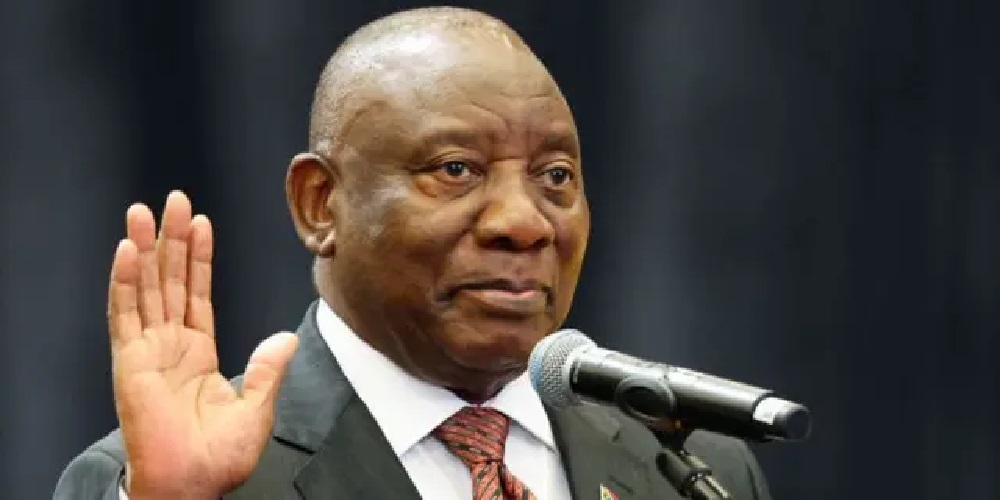
South Africa’s President Cyril Ramaphosa was re-elected for a second term on Friday after his humbled ANC cobbled together an unprecedented coalition government.


Lawmakers in Cape Town voted overwhelmingly to put Ramaphosa, 71, back in office for another five years after the May 29 general election that produced no outright winner.

“I accordingly declare honourable M.C. Ramaphosa duly elected President,” Chief Justice Raymond Zondo said after the votes were counted.

Last month’s election marked a historic turning point for South Africa, ending three decades of dominance by the African National Congress of the late Nelson Mandela.

Advertisement

The party that led the struggle to end apartheid won only 40 percent of the vote and, for the first time, lost its absolute majority in parliament.

It has now struck a deal to form what it calls a government of national unity.

ANC Secretary General Fikile Mbalula said on Friday the broad coalition brings together a majority of the 18 parties that won representation in the 400-seat National Assembly.

These include the centre-right Democratic Alliance (DA), the Zulu nationalist Inkatha Freedom Party (IFP) and other smaller groups.

Advertisement

Ramaphosa was re-elected by fellow MPs with 283 votes in a secret ballot.

He saw off a last-minute challenge by Julius Malema, the firebrand leader of the radical leftist Economic Freedom Fighters (EFF), whose candidacy gained 44 votes.

Ramaphosa will be sworn in next week in Pretoria and then unveil his new cabinet.

Earlier, Zondo had opened the parliament’s first sitting, swearing in MPs in batches ahead of votes on the election of a speaker and deputy speaker.

Advertisement

The first post went to the ANC’s Thoko Didiza and, in a first sign the power-sharing deal was working, the second went to the DA’s Annelie Lotriet. Both are women.

Lawmakers cast their ballot one by one in a lengthy ceremony held in a Cape Town convention centre, as the parliament building is being rebuilt after a 2022 fire.

EFF members took the oath wearing red overalls and in some cases rubber boots and plastic construction worker helmets.

They declined to support the incoming administration, having refused to countenance joining an alliance with right-wing or white-led parties.

Advertisement

“This is not a government of national unity, this is a grand coalition between the ANC and white monopoly capital. History will judge you harshly,” Malema said after conceding defeat.

Graft-tainted former president Jacob Zuma’s new party uMkhonto weSizwe (MK), which came third in the May 29 election, has disputed the results and its MPs boycotted Friday’s sitting.

“The sitting of the national assembly today as far as we’re concerned is illegal and unconstitutional,” MK spokesman Nhlamulo Ndhlela told AFP.

A former trade unionist turned millionaire businessman, Ramaphosa will preside over a government combining radically different political views.

Advertisement

The ANC is a historically pan-Africanist, progressive party of the left that has overseen welfare and economic empowerment programmes for poor, black South Africans.

The largest coalition party, the DA, pushes a liberal, free-market agenda. Smaller parties that are understood to have agreed to join the government range from the left to the far right.

“At the heart of this government of national unity statement is a shared respect and defence of our constitution and the rule of law,” DA leader John Steenhuisen said.

The agreement extended to Johannesburg’s Gauteng province and KwaZulu-Natal.

Advertisement

Zuma’s MK won the most votes in the latter but was left empty-handed as coalition members managed to get a wafer-thin majority of 41 out of 80 provincial councillors.

Steenhuisen added that the coalition agreement included a consensus mechanism to deal “with the disagreements that will inevitably arise”.

“This is not the end of the process. And the road ahead will not be an easy one,” Steenhuisen said, explaining that the two-week deadline imposed by the constitution to form a government did not leave enough time to iron out all details.

Ramaphosa first came to power in 2018 after Zuma was forced out under the cloud of corruption allegations.

Advertisement

Under his watch South Africa suffered from record power cuts, the economy languished and crime remained rife. Unemployment is at almost 33 percent.

He will now have the arduous task to bridge conflicting views within government to turn around South Africa’s economic fortunes.

“Rapid, inclusive and sustainable economic growth” was listed as a top priority in a draft of the coalition deal.

GDP grew by only 0.6 percent in 2023 and was down 0.1 percent in the first three months of 2024.

Advertisement

AFP

Continue Reading
Advertisement
Click to comment

Warning: Undefined variable $user_ID in /home/naijuinz/public_html/wp-content/themes/zox-news/comments.php on line 49

You must be logged in to post a comment Login

Leave a Reply

Foreign

Colombia earthquake death toll jumps to 111; president declares emergency

Published

on

By

ADVERTISEMENT
Zoom Ad
ADVERTISEMENT
Zoom Ad

Colombia on Monday declared a state of emergency following a powerful earthquake that caused at least 111 deaths and flattened dozens of buildings, trapping more victims underneath.

The 7.4-magnitude quake struck western Colombia at 7:34 am (1234 GMT) and triggered a frantic search for survivors in several cities.

“The national government is maintaining all its capacities deployed to protect lives, assist affected communities and deliver aid to every area that needs it,” President Abelardo de la Espriella stated from Bogota.

The leader appointed just three days ago reported 111 deaths, 87 people injured and over 1,000 buildings were damaged.

Advertisement

The quake’s epicenter was in Colombia’s coastal Choco region at a depth of 100 kilometers (60 miles). Authorities in the impoverished area reported 12 deaths.

The nearby city of Pereira was one of the worst-hit areas, with local authorities earlier announcing that at least 40 people had died in the Risaralda region of which it is the provincial capital.

The quake crumpled a tower of a beloved cathedral in the city of Manizales, an AFP journalist observed.

“A great many buildings” in the city sustained damage, said administrative worker Jaime Zuluaga, 50. “Traffic is paralyzed and people don’t want to go back to their homes for fear of an aftershock.”

Advertisement

– ‘Missing people’ –

At least 20 buildings crumbled in Colombia’s third-largest city, Cali, trapping people beneath the debris, Mayor Alejandro Eder said.

Choco’s governor warned of serious damage in the provincial capital Quibdo, where videos showed more buildings reduced to rubble.

“We are all devastated,” Quibdo community leader Luis Gregorio Moreno told AFP.

Advertisement

“At this moment there are reported deaths, dozens of wounded, but what there are most of are missing people,” he said.

Ecuador, Panama and Venezuela also felt the early-morning quake, which prompted building evacuations in the Colombian capital, Bogota.

Still wearing their pajamas, crowds of people rushed out into the street upon feeling the tremor, AFP reporters saw.

“The quake was very, very strong,” said content creator Valeria Polo, 29, in the capital, where only minimal damage was recorded.

Advertisement

Six small airports in western Colombia suspended operations, the civil aeronautics agency said, and the soccer governing body postponed upcoming football matches.

Washington is “closely monitoring the large earthquake that struck Colombia and stands ready to support the people of Colombia,” US Secretary of State Marco Rubio wrote on X.

European Union chief Ursula von der Leyen said the EU was “ready to provide more support” to the South American country.

“We have already mobilised Copernicus, our satellite service, to help with rescue operations,” she wrote on social media.

Advertisement

Israel, Mexico, Ecuador and France also offered assistance.

Latin America is already reeling from two disastrous quakes that struck Venezuela in June, killing more than 6,000 people and causing widespread destruction.

AFP

Advertisement
Continue Reading

Foreign

Iran demands war damages compensation for reopening Strait of Hormuz

Published

on

ADVERTISEMENT
Zoom Ad
ADVERTISEMENT
Zoom Ad


Iran on Saturday gives conditions for the reopening of the Strait of Hormuz, including compensation for war damages, complicating a potential deal to open the waterway essential to the world economy.

Tehran has imposed an effective blockade of the strait since the United States and Israel struck Iran in late February, and wants to charge tolls for passage, attacking ships it accuses of attempting to circumvent its preferred route.

Continued attacks in the strait, which was free to transit before the war, led to the collapse of an April ceasefire. Mediators have since urged both sides to return to the terms of a June memorandum.

Advertisement

Iranian Foreign Minister Abbas Araghchi said discussions with Oman over transit and management of the strait were “approaching the final stages”, but added the reopening of Hormuz “is subject to other conditions and compensation for the violation” of the June agreement.

Security chief Mohammad Bagher Zolghadr on Saturday laid out a list of demands for reopening the strait, including an end to the “war and aggression against Iran and its allies in Lebanon, Palestine, Yemen, and Iraq”.

He also demanded the lifting of a parallel US naval blockade of Iran, the end of sanctions, the release of frozen assets and compensation for wartime damage, according to remarks reported by Tasnim news agency.

Iran’s Revolutionary Guards, meanwhile, said Hormuz’s reopening had “nothing to do with the negotiations between Iran and Oman”, adding that the “enemy is forced to accept Iran’s conditions for the opening of the strait”.

Advertisement

The comments came as transit through Hormuz has dropped significantly, with Iran targeting ships it accuses of skirting its preferred route through Iranian waters.

The United Arab Emirates’ foreign ministry on Saturday condemned what it called a “hostile Iranian attack that targeted a tanker belonging to ADNOC (Abu Dhabi National Oil Company) with a missile while it was transiting the Strait of Hormuz, without causing casualties”.

Later on Saturday, the United Kingdom Maritime Trade Operations (UKMTO) said a ship was hit by a projectile off Oman in the Strait of Hormuz, causing a fire that was extinguished but no casualties. It was unclear whether they were referring to the same ship.

On Friday, ADNOC had put out a statement saying that since the start of the war, 15 of its vessels had been attacked in Hormuz, “including three vessels this week alone”.

Advertisement

Oman’s foreign ministry on Saturday condemned “repeated attacks on vessels transiting the Strait of Hormuz”, without naming Iran.

It also said that “ongoing negotiations regarding navigation arrangements in the Strait of Hormuz are proceeding in a positive and constructive atmosphere”, and urged against any actions that might jeopardise the progress.

The previous Iran-US deal — meant to serve as a jumping-off point for negotiations on a permanent settlement — had said Iran and Oman would hash out future arrangements for the strait in discussion with other Gulf countries and “in line with the applicable international law”.

International law generally forbids tolling in such waterways.

Advertisement

Security agreement

Turkey’s foreign minister said Saturday he expected Egypt to join a joint defence agreement between Turkey, Saudi Arabia and Pakistan designed to stabilize the region, calling the country a “natural partner on all issues”.

“I believe that at the next stage Egypt will also be among us in the alliance. We already act toward one another as if we were alliance members,” Foreign Minister Hakan Fidan said in an interview.

A drone struck US assets at an Egyptian port on the Mediterranean last month, marking the first drone attack on Egyptian territory since the outbreak of the Iran war.

Advertisement

Fidan said the agreement does not target a specific country.

“There is no common threat that we have put in writing,” he said, according to the news agency.

Pakistan’s foreign ministry said Friday the pact meant an attack on any member would be regarded as an attack on all, adding it was “intended to strengthen collective deterrence”.


Advertisement

AFP

Continue Reading

Foreign

Spain imposes border checks on Italy over migrant dispute

Published

on

By

ADVERTISEMENT
Zoom Ad
ADVERTISEMENT
Zoom Ad

Spain on Saturday started border checks on travellers arriving from Italy, responding to similar measures Rome imposed following an unprecedented migrant rush into the Spanish north African enclave of Ceuta.

“I don’t see a lot of the word ‘diplomacy’ used in these decisions, not by the Italian government, nor by the Spanish government,” said one 36-year-old Italian tourist, Maria Celeste Grillo, who had just flown into Madrid.

She said she had not seen any added checks as she stepped off the plane, but found their implementation “sad”.

Spain announced Friday it would proceed with the heightened controls, citing “persistent irregular migration pressure” facing Italy — deepening a row between the EU partners and NATO allies.

Advertisement

Spain’s left-wing government has complained that Italy’s hard-right government on July 31 unfairly imposed one month of border checks on travellers from Spain — suspending the EU’s Schengen Area visa-free travel arrangements — because of the Ceuta influx.

More than 70,000 migrants had crossed from Morocco into the Ceuta enclave on July 30 and 31, though almost all of them subsequently returned to Morocco within 48 hours.

The inflow alarmed European nations, especially right-wing ones urging tougher rules on irregular migrants. However, rules for Ceuta mean migrants cannot travel onward to continental Europe without passing another layer of border checks.

Spain’s interior ministry said the new checks on incoming travellers from Italy would apply until September 7.

Advertisement

AFP

Continue Reading

Trending

Copyright © 2024 Naija Blitz News