Foreign
US Senate passes first major online child safety bills in years
- /home/naijuinz/public_html/wp-content/plugins/mvp-social-buttons/mvp-social-buttons.php on line 27
https://naijablitznews.com/wp-content/uploads/2024/07/US-Senate-1000x600.jpg&description=US Senate passes first major online child safety bills in years', 'pinterestShare', 'width=750,height=350'); return false;" title="Pin This Post">
- Share
- Tweet /home/naijuinz/public_html/wp-content/plugins/mvp-social-buttons/mvp-social-buttons.php on line 72
https://naijablitznews.com/wp-content/uploads/2024/07/US-Senate-1000x600.jpg&description=US Senate passes first major online child safety bills in years', 'pinterestShare', 'width=750,height=350'); return false;" title="Pin This Post">
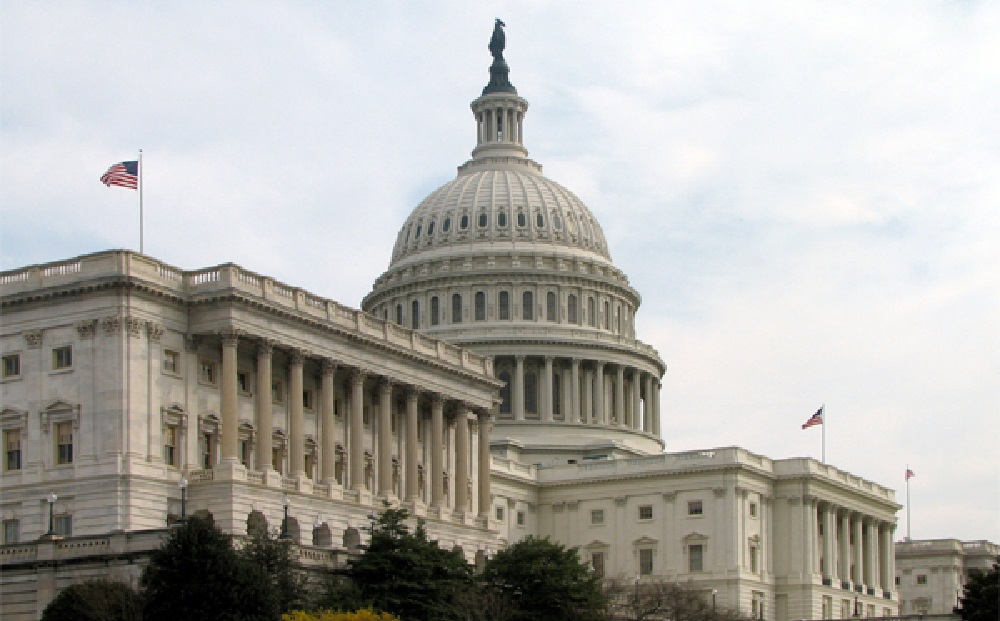
The US Senate passed a sweeping social media safety package Tuesday that would force tech companies to do more to protect children – the first major legislation targeting Silicon Valley in a generation.

Social media giants like Meta and X have been confronting a torrent of political anger for not putting in guardrails to thwart online dangers for children, including from sexual predators and teen suicide.
A rare sign of cross-party unity in an increasingly rancorous election year, the Kids Online Safety Act (KOSA) and the Children and Teens’ Online Privacy Protection Act (COPPA 2.0) were passed in an overwhelmingly bipartisan vote with just three dissenters.

But the bills face an uncertain path through the House of Representatives, where Republican Speaker Mike Johnson has spoken broadly in favor of the package but has not scheduled a vote.
“Today is a momentous day. The Senate keeps its promise to every parent who has lost a child because of the risks of social media,” said Senate Majority Leader Chuck Schumer said in a statement.
While there is widespread agreement in a politically divided Congress on curbing the negative impacts of social media, there has never been a united path on how to go about doing so.
The legislation was drawn up in consultation with parents of teens who had been bullied or sexually exploited but has been opposed by some free speech groups worried it could lead to censorship.
– ‘Duty of care’ –
House members are on their summer recess and will almost certainly be focusing on averting a looming government shutdown when they return in September.
But Schumer called on the lower chamber to pass the bills immediately on its return, urging lawmakers to “seize the opportunity to send them to the president’s desk.”
KOSA would establish a “duty of care” obligation on the online platforms that would demand special provisions be put in place to shield minors from toxic content.
Supported by Microsoft, X and Snap, the company that owns Snapchat, the legislation would require companies to give users a dedicated page to report harmful content — including sexual exploitation, online bullying, the promotion of suicide and eating disorders.
In January, Meta CEO Mark Zuckerberg gave a public apology to the families of victims at the Senate Judiciary Committee as hostile lawmakers grilled tech CEOs over the dangers that children face on social media.
“I’m sorry for everything you have all been through,” he said. “No one should go through the things that your families have suffered.”
– Censorship fears –
Seven LGBTQ advocacy groups initially opposed to the bill changed their position after changes they said mitigated concerns that teens would be limited in accessing information about gender identity, sexuality and reproductive health.
But free speech groups including the American Civil Liberties Union (ACLU) have argued the definition of harm is too broad and that it could lead to censorship.
“KOSA compounds nationwide attacks on young peoples’ right to learn and access information, on and offline,” said Jenna Leventoff, senior policy counsel at the ACLU.
Evan Greer, director of Fight for the Future, told reporters that KOSA was “a blank check for censorship of any piece of content that an administration could claim is harmful to kids.”
COPPA 2.0 would beef up legislation passed in 1998, in the earlier days of the internet.
It would require privacy standards for Americans aged under 17 and outlaw online advertising targeted at children and teens – requiring companies to allow users to delete personal information.
“Too many kids experience relentless promotion of suicide or substance abuse material. Too many kids have their personal data collected and then used nefariously,” Schumer said.
“With studies showing that kids today spend more time on social media than ever before, now is the moment to pass KOSA, pass COPPA, and instill guardrails that protect kids from these risks.”
AFP
Foreign
Drug trafficking: Court sentences popular tv presenter, 11 others to death
An Egyptian court has sentenced popular television presenter, Sarah Khalifa and 11 others to death over their alleged involvement in the production and trafficking of narcotics.
Khalifa, 39, is a well-known television personality and the presenter of ‘Mission Impossible’, a programme that focuses on security and crime-related issues.
According to the state-linked Al-Ahram newspaper, a Cairo court found Khalifa and the 11 other defendants guilty of forming an organized criminal gang involved in procuring materials used to manufacture narcotics for trafficking.
The defendants were also convicted of possessing and carrying unlicensed firearms and ammunition.
The court reached the death sentence after seeking the religious opinion of Egypt’s Grand Mufti, as required by law in capital punishment cases.
However, the verdict is subject to appeal.
State-run Akhbar Al-Youm newspaper reported that the defendants were accused of producing synthetic drugs for trafficking after allegedly importing the materials needed for their manufacture from outside Egypt.
Authorities reportedly seized more than 750 kilogrammes of narcotics and raw materials during investigations into the case. They also discovered two apartments allegedly being used as drug laboratories, alongside unlicensed firearms and ammunition.
Khalifa, who also owns a plastic surgery clinic and a production company involved in organizing parties and events, was further sentenced to five years in prison with other defendants in a separate case involving the kidnapping and assault of a young man.
Egyptian law allows the death penalty for offences including premeditated murder, terrorism, certain rape cases and drug trafficking. Data from the Egyptian Commission for Rights and Freedoms showed that 541 death sentences were handed down in Egypt in 2025
Foreign
US Will Destroy Oil Tankers If American Ships Are Attacked – Hegseth Warns Iran
The United States has issued a fresh warning to Iran, threatening to destroy and sink Iranian oil tankers if Tehran launches further attacks against American naval vessels.
U.S. Secretary of War Pete Hegseth issued the warning on Saturday, September 5, 2026, shortly after American forces struck three Iranian oil tankers following what Washington described as ballistic-missile attacks by Iran’s Islamic Revolutionary Guard Corps (IRGC) against two U.S. Navy warships.
Hegseth, in a statement on X, said the United States would respond directly by targeting Iran’s oil fleet if American ships came under fire.
“It’s simple: if Iran shoots at U.S. ships, we will destroy (and sink) their oil tankers,” Hegseth said, adding that Iran only needed to refrain from attacking the U.S. Navy.
He further claimed that Iran’s oil tanker fleet was vulnerable because, according to him, Tehran lacked the naval and air capabilities necessary to protect the vessels.
“Iran’s oil tanker fleet is defenseless — Iran has no navy or air force. Our planes, ships & subs can strike them all,” Hegseth said, referring to areas under the U.S. Central Command and U.S. Indo-Pacific Command.
US strikes three Iranian tankers
The warning came after U.S. Central Command (CENTCOM) confirmed that American forces had struck three Iranian crude oil carriers.
CENTCOM said the action followed missile attacks by the IRGC against a U.S. aircraft carrier and a guided-missile destroyer. According to the command, both American warships successfully evaded the missiles and no U.S. personnel were injured.
The American military identified two of the vessels as M/T Downy, which was struck off Kharg Island, and M/T Stark 1, targeted near Jask.
Both vessels were described by CENTCOM as “permanently disabled.”
A third tanker, M/T Kylo, also known as Noxen, was attacked in the Gulf of Oman. CENTCOM said the crew was warned to abandon the vessel before it was destroyed.
The U.S. military said the tankers were connected to what it described as a multibillion-dollar “shadow network” allegedly used to finance Iran’s Revolutionary Guard and its regional allies.
US threatens wider action
The commander of U.S. Central Command, Admiral Brad Cooper, also warned that Washington would impose an even greater economic cost on Tehran if Iranian forces continued attacking American vessels.
“If you shoot at two of our ships, we will impose an even higher economic cost — taking out three of yours,” Cooper said.
He added that the United States would not hesitate to defend its forces and, if necessary, destroy Iran’s “limited and exposed oil fleet.”
The latest threats signal a potentially significant expansion of the maritime confrontation between Washington and Tehran, with Iranian oil shipments increasingly becoming a direct target of U.S. military pressure.
Iran condemns attacks
Iran has condemned the American strikes on its oil tankers, describing the attacks as illegal and warning that Washington and its allies would bear responsibility for the consequences of continued attacks.
Iranian authorities have also warned that further attacks on Iranian vessels could trigger retaliation against American interests in the region.
The escalation is particularly significant because it is unfolding around the Strait of Hormuz, one of the world’s most important energy shipping routes.
The waterway connects the Persian Gulf with the Gulf of Oman and is a critical route for global oil supplies. Continued attacks on commercial vessels could therefore have wider implications for international energy markets and global shipping.
With the United States now openly threatening to target Iran’s oil fleet in response to attacks on its Navy, the latest confrontation could mark a new and more dangerous phase in the ongoing U.S.-Iran conflict.
Foreign
UN Backs New World Map To Correct Africa’s Distorted Size
The United Nations General Assembly has overwhelmingly backed a Togo-led resolution calling for a more accurate representation of the world’s continents, particularly Africa, on global maps.
The resolution, “Correct the Map: Rebalancing Global Cartographic Representation and Promoting Equitable Representation of the World’s Regions, Particularly Africa,” was adopted on Friday, September 4, with 164 countries voting in favour, six abstaining and only the United States voting against.
The initiative promotes the gradual adoption of the Equal Earth projection, which represents the relative areas of continents more accurately than the centuries-old Mercator projection. The Mercator map, developed in 1569 primarily for navigation, significantly enlarges landmasses closer to the poles while making equatorial regions such as Africa appear disproportionately smaller.
Togo, which spearheaded the initiative with African Union backing, argued that maps are not merely geographical tools but also shape how societies perceive the world and their place in it.
The resolution is not legally binding and does not ban the Mercator projection, which remains useful for maritime navigation. Instead, it encourages governments, educational institutions and other users to consider more geographically accurate alternatives.
The vote also exposed differing political interpretations of the initiative. The United States was the sole country to oppose the resolution, arguing that the United Nations should concentrate on more pressing global challenges rather than what Washington characterised as an ideological agenda.
The measure nonetheless represents a significant diplomatic victory for African countries seeking to challenge longstanding distortions in the way the continent is visually represented on commonly used world maps.
Africa has not changed its size. The map is finally being asked to show it.
-
News23 hours ago‘Provide Evidence El-Rufai Paid Bandits To Kill Kaduna People’ – Ex-Gen Queries Defence Minister
-
News24 hours agoTwo Policemen fired over death of UNIPORT graduate in Port Harcourt
-
Sports21 hours agoSad! Military jet crashes during airshow
-
Sports24 hours agoWilliams sisters lose in thrilling return to US Open doubles
-
Economy8 hours agoFG Can’t Account For ₦33.75 Billion Cash Transfers To Vulnerable Nigerians – Auditor-General
-
News23 hours agoStop empowering Nigerians with okada, Defense minister tells govs
-
News8 hours ago2027: Amaechi Chose Buhari Over Jonathan, We’ll Pay Him Back – Wike
-
News24 hours ago15 minors sold for N2m each rescued by NSCDC men

Warning: Undefined variable $user_ID in /home/naijuinz/public_html/wp-content/themes/zox-news/comments.php on line 49
You must be logged in to post a comment Login