Connect with us

News

Fuel Scarcity Worsens as Petrol Prices Surge: November 12th, 2024 Update

Published

on

ADVERTISEMENT
Zoom Ad
ADVERTISEMENT
Zoom Ad

By Kayode Sanni-Arewa

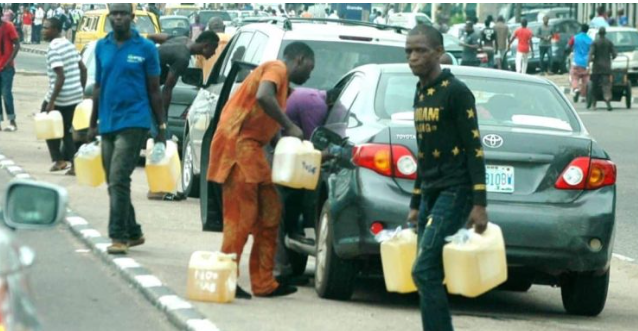
As Nigerians face the impact of a recent increase in fuel prices announced by the Nigerian National Petroleum Company (NNPC) Limited, citizens continue to grapple with both rising costs and a scarcity of petrol, which has disrupted daily life.

Gists9ja reports on the latest developments surrounding petrol availability, escalating prices, and the reactions of both government officials and the public.

A significant step toward addressing these challenges was recently taken by the Independent Petroleum Marketers Association of Nigeria (IPMAN), which secured a new agreement with the Dangote Refinery for direct fuel supply. This partnership is seen as a strategic move to stabilize fuel distribution nationwide.

Advertisement

At a press briefing held in Abuja, IPMAN’s National President, Abubakar Garima, announced the partnership after discussions with the association’s National Working Committee. Garima stated that the primary goal of this collaboration is to ensure an uninterrupted and reasonably priced supply of Premium Motor Spirit (PMS) to consumers across Nigeria.

Following meetings with Aliko Dangote and his management team in Lagos, Garima shared that Dangote Refinery agreed to provide IPMAN with PMS, Automotive Gas Oil (AGO), and Dual Purpose Kerosene (DPK). These products will be supplied directly to IPMAN’s depots and retail outlets to streamline distribution channels.

“We are very pleased to have reached an understanding with Dangote Refinery. This agreement will allow us to source PMS, AGO, and DPK directly from the refinery,” Garima explained. He also encouraged IPMAN members to embrace this partnership, highlighting that the initiative would contribute to local economic growth and reinforce Nigeria’s foreign exchange reserves by reducing dependence on imported fuels.

Garima emphasized the broader economic potential of this deal, noting that this move toward self-sufficiency supports the administration’s agenda for a revitalized Nigeria. “By relying on local refineries like Dangote, IPMAN members can contribute to job creation and help advance President Bola Tinubu’s vision for economic stability and prosperity,” he said.

Advertisement

After extensive negotiations spanning several months, this agreement aims to boost efficiency in fuel supply, reduce fuel prices for consumers, and stimulate economic development.

The financial implications of fuel importation have shifted recently, as the cost of landing Premium Motor Spirit (PMS) in Nigeria decreased by approximately 20.34 percent over the past three months, reducing from ₦1,219 per litre to ₦971.57 per litre. This reduction in landing costs, which include expenses for importation and distribution, is attributed to changes in global oil prices and adjustments within the supply chain. Yet, despite these lowered landing costs, Nigerians have seen retail petrol prices rise significantly.

Since August 2024, the price of petrol has surged by ₦443, marking a 71.79 percent increase from ₦617 per litre to ₦1,060 per litre as of November 8, 2024. Independent marketers, facing their own rising costs, have been selling petrol at rates as high as ₦1,180 per litre in some regions.

Data from the Major Energies Marketers Association’s energy bulletin illustrates the pricing shifts. In August, oil marketers imported petrol at ₦1,219 per litre when Brent crude was priced at $80.72 per barrel, with an exchange rate of ₦1,611 per dollar. At that time, petrol was retailing at ₦617 per litre. By November, the landing cost had decreased to ₦971.57 per litre, with Brent crude priced at $75.57 per barrel, and the exchange rate at ₦1,665.84 per dollar

Advertisement

In response to the price hikes, the Human Rights Writers Association of Nigeria (HURIWA) issued a statement condemning the policy of repeated fuel price increases. The organization’s National Coordinator, Emmanuel Onwubiko, argued that the government’s approach to fuel pricing appears to benefit a select few rather than address the needs of ordinary Nigerians.

According to HURIWA, the successive hikes in fuel prices have led to a rise in the cost of essential goods, pushing millions of Nigerians into deeper financial hardship. “The policy of incessantly increasing the pump price of petroleum products does not serve the interests of the Nigerian populace,” Onwubiko stated. “It primarily benefits the associates and business affiliates of those in power, rather than providing relief for average Nigerians.”

HURIWA expressed concerns that the rising fuel costs have driven up food prices, which many households can no longer afford. This has resulted in widespread malnutrition, increased hunger, and an alarming rise in the number of out-of-school children as families struggle to make ends meet. The organization noted that while most Nigerians face these difficult conditions, only a few in the oil and gas industry are profiting from the current situation, as recent statistics indicate.

HURIWA’s critique underscores the growing public frustration with the economic burden that fuel price hikes impose on Nigerians. Many are hopeful that initiatives like the IPMAN-Dangote partnership will alleviate these issues by ensuring a more stable and affordable fuel supply across the nation.
Advertisement
Continue Reading
Advertisement
Click to comment

Warning: Undefined variable $user_ID in /home/naijuinz/public_html/wp-content/themes/zox-news/comments.php on line 49

You must be logged in to post a comment Login

Leave a Reply

News

FG hands HND admissions to JAMB, moves to end illegal polytechnic admissions

Published

on

ADVERTISEMENT
Zoom Ad
ADVERTISEMENT
Zoom Ad

The Federal Government has approved the takeover of admissions into Higher National Diploma (HND) programmes by the Joint Admissions and Matriculation Board (JAMB), in a major reform aimed at sanitising the admission process in polytechnics and other institutions offering HND programmes.

The decision means prospective HND students will, from the current admission session, have their admissions processed through JAMB under a centralised system.

The National Board for Technical Education (NBTE) disclosed this in a circular dated September 9, 2026, signed by its Executive Secretary, Prof. Idris Bugaje, and obtained by LEADERSHIP Weekend.

The directive followed a meeting involving the Minister of Education, Dr Tunji Alausa; JAMB; NBTE; the National Youth Service Corps (NYSC); and officials of the Federal Ministry of Education.

Advertisement

According to the NBTE, the new system is designed to tackle illegal, irregular and compromised admissions, particularly cases that could leave students stranded after completing their programmes.

The board said some students admitted through questionable channels had faced difficulties securing NYSC mobilisation after obtaining their HND certificates.

“All HND admissions in all institutions shall from this session be taken over by JAMB to provide centralised process and avoid illegal and compromised admissions, jeopardising students’ mobilisation for NYSC after HND,” the circular stated.

The Federal Ministry of Education is expected to issue a detailed statement on the new policy next week.

Advertisement

NBTE also directed that comprehensive guidelines for HND admissions be developed immediately and submitted to JAMB to guide the implementation of the new digital admission platform.

The proposed guidelines will cover important issues, including the waiting period required for National Diploma (ND) holders before progressing to HND programmes.

They will also clarify exemptions applicable to certain ND health-related programmes.

Part-time ND admissions capped at 50%

Advertisement

The government also approved a new limit for part-time National Diploma admissions following the decision to bring all part-time ND admissions under JAMB.

Under the new arrangement, institutions will be permitted to admit part-time students up to 50 per cent of their approved full-time admission quota.

“Now that all part-time ND admissions are under the JAMB, the proportion of part-time students is pegged at 50 per cent of the approved full-time quota,” NBTE stated.

The Federal Government further reaffirmed an earlier NBTE directive concerning candidates holding combined National Certificate in Education (NCE) and HND qualifications.

Advertisement

In a separate circular issued on September 7, NBTE directed that candidates with an NCE/HND combination should not be presented for NYSC mobilisation.

The latest reforms are expected to strengthen central oversight of admissions into Nigeria’s technical and polytechnic institutions while reducing irregular admission practices and protecting students from complications after graduation.

Continue Reading

News

2027: Kwankwaso ‘unbeatable’ in Kano, Victor Umeh declares

Published

on

ADVERTISEMENT
Zoom Ad
ADVERTISEMENT
Zoom Ad

Senator Victor Umeh has expressed confidence that former Kano State governor and Nigeria Democratic Congress (NDC) vice-presidential candidate, Rabi’u Musa Kwankwaso, cannot be defeated in Kano State if the 2027 presidential election is free, fair and credible.

Umeh, who represents Anambra Central Senatorial District, made the assertion on Friday during an interview on Channels Television’s Politics Today, while discussing the NDC’s preparations for the 2027 general elections.

The senator said Kwankwaso’s political influence in Kano remained formidable, insisting that the former governor would retain his stronghold in the state under a transparent electoral process.

«“No matter the noise they make in Kano, nobody can beat Kwankwaso there once the election is credible, transparent, free and fair. I can bet it,” Umeh said.»

Advertisement

He added that he was working closely with Kwankwaso and other leaders of the party as the NDC positions itself for the 2027 elections.

“I’m working with him and other leaders of the party very closely. The party is well more prepared to be an opposition party that will contest this election with very credible candidates,” he said.

Umeh also pointed to the growing public reception for the party’s candidates, citing the recent outing of the NDC’s Rivers State governorship candidate, Dumo Lulu-Briggs, in Port Harcourt.

“Look at what our Rivers State governorship candidate, Dumo Lulu-Briggs, did in Port Harcourt in just his first outing. Port Harcourt was shut down,” he said.

Advertisement

The senator further cited the large crowd that reportedly followed the party’s presidential candidate, Peter Obi, during his recent activities in Port Harcourt, describing the turnout as evidence of growing enthusiasm among voters.

“Those people following them in Port Harcourt last week are Nigerians that will vote. Why were they following our presidential candidate, Peter Obi, like Jesus was crossing, and people were marching around him?

“Something must be motivating and driving the people, the voting population,” Umeh added.

His comments come as political parties and potential presidential contenders intensify mobilisation ahead of the 2027 general elections, with control of key states such as Kano expected to play a major role in the presidential contest.

Advertisement
Continue Reading

News

Nigeria must punish drug pushers—Speaker Abbas

Published

on

ADVERTISEMENT
Zoom Ad
ADVERTISEMENT
Zoom Ad

… says abuse is a menace to society

The Speaker of the House of Representatives Rt. Hon. Abbas Tajudeen, Ph.D., GCON, has said Nigeria must punish drug pushers to have a better society, saying the abuse is a menace to society.

“We must punish those who profit from drugs. We must also treat those who have become trapped by them. The dealer needs the law. The dependent person needs care,” he said, adding that, “The government is present. The law is active. The public must also participate.”

Speaker Abbas stated this on Saturday at the close of a three-day sensitisation programme against drug abuse and domestic violence held in Kaduna. The programme, which is part of the Speaker’s constituency outreach, was organised in collaboration with the National Orientation Agency (NOA).

Advertisement

He said, “Parents must watch for sudden changes in conduct. Schools must provide counseling and report warning signs. Pharmacists and medicine vendors must reject the unlawful sale of controlled substances.

“Traditional and religious leaders must reject silence around addiction and abuse. Neighbours must report violence. Market and transport unions must report suspicious movement of drugs. Young people must reject pressure and seek help when needed.

“Victims should seek safety, obtain medical care, preserve evidence, and report abuse. Communities must protect them, not punish them with blame or shame.”

Speaker Abbas recalled the last edition of the programme in February 2025, which heralded a four-month campaign across the North-West. “We promised to take the message beyond conference halls. We promised to engage traditional rulers, religious leaders, teachers, parents, young people, and community organisations,” he said.

Advertisement

He noted that Saturday’s edition of the programme showed that “we have kept that promise.”

The Speaker said NOA has taken the campaign into Kaduna’s streets and communities, while its officers are engaging market leaders, transport workers, youth groups, and traditional institutions “because prevention begins with proper information.”

While commending the Director General of NOA, Lanre Issa Onilu, and his team, Speaker Abbas equally appreciated the National Drug Law Enforcement Agency (NDLEA), Nigeria Police Force (NPF), Nigeria Immigration Service (NIS), Federal Road Safety Corps (FRSC), Nigerian Correctional Service (NCoS), National Youth Service Corps (NYSC), and the state agencies.

He said, “Drugs can impair judgement, increase aggression, and deepen poverty. But drugs never excuse violence. Every person remains responsible for his or her actions. Domestic violence is not discipline or culture. It is abuse. It harms the victim, frightens children, and weakens the community.

Advertisement

“The damage caused by drugs does not stop at the family door. It spreads into our streets, schools, markets, and security system. Drug trafficking gives criminal networks money. The same hidden routes can carry drugs, illegal weapons, criminal funds, and violent offenders. Drugs do not explain every crime, but they are part of Nigeria’s wider security challenge.”

The Speaker stated that “every shipment stopped can deny criminals money for weapons and recruitment,” stressing that “every person rescued from addiction is one less person exposed to violent groups.”

Speaker Abbas explained further that drug control is part of the fight against banditry and kidnapping in the North-West. “Security forces may clear the camps. Communities must help cut the supply lines,” he said, adding that, “Enforcement stops the shipment. Education reduces the demand. Treatment restores the individual. Community vigilance protects the neighbourhood.”

Speaker Abbas commended President Bola Ahmed Tinubu, GCFR, for retaining Brigadier General Mohammed Buba Marwa (rtd.) as Director-General of the NDLEA and supporting enforcement, international cooperation, public education and treatment, including a new 50-bed rehabilitation centre in Maiduguri.

Advertisement

He said, “The National Assembly has consistently played its part. In 2024, the House called for a preventive drug testing programme in secondary schools and directed NOA and NDLEA to expand student awareness.

“The House also moved against the indiscriminate sale of prescription medicines. We called for illegal outlets to close and for stronger joint enforcement by the responsible agencies.

“We have considered bills to strengthen the NDLEA Act. In 2025, the House called for faster investigation and prosecution of femicide, homicide, and related violence. We will continue to fund enforcement and treatment, close gaps in the law, and demand results through oversight.”

Advertisement
Continue Reading

Trending

Copyright © 2024 Naija Blitz News