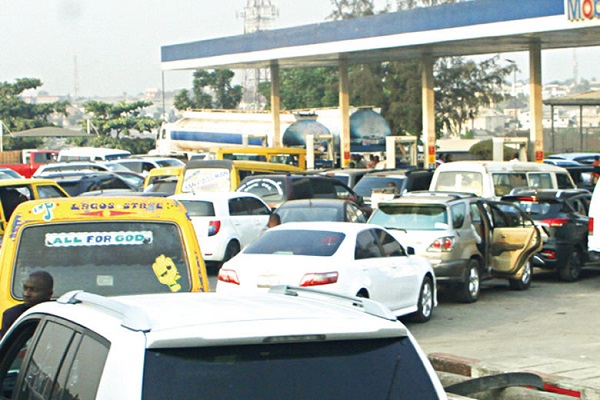
Banks are set to increase funding of petrol importation to N3.5 trillion as more marketers move to import the product amidst the push for the exclusivity of local production and supply led by Dangote Refinery.


Financial Vanguard learnt that banks are now receiving more loan requests for funding petroleum products imports with the head of oil and gas in a tier-1 bank saying about N250 billion single request came to his desk last week, the third in the last month.
He estimated the banking industry funding of petrol imports to be around N3.5 trillion before the end of this year. 
He stated: “We have started seeing a lot of petroleum marketers coming up with loan requests for importation of products, which we didn’t have before now not even when the President declared that subsidy is gone.
“We have also done our due diligence on the market and discovered that deregulation is gaining traction across the private and public sectors.
“Before now we do not entertain lending to petrol marketers due to issues around pump price regulations because many banks had burnt their fingers in the recent years over oil and gas related loans that failed.”
Petrol costlier than actual market price, NLC alleges
Meanwhile the Nigeria Labour Congress, NLC, has alleged that the pump price of petrol is higher than market price, accusing marketers of ripping off Nigerians.
NLC in a communiqué at the of its National Executive Council, NEC, in Port Harcourt Rivers State, by its President, Joe Ajaero, noted with “increasing dismay the shenanigans around the appropriate pricing of petrol, (Premium Motor Spirit, PMS) in Nigeria.”
NLC observed that there may be a gang up against Nigerians by fat cats in the industry as the current price of the product is significantly higher than the real market price. Padding of costs and abnormal margins seems to be the order of the day considering the revelations from the ongoing controversy between Marketers and the Dangote group. It is entirely possible that Nigerian workers and masses are being ripped off by those who control the levers of Economic power in Nigeria which explains why the domestic public refineries may not immediately be allowed to come on stream.
“How can one explain the situation where marketers are still eager to import petrol with all the taxes such are import charges, fright charges, Nigerian Port Authority, NPA, Nigerian Nigerian Maritime Administration and Safety Agency, NIMASA, among others, despite a local source of refined petroleum products speaks volume.
“NLC demands appropriate pricing of petrol and calls for the Public domestic refineries in PH, Warri and Kaduna to quickly come back on stream to break-up the monopolistic stranglehold the big players have on the industry.”
At $72 per barrel of oil, imported petrol should be cheaper in Nigeria — Experts
Supporting NLC’s position, experts and other stakeholders, weekend, said at the current price of $72 per barrel of crude oil, the price of Premium Motor Spirit, PMS, also known as petrol, should be cheaper in Nigeria.
They said the current price of N1, 025 per litre (Lagos) was taken when crude oil, a major feedstock stood at more than $80 per barrel in the global market September 2024.
Since then, they said the price of crude has been volatile before dropping to the current $72 per barrel, without reflecting in the domestic price of petrol.
In different interviews with Vanguard, the experts noted that deregulation as currently practiced should enable the market to respond seamlessly to changes, including crude oil, the major raw material.
On his part, a Port Harcourt-based energy analyst, Dr. Bala Zakki, said: “The irresponsible petroleum products price dynamics in Nigeria is never obtainable in any Organisation of Petroleum Exporting Countries, OPEC member nations and the reason is very simple and straightforward.
“OPEC member nations have their functional state-owned refineries. No responsible government will or should abdicate its responsibilities of providing goods & service to the private sector.
“Globally, private sector operators are known to be shylocks, exploitative and profit maximizers.”
Similarly, Chairman of the Lagos State chapter of the Petroleum Products Retail Outlets Owners Association of Nigeria, PETROAN, Mr. Joseph Ehimen, said: “The prices that are driven by market forces would slightly fall though it will be a short term because local sources may fight back.”
Also, the Chief Executive Officer, Major Energy Marketers Association of Nigeria, MEMAN, Clement Isong, said: “The global market has been volatile, dropping and going back up and dropping again.
“Theoretically, petrol prices can fall in the domestic market, if the international prices are lower or continue to drop lower than the local prices.”
As reported by Vanguard, the landing cost of petrol, dropped by 4.5 per cent to N903 per litre in October 2024, from N945.63/litre in September 2024.
Data released by the Major Energies Marketers Association, MEMAN, showed that the landing cost stood at N945.63 in September 2024.
However, the transactional analysis obtained by Vanguard, yesterday, indicated that the landing cost stood at N903.64 per litre in October 2024.
According to the breakdown, the total direct cost, including product cost, freight (Lome – Lagos), port charges, Nigerian Midstream and Downstream Petroleum Regulatory Authority, NMDPRA levy, Storage cost, Marine insurance and fendering cost at N863.06 per litre.
The transactional analysis, which guides oil traders and other stakeholders, puts total finance cost, including letter of credit (N15.60) and interest (N24.98) to N40.55 per litre.
The transactional analysis did not provide reasons for the drop in the landing cost but checks by Vanguard pointed to the relatively low price of crude oil, which stood at about $72 per barrel during the period.
IPMAN defaults NLC, say market fully deregulated
Independent Petroleum Marketers Association of Nigeria, IPMAN, has faulted the claims by the Nigerian Labour Congress that petrol prices in Nigeria are higher than actual market price.
IPMAN reminded NLC that the petrol pricing in Nigeria has been deregulated now it is now determined by forces of demand and supply.
The Public Relations Officer, IPMAN, Chief Chinedu Ukadike told Vanguard yesterday that with the deregulation, marketers set their prices based on the cost of purchase and another logistic cost as well as the cost of money.
Chief Ukadike said: “That assertion is completely not correct, it is false. NLC cannot set prices for marketers. If they are agitating that the price is too high for consumers, that is a different matter and the appropriate thing to do is to take their complaints to the government. The sector is completely deregulated and the government no longer determines the price of petrol in the country.
“The market is open for all players and prices are determined by the forces of demand and supply. The pump price is also determined by cost of purchase, cost of logistics and cost of money”.
He pointed out that the workers Union should put pressure on the government to supply crude oil to local refineries at a cheaper rate as a way of reducing the cost of the product in Nigeria.
On the ongoing negotiation between IPMAN and the Dangote Refinery, Chief Ukadike said significant progress has been made with the refinery agreeing to deal directly with the marketers.
“The negotiations have been fruitful and we are happy with how it is going. That’s all I can say at the moment because the National President will formally announce the outcome very soon. But I can tell you that it has been fruitful. The refinery has agreed to deal directly with us and agreement on terms is very close”, he explained.
Why marketers prefer importation —Analysts
Corroborating the increased request for bank loans to increase petrol importation many marketers said the industry is now deregulated enough for market reflective pricing, a situation which has made borrowing from banks to fund the imports becoming possible.
But Dangote Refinery has expressed discomfort over the expected massive importation of the product, saying its facility has capacity to meet demands in full.
According to Dangote Refinery Nigeria should protect its local industry from such imports which it also sees as “protection of national interest”.
However, many marketers who spoke to Financial Vanguard during the weekend disagreed with Dangote’s position, explaining that the argument is the other way round, meaning the importations would protect Nigerians from monopoly and pump price increases, which they see as a threat to national security.
Consequently, they said that most marketers are now going for their own petrol import cargoes.
Speaking along this line, Managing Director of Pinnacle Oil and Gas Limited, Robert Dickerman, stated: “It is Pinnacle’s firm position, as well as the position of any educated economist or market watcher, that the optimal solution for Nigeria’s energy security and pricing is a market-based solution that encourages all sources of supply, be they from local refineries or from import or any source.
“These suppliers must adhere to the strict specifications of the market and product must be handled safely. But the consumer should be indifferent to the source of supply, as long as the product is good quality, and the price is the lowest attainable. This solution demands competition.
“The objective is to make sure that there is energy security, in other words, always have supply, never have any queues or any shortages, either in supply or in distribution or even in retail.
“There’ll be no use to have market pricing controversies. It should be a transparent market pricing that comes with an unlimited availability of supply.
“In fact, globally, to be honest with you, there’s actually a bit of a surplus in refining capacity, and many European refineries lately have been closing their refineries, and even a couple refineries in the United States because there’s an over capacity.
“So globally, there’s no shortage of gasoline (petrol) or diesel or jet fuel or any particular petroleum product whatsoever, not at all. And the same goes for petrochemicals.
“Market pricing implies that there are many buyers and many sellers. That’s what creates a market. Demand is always going to seek the lowest price, and supply is always going to seek the highest price, right?
“Everyone works to their own incentives. Everyone acts in their own best interest. That’s the presumption in a marketplace.
“Where supply and demand meet, is the market price for that particular product at that particular point in time, at that particular location. It doesn’t mean that the market price in Amsterdam is the same as the market price in Lagos. It isn’t. It certainly doesn’t mean that the price for high-octane gasoline is the same price, is the same value as that for low-octane. It is not.
“There are differences for quality, the location, because of shipping, because of refining costs, but there is always a clearing market price, because it is a very, very widely distributed commodity, oil, crude oil and its products are the most traded commodity in the world.
“So it’s very easy to achieve and to have some transparency around what the market price is and but if you’re not sure what the market price is, no problem; buyers will bid, and sellers will bid, and they’ll find their own market price, and that they don’t have to look up in an index publications. They can determine their own market price”.
Dickerman also said his company is importing petroleum products explaining that before now they could import for its retail outlets only, but they are now going for wider market reach.
Also speaking to Financial Vanguard, a Port Harcourt-based energy analyst, Dr. Bala Zakki, said: “How can one private individual say that he has or will be the one that has the capacity to solve an entire sector problem, in a country of more than 200 million citizens? Does it mean that the constitutional public servants are docile or what?”
Recall that previous week, while speaking journalists in Abuja, Aliko Dangote, President of Dangote Group, stated: “I expect the NNPC and marketers to stop importing. They should come and collect; we have everything they need,”
Dangote said his refinery has the capacity to provide enough petrol to satisfy local consumption, noting that about 500 million liters have not been taken up by retailers, wondering why there are shortages of fuel at most filing stations.
He said further, “We have enough supply of crude; we can actually produce much more than 30 million liters every day. At full capacity, we can even supply whatever is being consumed.
“As we speak today, we have 500 million liters, you know, in our tanks. So, with 500 million liters in our tanks, even if there’s no production from anywhere or no imports, this will take the country more than 12 days, you know, with no imports, with no production, nothing.
“So we are very ready. We are more than ready. And you know, I’m also putting my own name on line by giving Mr President my word that, yes, we will be able to supply the market a minimum of 30 million per day, and we’ll be ramping up production. So, we’re ready. We’re more than ready.”
He also said that keeping fuel in storage tanks is costing him money.
The National President of the Oil and Gas Services Providers Association of Nigeria, OGSPAN, Mazi Colman, Obasi, told Financial Vanguard that the Federal Government is supporting the importation of petroleum products.
He stated: “The government is also behind the importation of fuel while Dangote Refinery can supply all filling stations across the country with clean and API-approved standard fuel. Is it not the Government that issues permits for importation of fuel?
“It is also the Government that can answer the question why it cannot fix its own refineries. The past administrations destroyed them and now the current regime wants to fix them.”
Dangote Refinery has commercial terms issue —expert
However, in a note on the issue, oil and gas governance expert, Henry Adigun explained that marketers were not just shying away from patronising Dangote Refinery because of just the cost of petrol, adding that there were other commercial factors.
According to him, “Dangote refinery does not have a cost problem. That’s not the issue. Dangote refinery has a commercial terms agreement problem that deters some local marketing companies.
“I have read those that promote a conspiracy theory. I read it all the time. Some in Malta do not want it to work. Some in Barbados. The only one I have not read is “some in heaven”.
“Refined products are not solely based on the product cost to determine the retail price. There are associated costs and terms like in all businesses, like in all sectors.
“The margins on petroleum products are not that high. So retailers squeeze margins. Petroleum products retailers also rely heavily on debt. It is not a cash and carry business.
“Thus when IPMAN and others suggest that it is cheaper for them to import, they do not speak to only one item. They speak to the economics of retailing”.
He pointed out that “What Dangote must do is stop the poor media publications. It is not helping perceptions of the business. The best deals are done around a table with consultation. Some give and take. Some flexibility in terms”.
An energy analyst, who pleaded to be anonymous, said: “We are currently under a deregulated regime. This means that there is freedom of entry and exit. Operators are free to establish refineries. They are also free to import and market petroleum products without any restrictions.”