

Connect with us

News

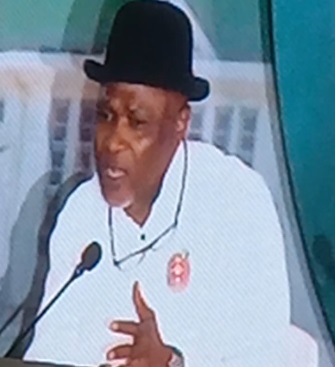
WATCH how HoR Minority Caucus leader, Chinda analysed why Nig needs to shift from presidential to home grown Parliamentary system

Published

on

ADVERTISEMENT
Zoom Ad
ADVERTISEMENT
Zoom Ad

By Chukwuka Kanu

The Dialogue to ensure Nigerians savour its own home grown Parliamentary System entered a different level on Monday as dignitaries from all walks of life espoused different views on the subject matter at the Shehu Yar’Dua International Conference Centre, Abuja.

Panelist of men of substance from egg heads to former governors, speakers, serving lawmakers all gathered to find a common solution to governance shift that would adopt Nigeria’s peculiarities and take Nigerians to the promised land.

To this end, at the National Dialogue on a Home Grown Parliamentary System of Government, a co-convener and HoR Minority Caucus leader Kingsley Chinda as one of panelists gave a breakdown on the way forward.

Advertisement

Hear him:

“I think that restates the cliche by Alexander Pope referred to by His Excellency that for every form of government they must contend for whatever is best administered.

“But I think it’s not just those who administer the system, you must also have a system that is administrable in your own circumstances.

“And that is why today if you ask, some persons might even say that Nigerians are inherently corrupt but that is not the case.

Advertisement

He stressed further: “When we started we were not like this, so you ask the question where did we get it wrong?

“The only thing that we have seen is that the system we imported, the laws we have so much loopholes and it makes it comfortable for us public office holders to do things that we get away with easily.

“The former speaker talked about the issue of impeachment, removing a councillor under our present law is almost an impossibility and so the councillor knows, I’m not talking about members of the National Assembly, I’m not talking about the executive, the councillor at the ward level because you have to get majority signatures of voters and that will be confirmed by INEC, how do you do that? When even the voters register had more than 50% ghost names, so where are you going to get the 50% genuine persons and their signatures confirmed?

“So this system has inherent loopholes that will allow those who are administering it to go scot-free and we need to tighten it.

Advertisement

“Another reason why we say so is that the same Nigerian who takes pride in beating the traffic light, who takes pride with even the NEPA at home you would want to do a bypass, send that same person to Ghana, I’m not talking about the United States, send him to Ghana and there is a queue somewhere, he will line up quietly because he knows that the system is not the same thing he had at home.

” So some people talk about mindset change, yes you might think about mindset change but to me the person sitting behind, the children behind are the people that require a mindset change because we already know that what we are doing is wrong and when we go to a clime where they have a better and stronger system we behave ourselves, so what mind are you going to change?

“We need to change the system, we need to begin to provide stronger penalty for those who commit crime.

“I remembered once either in the 8th or 7th Assembly we proposed a bill for death penalty for public office holders that steal public funds, it did not see the light of day.

Advertisement

” I think that we should begin to take extreme measures that will discourage public office holders from doing the things that they do.

“And the current presidential system we practice is one that allows a lot of leverage, there are so many things that are morally wrong but legally they are right under our laws and so it becomes difficult to hold anybody culpable even where people criticise over such actions.

“And for us to move on, we must begin to look at our own peculiar attitudes and couch laws that will take care of them, that is the homegrown.

“Homegrown is not that we look at our culture, tradition and all that, no. What are Nigerians likely to do if you give them this opportunity.

Advertisement

“Let me use discretion, if you bring a public office holder in Europe and bring a Nigerian public office holder and ask them to exercise discretion on an issue, I’m sure that you will agree that the Nigerian public office holder will be looking at religion, tribe whilst taking that matter.

Watch video below:

THE END
Advertisement
Continue Reading
Advertisement
Click to comment

Warning: Undefined variable $user_ID in /home/naijuinz/public_html/wp-content/themes/zox-news/comments.php on line 49

You must be logged in to post a comment Login

Leave a Reply

News

Northern Leaders Seek Unity As Almajiri, Insecurity Threaten Region

Published

on

ADVERTISEMENT
Zoom Ad
ADVERTISEMENT
Zoom Ad


Northern leaders and stakeholders have acknowledged deep-rooted social, political and leadership failures across the region, warning that insecurity, neglect of education, corruption, elite rivalry and the Almajiri crisis are threatening the future of Northern Nigeria.

The concerns were contained in the communiqué of the third Late General Hassan Usman Katsina Memorial Conference organised by the New Vision Development Initiative (NEVDI) at Arewa House, Kaduna.

The communique of the conference which held on July 25, 2026, with the theme, “From Sacrifice to Strategy: Rekindling General Hassan Usman’s Katsina Vision for Prosperous Northern Nigeria,” was released over the weekend. The conference brought together political, traditional and religious leaders, academics and other stakeholders.

Advertisement

Major-General Alwali Kazir, a former Chief of Army Staff, chaired the conference, while President Bola Tinubu was represented by Alhaji Ibrahim Masari.

Chairman of the Northern Elders Forum, Prof. Ango Abdullahi, presented a special report, while Dr Usman Bugaje of the Arewa Research Development Project delivered the lead paper, which was discussed by Prof. Siddique Abubakar Mohammed of the Centre for Development Research and Training, Zaria.

The conference said that after years of discussing the problems confronting the North, the region could no longer remain at the level of diagnosis without taking decisive action.

It identified insecurity, displacement of farmers, the persistence of the Almajiri system and the large number of out-of-school children as some of the most serious challenges requiring urgent intervention.

Advertisement

The gathering was particularly critical of what it described as a declining value system in the North, saying wealth had increasingly been elevated above knowledge in determining leadership.

It also expressed concern that corrupt individuals and sycophants were sometimes accorded greater respect than morally upright citizens.

The conference criticised what it called the waste of community resources on extravagant weddings, naming ceremonies and other celebrations, arguing that such wealth could instead be mobilised to tackle poverty and promote community development.

It also raised concern over the neglect of girl-child education, saying girls should be equipped with sufficient education and skills to sustain themselves and their families.

Advertisement

The communiqué equally lamented corruption across different sectors, including among some religious leaders, warning that such conduct had contributed to the erosion of traditional values such as truth, dignity, respect, sacrifice, fair play, promptness and dedication to duty.

Another major concern was the absence of reliable demographic planning.

According to the conference, the North does not sufficiently track how many people are born, die, marry or relocate, making meaningful development planning difficult.

The stakeholders also blamed persistent quarrels among Northern political, traditional and religious leaders for weakening the region.

Advertisement

“The North must have unity of purpose for development of the region,” the communiqué stated, stressing that meaningful development would remain difficult without cooperation among its leaders.

The conference also criticised what it described as endless campaigning and rhetoric by the political elite, declaring that the time had come to translate the legacy of General Hassan Usman Katsina into concrete action.

It further called for a review of approaches to insecurity, saying methods adopted since 2009 had failed to produce the desired results.

Almajiri Crisis Takes Centre Stage

Advertisement

At the heart of the resolutions was a commitment to confront the Almajiri problem, which participants identified as one of the gravest threats to the North’s human capital, economic competitiveness, security, social cohesion and sustainable development.

NEVDI resolved to develop a model for removing Almajiri children from the streets and providing them with meaningful education and opportunities.

Under the proposed initiative, influential and willing philanthropists would be mobilised across the Northern states to support the programme. A common implementation template would also be designed, while a committee of trustees would supervise the project.

The conference stressed, however, that success should not merely mean moving children from the streets into classrooms.

Advertisement

It said the ultimate objective should be to ensure that every child, irrespective of gender, location, disability, economic circumstances or educational tradition, receives meaningful learning, skills and competencies capable of providing a pathway to productive citizenship.

The communiqué warned that the crisis could no longer be addressed through conferences, television and radio discussions, fragmented interventions or short-term projects.

It called for sustained and coordinated action involving governments, development partners, civil society organisations, communities, philanthropists, individuals and the private sector.

NEVDI pledged to translate the resolutions of the conference into “practical, testable and scalable solutions.”

Advertisement

The communiqué was signed for the organisation’s Board of Trustees by retired Colonel Lawan Gwadabe.

Continue Reading

News

‘I Don’t Want to Return to Nigeria’ — Chimamanda Adichie Speaks After Son’s Death

Published

on

ADVERTISEMENT
Zoom Ad
ADVERTISEMENT
Zoom Ad

Nigerian author Chimamanda Ngozi Adichie has revealed that the death of her 21-month-old son, Nkanu, has profoundly changed her feelings towards Nigeria, saying she no longer wants to return to the country.

Adichie made the disclosure in an interview with The New York Times, where she was asked whether Nigeria still felt close to her heart.

“My feelings toward Nigeria have changed,” the award-winning author said, before adding, “I do not want to go back to Nigeria.”

Nkanu, one of Adichie’s twin sons, died in December 2025 following a medical emergency at Euracare in Nigeria.

Advertisement

According to Adichie, Nkanu initially developed a fever and was placed on antibiotics by her husband, Ivara Esege. However, when his condition failed to improve, he was taken to hospital for further medical evaluation.

She said her son was sedated with propofol during an MRI before suffering cardiac arrest and dying the following day.

Recounting the devastating experience, Adichie said a doctor approached her after the procedure and told her: “Well, look, they gave him too much Propofol.”

“That was his exact words, which I will never forget until the day I die,” she recalled.

Advertisement

Adichie had previously raised allegations of medical negligence concerning her son’s treatment. The circumstances surrounding Nkanu’s death are currently the subject of a coroner’s inquest, amid disagreements between the family and the hospital over what happened.

The author said her children could ultimately be the only reason she would consider returning to Nigeria, noting that her daughter still regards the country as her “happy place.”

Reflecting on the loss of her son, Adichie described her grief as surreal.

“I mean, it is so surreal, all of this. I still can’t believe we’re talking about my son who died,” she said.

Advertisement

“You’re going through something, but you also feel like you’re outside of it.”

Continue Reading

News

Break-Up Fears Grip UK as Scotland, Wales, Northern Ireland Leaders Plot New Constitutional Front

Published

on

ADVERTISEMENT
Zoom Ad
ADVERTISEMENT
Zoom Ad

Leaders of Scotland, Wales and Northern Ireland are set to meet in Cardiff on Monday in an unprecedented summit that could intensify calls for greater autonomy and a potential break-up of the United Kingdom.

Scottish First Minister John Swinney, Welsh First Minister Rhun ap Iowerth and Northern Ireland First Minister Michelle O’Neill are expected to discuss a joint approach to constitutional reform, including the right of their respective nations to determine their own futures.

They will be joined by Mary Lou McDonald, president of Sinn Féin and leader of the opposition in the Republic of Ireland.

The meeting at the St David’s Hotel overlooking Cardiff Bay is expected to focus on four broad areas: the economy, energy, relations with Europe and the wider international community, and self-determination.

Advertisement

The leaders are also expected to endorse a joint declaration asserting the democratic right of Scotland, Wales and Northern Ireland to determine their constitutional futures, potentially including independence referendums.

The gathering comes amid growing pressure for a major overhaul of the UK’s constitutional structure and greater powers for the devolved nations.

‘Status quo is not sustainable’

Swinney, whose Scottish National Party (SNP) has long campaigned for Scottish independence, has described the meeting as evidence of a fundamental shift in the political landscape.

Advertisement

“For the first time ever, Scotland, Wales and Northern Ireland are led by pro-independence first ministers,” he said, arguing that the development showed that the existing constitutional arrangement was becoming unsustainable.

“The momentum behind serious constitutional change is undeniable,” Swinney added.

He has also suggested that Westminster must prepare for a future in which the United Kingdom’s current structure could fundamentally change.

Independence and Irish unity

Advertisement

The summit could give fresh momentum to separate constitutional campaigns across the three nations.

In Scotland, the SNP continues to press for another independence referendum, while Plaid Cymru is seeking greater autonomy for Wales.

Northern Ireland’s Sinn Féin, meanwhile, is campaigning for Irish reunification under the terms of the Good Friday Agreement.

Sinn Féin is expected to use Monday’s meeting to argue that preparations for a referendum on Irish unity should begin now.

Advertisement

A party source said the agreement provided a democratic route for Northern Ireland to determine its future and that Irish unity should no longer be treated as a distant possibility.

Wales demands more powers

For Wales, the talks are also expected to focus on demands for greater control over taxation, public spending, policing and rail infrastructure.

Plaid Cymru is particularly pushing for Wales to receive revenues generated from the Crown Estate, including income from seabed areas used for offshore wind projects, rather than having the money transferred to the UK Treasury.

Advertisement

The party has argued that closer cooperation among the three devolved nations could deliver practical benefits while strengthening their collective bargaining position with Westminster.

Burnham pushes back

The growing constitutional debate has also drawn attention from Andy Burnham, who has previously indicated that another Scottish independence referendum could potentially be considered if there were a clear public consensus.

However, Burnham has since insisted that another referendum is not on the table before the next UK general election.

Advertisement

In a letter to Swinney, he said there was no clear consensus for Scottish independence and no evidence that a majority in Northern Ireland currently wanted to leave the United Kingdom.

Burnham also pointed to Labour’s 2024 election manifesto, which stated that the party did not support Scottish independence or another referendum.

He argued that reopening the issue would distract from the government’s priorities of economic growth and tackling the cost-of-living .

Advertisement
Continue Reading

Trending

Copyright © 2024 Naija Blitz News