Connect with us

Foreign

Biden pardons his son Hunter despite previous pledges not to

Published

on

ADVERTISEMENT
Zoom Ad
ADVERTISEMENT
Zoom Ad

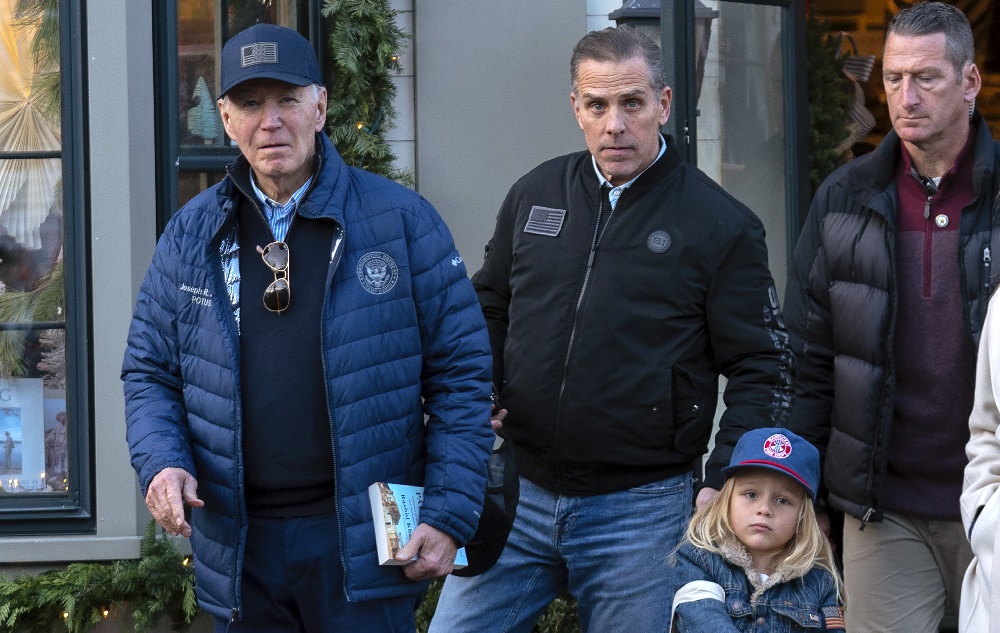
President Joe Biden pardoned his son, Hunter, on Sunday night, sparing the younger Biden a possible prison sentence for federal felony gun and tax convictions and reversing his past promises not to use the extraordinary powers of the presidency for the benefit of his family.


The Democratic president had previously said he would not pardon his son or commute his sentence after convictions in the two cases in Delaware and California. The move comes weeks before Hunter Biden was set to receive his punishment after his trial conviction in the gun case and guilty plea on tax charges, and less than two months before President-elect Donald Trump is set to return to the White House.

It caps a long-running legal saga for the younger Biden, who publicly disclosed he was under federal investigation in December 2020 — a month after his father’s 2020 victory — and casts a pall over the elder Biden’s legacy.

Biden, who time and again pledged to Americans that he would restore norms and respect for the rule of law after Trump’s first term in office, ultimately used his position to help his son, breaking his public pledge to Americans that he would do no such thing.

Advertisement

In a statement released Sunday evening, Biden said, “I believe in the justice system, but as I have wrestled with this, I also believe raw politics has infected this process and it led to a miscarriage of justice.”

The president’s sweeping pardon covers not just the gun and tax offenses against the younger Biden, but also any other “offenses against the United States which he has committed or may have committed or taken part in during the period from January 1, 2014 through December 1, 2024.”

In June, Biden categorically ruled out a pardon or commutation for his son, telling reporters as his son faced trial in the Delaware gun case, “I abide by the jury decision. I will do that and I will not pardon him.”

As recently as Nov. 8, days after Trump’s victory, White House press secretary Karine Jean-Pierre ruled out a pardon or clemency for the younger Biden, saying, “We’ve been asked that question multiple times. Our answer stands, which is no.”

Advertisement

The elder Biden has publicly stood by his only living son as Hunter descended into serious drug addiction and threw his family life into turmoil before getting back on track in recent years. The president’s political rivals have long used Hunter Biden’s myriad mistakes as a political cudgel against his father: In one hearing, lawmakers displayed photos of the drug-addled president’s son half-naked in a seedy hotel.

House Republicans also sought to use the younger Biden’s years of questionable overseas business ventures in a since-abandoned attempt to impeach his father, who has long denied involvement in his son’s dealings or benefiting from them in any way.

“The charges in his cases came about only after several of my political opponents in Congress instigated them to attack me and oppose my election,” Biden said in his statement. “No reasonable person who looks at the facts of Hunter’s cases can reach any other conclusion than Hunter was singled out only because he is my son.”

“I hope Americans will understand why a father and a President would come to this decision,” Biden added, claiming he made the decision this weekend.

Advertisement

The president had spent the Thanksgiving holiday in Nantucket, Massachusetts, with Hunter and his family, and was set to depart for Angola later Sunday on what may be his last foreign trip as president before leaving office on Jan. 20, 2025.

Hunter Biden was convicted in June in Delaware federal court of three felonies for purchasing a gun in 2018 when, prosecutors said, he lied on a federal form by claiming he was not illegally using or addicted to drugs.

He had been set to stand trial in September in the California case accusing him of failing to pay at least $1.4 million in taxes. But he agreed to plead guilty to misdemeanor and felony charges in a surprise move hours after jury selection was set to begin.

David Weiss, the Trump-appointed U.S. attorney in Delaware who negotiated the plea deal, was subsequently named a special counsel by Attorney General Merrick Garland to have more autonomy over the prosecution of the president’s son.

Advertisement

Hunter Biden said he was pleading guilty in that case to spare his family more pain and embarrassment after the gun trial aired salacious details about his struggles with a crack cocaine addiction.

The tax charges carry up to 17 years behind bars and the gun charges are punishable by up to 25 years in prison, though federal sentencing guidelines were expected to call for far less time and it was possible he would have avoided prison time entirely.

Hunter Biden was supposed to be sentenced this month in the two federal cases, which the special counsel brought after a plea deal with prosecutors that likely would have spared him prison time fell apart under scrutiny by a judge. Under the original deal, Hunter was supposed to plead guilty to misdemeanor tax offenses and and would have avoided prosecution in the gun case as long as he stayed out of trouble for two years.

But the plea hearing quickly unraveled last year when the judge raised concerns about unusual aspects of the deal. The younger Biden was subsequently indicted in the two cases.

Advertisement

Hunter Biden’s legal team this weekend released a 52-page white paper titled “The political prosecutions of Hunter Biden,” describing the president’s son as a “surrogate to attack and injure his father, both as a candidate in 2020 and later as president.”

The younger Biden’s lawyers have long argued that prosecutors bowed to political pressure to indict the president’s son amid heavy criticism by Trump and other Republicans of what they called the “sweetheart” plea deal.

Rep. James Comer, one of the Republican chairmen leading congressional investigations into Biden’s family, blasted the president’s pardon, saying that the evidence against Hunter was “just the tip of the iceberg.”

“It’s unfortunate that, rather than come clean about their decades of wrongdoing, President Biden and his family continue to do everything they can to avoid accountability,” Comer said on X, the website formerly known as Twitter.

Advertisement

Biden is hardly the first president to deploy his pardon powers to benefit those close to him.

In his final weeks in office, Trump pardoned Charles Kushner, the father of his son-in law, Jared Kushner, as well as multiple allies convicted in special counsel Robert Mueller’s Russia investigation. Trump over the weekend announced plans to nominate the elder Kushner to be the U.S. envoy to France in his next administration.

Trump, who has pledged to dramatically overhaul and install loyalists across the Justice Department after he was prosecuted for his role in trying to subvert the 2020 presidential election, said in a social media post on Sunday that Hunter Biden’s pardon was “such an abuse and miscarriage of Justice.”

“Does the Pardon given by Joe to Hunter include the J-6 Hostages, who have now been imprisoned for years?” Trump asked, referring to those convicted in the violent Jan. 6, 2021 riot at the U.S. Capitol by his supporters.

Advertisement

Hunter Biden said in an emailed statement that he will never take for granted the relief granted to him and vowed to devote the life he has rebuilt “to helping those who are still sick and suffering.”

“I have admitted and taken responsibility for my mistakes during the darkest days of my addiction – mistakes that have been exploited to publicly humiliate and shame me and my family for political sport,” the younger Biden said.

Hunter Biden’s legal team filed Sunday night in both Los Angeles and Delaware asking the judges handling his gun and tax cases to immediately dismiss them, citing the pardon.

A spokesperson for Weiss did not respond to messages seeking comment Sunday night.

Advertisement

NBC News was first to report Biden was expected to pardon his son Sunday.
Foreign

Trump To End HIV Funding For South Africa Over Violence

Published

on

By

ADVERTISEMENT
Zoom Ad
ADVERTISEMENT
Zoom Ad

The US government says it will stop funding programmes in South Africa intended to tackle the spread of HIV and Aids.

More than eight million South Africans are living with HIV – the highest number of any country in the world.

The US State Department appeared to link the decision to South Africa’s alleged failure to protect the white-minority Afrikaner community – an allegation the South African government has repeatedly rejected.

South Africa’s health ministry responded by saying that though it had not been informed of this decision, it had “long been working on a self-reliance plan”.

Advertisement

Until 2025, the US was supporting South Africa’s efforts to deal with the virus with an estimated $400m (£300m) a year through the President’s Emergency Fund for Aids Relief (PEPFAR).

But since the inauguration of President Donald Trump, relations between the two countries have increasingly soured.

Shortly after he came into office, Trump issued an executive order alleging that “countless” South African policies dismantled equal opportunities and fuelled violence “against racially disfavored landowners”.

This is disputed by the South African government, which says its Black Economic Empowerment policy is needed to correct economic inequality dating from the apartheid era.

Advertisement

The executive order also highlighted South Africa’s case against Israel at the International Court of Justice and its links to Iran.

The White House said that given these “unjust and immoral practices”, further aid to South Africa would not be provided.

Trump has also falsely alleged that there is a “white genocide” taking place in South Africa, which has led to the administration setting up a refugee programme for Afrikaners – descendants of Western Europeans who settled in southern Africa in the 17th Century.

They are now just about the only refugees being allowed into the US.

Advertisement

The genocide claim has been widely discredited.

Pepfar funding, which had been providing about a fifth of South Africa’s total spending on HIV programmes, got a reprieve last October with what was called a “bridge plan”.

But a US State Department official has confirmed that a “phased drawdown” of Pepfar funding would now start.

This was because of “South Africa’s failure to make demonstrable progress on policy requests by the administration”, the official said.

Advertisement

The US government intended to “foster self-reliance” and reduce dependency on American funding, they added, pointing out that “South Africa is a middle-income country and is more than capable of supporting its own health programs”.

South Africa’s health ministry has said that while Pepfar contributed to the country’s HIV programme, the provision of life-saving antiretroviral drugs was funded entirely separately, with most coming from the government.

Attempts to mend US-South Africa relations have floundered. These include a high-profile White House meeting between Trump and South African President Cyril Ramaphosa just over a year ago, when the US president confronted his counterpart with his claims of white persecution.

The US also boycotted the G20 meeting, a gathering of the world’s major economies, hosted by South Africa last November.

Advertisement
Continue Reading

Foreign

Israel, Hezbollah Agree Ceasefire As US-Iran Deal Under Strain

Published

on

By

ADVERTISEMENT
Zoom Ad
ADVERTISEMENT
Zoom Ad

Israel and Hezbollah agreed a ceasefire on Friday, a US official said, after deadly exchanges between the two sides in Lebanon put a deal to end the Middle East war under strain, less than two days after it was signed.

Talks that were scheduled to take place between the US and Iran in Switzerland on Friday to build on the deal and work towards a lasting settlement were postponed amid the fighting, with no new date announced.

Tehran’s top negotiator warned it would not bend on its red lines and that its finger was still “on the trigger”, even as shipping appeared to pick up in the Strait of Hormuz, which had essentially been closed during the war.

The deal signed this week by President Donald Trump and his Iranian counterpart Masoud Pezeshkian aims to end a war that began on February 28 with US-Israeli strikes that killed supreme leader Ayatollah Ali Khamenei.

Advertisement

The agreement was also meant to halt the fighting in Lebanon, which Iran has always insisted should be covered under any accord, turning Israel’s ongoing campaign there into a source of frustration for Washington.

Israel’s military said Friday that it had struck more than 80 Hezbollah targets in Lebanon and killed dozens of members of the Iran-backed group.

‘Permanent war’

Lebanon said 47 people were killed and 97 others wounded in Israeli strikes on Lebanon Friday. Israel’s military reported four troops were killed.

Advertisement

But a US official told AFP a truce between Israel and Hezbollah, beginning immediately, had been brokered by US and Qatari mediators following talks with Israel and Iran. A Gulf diplomat confirmed the ceasefire.

Yet even after the truce was announced, Lebanese state media reported an Israeli airstrike on the country’s south in the Jezzine region.

A previous truce nominally agreed in April did nothing to stop attacks by either side, and Prime Minister Benjamin Netanyahu had said just hours earlier that the Israeli army would stay in Lebanon “as long as necessary” and would make Iran-backed Hezbollah pay a “heavy price” for its attacks.

Far-right Israeli National Security Minister Itamar Ben Gvir went even further, saying after the soldiers’ deaths that “all of Lebanon must burn”.

Advertisement

Iran’s Foreign Minister Abbas Araghchi accused Israel of only being interested in “permanent war”.

‘No urgency’

Preparations had been made to host Iranian and US delegations led by Tehran’s top negotiator Mohammad Bagher Ghalibaf and US Vice President JD Vance at the Swiss resort of Burgenstock, overlooking Lake Lucerne.

The talks were due to kick off a two-month period of negotiations to discuss outstanding issues not covered by the initial deal, notably Iran’s nuclear programme.

Advertisement

Switzerland’s foreign ministry confirmed the discussions had been postponed but said it “remains ready to facilitate these talks”.

Quoting diplomats, the Financial Times said Israel’s strikes on Lebanon had led to the postponement but there was no immediate confirmation.

Iranian foreign ministry spokesman, Esmaeil Baqaei, said there was “no urgency to hold the meeting” but that it was planned “in the coming days”

‘Crushing response’

Advertisement

Ghalibaf said on Friday that talks with the United States would remain bound by Tehran’s “red lines”.

“If the enemy seeks to be excessive, we have proven that our fingers are on the trigger and we have no hesitation in giving a crushing response to the enemy,” he said, in remarks published by the official IRNA news agency.

Vance, meanwhile, has expressed a degree of exasperation with the Israeli government rare for a top US official, telling the New York Times “you can’t just kill your way out of solving every single national security problem that you have”.

A key aspect of the deal was the immediate re-opening of the Strait of Hormuz, the key shipping bottleneck whose closure caused global energy prices to rise.

Advertisement

A total of 25 commercial vessels crossed the newly-reopened strait on Thursday, the highest number since mid-April, according to data from maritime tracking firm AXSMarine published on Friday.

American forces on Thursday lifted their parallel naval blockade of Iranian ports, the US military said, noting that American warships “will remain in the general area”.

Iran’s maritime authority said on Friday that all ships seeking to cross the Strait of Hormuz should submit a transit request “48 hours in advance”, despite its reopening.

AFP

Advertisement
Continue Reading

Foreign

Vance defends Iran deal, eyes Swiss talks

Published

on

By

ADVERTISEMENT
Zoom Ad
ADVERTISEMENT
Zoom Ad

US Vice President JD Vance on Thursday defended the deal to end the Iran war, saying he would likely head to Switzerland for talks to turn it into a long-term agreement.

“The Iranians have to perform,” Vance told a briefing at the White House as President Donald Trump faced mounting criticism over the deal.

“If they don’t perform as we’ve said before, they don’t get any of the benefits of the bargain.”

Vance — a war skeptic who has become the public face of the deal Trump signed at Versailles on Wednesday — rejected claims that the deal rewards Iran without achieving Trump’s war aims.

Advertisement

The most controversial points have been around oil sales, sanctions relief and a $300 billion reconstruction fund for Iran, while there is no firm program for destroying Iran’s nuclear program.

But Vance said Iran would only get the rewards if it proves that it has complied with the terms that will be hammered out in a 60-day period that he said began on Thursday following the signing of the memorandum of understanding (MoU).

“There’s a lot of discussion — the MoU, the gentleman’s agreements, the final deal. Words don’t matter, ladies and gentlemen, we’re about verification,” Vance told reporters.

He added that oil prices were falling, and said the US had lifted its blockade of Iran.

Advertisement

The US military “has allowed north of a dozen ships to go through our naval blockade, and so we’re also honoring our end of the early part of the agreement,” Vance told journalists.

– ‘Smell the reality’ –

Vance said he now planned to head to Switzerland for technical talks on a long-term deal, although the arrangements were not yet finalized.

“I plan to go to Switzerland,” Vance said. “I suspect this weekend but I’m not sure. It just depends on exactly when the Iranians can get there.”

Advertisement

Vance’s new role as Iran pointman is a political gamble for a man who is widely expected to run for president in the 2028 US election.

If a deal to end the war succeeds it will be a boost for a long-term skeptic of US military entanglements — but if it fails, Trump has already said that he will blame Vance.

“I mean, I think the president was joking, as he often does,” Vance said when asked if he feared that Trump would make him the fall guy.

“But, no, look, the entire team has worked very well on this, and we’ve got this thing to a very good place for the American people.”

Advertisement

Vance meanwhile issued an extraordinary rebuke to Israeli critics of the Iran deal, amid growing tensions between Trump and Prime Minister Benjamin Netanyahu.

“If I was in the cabinet of the Israeli government, I might not be attacking the only powerful ally that I have anywhere left in the entire world,” Vance said.

“Anybody in Israel who thinks their biggest problem is the president of the United States needs to wake up and smell the reality of the situation.”

AFP

Advertisement
Continue Reading

Trending

Copyright © 2024 Naija Blitz News