Connect with us

Foreign

Ghana counts ballots after stiff presidential election

Published

on

ADVERTISEMENT
Zoom Ad
ADVERTISEMENT
Zoom Ad

Ghana counted ballots on Saturday after a tight election with the ruling party’s Vice President Mahamudu Bawumia trying to shake off anger over economic woes and rebuff a challenge by opposition party candidate ex-president John Mahama.


Ghana’s struggling economy dominated the election, after the west Africa gold and cacao producer went through a debt default, high inflation and negotiations for a $3 billion IMF bailout.

Voters were choosing a successor to Bawumia’s boss, President Nana Akufo-Addo, who steps down after serving the maximum of two four-year terms. They will also elect the country’s new parliament.

Voting was mostly calm, but one person was shot dead and four people arrested at a polling station in Nyankpala in the country’s northern region, police and local media said.

Advertisement

After polls closed at 1700 GMT, election teams immediately began tallying ballots under the watch of agents from political parties before sending them to collation centres.

Preliminary results are expected early Sunday, with full presidential results scheduled by Tuesday.

“Everyone is complaining prices are high. So I want a change, I want a good president who will bring in changes,” Abdullah Mohammed, a student said after voting in Accra’s Nima district.

With a history of political stability, Ghana’s two main parties, the ruling New Patriotic Party (NPP) and National Democratic Congress (NDC), have alternated in power equally since the return to multi-party democracy in 1992.

Advertisement

Touting the slogan “Break the 8” — a reference to going past the usual two terms in power — the NPP hopes Bawumia can lead them to an unprecedented third term. But he struggled to break away from criticism of Akufo-Addo’s economic record.

“I think we have done a lot of work with our message to the people and the message has been well received,” Bawumia said after voting in his northern home Walewale.

A UK-educated economist and former central banker, he points to an economy turning a corner and the government’s continued plans for digitalisation to ease business, as well as free education and health programmes.

Economic frustrations

Advertisement

But though inflation slowed from more than 50 percent to around 23 percent, and other macro-economic indicators are stabilising, the economic pain was still a clear election issue.

Many Ghanaians still say they struggle with the cost of living, scarce jobs and a depreciated cedi currency.

Frustration over the economy has opened the way for a comeback challenge from Mahama, who was president from 2012 to 2017 but has since failed twice in presidential bids.

The NDC flag-bearer says he will “reset” Ghana and introduce a “24-hour economy”, extending industrial hours to create jobs, and also renegotiate parts of the IMF deal.

Advertisement

“Other elections have not been as obvious,” Mahama said voting in his northern hometown. “With this one, everybody can tell the direction because of the abysmal performance of the Akufo-Addo-Bawumia government.”

Some analysts gave him an edge because of voter dismay with NPP, but the former president faced criticism from those who remember financial woes and massive power cuts during his time in office.

Shoe saleswoman Esther Adobea said the economic situation hurt, but she was willing to give Bawumia a chance to make things better.

“I can see he can handle the country for us. Our economy is not good, but he can do better,” she said.

Advertisement

Both major candidates are from the north of the country — traditionally an NDC stronghold, but now more fragmented — making the region a key battleground.

While the economy was key, Ghana also faces an increasing risk of spillover in its northern regions from jihadist conflicts in Niger and Burkina Faso, where military juntas rule.

The spread of illegal gold mining also became an election issue. Akufo-Addo promised to stop illegal mining, but it has expanded, poisoning riverways and impacting cacao farmlands — a major source of export income.

AFP

Advertisement

Foreign

Trump ends NBC interview after clashes over election claims

Published

on

By

ADVERTISEMENT
Zoom Ad
ADVERTISEMENT
Zoom Ad

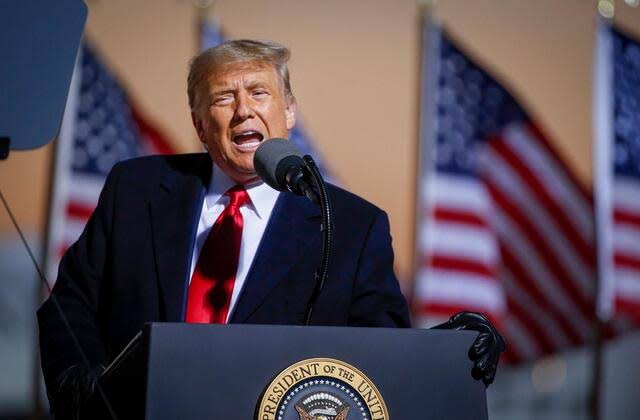
US President Donald Trump abruptly walked out of an interview with NBC after being repeatedly challenged on several claims by the show’s presenter Kristen Welker.

During the interview, which aired on Sunday’s Meet The Press, the president claimed both the current primary elections in California and the 2020 presidential election were “rigged”.

When pressed for evidence on California’s vote by Welker, he said: “All I have to do is look, and I listen.”

After the presenter replied “that’s not evidence”, Trump accused the media of being “crooked”, before ending the interview: “Sorry, let’s call it quits because I’ve had enough.”

Advertisement

The president has had a fraught relationship with traditional media outlets, often accusing them of bias against him.

The interview, set in a barn as Trump appeared at an event with farmers in Wisconsin, was delayed repeatedly due to technical difficulties and rain hitting the metal roof. NBC reported that he walked out 50 minutes after sitting down for it on Friday.

Much of the interview involved Welker questioning Trump over the conflict with Iran, with him insisting the US needed to act to stop Iran from getting a nuclear weapon and that it would not be “an endless war”.

“We’re there for a few months and the threat is largely over,” he said.

Advertisement

Around six minutes before he left the set, the pair discussed the “anti-weaponisation” fund, a now-dropped plan to create a $1.8bn (£1.3bn) fund to compensate individuals who claim they were unfairly targeted or investigated by the government.

The plan drew strong criticism from Democrats and some Republicans, who argued it could result in payments to people prosecuted over the US Capitol riot on 6 January 2021.

The pair then moved onto discussing that riot, and Trump was challenged after he repeated his unsubstantiated claim that the 2020 election was rigged.

Trump turned to the California primary elections, where votes are still being counted to determine which two candidates in a series of races – including governor of the state – will be on the ballot in November’s midterm elections.

Advertisement

He said the results had not been called after four days, adding: “They’re cheating on the election.”

“Do you have evidence to support that?” Welker responded.

“All I have to do is look, and I listen,” the president replied.

“But that’s not evidence,” she interjected.

Advertisement

Full results have not yet been called in the state where delays are common due to a particularly meticulous vote-counting process and broad use of mail-in ballots. Mail-in voting has long irked the president.

“They’re crooked,” he continued, “just like you’re crooked.”

Welker said: “To be fair, I’m not crooked. But let’s continue.”

Trump then told Welker “you’re either crooked or you’re stupid”, and after a further exchange said: “Let’s call it quits because I’ve had enough. Thank you darling, have a good time.”

Advertisement

Welker attempted to continue the interview, but Trump interrupted: “I’ve sat in the rain with you for an hour, on and off in the rain, and I’ve given you enough time.

“You ought to straighten out your press, because you know what? A country can never be great with a dishonest press.”

He then gestured to people behind the camera, saying “come on, let’s go”, before standing up and walking off the set.

After the interview was broadcast, Welker said: “I spoke with President Trump on Saturday and we both acknowledged the complications during the interview posed by the rain. He agreed to sit down with me for another Meet the Press interview.”

Advertisement
Continue Reading

Foreign

Trump says Iran has 22% of missiles left

Published

on

By

ADVERTISEMENT
Zoom Ad
ADVERTISEMENT
Zoom Ad

Iran still has “21, 22 per cent” of its missiles left, US President Donald Trump said Friday, in a week in which Tehran fired dozens of them toward regional neighbours, despite a sputtering ceasefire.

“They still have capacity. They have some missiles, they have some drones. I would say, percentage wise, maybe 21, 22 percent of their missiles,” Trump told NBC News in an interview.

That figure for Iran’s missile stockpile is higher than one of 18 per cent Trump gave in May. He has often claimed to have completely destroyed Iran’s war-fighting capacity.

Iran’s military said Friday it had fired “warning missiles” at two US destroyers in the Gulf of Oman — a claim promptly denied by the US military. Two days earlier, Kuwait said it had intercepted 30 ballistic missiles fired as part of “heinous Iranian aggression.”

Advertisement

AFP

Continue Reading

Foreign

US, allies oppose Bolivia President Paz’s ouster as unrest grow

Published

on

By

ADVERTISEMENT
Zoom Ad
ADVERTISEMENT
Zoom Ad

The United States and allies on Friday condemned the ongoing efforts to overthrow the elected government of President Rodrigo Paz in Bolivia.

The Shield of the Americas member states said “mob rule” cannot replace the decision that most Bolivians made at the ballot box to remove “two decades of corrupt governments.”

The U.S., Argentina, Bolivia, Chile, Costa Rica, Dominican Republic, Ecuador, El Salvador, Guyana, Honduras, Panama, Paraguay, and Trinidad and Tobago signed the joint statement.

They affirm support for the Paz administration as it resists “attempts to drag Bolivia backwards through cynical efforts to prevent the delivery of food, medicine and other vital supplies.”

Advertisement

“Those who are funding these protests with dirty money from drug trafficking and transnational crime should be held accountable,” the allies urged.

The governments encouraged people who have grievances to dialogue with the government, warning against abusing their causes to “regain power.”

President Paz admitted Bolivia has been pushed to a “breaking point” amid weeks of widespread protests and a blockade that has paralyzed major cities.

Farmers, miners, transport workers and teachers are demanding immediate measures to ease the country’s worst economic crisis in four decades.

Advertisement

Defence Minister Marcelo Salinas and Education Minister Beatriz Garcia resigned this week as demonstrators continue to demand Paz’s resignation, a call he rejects.

The government accuses ex-President Evo Morales of fuelling unrest, which opposition figures believe could end with a referendum to decide whether Paz should remain in office.

Continue Reading

Trending

Copyright © 2024 Naija Blitz News