News
Court Orders Final Forfeiture Of Properties Linked To Emefiele
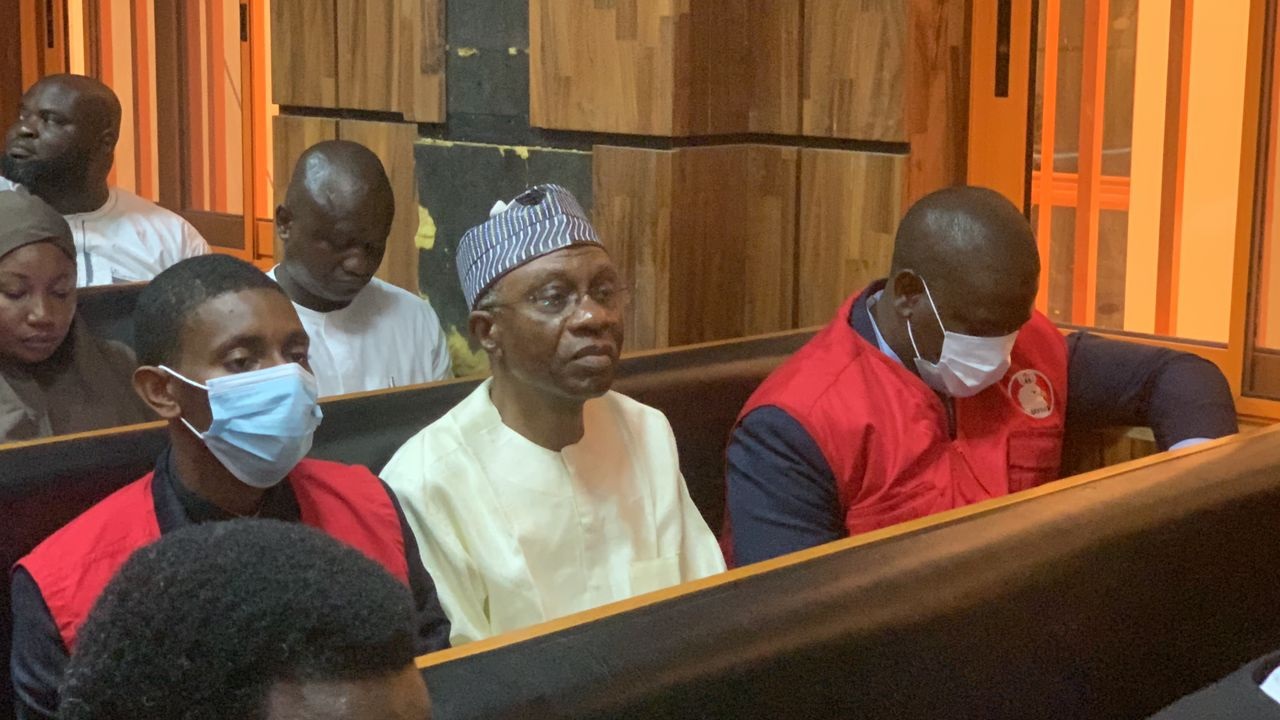
Justice Deinde Dipeolu of the Federal High Court sitting in Lagos has ordered the permanent forfeiture of a warehouse built on a 1.925-hectare property along the Lagos-Ibadan Expressway in Magboro, Obafemi Owode local government area of Ogun State.

The court also ordered the final forfeiture of 54 general-purpose steel containers, which the Economic and Financial Crimes Commission (EFCC) claimed are linked to a former Governor of the Central Bank of Nigeria (CBN,) Godwin Emefiele.
The Judge ordered that the assets be forfeited to the federal government after no individual or organisation came forward to claim them.

On November 28, 2024, the judge had granted an interim forfeiture of the assets, directing the anti-graft agency to publish the order in a national newspaper to allow any interested party to appear before the court and show cause why the assets should not be finally forfeited.
However, at the resumed hearing of the matter on Thursday, EFCC’s counsel, Rotimi Oyedepo, SAN, informed the court that the commission had complied with the court’s directives.
Oyedepo also informed the court that the application for final forfeiture was made pursuant to Section 44(2)(B) of the Constitution of the Federal Republic of Nigeria 1999 (as amended) and Section 17 of the Advance Fee Fraud and Other Fraud Related Offences Act of 2006, as well as the court’s inherent jurisdiction.
The lawyer urged the court to issue a final forfeiture order to the Federal Government of Nigeria for the properties listed in Schedule A, which includes the warehouse located at Km 8 along the Lagos-Ibadan Expressway, Magboro, and the 54 general-purpose steel containers, suspected to have been acquired through unlawful activities.
After reviewing the submissions of the anti-graft agency’s lawyer and the documents filed before the court, Justice Dipeolu granted the requested relief and ordered the final forfeiture of all the assets.
News
Appeals Court upholds NDC party registration, overturns Lokoja ruling
The Abuja Division of the Court of Appeal on Friday set aside a judgement of the Federal High Court that deregistered Nigeria Democratic Congress (NDC).
The two-member majority ruling held that the ruling of June 26, 2026, was an abuse of power, saying the court was wrong to sit over appeal of its own earlier judgment of December 10, 2025, which had directed the Independent National Electoral Commission (INEC) to register the NDC.
The appellate judges also dismissed the adversarial claims over the NDC’s use of a logo said to belong to another political association, the Peace Movement Party (PMP), which was the basis of Justice Isah Dashen’s in December.
Justice Okon Abang dissented in the ruling, saying he would have upheld the deregistering of the NDC, a major opposition party under which Nigerian political figure Peter Obi is contesting the presidency in 2027.
News
FG begins review of tax laws, fiscal policies
The Federal Government has commenced a six-week review of the new tax laws to identify implementation gaps, address consequences that have emerged since their implementation and consider concerns raised by the organised private sector and other stakeholders.
The review will examine areas including Value Added Tax thresholds, withholding tax, capital gains treatment and multiple taxation.
The media reports that President Bola Ahmed Tinubu last year signed into law four new tax bills passed by the National Assembly, describing the laws as pivotal to the success of his administration’s reforms and the country’s prosperity.
The bills were the Nigeria Tax Bill (Ease of Doing Business), which seeks to consolidate Nigeria’s fragmented tax laws into a harmonised statute; the Nigeria Tax Administration Bill, which establishes a uniform legal and operational framework for tax administration across the federal, state and local governments.
Others are the Nigeria Revenue Service (Establishment) Bill, which repeals the Federal Inland Revenue Service Act and creates a more autonomous and performance-driven national revenue agency, the Nigeria Revenue Service (NRS); and the Joint Revenue Board (Establishment) Bill, which provides a formal governance structure to facilitate cooperation between revenue authorities at all levels of government.
As implementation commenced, organised private sector groups raised concerns over some provisions of the laws, including those relating to Companies Income Tax and withholding tax.
In June, the organised private sector (OPS) wrote an open letter to President Bola Ahmed Tinubu, jointly signed by the leadership of key private sector bodies, including the Manufacturers Association of Nigeria (MAN), Nigerian Association of Small and Medium Enterprises (NASME), Nigerian Association of Small Scale Industrialists (NASSI), Nigerian Association of Chambers of Commerce, Industry, Mines and Agriculture (NACCIMA) and Nigeria Employers’ Consultative Association (NECA).
The groups warned that conflicting interpretations of the new tax laws had effectively paralysed corporate tax filings across the country.
The OPS said it fully supported the administration’s tax reform agenda and remained committed to lawful tax compliance, but argued that the implementation approach adopted by the NRS undermined the spirit and intent of the reforms.
“This Open Letter is not an attack on tax reform or lawful revenue mobilisation,” the group stated.
“It is a plea to preserve the legality, credibility and economic promise of the historic reforms championed by Your Excellency. Our members are willing and ready taxpayers. They seek a clear, lawful and functional framework through which they can file accurate returns, pay taxes already accrued to the Federation, protect jobs and continue investing in Nigeria.”
The dispute centres on how taxes relating to accounting periods that ended before January 1, 2026, should be treated.
According to the OPS, the General Transition Guidelines issued by the Minister of Finance and Coordinating Minister of the Economy pursuant to provisions of the Nigeria Tax Administration Act (NTAA) 2025 and Nigeria Tax Act (NTA) 2025 state that tax obligations arising from accounting periods ending before the commencement of the new laws should continue to be governed by the repealed tax laws, even if the filing and payment deadlines fall in 2026.
The private sector groups noted that the guidelines expressly provide that the new tax laws apply prospectively from January 1, 2026, except where specific provisions state otherwise.
The guidelines further state that no tax, penalty, surcharge, interest, filing obligation or administrative requirement under the new Acts should apply to any period before their commencement.
They also stipulate that Companies Income Tax payable for any basis period ending before January 1, 2026, should be determined under the repealed Companies Income Tax Act, notwithstanding that filing and payment may become due after the commencement date.
However, the OPS alleged that the NRS had adopted a different interpretation.
The controversy intensified after the NRS Emerging Taxpayers Office in Abuja issued a notice dated June 23, 2026, directing companies yet to file their Companies Income Tax returns for the 2026 Year of Assessment to do so under the new NTA and NTAA framework.
The notice stated that the NRS had no statutory authority to process Companies Income Tax returns for the 2026 Year of Assessment under the repealed Companies Income Tax Act or any other repealed tax legislation.
“The applicable law for filing is determined by statute and not by taxpayer election, publication, administrative discretion, advisory, or any other communication suggesting an alternative filing basis,” the notice said.
“The Service has no statutory authority to process Companies Income Tax returns for the 2026 Year of Assessment under the repealed Companies Income Tax Act or any other repealed tax legislation.”
While inaugurating the Technical Subcommittee on Fiscal Policy and Tax Reforms in Abuja yesterday, the Minister of Finance and Coordinating Minister of the Economy, Taiwo Oyedele, said implementation of the new laws had exposed areas requiring clarification and further reforms.
“The real test begins when the law meets the economy, as businesses interpret it, administrators implement it, investors respond to it, and citizens experience it. Implementation inevitably reveals areas requiring clarification, refinement or further reform,” the minister said.
The Nigeria Tax Act 2025, Nigeria Tax Administration Act 2025, Nigeria Revenue Service (Establishment) Act 2025 and Joint Revenue Board (Establishment) Act 2025 took full effect on January 1, 2026.
Oyedele said the government was shifting from fundamental tax reforms to continuous improvement, stressing that the review was not intended to reverse the 2025 reforms.
He said, “The Finance Bill 2027 should not be seen as just another annual legislative exercise. Our task is not to rewrite the 2025 reforms, but to preserve their fundamental principles while learning from implementation and responding to new economic realities.
“We must ask where implementation has revealed ambiguity, where unintended consequences have emerged, where compliance can be simplified, and where we can improve investment and competitiveness.”
The review will also cover fiscal policy and management, public financial management, debt, transparency, capital markets and cross-border capital flows.
According to Oyedele, the government received 134 submissions from across Nigeria’s geopolitical zones after inviting public input, alongside additional submissions made in hard copy.
Preliminary concerns raised by stakeholders included calls to clarify and simplify VAT thresholds, withholding tax and capital gains provisions.
Stakeholders also proposed stronger measures against multiple taxation and improved coordination among revenue authorities.
They called for greater digitalisation and data sharing to prevent taxpayers from repeatedly submitting information already available to government agencies.
Other proposals included stronger taxpayer rights, faster refunds, safeguards for small businesses and measures to improve investment and competitiveness in mining, renewable energy, healthcare and capital markets.
Oyedele urged the subcommittee to assess the economic impact of proposed changes, particularly on low-income households, workers and businesses.
“Every tax reform produces winners and losers; the question is whether a policy is fair, efficient and competitive, not whether it is popular with everyone,” he said.
He added, “A provision that raises revenue may impose a far greater cost on the wider economy. The government must optimise the whole economy, not merely achieve a single objective.”
The minister warned that complicated tax rules could increase compliance costs for businesses.
Beyond preparing recommendations for the Finance Bill 2027, the subcommittee will review the Deduction of Tax at Source Regulations 2024 and prepare revised withholding tax regulations.
It will also review the Companies Income Tax (Significant Economic Presence) Order 2020 and develop an updated framework aligned with the new tax laws and international practices.
The Permanent Secretary of the Federal Ministry of Finance chairs the subcommittee, while Chairman of the Tax Advisory Committee Albert Folorunsho serves as co-chair.
Members include representatives of the Federal Ministry of Justice, Nigeria Revenue Service, Joint Revenue Board, Nigeria Customs Service, Central Bank of Nigeria, Debt Management Office, Budget Office of the Federation and Nigerian Investment Promotion Commission.
Other members are drawn from the Small and Medium Enterprises Development Agency of Nigeria, Manufacturers Association of Nigeria, Nigerian Economic Summit Group, Nigerian Bar Association, Association of National Accountants of Nigeria, Chartered Institute of Taxation of Nigeria and Institute of Chartered Accountants of Nigeria.
Representatives of the Nigerian Association of Chambers of Commerce, Industry, Mines and Agriculture and the Big Four accounting firms — Deloitte, EY, KPMG and PwC — are also members.
Folorunsho said the committee would develop recommendations that respond to the needs of taxpayers, businesses and government.
News
Graduation Of 4Th Edition Of Prof Nnnamchi Sponsored Computer Training Began on Thursday At Ndorommiri(Photos)
——As Brilliant Pupil Steals Show, Wins Cash Rewards From Dignitaries
By Tai Agbo
The graduation ceremony of the 4th Edition of the Annual Free Computer Training Programme sponsored by the Member representing Enugu East/Isi-Uzo Federal Constituency, Hon. Prof. Paul Sunday Nnamchi, kicked off Thursday, 17th September, 2026 at Queen of Peace Parish, Ndorommiri.
The well-attended ceremony drew clergy, community leaders, parents guardians, party stalwarts , beneficiaries and stakeholders from across the constituency.
The highlight of the day was a brilliant performance by a young participant, Miss ugwu chinaza who mounted the podium to deliver a speech on behalf of the pupils/students. The young girl, dressed in her blue school uniform, spoke with eloquence, confidence and composure, drawing loud applause from the entire audience.
Moved by her brilliance, dignitaries on the high table including the sponsor, Hon. Prof. Paul Nnamchi, and other guests spontaneously rewarded her with cash gifts, while she was still on stage.
The atmosphere became electrifying as more guests joined in spraying her, appreciating her intelligence and boldness.
Speaking at the event, Hon. Prof. Nnamchi, who was highly elated reaffirmed his commitment to education and digital empowerment as a tool for lifting youths and children out of poverty and preparing them for a competitive future.
Professor Nnamchi expressed delight over the commitment of the resources persons who have made the training programme more dept and enduring even as he congratulated all graduates for participating.
Stacks of educational materials and certificates were also distribution to graduands.
The graduation exercise, which is being held in four different centres across the Federal Constituency, continues today, Friday, 18th September, 2026 at Our Lady of Rosary Parish, Emene by 1:00pm.
The programme is part of Hon. Prof. Nnamchi’s sustained human capital development interventions in Enugu East/Isi-Uzo Federal Constituency of Enugu State.
-
Opinion24 hours ago
Wike and the APC Governors’ Nightmare
-
News19 hours agoBREAKING: Gov Bago briefs Niger citizens after tragic death of 37 miners
-
Entertainment19 hours agoGrammy-Nominated Producer Tay Keith Died From Drug Toxicity, Autopsy Reveals
-
News22 hours agoUN Probe: US Strikes That Killed Children in Iran May Amount to War Crimes
-
News22 hours ago2027: OK Movement Unveils 59-Member Campaign Council for Obi-Kwankwaso Ticket
-
News14 hours agoJust in: Alleged Thugs Attack Obi-Kwankwaso Supporters, Disrupt Rally in Warri

Warning: Undefined variable $user_ID in /home/naijuinz/public_html/wp-content/themes/zox-news/comments.php on line 49
You must be logged in to post a comment Login