Connect with us

News

Full list of misconduct, financial breaches, other allegations against Fubara revealed

Published

on

ADVERTISEMENT
Zoom Ad
ADVERTISEMENT
Zoom Ad

By Francesca Hangeior

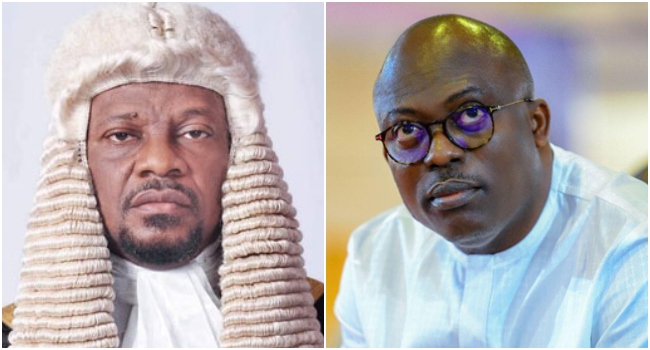
Rivers State House of Assembly has issued a notice accusing the state governor, Siminalayi Fubara, and his deputy, Ngozi Odu, of alleged misconduct.

Twenty-six members of the assembly made the misconduct allegation against Fubara in a notice sent to the Speaker, Martin Amaewhule, on Monday.

According to the lawmakers, their action follows “Section 188 of the Constitution of the Federal Republic of Nigeria, 1999 (as amended) and other existing laws.”

Advertisement

They accused Fubara of several offences including reckless and unconstitutional spending of public funds, ans obstructing the Assembly’s activities among others.

The allegations filed against Fubara by the House is listed brelow:

1. “That His Excellency, Sir Siminalayi Fubara GSSRS, Governor of Rivers State refused to present the Rivers State Appropriation Bill, 2024 to the Rivers State House of Assembly contrary to Section 121(1)(2) of the Constitution and disobeyed the order of the Federal High Court in Suit no. FHC/ABJ/CS/1613/2023 which declared that “thus as it stands in law, no Appropriation Bill of Rivers State has been presented neither has any of such Bill being passed into law as the purported presentation, passage and signing into law of the Appropriation Bill 2024 of Rivers State is void ab initio” and ordered him to present the Appropriation Bill 2024 to the House.

2. “That His Excellency, Sir Siminalayi Fubara GSSRS, Governor of Rivers State authorised or approved withdrawals from the Consolidated Revenue Fund of Rivers State in the 2024 financial year of Rivers State without an appropriation law duly passed by the Rivers State House of Assembly contrary to Section 120 of the Constitution.

Advertisement

3. ”That His Excellency, Sir Siminalayi Fubara GSSRS, Governor of Rivers State violated Section 122 of the Constitution by authorising expenditures from the Consolidated Revenue Fund of Rivers State even after the Rivers State House of Assembly declared a shutdown on Rivers State Government expenditure in a resolution passed at the 4′ Legislative day of the Second Session of the 10th Rivers State House of Assembly which held on Monday the 15* day of July 2024, thereby relegating the constitutional resolution passed by the House to the background.

4. ”That on Friday the 28th of February 2025, the Supreme Court of Nigeria before their Lordships Uwani Musa Abba Aji JSC, Ibrahim Mohanned Musa Saulawa JSC, Emmanuel Akomaye Agim JSC, Chioma Egondu Nwosu-Iheme JSC and Jamilu Yammama Tukur JSC in Suit no. SC/CV/1174/2024 restored the kudgment of the Federal High Court in Suit No. FHC/ABJ/CS/984/2024 which confirmed that Sir Siminalayi Fubara GSSRS, Governor of Rivers State never presented an Appropriation Bill for 2024, still does not have an Appropriation Law for 2025 so, ordered that “the Central Bank of Nigeria and the Accountant General of the Federation should forthwith stop releasing and paying to the Government of Rivers State, its organs, departments and officials any money belonging to Rivers State until an Appropriation law is made by Rivers State House of Assembly constituted as prescribed by the 1999 Constitution”.

5. “Hindering or obstructing the Rivers State House of Assembly which is another arm of government protected by the Constitution of the Federal Republic of Nigeria, 1999 (as amended) from performing her constitutional duties.

6. “That His Excellency, Sir Siminalayi Fubara GSSRS ordered and personally supervised the demolition of the Rivers State House of Assembly Hallowed Chamber and Auditorium at the Rivers State House of Assembly Complex, Moscow Road, Port Harcourt on the 13th day of December 2023. This action was in contravention of the ex parte order of the Federal High Court in Suit No.: FHC/ABJ/CS/1613/2013 issued on the 30* of November 2023 which declared “that the Rivers State House of Assembly is a constitutional institution that needs to be preserved pending the determination of the Motion on Notice dated and filled 29th November, 2023.”

Advertisement

7. “That the judgelment delivered on the 220d of January 2024 in favour of the Rivers State House of Assembly where the presiding judge-Justice J.K Omotosho in Suit No.: FHC/ABJ/CS/1613/2013 condemned the act of demolition and stated that “this court finds it strange that the 11th defendant as Chief Executive of the State would go to the extent of stopping the authentic House of Assembly from sitting through devious means such as destroying the House of Assembly Complex” is noteworthy.

8. “That the Supreme Court in Suit No.: SC/CV/1174/2024 delivered on the 28 of February 2025 took judicial notice of the illegal demolition and condemned the action of the Governor of Rivers State wherein it was stated that “surprisingly on 13-12-23, in gross violation of the subsisting Order of the trial court, the appellant demolished Rivers State House of Assembly complex at Moscow Road and secretly arranged four members of the 15 Respondent led by Rt. Hon, Ehie Ogerenye Edison to a place outside the premises of the said House of Assembly and held a sham sitting of the 1s Respondent”.

9. “Appointment of persons to occupy offices/positions in the Rivers
State Government without allowing for the requirement of screening and confirmation as prescribed by the Constitution of the Federal Republic of Nigeria, 1999 (as amended), other extant laws but making the request for screening to persons other than the legitimate Rivers State House of Assembly.

10. “That His Excellency, Sir Siminalayi Fubara GSSRS, Governor of Rivers State made several appointments which are in contempt of the Order of the Federal High Court in a Judgement delivered in Suit No.: FHC/ABJ/CS/1613/2023 that prohibited him from dealing with any other persons or House other than the Rivers State House of Assembly under the leadership of Rt. Hon. Martin Chike Amaewhule as Speaker.
This judgement which was upheld by the Court of Appeal and the Supreme Court stated among other things that “AN ORDER is hereby made restraining the 11th Defendant from howsoever or in whatsoever manner making any request, presentation or nomination to the Rivers State House of Assembly except to the Rivers State House of Assembly under the leadership of the 2d Plaintiff as Speaker”.

Advertisement

11. “That His Excellency, Sir Siminalayi Fubara GSSRS, Governor of Rivers State failed to forward the name of a nominee for appointment as Attorney-General and Commissioner for Justice in line with Section 192(2) & (6) as well as Section 195(1) of the 1999 Constitution as amended to the legitimate Rivers State House of Assembly as declared by the Judgement of the Federal High Court in FHC/ABJ/CS/1613/2023 but chose to announce one Mr. Dagogo Iboroma to assume the said position.

12. “That His Excellency, Sir Siminalayi Fubara GSSRS illegally swore-in several other persons who were purportedly confirmed by certain individuals for appointment into the Rivers State Executive Council on Tuesday 21st May, 2024 namely- Prince Charles O. Beke; Collins Onunwo; Solomon Eke; Peter Medee; Elloka Tasie-Amadi; Basoene Joshua Benibo; Tambari Sydney Gbara and Ovy Orluideye Chinendum Chukwuma without screening and confirmation by the Rivers State House of Assembly in full compliance with Section 192(2) & (6) of the 1999 Constitution as amended. Others who were sworn in on Tuesday 13th of August 2024 are Illamu Arugu; Rowland Obed Whyte; Samuel Anya; Samuel Eyiba and Austin Emeka Nnadozie while Israel Ngbuelu; Evans Bipi;
Otamiri Ngubo and Benibo Alabraba were sworn in on Monday 7th October 2024. Emmanuel Frank-Fubara was sworn-in on the 8th of July 2024 amounting to a total number of 19 persons parading themselves and misleading Rivers people that they are Commissioners with your tacit approval.

13. “That His Excellency, Sir Siminalayi Fubara GSSRS, Governor of Rivers State illegally swore-in Mr. Lawrence Oko-Jaja as Chairman; Earnest Ibekwe Ekwe; Mina Ogbanga; Iseleye Amachree and Adokiye Oyagiri as members of the Rivers State Bureau on Public Procurement on Friday 30th of August 2024 without screening and confirmation by the legitimate Rivers State House of Assembly as stipulated in Section 4(a) of the Rivers State Public Procurement Law No. 4 of 2008. Others are Gift Alex-Hart; Grace Osaronu and Selinah Amonieah as members.

14. “That His Excellency, Sir Siminalayi Fubara GSSRS, Governor of Rivers State engaged Mr. Goodlife Ben as Chairman;
Emmanuel Jaja; Betty Warmate; Jerome Chimenem; Prince Ohochukwu; Philip Okparaji and Christian Amadi as members of the Rivers State Local Government Service Commission without screening and confirmation by the legitimate Rivers State House of Assembly contrary to Section 44(3) of the Rivers State Local Government Law No. 5 of 2018.

Advertisement

15. “That His Excellency, Sir Siminalayi Fubara GSSRS, Governor of Rivers State made the illegal appointments and refused to rescind his actions even after several letters were sent to him and published in the electronic and print media following resolutions of the house.

16. “His Excellency, Sir Siminalayi Fubara GSSRS, Governor of Rivers State seized salaries of some members of the Rivers State House of Assembly which were hitherto paid monthly from the Ministry of Finance of Rivers State. The month of April, 2024 was the last time monthly salaries were paid to Rt. Hon.
Martin Chike Amaewhule; Rt. Hon. Dumle Maol; Hon. Major Jack; Hon. Franklin Uchenna Nwabochi; Hon. Christopher Ofiks Kagbang; Hon. Azeru Opara and Hon. Enemi Alabo George. Others in the same fate are Hon. Granville Tekenari Wellington; Hon. Solomon Wami; Hon. Bernard Mgbar; Hon. John Dominic Iderima; Hon. Queen Uwuma Tony Williams and Hon. Lolo Isaiah Opuende. Hon. Peter Abbey; Hon. Igwe-Obey Aforji; Hon. Justina Emeji; Hon. Ignatius Onwuka; Hon. Chimezie Nwankwo; Hon. Lemchi Prince Nyeche as well as Hon. Barile Nwakoh; Hon. Emilia Lucky Amadi;Hon. Nkemjika Ezekwe; Hon. Davids Arnold Okobiriari; Hon. Sylvanus Nwankwo and Hon. Gerald Oforji are also affected.

17. “His Excellency, Sir Siminalayi Fubara GSSRS, Governor of Rivers State seized funds standing to the credit of the Rivers State House of Asembly since the month of April 2024 in a bid to frustrate the House and cripple her activities as well as relegate the Judgement of the Federal High Court in Suit No.: FHC/ABJ/CS/1613/2023 to the background. The Judgement stated that ” AN ORDER OF INJUNCTION is hereby granted restraining the Governor of Rivers State (the 11th Defendant) whether by himself or his servants or agents and/or the executive arm of the Government of Rivers state, including the 12th, 13th and 14th Defendants (by themselves individually or collectively), or by their servants or subordinates from withholding any amount standing to the credit of Rivers State House of Assembly in Consolidated Revenue Fund of Rivers State including salaries and emoluments due and payable to the Speaker, Deputy Speaker, and other members of staff of the House or in any manner whatsoever denying the Rivers State House of Assembly of the due fund for running its affairs including the payment of salaries, allowances, emoluments and meeting its financial obligations no matter how described.”

18. “His Excellency, Sir Siminalayi Fubara GSSRS, Governor of Rivers State illegally withheld the salary of the Clerk of the Rivers State House of Assembly contrary to the Judgement of the Federal High Court in Suit No.: FHC/ABJ/CS/1613/2023 which stated that ” AN ORDER OF INJUNCTION is hereby granted restraining the Governor of Rivers State (the 11h Defendant) whether by himself or his servants or agents and/or the executive arm of the Government of rivers state, including the 12th, 13th and 14th Defendants (by themselves individually or collectively), or by their servants or subordinates from withholding any amount standing to the credit of Rivers State House of Assembly in Consolidated Revenue Fund of Rivers State including salaries and emoluments due and payable to the Speaker, Deputy Speaker, and other members of staff of the House or in any manner whatsoever denying the Rivers State House of Assembly of the due fund for running its affairs including the payment of salaries, allowances, emoluments and meeting its financial obligations no matter how described.”

Advertisement

19. “Mr. Speaker, we conclude by stating that the Governor has shown that he is not prepared to govern Rivers State in line with the Constitution of the Federal Republic of Nigeria, 1999 (as amended) and his oath of office. The Supreme Court in Suit No.: SC/CV/1174/2024 condemned his actions when it stated that “the 8th respondents fear of impeachment by the House of Assembly is no justification for his attacks on the House of Assembly, the Constitution, the Government of Rivers State and the rule of law. Political disagreements cannot justify these attacks and contempt for the rule of law by the Governor of a State or any person. What the 8th respondent has done is to destroy the government because of fear of being impeached”.
Continue Reading
Advertisement
Click to comment

Warning: Undefined variable $user_ID in /home/naijuinz/public_html/wp-content/themes/zox-news/comments.php on line 49

You must be logged in to post a comment Login

Leave a Reply

News

Reps Launch Defence Reform Hearings as Push Grows for Stronger Military, Better Veterans’ Welfare

Published

on

ADVERTISEMENT
Zoom Ad
ADVERTISEMENT
Zoom Ad

…as ex-servicemen call for a greater voice in proposed support structures

By Gloria Ikibah

The House of Representatives has begun deliberations on a package of defence-related bills aimed at overhauling Nigeria’s military framework, enhancing the welfare of serving and retired personnel, and improving the Armed Forces’ capacity to confront the country’s increasingly complex security challenges.

The two-day public hearing, which opened on Monday at the National Assembly Complex, attracted lawmakers, military personnel, veterans, civil society groups and policy experts. Discussions centred on legislative proposals designed to modernise military operations, strengthen accountability and address emerging threats to national security.

Advertisement

Opening the hearing, Speaker of the House of Representatives, Rt. Hon. Tajudeen Abbas, said the proposed reforms were a direct response to the changing nature of insecurity across the country and formed an important part of the legislative priorities of the 10th House.

He pointed to the persistent threats facing Nigeria, including insurgency in the North-East, banditry and kidnappings in the North-West, farmer-herder clashes in the North-Central, separatist agitations in the South-East, as well as newer challenges such as cyber warfare, maritime piracy and organised criminal networks with links to terrorism.

“We cannot pretend that our nation is at ease. Our Armed Forces are stretched, yet they remain our first and last line of defence,” the Speaker said.

According to Abbas, the bills seek to strengthen the legal and institutional foundations of the military, ensuring that the Armed Forces become more effective, accountable, inclusive and adaptable to contemporary security realities.

Advertisement

Among the key proposals before lawmakers is a bill to establish an Armed Forces Farms and Ranches Scheme aimed at boosting food security, particularly in areas affected by conflict. Other measures include legislation to improve gender representation within the military, a proposal to repeal and replace the Armed Forces Act with a new Nigerian Military Force Bill, and a bill seeking the creation of a Veterans’ Federation of Nigeria to enhance support for retired service personnel.

The issue of veterans’ welfare featured prominently during the proceedings, with retired military personnel advocating stronger representation in the proposed welfare framework and greater involvement in decisions affecting former members of the Armed Forces.

Abbas assured participants that the public hearing will not be treated as a mere formality, stressing that all contributions would receive careful consideration before the bills return to the House.

“I give you my word every memorandum will be read, every oral presentation will be noted, and all relevant contributions will be considered and, where applicable, incorporated into the final reports and bills,” Abbas assured stakeholders.

Advertisement

He encouraged active participation from serving and retired military officers, civil society organisations, legal practitioners, gender advocates and members of the public, noting that innovative legislation would be essential in responding to the country’s multifaceted security concerns.

The Speaker also commended the House Committee on Defence for organising the hearing and expressed confidence in the committee’s ability to manage an open, transparent and inclusive process.

“We are here to serve the Nigerian people and to produce legislation that will make our Armed Forces more professional, more accountable, more gender-sensitive, and more effective in protecting lives and property,” he said.

In his welcome address, Chairman of the House Committee on Defence, Babajimi Benson, described the public hearing as a critical democratic exercise designed to ensure stakeholder participation in the lawmaking process.

Advertisement

According to Benson, defence legislation directly impacts national sovereignty, military effectiveness, operational readiness and the safety of Nigerians, making public input essential.

“The importance of public participation becomes even more significant when dealing with matters of defence and national security,” he said.

He explained that the bills address key areas including military education and professional development, joint operational effectiveness, medical training and healthcare support, strategic research and doctrine development, military governance reforms, food security initiatives, veterans’ welfare and inclusiveness within the Armed Forces.

“Collectively, these proposals represent an important effort to build a stronger, more professional, innovative and future-ready military institution,” Benson stated.

Advertisement

The lawmaker encouraged stakeholders to make oral presentations and submit memoranda, assuring them that all submissions would be carefully reviewed by the committee.

He also paid tribute to officers and soldiers of the Armed Forces of Nigeria for their dedication and sacrifices in safeguarding the nation despite difficult operating conditions.

The hearing also witnessed strong reactions from some veterans who expressed reservations about aspects of the proposed Veterans’ Federation of Nigeria Bill.

Supporters of the proposed (VFN) Bill urged lawmakers to adopt a framework they said aligns with international best practices for veterans’ welfare and representation.

Advertisement

In a policy brief submitted to the Committee, G.A Olonisakin speaking on behalf of veteran stakeholders argued that the debate surrounding the bill should focus on facts, global standards and the welfare of Nigerian veterans rather than on institutional sentiments or nomenclature.

The memorandum noted that in countries such as the United States, the United Kingdom, Canada and Australia, veterans’ organisations such as the American Legion, the Royal British Legion and the Royal Canadian Legion operate as non-governmental charitable associations rather than statutory government bodies.

According to the submission, responsibility for veterans’ welfare in those countries rests with dedicated government agencies, including the United States Department of Veterans Affairs, Veterans Affairs Canada, the United Kingdom’s Office for Veterans Affairs and Australia’s Department of Veterans Affairs.

The stakeholders further argued that Nigeria’s current arrangement, in which the Nigerian Legion combines the roles of both an association and a statutory government body, is uncommon internationally.

Advertisement

They maintained that the proposed VFN model would bring Nigeria closer to global standards by creating a government-driven umbrella body for veterans while preserving the identities of existing associations.

“The proposed Veterans Federation of Nigeria follows international practice by creating one umbrella body for all veterans and veterans’ associations, ensuring inclusiveness across Army, Navy and Air Force veterans, strengthening welfare coordination and improving engagement with government,” the memorandum stated.

The submission also sought to allay fears that the bill would undermine the Nigerian Legion, stressing that the federation would not erase the Legion’s history, traditions or identity.

Rather, it said, the Nigerian Legion would continue to exist as one of the recognised constituent bodies within the proposed federation alongside other veterans’ associations.

Advertisement

The position contrasted with concerns raised by some retired personnel who argued that the bill concentrates leadership positions in the hands of senior officers and called instead for the establishment of a standalone Ministry of Veterans Affairs headed by veterans.

The differing perspectives highlighted the intense interest among stakeholders in shaping the future structure of veterans’ welfare and representation in Nigeria, one of the key issues under consideration during the two-day public hearing.

Also a retired non-commissioned officer and legal practitioner,  Sadiqe Nwabuezeh who identified himself as a former sergeant in the Nigerian Army, argued that the draft legislation was overly tilted in favour of senior military officers and failed to adequately accommodate the interests of rank-and-file veterans.

According to him, provisions of the bill appeared to reserve key leadership positions for retired senior officers, including the office of the Director-General, which he said was proposed to be occupied by a retired major general.

Advertisement

He urged lawmakers to reject the bill in its current form and instead consider the establishment of a dedicated Ministry of Veterans Affairs that would be managed by veterans themselves.

“The bill was not properly prepared. It was rushed and concentrates power in the hands of senior officers. We want a level playing ground where all veterans, regardless of rank, can participate in leadership and decision-making,” he told the hearing.

The retired soldier further questioned the involvement of serving military personnel and civilians in handling veterans’ affairs, arguing that retired personnel were best positioned to manage issues affecting former service members.

He maintained that veterans should have greater control over institutions established for their welfare and called for reforms that would guarantee broader representation across all ranks of retired military personnel.

Advertisement

The submission added to a range of perspectives presented by stakeholders as lawmakers continued deliberations on proposals aimed at reforming military administration, strengthening veterans’ welfare and enhancing the effectiveness of Nigeria’s defence sector.

The two-day hearing is expected to produce recommendations that will guide the House Committee on Defence in finalising the bills before their consideration by the House of Representatives.

The hearing is expected to continue on Tuesday, with stakeholders presenting memoranda and recommendations that could shape the future of Nigeria’s military and veterans’ support systems.

Advertisement
Continue Reading

News

ECOWAS Parliament Pushes Renewable Energy as Key to Unlocking Rural Prosperity

Published

on

ADVERTISEMENT
Zoom Ad
ADVERTISEMENT
Zoom Ad

…as lawmakers, experts, development partners seek practical solutions to West Africa’s electricity deficit

By Gloria Ikibah

The ECOWAS Parliament has opened a five-day high-level meeting in Dakar with a renewed call for greater investment in renewable energy, positioning rural electrification as a critical tool for economic growth, job creation and sustainable development across West Africa.

The Delocalised Joint Committee Meeting brings together parliamentarians, government officials, energy specialists, development partners and private sector stakeholders to examine ways of expanding electricity access in rural communities, where millions of residents remain disconnected from reliable power despite the region’s vast renewable energy resources.

Advertisement

The gathering is expected to focus on policy reforms, financing mechanisms and legislative frameworks needed to accelerate the deployment of clean energy solutions throughout the sub-region, under the theme, “Harnessing Renewable Energy for Rural Electrification and Empowerment of Rural Economies in the ECOWAS Region: The Role of the ECOWAS Parliament” .

Declaring the meeting open on behalf of the Speaker of the ECOWAS Parliament, Rt. Hon. Hadja Memounatou Ibrahima, the Fourth Deputy Speaker, Hon. Billay Tunkara, emphasised that renewable energy must be viewed not only as a means of supplying electricity but also as a powerful instrument for transforming rural economies.

“Renewable energy is not merely a technical response to electricity demand. It is a key driver in transforming economic activities, particularly in rural areas,” he said.

Tunkara commended Senegal for its commitment to energy transition efforts and acknowledged the country’s drive towards greater energy independence. He noted that investments in solar power and diversification of energy sources had contributed significantly to improving electricity access in rural communities.

Advertisement

He also called on member states to intensify efforts to ensure that renewable energy becomes a vehicle for inclusive growth and social development across the region.

“Together, let us make rural electrification through renewable energy a catalyst for the economic empowerment of women, young people and farmers. Access to clean energy is a fundamental right, a factor in social peace and a driver of sustainable development”, he added.

The Deputy Speaker further urged governments across the ECOWAS region to strengthen support for renewable energy programmes through innovative financing arrangements, technology transfer initiatives, local manufacturing and stronger parliamentary oversight of regional energy policies.

In his welcome remarks, Head of the Senegalese Delegation to the ECOWAS Parliament, Hon. Guy Marius Sagna, described the conference as a crucial opportunity for West Africa to advance its quest for energy sovereignty and sustainable development.

Advertisement

He expressed concern that electricity access in many rural areas remains critically low despite the region’s abundant renewable energy potential.

“Our country, the Republic of Senegal, is deeply honored and truly enthusiastic to host this meeting, whose theme resonates particularly strongly as a call to action. A call to make the development of renewable energy a key component of our energy sovereignty.

“The figures speak for themselves. In our ECOWAS region, access to electricity for rural households is still capped at around 12 percent, while our region boasts exceptional solar potential. This gap between our resources and their exploitation is a challenge that we must collectively and urgently address”, he added.

According to Sagna, achieving energy independence is essential to addressing broader socio-economic challenges such as poverty, unemployment, food insecurity and underdevelopment.

Advertisement

Earlier, Chairperson of the Joint Committee on Energy and Mines, Agriculture, Environment and Natural Resources, and Infrastructure, Hon. Fanta Conte, highlighted the urgency of tackling the widening gap between energy demand and supply across the region.

“Less than 40 percent of the rural population has access to electricity. In some of our Member States, this rate falls below 10 percent in the most remote areas,” she said.

Conte noted that inadequate electricity access continues to undermine healthcare services, agricultural productivity, educational opportunities and income generation, particularly for women and young people living in rural communities.

She also emphasised the responsibility of lawmakers in ensuring that regional energy policies are translated into effective national legislation and implemented successfully.

Advertisement

“Our role is to ensure that commitments made at the regional level, particularly the ECOWAS Renewable Energy Policy and the Energy Efficiency Action Plan, are effectively transposed into national legislation and, above all, implemented on the ground,” she stated.

The committee chair expressed optimism that the deliberations, which include technical sessions and a field visit to renewable energy projects in Mboursine village, would yield practical recommendations capable of accelerating rural electrification and driving sustainable economic growth throughout the ECOWAS region.

The meeting is expected to continue until June 19, culminating in recommendations aimed at strengthening regional energy cooperation and expanding access to clean, affordable and reliable electricity across West Africa.

Advertisement
Continue Reading

News

Nigerian Ports Record Global Leap as Apapa, Tin Can Gain World Bank Recognition

Published

on

ADVERTISEMENT
Zoom Ad
ADVERTISEMENT
Zoom Ad

By Gloria Ikibah

Nigeria’s maritime sector has received a major boost after the World Bank named the Apapa Port Complex and Tin Can Island Port Complex among the world’s 20 most improved ports, reflecting significant progress in operational efficiency and service delivery.

The recognition was contained in the 2025 Container Port Performance Index (CPPI), released by the World Bank in June 2026, which highlighted both Lagos ports for their notable improvements in vessel turnaround times and overall port performance.

The ranking is widely regarded as one of the most authoritative global assessments of port efficiency, measuring how quickly ships are serviced and cleared through ports. It provides a standardised, data-driven framework for comparing the performance of ports across different countries and regions.

Advertisement

The latest recognition comes amid ongoing reforms and modernisation efforts at Nigeria’s seaports, spearheaded by the Nigerian Ports Authority (NPA) under the leadership of its Managing Director, Dr Abubakar Dantsoho.

Industry observers say the improved ranking reflects sustained efforts to streamline port operations, reduce delays and enhance the competitiveness of Nigeria’s maritime gateways in the global shipping industry.

The latest recognition comes on the heels of the Nigerian Ports Authority’s pivotal role in sustaining Nigeria’s trade surplus. Through enhanced efficiency and improved port operations, the NPA has continued to provide the platform for Nigeria’s successive attainment of trade surpluses since 2024. Most recently, the National Bureau of Statistics (NBS) reported a trade surplus of ₦7.54 trillion in the first quarter (Q1) of 2026, highlighting the strategic importance of the nation’s ports to economic growth and international trade.

Reacting to the World Bank report, the Managing Director of the NPA, Dr. Abubakar Dantsoho, attributed the achievement to the investor-friendly policies of President Bola Ahmed Tinubu and the support of the Minister of Marine and Blue Economy, Adegboyega Oyetola.

Advertisement

“With the investor-friendly policies of President Bola Ahmed Tinubu providing the impetus for increased investment to drive our port infrastructure and equipment modernization programme, coupled with the unflinching support of the Honourable Minister of Marine and Blue Economy, Adegboyega Oyetola, we have all it takes to further enhance trade facilitation, improve competitiveness and boost the national economy.”

The inclusion of Apapa and Tin Can Island ports in the global Top 20 for improvement marks a significant milestone for the country’s maritime sector, which has in recent years pursued measures aimed at boosting efficiency, attracting investment and strengthening Nigeria’s position as a regional trade hub.

The Container Port Performance Index serves as an important benchmark for governments, port operators and investors by identifying ports that are making measurable progress while also highlighting areas requiring further operational improvement.

For Nigeria, the latest ranking is expected to reinforce confidence in ongoing port reforms and support efforts to improve trade facilitation, logistics performance and economic competitiveness.

Advertisement
Continue Reading

Trending

Copyright © 2024 Naija Blitz News