Foreign
US will ‘pass’ on Ukraine peace talks if no progress soon – Trump
- /home/naijuinz/public_html/wp-content/plugins/mvp-social-buttons/mvp-social-buttons.php on line 27
https://naijablitznews.com/wp-content/uploads/2024/03/Donald-Trump-1.jpg&description=US will ‘pass’ on Ukraine peace talks if no progress soon – Trump', 'pinterestShare', 'width=750,height=350'); return false;" title="Pin This Post">
- Share
- Tweet /home/naijuinz/public_html/wp-content/plugins/mvp-social-buttons/mvp-social-buttons.php on line 72
https://naijablitznews.com/wp-content/uploads/2024/03/Donald-Trump-1.jpg&description=US will ‘pass’ on Ukraine peace talks if no progress soon – Trump', 'pinterestShare', 'width=750,height=350'); return false;" title="Pin This Post">
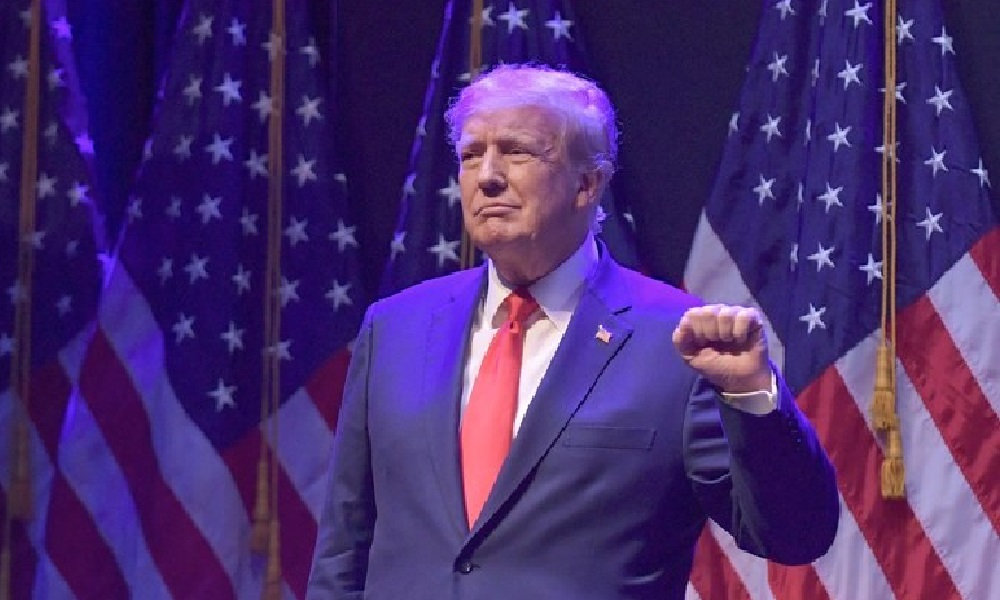
Donald Trump said the US will “take a pass” on brokering further Russia-Ukraine war talks if Moscow or Kyiv “make it very difficult” to reach a peace deal.

The US president told reporters in the Oval Office on Friday that he was not expecting a truce to happen in “a specific number of days” but he wanted it done “quickly”.
His comments came hours after US Secretary of State Marco Rubio warned that the US would abandon talks “if it’s not going to happen”.

“We’re not going to continue with this endeavour for weeks and months on end,” Rubio said, adding that the US had “other priorities to focus on”.
When asked about the deal between Russian and Ukraine, Trump said: “We’re talking about here people dying. We’re going to get it stopped, ideally.
“Now if, for some reason, one of the two parties makes it very difficult, we’re just going to say, ‘You’re foolish, you’re fools, you’re horrible people,’ and we’re going to just take a pass.”
Russia launched a full-scale invasion of Ukraine in 2022 and has placed a number of conditions on any potential ceasefire.
Despite the Trump administration’s initial confidence that it could secure a deal quickly, attempts to reach a full ceasefire have yet to materialise, with Washington blaming both sides.
Following a meeting with European leaders in Paris about a potential ceasefire on Thursday, Rubio told reporters on Friday: “We need to determine very quickly now – and I’m talking about a matter of days – whether or not this is doable.”
“If it’s not going to happen, then we’re just going to move on,” he said about truce talks.
He said it was clear that a peace deal would be difficult to strike but there needed to be signs it could be done soon.
Trump had said before he re-entered office that he would stop the fighting in the first 24 hours of his presidency.
Kremlin spokesman Dmitry Peskov, when asked to respond to Trump saying he expected an answer from Russia on a ceasefire, said “the negotiations taking place are quite difficult”.
“The Russian side is striving to reach a peace settlement in this conflict, to ensure its own interests, and is open to dialogue,” he said.
The comments come as Russian strikes on Ukraine continue. On Friday, Ukrainian President Volodymyr Zelensky said in a post on X that Russia had launched a volley of missile attacks that killed two people.
During a meeting with Italian Prime Minister Giorgia Meloni in Rome on Friday, US Vice President JD Vance said he was “optimistic” about ending the Ukraine war.
“I want to update the prime minister on some of the negotiations between Russia, Ukraine, and also some of the things that have happened even in the past 24 hours,” he said.
“I won’t prejudge them, but we do feel optimistic that we can hopefully bring this war – this very brutal war – to a close.”
Vance’s comments followed separate news that Ukraine and the US took the first step towards striking a minerals deal, after an initial agreement was derailed when a February meeting between Trump and Zelensky erupted into a public shouting match.
On Thursday, the two countries signed a memorandum of intent stating that they intend to establish an investment fund for Ukraine’s reconstruction as part of an economic partnership agreement.
The aim is to finalise the deal by 26 April, the memo published by the Ukrainian government says.
The details of any deal remain unclear. Previous leaks have suggested the agreement has been extended beyond minerals to control of Ukraine’s energy infrastructure, as well as its oil and gas.
Ukrainian negotiators have tried to resist Trump’s demands that a joint investment fund would pay back the US for previous military aid, but have seemingly accepted his claim that it would help the country recover after the war ends.
The memo said the “American people desire to invest alongside the Ukrainian people in a free, sovereign and secure Ukraine”.
Zelensky had been hoping to use the deal to secure a US security guarantee in the event of a ceasefire deal, telling European leaders last month that “a ceasefire without security guarantees is dangerous for Ukraine”.
The US has so far resisted providing Kyiv with security guarantees.
The White House argues the mere presence of US businesses would put off Russia from further aggression, but that did not exactly work when they invaded in 2022.
Economy Minister Yulia Svyrydenko announced the signing of the memorandum on X, with pictures of Svyrydenko and US Treasury Secretary Scott Bessent separately signing the document over an online call.
“There is a lot to do, but the current pace and significant progress give reason to expect that the document will be very beneficial for both countries,” Svyrydenko wrote.
Bessent said the details were still being worked out but the deal is “substantially what we’d agreed on previously.”
Trump hinted at the deal during a press conference with Italian leader Giorgia Meloni, saying “we have a minerals deal which I guess is going to be signed on (next) Thursday…and I assume they’re going to live up to the deal. So we’ll see. But we have a deal on that.”
Ivanna Klympush-Tsintsadze, an MP and the chair of Ukraine’s parliamentary committee on EU Integration, told the BBC the Ukrainian Parliament will have “the last word” in the deal.
She added: “I hope that there will be enough reasoning to ensure that whatever is signed, and if it is going to be ratified that it is in the interest of our country and our people.
The memo release comes as a 30-day moratorium on striking Ukrainian energy infrastructure ordered by Russian President Vladimir Putin expires.
Peskov said Putin had not yet issued any new orders regarding the temporary ceasefire.
On Thursday, Ukraine’s Foreign Minister Andrii Sybiha met Rubio and Trump’s special envoy Steve Witkoff in Paris to discuss how to end the war.
Sybiha said they had “discussed the paths to a fair and lasting peace, including full ceasefire, multinational contingent, and security guarantees for Ukraine”.
Foreign
Death Toll From Venezuela Quakes Jumps To 188, Over 1,500 Injured
The death toll from Venezuela’s devastating earthquakes has risen to at least 188, with 971 people injured, National Assembly chief Jorge Rodriguez, said on Thursday.
Interim president Delcy Rodriguez had earlier said that round 30 aftershocks have been recorded following the two strongest quakes on Wednesday.
Authorities initially reported 32 dead and more than 700 injured.
The earthquakes of magnitude 7.2 and 7.5 struck the same area of Venezuela on Wednesday, according to the United States Geological Survey (USGS), causing buildings in the capital to crumble and forcing the closure of the country’s main airport.
US President Donald Trump said late Wednesday that “the two major earthquakes that just hit the great people of Venezuela are both massive in scale and have left a devastating number of deaths.”
“The U.S.A. stands ready, willing, and able to help! I have instructed all agencies of our government to get ready to move quickly,” the American president wrote on his Truth Social platform.
An AFP journalist saw a 22-story building completely destroyed in the capital’s Altamira neighborhood, where people cried out relatives’ names as volunteers climbed over the rubble.
“We need flashlights,” one of them said.
The first quake, with an epicenter 21 kilometers (13 miles) west of the coastal town of Moron, occurred at 2204 GMT, USGS said. Within a minute, a 7.5-magnitude quake struck about 45 kilometers away.
“This earthquake was the second event in a doublet. This magnitude 7.5 mainshock was preceded by 39 seconds by a 7.2 foreshock,” USGS said.
Foreign
US Targets Alleged ISIS Funding Network, Names Nigerian
The United States government has identified a Nigerian national among several individuals and organisations accused of facilitating financial operations for the Islamic State of Iraq and Syria (ISIS), as part of a broader crackdown on the group’s global funding network.
In a statement issued by the U.S. Department of State, officials said the action targeted three individuals and six entities operating across Europe, the Middle East, and West Africa, who are allegedly involved in moving funds used to support ISIS activities.
According to the department, the measures are aimed at disrupting the terrorist group’s ability to finance attacks and sustain its international operations.
“Under the leadership of President Trump, the United States is dismantling ISIS’s ability to finance terrorism around the world. We are cutting off the financial lifelines from around the world that enable ISIS to fund attacks, support its regional affiliates, and threaten civilians, including religious minorities,” spokesperson Thomas Pigott said.
The statement noted that the network spans France, Syria, Türkiye, and Nigeria, and is believed to have facilitated the cross-border movement of funds linked to the extremist group.
Officials alleged that the designated individuals include a France-based facilitator connected to explosives-related information shared with ISIS supporters, a Syria-based operator who reportedly used cryptocurrency to transfer funds internationally, and a Nigeria-based facilitator whose money exchange businesses were allegedly used as channels for ISIS financing.
The U.S. government said the designations are part of ongoing efforts to dismantle financial pipelines supporting terrorist organisations and to restrict their global operations.
Foreign
Seven PMs In 10 Years: Britain’s Decade Of ‘Change’
Britain will have its seventh prime minister in 10 years after Labour leader Keir Starmer was ousted on Monday by his own party.
The party’s self-inflicted wound was a trend set by the Conservatives when they were in office.
Starmer announced his resignation on Monday following months of nose-diving poll ratings and manoeuvring by his own MPs.

Veteran Labour politician Andy Burnham has confirmed he will seek to replace him.
The main opposition Tories went through five prime ministers between 2016 and July 2024 when Starmer swept to power in a landslide general election victory.
The rapid turnover at the top prompted Starmer — before he became prime minister — to call for an end to the “chaos” of chopping and changing leaders.
After less than two years, Starmer has now met a similar fate himself.
Here’s what happened to his predecessors:
David Cameron (May 2010 to July 2016)

Britain’s decision to leave the European Union ended Cameron’s second term as prime minister.
After the country voted to leave in a June 2016 referendum, Cameron, who had campaigned to remain in the bloc, resigned.
Theresa May (July 2016 to July 2019)

Tolga AKMEN / AFP
May took over amid the fallout from the Brexit referendum after a long tenure in the notoriously difficult post of interior minister.
She called a snap election the following year to strengthen her hand in Brexit negotiations, but the move backfired when her party emerged as the biggest in parliament but without a majority.
Unable to get her Brexit deal through parliament, the Conservatives suffered a drubbing in European Parliament elections in May 2019, leading to her resignation.
Boris Johnson (July 2019 to September 2022)

Johnson, a maverick politician famed for making a career out of breaking the rules, had to navigate the coronavirus pandemic and Britain’s departure from the European Union.
He led the Conservatives to victory in the December 2019 snap general election.
But weakened by scandals, he was eventually forced to step down following a cascade of resignations by ministers and aides.
Liz Truss (September 2022 to October 2022)

Truss was prime minister for just 49 days, the shortest on record, before being ousted over her disastrous tax-cutting mini-budget.
Her economic agenda spooked the markets and took the UK to the brink of financial meltdown, losing her the support of her own party.
Rishi Sunak (October 2022 to July 2024)

Sunak was at the helm for 20 months before losing the 2024 general election to Starmer, bringing to an end 14 years of Conservative rule.
He brought some stability following the Truss debacle but failed to stop bitter Tory infighting.
The privately wealthy former financier ultimately failed to connect with regular voters struggling with a cost-of-living crisis.
AFP
-
News20 hours agoYou Clearly Didn’t Read the State Police Bill — Akpabio’s Aide Fires Back at Obi
-
News20 hours agoPeter Obi Reacts To court Ruling Nullifying NDC’s Registration
-
News20 hours agoMy Dad’s Wife Needs Money To Maintain Her Lavish Lifestyle- Mr. Ibu’s Son
-
News19 hours agoEdo CJ constitutes special court to try cultists, kidnappers
-
Metro19 hours agoTwo killed in fresh Imo bomb explosion
-
News19 hours agoArmy to recruit 28,000 additional soldiers to combat insecurity
-
News20 hours agoXenophobia: “South Africa is nothing without Africa — MTN Group Chairman, Mcebisi Jonas
-
Entertainment20 hours agoNollywood Actor Joseph Momodu Joins US Army

Warning: Undefined variable $user_ID in /home/naijuinz/public_html/wp-content/themes/zox-news/comments.php on line 49
You must be logged in to post a comment Login