News
N70,000 minimum wage has lost value as naira falls – US Report
- /home/naijuinz/public_html/wp-content/plugins/mvp-social-buttons/mvp-social-buttons.php on line 27
https://naijablitznews.com/wp-content/uploads/2024/06/minimum-wage.jpg&description=N70,000 minimum wage has lost value as naira falls – US Report', 'pinterestShare', 'width=750,height=350'); return false;" title="Pin This Post">
- Share
- Tweet /home/naijuinz/public_html/wp-content/plugins/mvp-social-buttons/mvp-social-buttons.php on line 72
https://naijablitznews.com/wp-content/uploads/2024/06/minimum-wage.jpg&description=N70,000 minimum wage has lost value as naira falls – US Report', 'pinterestShare', 'width=750,height=350'); return false;" title="Pin This Post">
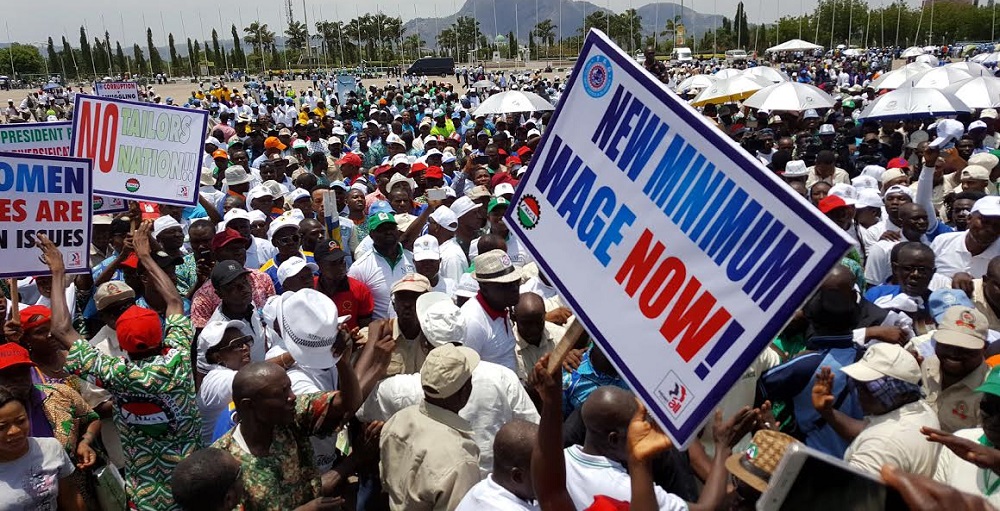
The United States has said Nigeria’s recently approved minimum wage of N70,000 for federal workers has been undermined by the continued depreciation of the naira.

In its Country Reports on the US department of state website dated August 12 on Human Rights Practices for 2024, released by the US Department of State, Bureau of Democracy, Human Rights, and Labour, the report noted that the new wage, pegged at about $47.90 per month, had lost its value due to the naira trading at over N1,500 to the dollar.
It added that firms with fewer than 25 workers did not benefit from the wage increase.

“The National Minimum Wage (Amendment) Act 2024 doubled the minimum wage to 70,000 naira ($47.90) per month.
“Despite the increase, currency devaluation meant the minimum wage was no longer higher than the poverty income level.
“Many employers had fewer than 25 employees, so most workers were not covered,” the report said.
The law provides a national minimum wage for employers with 25 or more full-time staff, with exceptions for seasonal agricultural workers, part-time employees, and commission-based roles.
The US report further observed that some states had declined to implement the law, citing financial constraints. It also pointed out gaps in enforcement.
It stated,”The law did not define premium pay or overtime and prohibited excessive compulsory overtime for civilian government employees, stressing that the government rarely effectively enforced minimum wage and overtime, while penalties were low and not commensurate with other crimes such as fraud.”
According to the report, between 70 and 80 per cent of Nigeria’s working population operates in the informal economy, where authorities fail to enforce wage, hour, and Occupational Safety and Health laws.
On child rights, the US flagged concerns over early marriage despite federal laws stipulating 18 years as the minimum age.
“Federal law sets a minimum age of 18 for marriage for both boys and girls.
“While 35 states, all except Zamfara State, adopted the law, many states, especially northern states, did not uphold the federal minimum age.
“In some states, children as young as 11 could be legally married under customary or religious law.
“The government worked with local and international partners to engage religious leaders, emirs, and sultans on the issue, emphasising the health hazards of early marriage,” the report emphasised.
The report also raised concerns over security and justice delivery, citing cases of enforced disappearances and arbitrary detentions.
It quoted Amnesty International as saying the whereabouts of “dozens of young men detained at SARS Awkuzu,” a former police station in Anambra State, remain unknown since the disbandment of SARS in 2020.
“Police and other security services had the authority to arrest individuals without a warrant if officials reasonably suspected a person committed a crime. Security forces sometimes abused this authority.
“The law required subjects be brought before a magistrate within 48 hours and have access to lawyers and family members.
“According to the law, initial pretrial detention orders were not to exceed 14 days. In some instances, government and security employees did not adhere to this regulation,” it said.
It further noted that bail provisions were often arbitrary, with suspects kept incommunicado and sometimes incarcerated indefinitely in investigative detention.
“In their prosecution of corruption cases, law enforcement and intelligence agencies did not always follow due process, arresting suspects without appropriate arrest and search warrants,” the report stated.
On the judiciary, the US identified lengthy pretrial detention and delays as major challenges.
“Some detainees were held in pretrial detention for periods equal or exceeding the maximum sentence for the accused crime.
“The shortage of trial judges, trial backlogs, endemic corruption, bureaucratic inertia, and undue political influence seriously hampered the judicial system.
“Some detainees had their cases delayed because the Nigeria Police Force and the Nigerian Correctional Service did not have vehicles to transport them to court.
“Some individuals remained in detention because authorities lost their case files,” the report said.
News
FG inaugurates National Laureate Committee, unveils ₦365m Annual Research Prize for Nigerian Students
In what education stakeholders are describing as one of Nigeria’s most ambitious attempts to reposition scholarship, innovation and research as national priorities, the Federal Government on Monday inaugurated the Tertiary Institutions National Laureate Committee.
The Committee will set in motion a new annual award programme that will reward outstanding undergraduate, master’s and doctoral research with prizes valued at approximately ₦365 million.
The Committee was inaugurated by the Honourable Minister of Education, Dr Tunji Alausa, CON, at the Digital Resource Centre of the Universal Basic Education Commission (UBEC). It will oversee the implementation of the National Laureate Programme, a flagship initiative designed to elevate academic excellence to the highest level of national recognition while promoting research commercialisation and innovation across Nigeria’s accredited post-secondary and tertiary institutions.
Speaking at the inauguration, Dr Alausa said the programme represented a deliberate effort by the Federal Government to reshape the country’s reward system. According to him, it will place scholarly achievement, scientific discovery and innovation alongside other nationally celebrated accomplishments.
The Minister said the initiative seeks to inspire a new generation of young Nigerians to pursue research capable of solving real-world problems, creating new industries and strengthening the nation’s global competitiveness.
“The future prosperity of nations will increasingly depend on their ability to convert knowledge into economic value,” the Minister said. He noted that Nigeria must deliberately celebrate intellectual achievement if it hopes to build a globally competitive knowledge economy.
Alausa observed that in an era increasingly dominated by the social media-driven “attention economy”, the Federal Government considered it necessary to establish a national platform. The platform will reward creativity, scholarship, invention and commercially valuable research, particularly among young people.
The newly inaugurated Committee comprises the following members:
Professor Abubakar Sambo, OON, President of the Nigerian Academy of Science, as Chairman; Professor Solomon Nwhator of Obafemi Awolowo University, Ile-Ife; Professor (Mrs.) Tolulope Ariyomo of the Federal University Oye-Ekiti; Professor Francis F. Uba of the Federal University of Health Sciences, Otukpo; Dr Babangida Abubakar Albaba, representing the National Board for Technical Education (NBTE); Dr Salihu Bakari Girei, representing TETFund; Professor (Mrs.) Carol Arinze-Umobi of Nnamdi Azikiwe University; Dr (Mrs.) Obianuju Anigbogu, representing the Federal Ministry of Education; Mr. Francis Egbokare, representing the Nigerian Academy of Letters; Dr Ezinne Orisakwe, representing the National Universities Commission (NUC); and Dr Pius O. Ekireghwo, representing the National Commission for Colleges of Education (NCCE).
Mr Richard Falaye, Secretary of the Nigeria Education Repository and Databank (NERD), will serve as Secretary to the Committee.
The inaugural National Laureate Awards are scheduled for November 2026. The awards will recognise the country’s finest Undergraduate Dissertations, Master’s Theses and Doctoral (PhD) Theses, alongside six thematic Excellence Awards. The thematic categories cover Medicine and Health Sciences, Engineering and Technology, Agriculture, Law, Arts and Social Sciences, and Teaching Innovation.
Under the approved prize structure, the winner of the Undergraduate Dissertation category will receive ₦35 million, while the best Master’s Thesis will attract ₦50 million. The overall winner in the Doctoral (PhD) category will receive ₦100 million.
In addition, six National Laureate Excellence Awards, each valued at ₦30 million, will be presented annually. This brings the programme’s total prize pool to approximately ₦365 million.
The Minister also announced the establishment of the Dr Stella Adadevoh Excellence Award in Medicine and Medical Innovation. The award, one of the programme’s special awards, honours the late physician whose leadership during the 2014 Ebola outbreak helped prevent a national public health catastrophe.
He further directed the Committee to conclude its work on eligibility requirements, evaluation procedures and institutional engagement in good time. This is to ensure the successful hosting of the inaugural National Laureate Awards in November.
Dr Alausa also used the occasion to commend Engr Olatunji Ariyomo, Chairman of NERD, for his innovative contributions towards transformative interventions within Nigeria’s education sector.
Responding on behalf of the Committee, its Chairman, Emeritus Professor Abubakar Sambo,, described the initiative as a historic turning point in the nation’s education policy. He praised President Bola Ahmed Tinubu’s administration for placing academic excellence and research at the centre of national development.
Professor Sambo pledged that the Committee would uphold the highest standards of transparency, fairness and merit throughout the selection process. He commended Dr Alausa for leading a national revolution to reward and promote innovation and its commercialisation.
He assured the Minister that every eligible student, irrespective of institution or geographical location, would have an equal opportunity to attain National Laureate status. The process, he said, would be insulated from institutional favouritism and other extraneous considerations.
Education analysts say the National Laureate Programme could become one of the most consequential reforms in Nigeria’s tertiary education landscape if successfully implemented. Beyond its substantial prize fund, they argue that the initiative signals a shift in national priorities — from prioritizing social media celebrity culture to deliberately recognising ideas, discoveries and innovations capable of driving economic transformation.
The programme is expected to deepen collaboration between universities, polytechnics, colleges of education, industry and government. It will also create stronger incentives for commercially viable research and position Nigeria to compete more effectively within the global knowledge economy.
News
Photos: Etsu Kwali celebrates completed Gomani – Dafa – Yangoji road
The Etsu Kwali, Luka Nizassan III, has celebrated the newly constructed Gomani – Dafa – Yangoji Road, in Kwali Area Council of the Federal Capital Territory (FCT), describing it as a “major infrastructure milestone” in the area.

Nizassan told journalists on the sideline of the inauguration of the project, at Dafa on Tuesday, that the road was a long-awaited answer to the prayers of his people.
He commended President Bola Tinubu and FCT Minister, Mr Nyesom Wike, for responding to the cries and prayers of his people.
“We feel so delighted that this part of the area council is benefiting from government intervention. There is nothing happier than having you make demands and the demands have been met.”
He said the newly constructed road holds deep historical and economic significance for the region.
According to the Etsu, it is one of the oldest routes in the old Abuja Emirate, now Suleja Emirate, dating back to the colonial era when it was used by emissaries for tax collection.
He, however, said that despite its historical contribution to Nigeria’s development, the corridor had suffered decades of total neglect.
“Previous administrations and private individuals had attempted to fix the road, but all efforts failed until Wike intervened,” he said.
He said that the new road would not only revitalise the economy of the area but also enhance security.
He disclosed that before the construction, the road had deteriorated to a level that severely hindered law enforcement and crippled economic activities.

“This road was so bad to the level that having security men accessing this place for patrols and search and combing became so difficult.
“It will improve the security of this area because people who commit heinous crimes do not like accessible areas,” he noted.
Nizassan pointed out that Kwali, being a predominantly an agrarian society, would benefit immensely from the road that directly links four vital political wards—connecting Yangoji on the main express to Dafa, Gomani, and Pai.
This connectivity, he said, is expected to drastically reduce transit times for commuters and local farmers moving agricultural produce to urban markets.
Noting governance as a reciprocal relationship between the government and the people, the traditional ruler urged his subjects to rally behind Tinubu’s administration.
“Government is a game of give and take. Our responsibility now is to also supply our own share, which is support.
“We will continue to provide support for this administration because we still expect more from the government,” he said.
Looking ahead, Nizassan said that the Kwali community would anchor its trust in the FCT minister’s promises for further development, specifically pipe-borne water projects and the ongoing rehabilitation of
school infrastructure.
“This will provide clean water for my people and ensure a conducive learning environment for students,” he said.
News
PFIPC: Centre demands probe of Prince Adeyemi over alleged impersonation, false claims
The Centre for Transparency and Accountability in Governance (CTAG) has called on the Department of State Services (DSS), the Nigeria Police Force, and other relevant anti-corruption agencies to immediately arrest and investigate one Prince Adeniyi Adeyemi over what it described as “a dangerous pattern of impersonation, misinformation, cocktail of blackmail and attempts to undermine public institutions.”
The group, in a statement signed by its Executive Director, Comrade Sunday Itodo, on Tuesday, condemned what it termed the “reckless and scandalous allegations” made by Adeyemi against the Chief of Staff to the President, Hon. Femi Gbajabiamila, insisting that such claims must not be allowed to go uninvestigated.
According to the group, the categorical disclaimer issued by the Office of the Chief of Staff to the President, stating that no agency known as the Presidential Foreign Intervention Promotion Council exists under the Presidency, raises serious questions about the authenticity of Adeyemi’s claims and activities.
“Prince Adeyemi has publicly claimed to be the head of an agency which the Presidency has unequivocally denied knowledge of. This is a grave matter touching on national security, public trust and the integrity of government institutions. The DSS and the Police must immediately invite and investigate him,” the statement said.
CTAG challenged Adeyemi to make public, without delay, his purported appointment letter as Head of the so-called Presidential Foreign Intervention Promotion Council.
“If indeed such an agency exists and Prince Adeyemi was legitimately appointed to head it, he should publish his appointment letter and disclose the authority under which the appointment was made.
“He further claimed that the Office of the Head of the Civil Service of the Federation approved no fewer than 300 staff members for the take-off of the agency. Nigerians deserve to know the identities of these purported staff members.
“We therefore demand that Prince Adeyemi immediately publish the list of the alleged 300 staff, indicate where and when their recruitment was advertised, provide evidence of their appointments, disclose the payroll platform on which they are being remunerated, and state the source of funds used in paying them”, Itodo queried.
The group also queried Adeyemi’s assertion that the agency maintains an account with the Central Bank of Nigeria (CBN).
It said: “If there is indeed a CBN account in the name of this purported agency, Nigerians must know who authorised the opening of such account, who the signatories are, and under what legal instrument the account was created.
“The CBN should equally clarify whether any account exists in the name of the said agency and furnish the public with relevant details within the ambit of the law.”
On the allegation that he allegedly paid N600 million to secure the position through a third party allegedly linked to the Chief of Staff, CTAG described the claim as weighty and incapable of being left in the realm of speculation.
“Adeyemi has alleged that he paid N600 million to obtain the position, with N400 million allegedly transferred through a third party as upfront. Such an allegation is too serious to be treated casually.
“He must immediately provide documentary evidence of the transactions, including bank transfer records, payment receipts, account details, dates of payment, identities of intermediaries involved, and any communication establishing the alleged arrangement.
“He must also provide incontrovertible evidence supporting his allegation that Hon. Femi Gbajabiamila demanded a percentage of the purported N24 billion take-off grant allegedly approved for the agency.
“These are criminal allegations. They cannot simply be thrown into the public space without proof”, Itodo stressed.
The group maintained that public office holders must be held accountable where evidence exists, but stressed that unfounded allegations, blackmail and deliberate attempts to tarnish reputations for pecuniary or other ulterior motives should be firmly resisted.
“It is becoming increasingly common for certain individuals and groups to weaponise false allegations and media sensationalism in a desperate bid to blackmail, distract or extort public officials.
“Nigerians are no longer deceived by these antics. Those who specialise in the business of character assassination and blackmail should know that the public is increasingly aware of their methods and will not subscribe to such schemes.
“While no public officer is above scrutiny, allegations must be backed by verifiable evidence. The era of reckless accusations without consequences must come to an end”, the statement read.
CTAG therefore urged security agencies to conduct a thorough and transparent investigation into all the claims made by Prince Adeyemi and ensure that anyone found culpable of impersonation, fraud, false information or criminal defamation is prosecuted in accordance with the law.
“The integrity of the Presidency and public institutions must be protected from individuals seeking to exploit them for personal gain or notoriety,” the statement added.
-
News14 hours agoFEC Approves Major NYSC Reform, Introduces New Uniform, Graduation Ceremony
-
Economy14 hours agoNCC earns 3rd spot in 2026 MDAs ranking
-
Sports14 hours agoBrazil Fight Back to Beat Japan 2-1 as Martinelli’s Late Winner Secures World Cup Last-16 Spot
-
Metro14 hours agoSoldier, CJTF Member Die During Rescue Of Borno NECO Candidates, Teachers – Nigerian Army Confirms
-
Entertainment14 hours agoSouth Africa Begins Deportation Proceedings Against Miss Universe Nigeria Chidimma Adetshina
-
News14 hours agoNigeria Ranked Most Generous Country in The World
-
News13 hours agoEbonyi Governor Nwifuru reshuffles cabinet
-
News5 hours agoRelief for Activist, Sowore as court grants him fresh N200m bail

Warning: Undefined variable $user_ID in /home/naijuinz/public_html/wp-content/themes/zox-news/comments.php on line 49
You must be logged in to post a comment Login