News
Three Soldiers Receive Life Sentences For Selling Arms To Terrorists
- /home/naijuinz/public_html/wp-content/plugins/mvp-social-buttons/mvp-social-buttons.php on line 27
https://naijablitznews.com/wp-content/uploads/2024/02/army2.jpg&description=Three Soldiers Receive Life Sentences For Selling Arms To Terrorists', 'pinterestShare', 'width=750,height=350'); return false;" title="Pin This Post">
- Share
- Tweet /home/naijuinz/public_html/wp-content/plugins/mvp-social-buttons/mvp-social-buttons.php on line 72
https://naijablitznews.com/wp-content/uploads/2024/02/army2.jpg&description=Three Soldiers Receive Life Sentences For Selling Arms To Terrorists', 'pinterestShare', 'width=750,height=350'); return false;" title="Pin This Post">
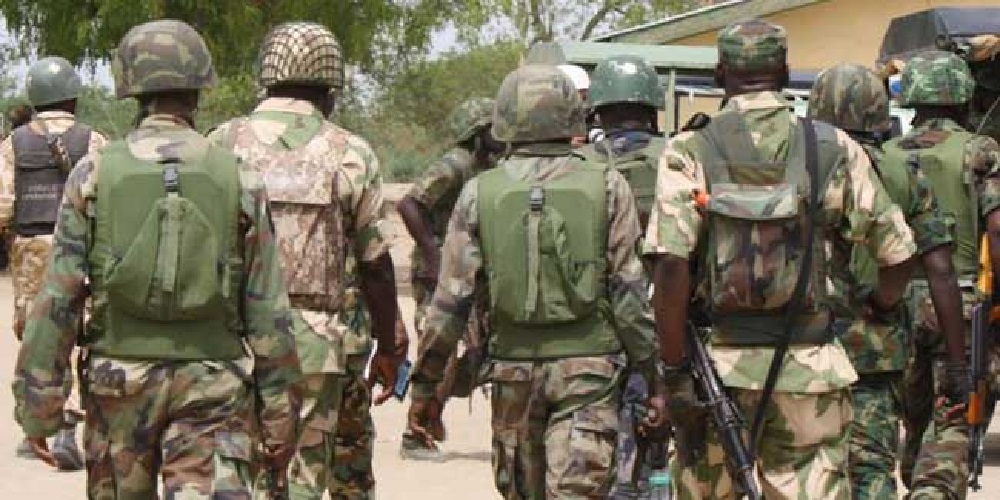
A Special Court-Martial of the Nigerian Army in Maiduguri, Borno State, has sentenced three soldiers to life imprisonment and a fourth to 15 years for illegally selling arms in collaboration with police officers and terrorist groups.
The trial was presided over by Brigadier General Ugochukwu Unachukwu, the Acting General Officer Commanding 7 Division and Commander of Sector 1, Operation Hadin Kai (OPHK). It was held at the Officers’ Mess of the Theatre Command Headquarters in Maiduguri.
Delivering the judgment, Brigadier General Mohammed Abdullahi, President of the Court-Martial, found Sergeant Raphael Ameh, Sergeant Ejiga Musa, and Lance Corporal Patrick Ocheje guilty and sentenced them to life imprisonment.

Corporal Omitoye Rufus, however, was sentenced to 15 years in prison.
The soldiers were convicted of multiple offences, including theft, unlawful dealing in ammunition, and aiding the enemy, all punishable under the Armed Forces Act.
Sergeant Raphael Ameh, who served as an armourer at the 7 Division Garrison, was found guilty of conspiring with a deceased colleague to steal ammunition from the division’s armoury.
He reportedly collaborated with police officers to conceal the weapons in bags of beans and smuggle them to Enugu and Ebonyi States, where they were supplied to criminals.
Brigadier General Abdullahi revealed that bank records linked Sergeant Ameh to over 100 suspicious transactions between July 2022 and June 2024.
Sergeant Musa, who served as the armourer of the 195 Battalion, was found to have conspired with Lance Corporal Ocheje and several police officers to sell an AK-47 rifle and large quantities of ammunition. Financial records indicated that Musa received over ₦500,000 from these transactions before he was arrested while attempting to sell additional rounds.
Corporal Rufus was convicted of selling 40 rounds of 7.62mm special ammunition to a police officer.
Meanwhile, Lance Corporal Ocheje, deployed at the forward operating base in Molai, was found guilty of diverting ammunition during communal clashes, acting on the instructions of a police officer. He also stole an AK-47 rifle belonging to a fellow soldier.
The court ruled that their actions posed a direct threat to military operations and national security, constituting a clear case of aiding the enemy.
In his condemnation of the convicts, Brigadier General Abdullahi described them as “bad eggs” who had betrayed the trust, discipline, and honour expected of soldiers engaged in the fight against insurgency. He reaffirmed the Nigerian Army’s zero-tolerance policy on the sale of arms and ammunition to adversaries, stating it would not be tolerated “in whatever form or guise.”
News
Kidnappers demand N200m to free abducted Kebbi High Court Judge
Kidnappers holding Kebbi State High Court Judge, Justice Faruku Hassan Bunza, have demanded a N200 million ransom from his family for his release, as security operatives intensify efforts to rescue him.
Kebbi State Commissioner of Police, Umar Muhammad Hadejia, disclosed the ransom demand while briefing journalists on Monday in Birnin Kebbi.
He said the police received intelligence on the demand after launching a swift response to the judge’s abduction, which occurred in the early hours of Sunday at his residence along Zogirma Road in Bunza.
According to Hadejia, the Command has deployed a combined team of police operatives to comb suspected escape routes used by the kidnappers in a bid to rescue the judge unharmed and apprehend those responsible.
He added that multiple checkpoints had been mounted along strategic routes believed to have been used by the abductors to prevent their escape.
The police commissioner expressed confidence that the ongoing operation would lead to the safe rescue of the judge and the arrest of the kidnappers.
Hadejia also confirmed the killing of a suspected kidnapper, Abdulaziz Dogo, and the arrest of another suspect, Ibrahim Abdulwahab, both residents of Ilesha in Kwara State, over the abduction of former Kebbi State Deputy Speaker, Muhammad Samaila Bagudo, on October 31, 2025.
He advised residents, particularly government officials, to avoid travelling late at night, warning that such journeys expose them to attacks by bandits and kidnappers.
The commissioner said the judge’s family informed the police that he frequently travelled at night despite repeated warnings.
He added that the family also reported that the kidnappers had contacted a registrar of the High Court in Abuja regarding negotiations over the N200 million ransom.
News
We Have the Right to Deal With Illegal Migration— South Africa Fires Back at Nigeria
Nigerian and South African diplomats held tense talks in Abuja on Monday to address a wave of xenophobic attacks against foreigners in South Africa, with both sides invoking “brotherhood” even as deep divisions emerged over responsibility and solutions.
The meeting at the Nigerian Ministry of Foreign Affairs came amid months of protests in South Africa — some violent — targeting African immigrants whom demonstrators blame for crime, unemployment and pressure on public services.
Opening the discussions, both delegations addressed each other as “brothers” and referenced Nigeria’s historic support for South Africa’s struggle against apartheid. But the pleasantries quickly gave way to sharp exchanges.
Nigeria’s Minister of State for Foreign Affairs, Ambassador Sola Enikanolaiye, accused Pretoria of complicity in the violence.
“We have records of Nigerians who have legitimate papers to remain in South Africa, yet they have been attacked,” Enikanolaiye said before the meeting went into a closed-door session.
“And we could see some mob actions in which we saw the police watching, as if they are helpless to address this situation.”
South African Minister of International Relations, Ronald Lamola, countered that the country was grappling with “criminality” linked to immigrants, including drug peddling and wire fraud.
“President Cyril Ramaphosa and the government he leads have been outspoken against any intolerance,” Lamola said.
He added that South Africa has the right to “deal decisively with irregular migration, undocumented immigrants — including acts of criminality.”
South African police say at least four foreign nationals have been killed in attacks linked to the anti-migrant protests, though some African governments repatriating citizens have reported a higher toll.
According to an AFP tally based on figures from governments evacuating their nationals, more than 160,000 people have fled South Africa, including about 1,500 Nigerians.
Nigeria and Ghana have been among the most vocal critics of Pretoria’s handling of the protests. Reports indicate that in some instances, anti-immigrant groups have stormed homes and dragged people into police vans.
Analysts say South Africa, one of the continent’s most industrialised economies, has long attracted both documented and undocumented immigrants. However, high unemployment, weak social services and rising crime have fueled resentment, with immigrants often scapegoated for broader government failures.
Vanguard report that the Abuja meeting ended without a public agreement on concrete steps to curb the violence, highlighting the challenge of balancing diplomatic ties with domestic pressure in both countries.
News
Buhari Media Office Denies PFIPC Link, Says Former President Created Only PEAC
The Buhari Media Office (BMO) has denied reports linking former President Muhammadu Buhari to the controversy surrounding the alleged Presidential Foreign Intervention Promotion Council (PFIPC), describing the claims as false and lacking any factual basis.
In a statement released on Sunday, the BMO clarified that Buhari never established any agency known as the PFIPC and did not approve a ₦1.3 billion allocation for such an organization in the 2026 Appropriation.
According to the office, the only body created during Buhari’s administration was the Presidential Economic Advisory Council (PEAC), which served as an ad hoc advisory committee focused on economic matters.
The BMO explained that the PEAC initially operated from offices assigned to the Chief Economic Adviser to the President at the Federal Secretariat. Throughout Buhari’s tenure, the council functioned without a dedicated budget line.
Instead, its activities were funded through presidential approvals issued to the Minister of Finance, while operational expenses were covered by the State House following presidential authorization.
The statement noted that the PEAC was a part-time advisory body comprising economists and financial experts who provided economic policy advice to the President. Members received no salaries, with only operational costs funded to support the council’s work.
The council was chaired by Professor Doyin Salami, CFR, before his later appointment as Chief Economic Adviser to the President. Other members included Professor Mahmuda Sagagi as Vice Chairman, Professor Ode Ojowu, Dr. Shehu Yahaya, Dr. Iyabo Masha, Professor Chukwuma Soludo, Mr. Bismarck Rewane, and Dr. Mohammed Adaya Salisu, who served as secretary.
The BMO further stated that when the current administration took office in 2023, it neither dissolved the Buhari-appointed PEAC nor renewed the appointments of its members, who considered their tenure to have ended with the expiration of the administration that constituted the council.
It also revealed that the office jointly designated for the Presidential Economic Advisory Council and the Office of the Chief Economic Adviser remained vacant after the transition of power and was only occupied years later.
Rejecting any attempt to associate Buhari with the ongoing PFIPC controversy, the media office insisted that claims suggesting the alleged agency originated under his administration are false, baseless, and unsupported by evidence.
The BMO urged Nigerians to disregard reports linking the former President to the alleged PFIPC, reiterating that the only advisory body established during Buhari’s administration was the Presidential Economic Advisory Council, which operated without a statutory budget line.
-
News12 hours agoFugitive drug kingpin, ex-int’l footballer bag 24 years jail term for cocaine importation(Photos)
-
News34 minutes agoUK Eases Student Visa Rules for Three African Nations
-
News16 hours agoWe don’t have current negotiations with US — Iran
-
News12 hours agoReps Order IGP to Produce Alleged Fake Presidential Council DG as Probe Uncovers Fresh Forgery Claims
-
News19 hours agoArmy Nabs Wanted Soldier Accused Of Supplying Uniforms To Terrorists While Escaping to Cameroon
-
News16 hours agoZamfara federal lawmaker urges constituents to withdraw money to buy weapons to defend themselves
-
News37 minutes agoNigeria, South Africa Set for Fresh Diplomatic Talks Amid Xenophobia Concerns
-
News14 hours agoNo Rest Until Key FCT Projects Are Delivered, Wike Declares(Photos)