
By Dr Chukwuma Ume


Context to the study
New research from South-East Nigeria tracks how women smallholders are quietly building a parallel, community-centred food system-and it works. The success of this parallel food system is attributed to the fact that Nigeria faces a deepening food and nutrition crisis, driven by rising prices, conflict disruptions, and climate stress. Women smallholders-responsible for most household food provisioning-remain excluded from many input-heavy agricultural programs. During COVID-19 restrictions, these barter networks kept food moving when cash markets stalled..
Summary of findings
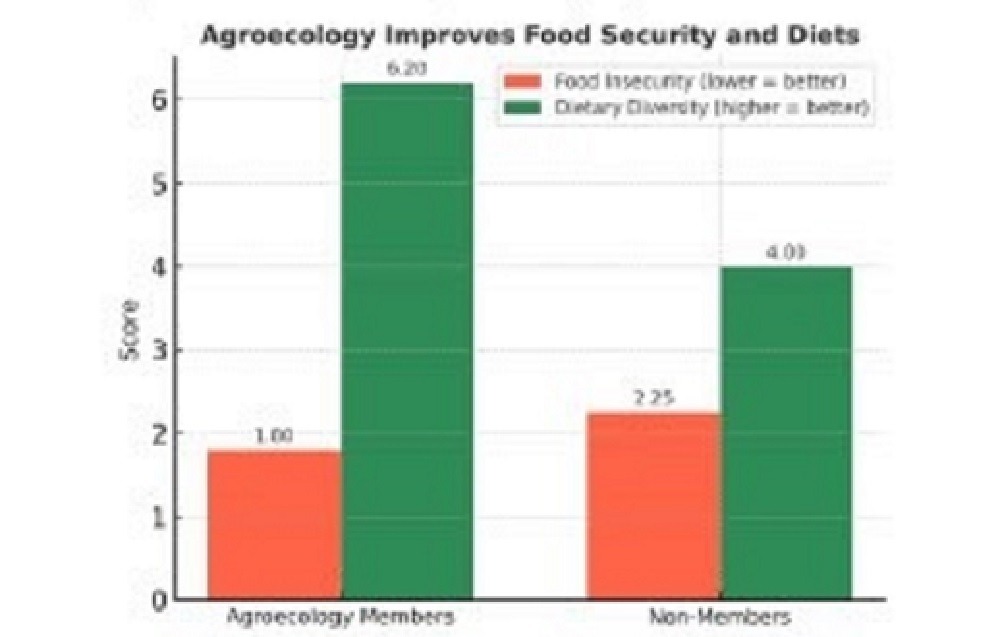
A comparative study of 334 farmers (111 agroecology members; 223 non-members) reveals that group members scored 0.45 points lower on food insecurity and 2.18 points higher on dietary diversity, even after controlling for differences. Gains were strongest among farmers excluded from formal extension. Qualitative insights show how women mobilize collective labour, use organic inputs, save seeds, run local barter markets, and share tools and savings schemes. These practices not only lower production costs but also shift decision-making power to women, who directly influence household diets. 
Introduction
Agroecology is increasingly recognised worldwide as an alternative pathway to food security and sovereignty. In Nigeria, women farmers are pioneering agroecological practices that rely on shared knowledge, organic inputs, and local markets. Unlike subsidy-driven models, these systems emphasise food diversity, resilience, and empowerment. Yet they remain under-supported in mainstream policy frameworks. This study highlights how women’s agroecology groups deliver measurable gains in nutritional benefits and empowerment.
Summary of Research
The research draws on two complementary approaches:
*Quantitative survey: cross sectional data from 2019 covering 334 households, assessed using food insecurity scores and dietary diversity indices [1].
*Qualitative Inquiry: Interviews, focus groups, and field observation capturing practices such as seed saving, tool sharing, zero tillage, and women-led markets [2].
Together, these provide a robust picture of how agroecology strengthens local food systems
Research Findings
*Food insecurity is significantly lower among agroecology group members (average score 1.8) than non-members (2.25).
*Dietary diversity is higher among members (6.2 food groups) compared to non-members (4.0).
*Nutrition gains are most pronounced for the poorest and most food-insecure households
*Women dominate group membership (over 80%), gaining more voice in household decisions.
*Agroecology groups build resilience: during COVID-19 restrictions, barter networks kept food flowing even when cash markets stalled.
*Collective savings and labour-sharing reduce cash dependence and improve equity.
Ume, C., Wahlen, S., Nuppenau, E. A., & Domptail, S. (2025). Women smallholders build an agroecology food system: the construction of empowerment and food sovereignty. The Journal of Peasant Studies, 1-21. https://doi.org/10.1080/03066150.2025.2462760
Ume, C., Nuppenau, E., & Domptail, S. E. (2023). Who profits from agroecology to secure food and nutrition? On access of women to markets and assets. Frontiers in Sustainable Food Systems, 7, 1082944. https://doi.org/10.3389/fsufs 2023,1082944
Nigeria can spend smarter, not just more. If we want fast, measurable progress on hunger and malnutrition in 2025-2026, government should fund and formalise the women-led systems that are already delivering.
Nigeria’s mainstream approach still channels scarce public funds into subsidised inputs, mechanisation and single commodity drives that many women cannot access or control.
This model misses the reproduction economy-the daily work of feeding families-where women’s agency is decisive for nutrition outcomes.
Women-led agroecology groups are closing that gap at low cost. What we need to do now is ring-fence at least 10% of input-subsidy budgets for proven low-cash, time-saving practices such as zero tillage, green manures, botanical pest control, push-pull and equip wards with shared tool banks rather than individual input coupons.