News
Senate condemns killing of 56 in Niger
- Share
- Tweet /home/naijuinz/public_html/wp-content/plugins/mvp-social-buttons/mvp-social-buttons.php on line 72
https://naijablitznews.com/wp-content/uploads/2024/11/Senate.jpg&description=Senate condemns killing of 56 in Niger', 'pinterestShare', 'width=750,height=350'); return false;" title="Pin This Post">
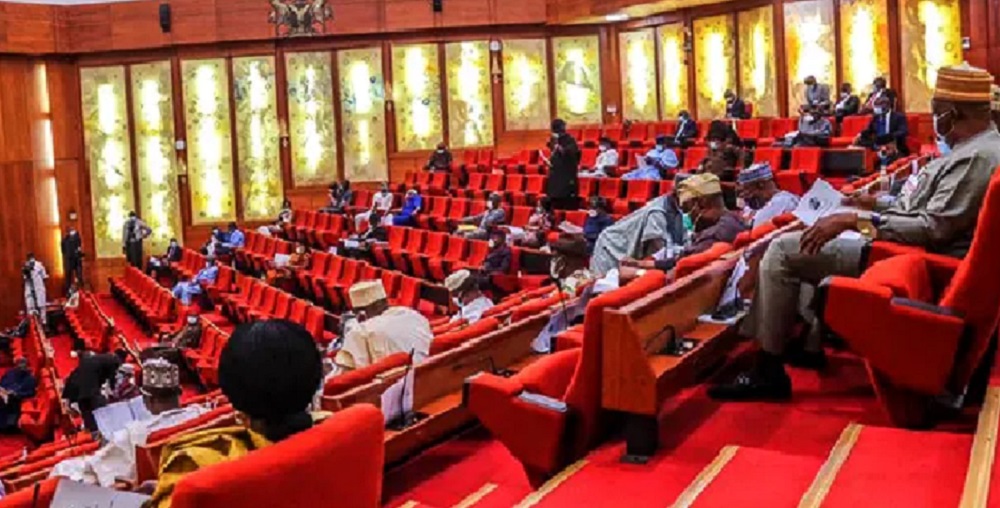
The Senate on Tuesday condemned in strong terms the killing of at least 56 persons and the abduction of women and children in Konkoso Village, Niger State, describing the attack as brutal and unacceptable.

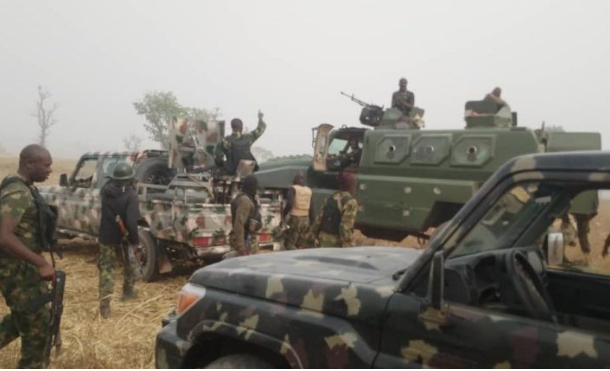
The attack occurred on February 14 when terrorists invaded communities in Borgu Local Government Area, killing residents, abducting several others, and razing houses, including a police station.
The upper chamber called for the immediate deployment of additional security personnel to the affected local government areas to strengthen rapid response and forestall further attacks.

It also mandated its Committees on Defence, Army, Air Force, Police Affairs, and National Security to conduct a joint assessment of the security situation and report back within four weeks.
The Senate observed a minute of silence in honour of the victims and extended condolences to the bereaved families, as well as the government and people of Niger State.
The resolutions followed a motion of urgent national importance moved by Senator Mohammed Sani Musa (Niger East).
Moving the motion, Musa informed the Senate that more than 56 citizens were killed in Konkoso and nearby Pissa villages, while several women and children were abducted.
He said the affected communities share boundaries with strategic forests linking neighbouring states, which have become corridors exploited by terrorists for cross-border movements and coordinated criminal operations.
“The North Central region has witnessed rising attacks on rural communities and farmlands, threatening food security, local economies, and broader national stability,” he said.
Musa commended President Bola Tinubu and security agencies for sustained counter-terrorism efforts and the sacrifices of troops confronting violent extremism.
However, he expressed concern that repeated assaults on remote communities expose gaps in intelligence gathering, coordination, rapid response, and sustained territorial security presence.
“The abduction of women and children has deepened the humanitarian crisis, inflicting lasting psychological trauma on families and destabilising affected communities,” he added.
Musa warned that without structural reforms and modernisation of Nigeria’s security framework, similar tragedies could persist despite ongoing military and intelligence operations.
Seconding the motion, Chief Whip of the Senate, Senator Mohammed Monguno (Borno North), called for increased budgetary allocation to security agencies to address the security challenge.
“In the course of the ongoing budget defence, we discovered that there were zero capital budget releases to security agencies,” he said.
“So, in line with the President’s declaration of a state of emergency on security, prominence should be given to security agencies,” Monguno added.
News
Osun to distribute nearly 2.9m mosquito nets to tackle malaria
A total of 2,897,443 insecticide-treated mosquito nets will be distributed to households across Osun State as part of the efforts to tackle malaria.
The mass campaign led by the Osun State Government is being executed in collaboration with the National Malaria Elimination Programme, Catholic Relief Services, Society for Family Health, and other malaria partners, with funding support from the Global Fund Malaria.
Speaking with journalists in Osogbo, the Logistics Advisor for the campaign, Simeon Ibvori, said the new nets would be given out to replace the ones distributed in 2023.
Ibvori, who spoke with journalists on Tuesday, said the insecticide-treated nets were being transported to the distribution hubs after they were moved from the state warehouse to the local government distribution stores across the state.
He added that the distribution will target rural wards where the risk of malaria remains very high.
“A total of 2,897,443 ITNs will be distributed to the people of Osun State. The objective of the ITN mass campaign is to ensure that for every two persons, there is one bed net to sleep inside.
“We do this every three years, and this campaign is to replace the nets we gave out in 2023.
“After collecting the nets, residents must air them under a shade for 24 hours before hanging and sleeping inside,” Ibvori noted.
He urged the residents to collect the nets once the distribution started, adding that the nets are to prevent them from contracting malaria.
“I want to appeal to the good people of Osun State to go out once the distribution starts to collect the nets.
“The idea is to replace the new nets with the old ones. The nets are meant to be used and not for sale. It is free of charge.
“Residents should also respect the health workers during the distribution and allow them to do their job. They have been trained and are fully equipped with the right information,” Ibvori added.
In 2023, about 3.68 million mosquito nets were distributed to households across the state.
Osun State Manager, Malaria Elimination Programme, Dr Olufemi Oroge, made the disclosure during a one-day campaign orientation meeting with selected media practitioners organised by SFHm in conjunction with the state Ministry of Health.
Dr Oroge further disclosed that since the commencement of the malaria elimination programme, over 200 million nets have been distributed, adding that the lifespan of the insecticide-treated nets is between one and four years.
News
Atiku queries INEC over leaked data, demands full disclosure of probe report
Former Vice President Atiku Abubakar has said that the latest statement by the Independent National Electoral Commission (INEC) concerning the unauthorised disclosure of information from its Continuous Voter Registration (CVR) database has only reinforced the urgent need for a full, transparent and independent investigation into the matter.
In a statement issued by his Senior Special Assistant on Public Communication, Phrank Shaibu, the presidential candidate of the African Democratic Congress (ADC) asked the commission to provide information about the individuals who leaked the data if there was no hacking.
The former Vice President noted that INEC’s own statement reveals that it has identified the specific user account through which the information was accessed and that relevant personnel have already been questioned.
“That is welcome. But identifying a user account is only the beginning. Nigerians deserve to know the full chain of custody of this information: who accessed it, who authorized its release, how it reached political actors, and whether anyone outside the Commission benefited from or encouraged the unauthorized disclosure.”
The Waziri Adamawa noted that while INEC has attempted to reassure Nigerians that there was no external hacking incident or breach of its ICT infrastructure, the commission has nevertheless admitted that sensitive voter information was accessed through valid official credentials and subsequently released without authorisation.
“INEC’s statement has moved this issue beyond conjecture. The Commission has now confirmed that voter information was accessed through credentials assigned to personnel participating in the ongoing CVR exercise and that such information was released without authority. That admission alone should concern every Nigerian.
“What Nigerians want to know is simple: how did information that resides within a restricted electoral database find its way into the hands of political actors and their associates? The fact that there was no external hack does not diminish the gravity of the incident. If anything, it raises even more troubling questions about internal controls, institutional safeguards, and the possibility of political interference.”
Atiku therefore called on INEC to go beyond assurances and provide Nigerians with full transparency.
“INEC must publish the complete findings of its investigation. Nigerians deserve to know precisely what happened, who was responsible, what disciplinary measures will follow, and what reforms are being implemented to prevent a recurrence.
“The credibility of the 2027 election will not be determined solely on election day. It is being shaped right now by the willingness of institutions to demonstrate transparency, accountability, and independence.
“Nigeria cannot afford a situation where confidence in electoral institutions is weakened before campaigns have even properly commenced. The Nigerian people deserve to know that their data is protected, that electoral systems remain secure, and that no politician—regardless of influence or position—enjoys privileged access to the machinery of democracy.
“If there has been no compromise, let the facts be made public. If electoral institutions are truly independent, let them demonstrate that independence. Democracy flourishes in transparency, accountability, and public trust—not in secrecy and unanswered questions.”
The former Vice President said the controversy remains particularly disturbing because the material in question was not exposed by whistleblowers, investigative journalists, or anonymous sources but was voluntarily published by Mr Lere Olayinka, spokesman to the Minister of the Federal Capital Territory, Nyesom Wike.
“INEC has confirmed that this information was retrieved using authorized credentials. Nigerians deserve to know how material obtained from a restricted electoral platform found its way into the public domain through individuals closely associated with a serving minister. That question remains unanswered.
“What makes this entire episode impossible to ignore is that the information in question did not emerge from a whistleblower, an investigative journalist, or an anti-corruption agency. It was publicly released by Mr. Lere Olayinka, spokesman to the Minister of the Federal Capital Territory, Nyesom Wike.
“INEC has now admitted that the information originated from its restricted voter registration database and was accessed using valid official credentials. Nigerians are therefore entitled to ask a simple question: how did information stored within a supposedly secure electoral database travel from INEC’s internal system into the possession of the spokesman of a serving minister?
“That question becomes even more compelling when viewed against the backdrop of recent political events.
“Only days before this controversy erupted, Minister Wike publicly declared with remarkable certainty that Atiku Abubakar would not secure up to ten percent of the votes in Rivers State in the 2027 presidential election. It was an astonishing claim. Not because politicians are forbidden from making predictions, but because of the confidence, precision, and finality with which it was delivered.
“Ordinarily, such comments could be dismissed as political bravado. However, Nigerians are now confronted with a disturbing reality: individuals operating within the Minister’s political circle have been found in possession of information sourced from INEC’s restricted database.
“The question therefore arises: what was the basis of such extraordinary confidence? Was it merely political chest-thumping, or does it reveal a mindset that believes certain political actors possess privileged access to institutions that are constitutionally required to remain neutral?
“Democracy cannot survive on assurances alone. Electoral integrity depends not only on the actual independence of institutions but also on the public perception of that independence. Once political actors begin to appear unusually familiar with information that should be inaccessible to them, public trust inevitably suffers.
“Minister Wike is not just another politician. He is a powerful member of the ruling establishment and one of the most vocal political actors in the country. Consequently, when sensitive electoral information surfaces through individuals directly associated with him, Nigerians have every right to demand answers.
“This is why the issue can no longer be reduced to the unauthorized disclosure of a single voter record. It has become a test of whether Nigeria’s electoral institutions are truly insulated from political influence or whether politically connected individuals enjoy access and advantages unavailable to ordinary citizens.
“The Nigerian people deserve to know the complete chain of custody. Who accessed the information? Who requested it? Who received it? How did it leave INEC’s custody? And why did the trail lead directly to political actors associated with a serving minister who has repeatedly made unusually confident pronouncements about the outcome of a future election?
“These are not partisan questions. They are questions about the integrity of the democratic process itself. Until they are fully answered, concerns about political interference, privileged access, and the neutrality of key institutions will continue to grow.”
Atiku emphasised that the issue extends far beyond the personalities involved.
“This is not about Mr. Olayinka. It is not even about Mr. Wike. It is about the credibility of Nigeria’s democratic institutions and the confidence citizens can place in them.
“Democracy depends on trust. Once citizens begin to suspect that political actors have access to the referee’s notebook, confidence in the entire process begins to erode. Electoral commissions are supposed to inspire confidence, not provoke anxiety.”
He further welcomed the involvement of the Department of State Services (DSS), which INEC says has commenced an independent investigation.
“The Nigerian people will expect that investigation to be thorough, impartial, and fearless. No individual, regardless of political influence or proximity to power, should be beyond scrutiny.”
Atiku warned that public confidence in democratic institutions is already under severe strain and that incidents of this nature only deepen existing concerns.
“For years, Nigerians have watched institutions that ought to stand above politics become increasingly entangled in partisan controversies. This incident reinforces the growing fear that some public institutions are being viewed not as national assets but as instruments to be manipulated for political advantage.
“The danger lies not only in actual misconduct but also in public perception. Elections are undermined not merely by manipulation but by the belief that manipulation is possible. Once citizens begin to suspect that electoral systems are vulnerable to partisan influence, the credibility of future elections is placed at risk.”
News
Tinubu’s re-election my priority project, Oborevwori declares
Delta State Governor, Sheriff Oborevwori, has declared that President Bola Tinubu’s re-election in 2027 remains his “number one political project,” insisting that the President’s economic reforms are yielding tangible benefits for Delta State and other subnational governments.
Oborevwori, who spoke in an interview on ARISE News monitored on Tuesday, said the improved revenue allocation under the Tinubu administration had enabled Delta to execute projects without financial strain, adding that contractors are now being paid promptly as a result of increased federal inflows.
“I’m begging people to vote for President Bola Tinubu. It’s my number one project.
That project is bigger than any other project because it will help us achieve more for our people,” the governor said.
According to him, for the first time in the state’s history, Delta is not indebted to contractors, stressing that project financing is now done seamlessly without waiting for monthly federal allocations.
Oborevwori attributed the development to the Federal Government’s ongoing economic reforms, arguing that increased revenues accruing to states are evidence that the policies are working.
“If the reforms are not working, will we get this money? More money is coming to the states. The reforms are working very well in Delta State, and that is why we are able to execute projects and meet our obligations,” he said.
The governor also expressed confidence that the All Progressives Congress would record strong support in Delta State in 2027, following what he described as broad consultations that led to the mass defection of political stakeholders from the Peoples Democratic Party to the ruling party.
He described the movement as a “political tsunami,” saying it involved party leaders, elected officials, stakeholders, religious leaders and other groups across the state.
“We all agreed that we should move. That was why the movement was a tsunami. We moved en masse into the APC, and nobody was left behind,” he said.
Oborevwori further said opposition parties had little chance of making electoral gains in Delta, insisting that ongoing projects across the state would secure voter confidence for the APC.
“There are too many projects that we have done, and we are still doing. If I start commissioning projects every week, I may not finish before the election. The people can see what we are doing, and they know the difference,” he said.
On the political landscape ahead of 2027, the governor dismissed concerns over the resignation of former Deputy Senate President, Ovie Omo-Agege, from the APC, saying the development did not pose any threat to the party in Delta State.
He said indications of Omo-Agege’s exit had been evident for months, noting that many of his political associates had already left the party long before his resignation.
“We saw it coming. Before he left, most of his people had already left over three months ago, so we were all aware,” Oborevwori said.
The governor also dismissed suggestions that Omo-Agege’s departure would weaken the APC in Delta Central Senatorial District, insisting that the party remained strong and united behind Senator Ede Dafinone.
“He is not a threat because I have won it before,” he said, adding that Dafinone remains a respected figure with deep roots in Urhoboland.
Oborevwori maintained that the APC primary election that produced Dafinone was transparent and fair, urging aggrieved aspirants to accept the outcome.
“Somebody was given the opportunity, we conducted a free and fair primary, and he lost. It is for him to embrace the outcome because the process was transparent,” he said.
The governor expressed optimism that President Tinubu enjoys strong support in Delta State, citing political alignment, development projects and personal ties as factors that would favour the President’s re-election bid.
He added that consultations across the state showed broad acceptance of the APC and confidence in the administration’s economic direction.
Oborevwori also claimed that Tinubu shares strong familial and political ties with different ethnic groups in Delta State, which he said would further boost his chances in 2027.
“The people of Delta State believe in President Bola Tinubu. They believe in him because, among all the candidates that may emerge, he is the only one with a strong affiliation to Delta State,” he said.
-
News14 hours agoWike Assures Protesting Teachers of Rescue Efforts, Warns Against Politicising Insecurity
-
News24 hours ago2022 train attack: FG re-arraigns Tukur Mamu on amended terrorism charge
-
News24 hours agoKano lawmaker rejoins APC after losing return ticket in NDC
-
News13 hours agoBETNLAFF New Betting Platform Set To Hit Nigerian Markets
-
News20 hours agoSix members of same family shot dead during domestic dispute in US
-
Economy24 hours agoMiddle East Tensions: Oil Prices Jump as Iran Suspends Peace Talks with US
-
News14 hours agoDefection Storm Rocks Reps as 13 Lawmakers Switch Parties, Chinda Quits Minority Leader Role
-
Economy24 hours agoCBN targets 95% financial inclusion in new payment system goal