
Opinion
Will Satellite boost internet connectivity?




By Sonny Aragba-Akpore
The Nigerian Communications Commission (NCC), the telecommunications industry regulator, believes licensing more Internet Service Providers (ISPs) will boost internet access in the country.
Not just any run-of-the-mill company, but globally acclaimed ones that will bring meaningful investments and accelerate connectivity.
Although the NCC is silent on the cost of services to end users, the regulator believes that good services will attract good prices, especially for sign-on fees and device acquisition costs. But it is not clear whether connectivity will boost affordability, since the investors are not in the business of charity.
Like the devices, data is not cheap, but if the NCC provides assurances that the cost of acquisition will drop significantly, making services not only available but also affordable, then these satellite communications licenses will be seen as good news by potential subscribers.
On the other hand, there are no guarantees that existing subscribers who are already connected to other mobile services will suddenly switch networks.
Unless there are incentives to attract such transitions.
When it announced licenses for two multinational companies early in 2026, the NCC said it was to boost competition in connectivity and take services to underserved and unserved areas of the country via satellite.
The licenses grant Amazon LEO to operate its space segment in Nigeria as part of a global constellation of up to 3,236 satellites, and NCC says the approval aligns with global best practices and reflects Nigeria’s willingness to open its satellite communications market to next-generation broadband providers.
The permit positions Amazon LEO “to provide satellite internet services over Nigerian territory and sets the stage for intensified competition with Starlink, currently the most visible satellite internet provider in the country,” according to agency reports.
The second is Beetle Sat-1.
Both Amazon LEO and BeetleSat-1 also get the legal comfort to invest in ground infrastructure, local partnerships, and enterprise contracts, while giving Nigeria a wider market opportunity to play in space internet service delivery, where Starlink currently operates as a dominant player.
The two new licences have the potential to extend their footprints to underserved and unserved communities across the country. The licensing was done in line with NCC’s powers under Sections 2 and 70(2) of the Nigerian Communications Act 2003 and the Commercial Satellite Communications Guidelines for the telecommunications sector in Nigeria. The Guidelines, which came into effect in November 2018, regulate all Satellite Communications Services in all Orbits in Nigeria.
NCC claims it has put in place deliberate policies to facilitate the provisioning of Space-based communications services and has developed a licensing framework to facilitate investment and entry into the Nigerian market for the provision of communications services.
The Commercial Satellite Communications Guidelines of 2018 provide a regulatory framework for satellite communications services and networks within Nigeria or on Nigerian-registered vessels.
The Objectives and Scope of the guidelines aim to organise the Nigerian satellite market in line with international best practices, encourage innovation, and ensure public safety.
The guidelines, among others, apply to: Commercial satellite services, space segment and earth station operators, gateway providers, and vendors of terminal equipment. The guidelines, however, do not cover Military, non-commercial government, radio navigation, amateur, and earth observation satellites, as well as receive-only earth stations.
The guidelines cover the licensing and authorisation of the Establishment of an earth station, which requires being a corporate body registered in Nigeria and obtaining a license before providing service listed as Very Small Aperture Terminal (VSAT) Earth Station Network Frequency Licence, Earth Station-in-motion (ESIM) Network Frequency Licence (Aero, Land and Maritime).
The guidelines also cover UAV/Drone Network Frequency Licence, Mobile Satellite Service (MSS), Network Frequency Licence, Gateway Earth Station (GES) Frequency Licence, High Altitude Platform Station (HAPS), and others.
Under Space Segments, Operators authorised by foreign administrations may request NCC authorisation to provide services in Nigeria, and Authorized satellites are included in a list maintained by the Commission.
Space segment operators must apply for landing rights; although landing rights do not incur a fee, authorisation is granted for the lifespan of the satellite.
Both individual and frequency licenses for earth stations are valid for 10 years.
Earth Stations in Motion (ESIM) on aircraft, ships, or vehicles must comply with specific registration and technical conditions.
Visiting ESIMs staying longer than six weeks must notify the NCC and obtain a permit. The guidelines state that no operating license is required for portable terminal equipment used by end-users. But all satellite ground equipment and portable terminals must be type-approved by the NCC before being sold or used in Nigeria.
The guidelines specify Technical and Financial Obligations, including yearly spectrum usage fees for Earth stations on L, C, Ku, Ka bands, and ESIM/VSAT terminals whose fees are pegged at $2,000 USD (or the Naira equivalent).
The NCC mandates technical measures such as power-flux-density limits and minimum separation distances to prevent interference between satellite and terrestrial systems. Licensees must maintain customer databases and ensure the security of subscriber information, granting third-party access only when legally required.
Apart from the state-owned communications satellite company, Nigerian Communications Satellite Limited (NIGCOMSAT), there are four commercial communications satellite companies operating in the country.
These include Starlink Internet Services Nigeria Ltd – a satellite broadband service provider owned by SpaceX (Elon Musk’s company).
Starlink was granted regulatory approval to operate in Nigeria with an International Gateway license and an Internet Service Provider (ISP) license, enabling satellite internet access across the country.
Kuiper Systems LLC (Amazon’s Project Kuiper) received a seven-year landing permit and satellite operating license from the NCC recently to provide non-geostationary broadband services (Ka-band) over Nigeria via its planned constellation of up to 3,236 satellites (valid from February 28, 2026 to February 28, 2033).
There are also NSLComm BeetleSat Licensed by the NCC to operate its BeetleSat-1 non-geostationary satellite network (about 264 satellites) over Nigerian territory with a seven-year permit, providing broadband and mobile connectivity services and Satelio IoT Services – Germany-based operator approved to operate its planned constellation focused on Internet of Things (IoT) connectivity (about 491 satellites planned) under a seven-year license covering S-band operations.
The NCC also maintains landing permits and spectrum licences for many global satellite operators that can deliver space segment capacity (Fixed Satellite Service – FSS, Mobile Satellite Service – MSS) over Nigerian territory.
These include long-established space segment operators with landing permits (historically), such as:
Intelsat LLC – FSS satellite network operator with permits to serve Nigeria through its multiple satellites.
There’s also Eutelsat S.A. / OneWeb – providing satellite fleet services over Nigeria. Iridium Communications – MSS operator has landing permit rights. There is also Avanti Communications, a satellite broadband operator with Nigerian authorisations. Inmarsat / Viasat – Satellite communications providers with historic Earth station and MSS licences, and SES (NSS Licensee B.V.) – Satellite operator holding multiple permits for O3B and other networks.
These operators primarily hold landing permits authorising them to beam services over Nigeria rather than directly licensed end-user service operations.
Active Internet Subscribers in Nigeria as of October 2025 stood at 142,631,825, and by December 2025, the figure rose to 148,166,926. Broadband penetration, as of December 2025, was 112,665,176, representing 51.97%.
In terms of connectivity speeds, the Sub-Saharan Africa regional average is 15 Mbps, well below the speeds in many developed countries, where averages often exceed 100 Mbps.
Urban centres like Lagos, Abuja, however, tend to have higher speeds (often 30–40 Mbps or more), while rural areas lag behind, sometimes around 10–15 Mbps in average urban/rural reports.
Nigeria’s average overall nationwide internet speed hovers between ~27–28 Mbps for downloads, based on global broadband testing across the country.
Mobile Internet Speeds: median mobile download speeds vary by measurement source and period, but are typically around 22–33 Mbps for 4G/combined mobile services. Some operator-specific median figures (like MTN 5G) can be much higher Mbps, but this reflects 5G experienced speeds in limited areas, not the national average. Fixed Broadband for home Internet shows that Median fixed broadband speeds are typically in the 20–38 Mbps download range, depending on provider and location.

By Ken Harries Esq
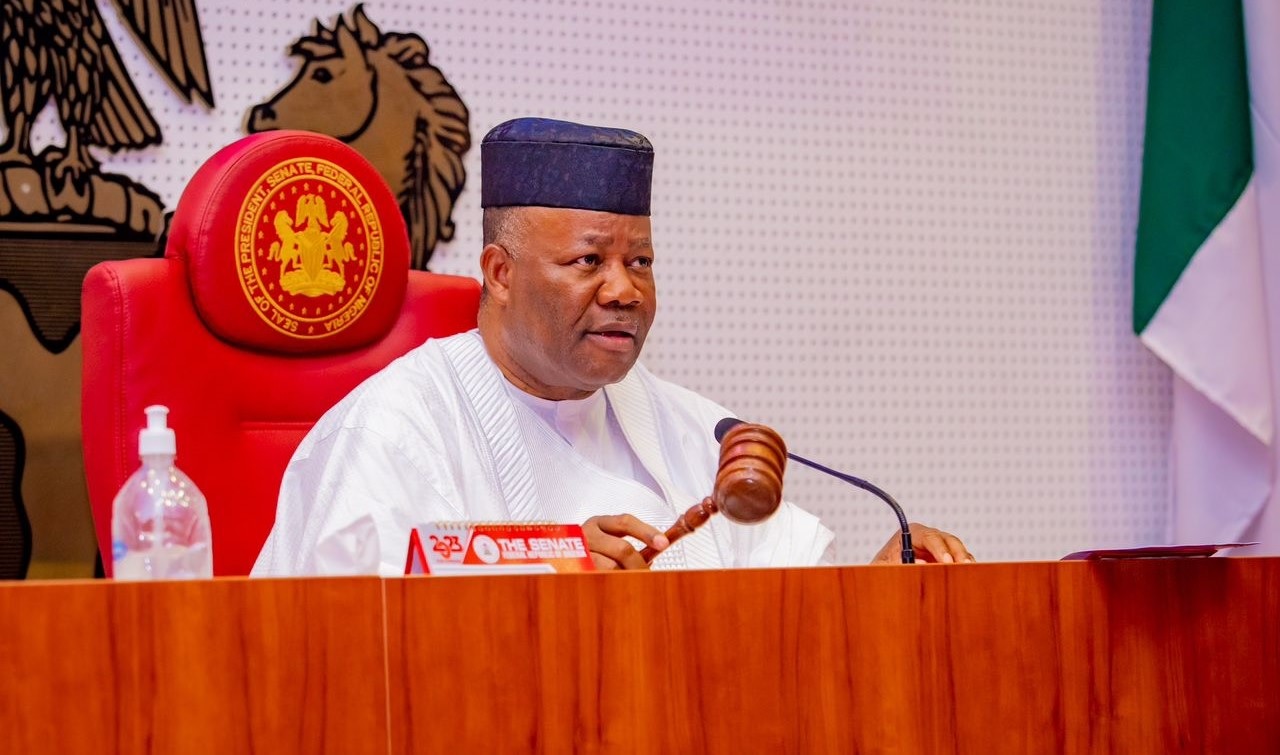
There’s a trend in Nigeria where accusations are louder than the coin box, and everyone scrambles to the high ground of moral outrage. Yet, here comes Senator Godswill Akpabio, the President of the 10th Senate, going against the trend like a devoted monk who has decided that the usual script of lawsuits, vendettas, and endless bitterness won’t augur well.
In our clime, these spectacles are enough to fill a library. This stands out like the script for one of the best sellers.
A wild and unsubstantiated allegation of murder and organ harvesting levied on Akpabio, which occasioned investigations, courtrooms, and quite unexpectedly, forgiveness.
In a land where politicians hold on to grudges tighter than their lust for power, Akpabio chose grace. Amazing! Could this be a sign that even in our polarised landscape, truth and reconciliation might yet have a fighting chance?
● *The weird allegation*
Scandal usually starts small and balloons into monstrous dimensions that devour reputations and leave a foul stench on the victim.
In this case, it was the telephone conversation between Senator Natasha Akpoti-Uduaghan and a US-based activist – Sandra Duru that leaked – naturally, because what good is a juicy gist if it stays private?
The claims were as shocking as they were grave: that Akpabio and his wife had a hand in the 2021 murder of Iniobong Umoren, a young job-seeker from Akwa Ibom State. Not just murder, but with the twisted tale that Umoren’s organs were harvested to treat the wife’s illness.
One marvels at how such tales gain legs in Nigerian politics. It is as if we have all signed up for a perpetual drama series, complete with villains, victims, and plot twists. These were accusations that could ruin lives, hurled into the public space without a shred of evidence.
In a country where political rivals sharpen knives at every turn, this one went deep, painting Senator Akpabio as some sort of macabre mastermind.
● *The Facts of the matter*
On April 2, 2025, Sandra Duru wrote a formal petition to the Inspector General of Police, demanding investigation into the leaked conversation between her and Senator Natasha Akpoti-Uduaghan. The petition was assigned to the Police Monitoring Unit. The investigation took the police team to Akwa Ibom State for a thorough assignment. They pored over certified court records, the post-mortem report, and also interviewed the family members of the late Iniobong Umoren who had witnessed the autopsy. What emerged was a picture as clear as day, though not what the accusers were expecting.
Back in April 2021, the youthful Iniobong Umoren met a tragic end at the hands of Uduak Frank Akpan, who lured her with a fake job offer, sexually assaulted, and murdered her. Akpan was tried in the Akwa Ibom State High Court, convicted, and sentenced to death.
• *Any post-mortem?*
It was confirmed no organs were missing; everything was intact, as attested to by Umoren’s sister – Ifiok Umoren, who stood there during medical procedure. “No organs were removed,” Ifiok Umoren said plainly, putting paid to the offensive rumour.
• *Any link to Akpabio?* None whatsoever. Something must have plucked from the imagination of the purveyor of this indiscretion – who is a known content creator and also given to mischief and lawlessness. The Akwa Ibom State Director of Public Prosecution – Mr Friday Johnson Itim, laid it out: the crime was a lone wolf act, no connections to high places. The allegation was “false and without any iota of truth,” as the police report declared.
• *Any deepfakes?*
The forensic audio analysis contrary to Senator Natasha’s denial, confirmed the recording was the real voice communication between Senator Natasha Akpoti-Uduaghan and Sandra Duru who were both brought together by one Ina Okopi Agu, not AI generated or deepfake. So, there you have it: a baseless storm in a teacup, debunked by cold and hard facts. One cannot help but wonder why such fictions take root so easily in our soil. Is it the thrill of taking down a highly-placed individual? Or is it a national pastime to murmur and spread rumours without demanding evidence?
● *The legal aftermath*
With the truth laid bare, the legal wheels began to turn in earnest. On March 29, 2025, the Office of the Attorney-General of the Federation slammed charges of criminal defamation on Senator Natasha Akpoti-Uduaghan, zeroing in on that organ-harvesting imputation. Akpabio, no stranger to the rough and tumble of politics, initially went on the offensive, filing many defamation suits against various individuals, including the aforementioned Senator. One could hardly blame him; in the arena of high stakes politics, you fight fire with fire or risk getting scorched.
Regardless, the tale twists away from the predictable. Instead of dragging this out into an endless courtroom saga, Akpabio paused. As discerning readers know, many of these courtroom battles often end in mutual exhaustion, with no winners save the lawyers. Yet Akpabio’s move hinted at something deeper, a willingness to step back from the brink.
● *A gesture of Forgiveness or Foolishness?*
And then came the pivotal moment, as if scripted by a higher power of providence. It was during the New Year Mass at Sacred Heart Parish in Uyo, Akwa Ibom State, early in January 2026. The priest preached on forgiveness, that age-old virtue we all nod at but seldom practice.
The Senate President later reflected that the sermon felt aimed straight at him, a divine nudge in the ribs. “It was as if the priest was speaking directly to me,” he said, realising the weight of carrying grudges into a new year.
Inspired by faith, Senator Godswill Akpabio directed his legal team to withdraw all pending lawsuits in every court. No fanfare, no conditions; just a clean slate. The notice of discontinuance was filed, and on January 15, 2026, the Federal Capital Territory High Court struck out the charges against Senator Natasha Akpoti-Uduaghan.
In Nigerian politics, where forgiveness is as common as snow in the Sahara, this was nothing short of extraordinary. One must show respect to whom it is due. It is so easy to talk about grace, but to actually demonstrate it? That is the trademark of legends.
*A Word to Senator Natasha Akpoti-Uduaghan*
As we celebrate this uncommon act of grace, a word of caution becomes necessary for the beneficiary thereof. Senator Natasha Akpoti-Uduaghan would do well to recognise that she has been shown a level of magnanimity rarely seen in our clime. She now stands at a crossroad where the path she chooses will define not just her immediate political future but her legacy. To continue to travel on this ignominious path with tar brush and theatrical indignation, having been handed an exit from a well-deserved legal ordeal, would be the height of political folly. The public is watching; history is recording. The wise course now is to accept the olive branch, reflect deeply on the gravity of her invidious umbrage and conduct herself with the maturity that her office demands. Grace, after all, is not a licence to repeat old mistakes but an invitation to embrace a new, better and purposeful path.
● *Public reaction*
The public, like a jubilation in a rapture, responded with a wave of overwhelming support for Senator Akpabio. A coalition of civil society groups under the aegis of Human Rights Africa led the applause, hailing and praising Akpabio’s act as an “exemplary display of maturity, tolerance and magnanimity.” They were never wrong; in a time of division, this gesture spoke volumes about the Senate President’s demonstrated commitment to the ideals of our social democracy, the rule of law, peaceful co-existent, national cohesion and institutional integrity.
● *The enduring lessons*
How did such a baseless allegation gain such massive traction? Sandra Duru still calls for accountability, insisting the matter is not buried. Fair play to her; voices like that keep the powerful on their toes. But for Akpabio, the chapter is closed, with a focus on forgiveness over vengeance.
• *The wider implications*
In an age of instant judgements and viral claims, Akpabio’s actions demonstrate leadership that rises above the fray. It is a lesson in how truth prevails, grace bridges divides, and reconciliation can heal what division tears apart.
Those who have studied the growth of other nations understand that to get things done in this country, a touch of radical idealism is needed.
• *Akpabio’s path of grace?*
That is idealism in action, pursued not with ruthlessness but with the softened heart of a grace carrier and a man who knows his priest is a human vessel bearing a divine message.
As we murmur and grumble our way forward, we should all pause and reflect. In Nigeria, where nice guys often finish last, Senate President Godswill Akpabio shows that grace doesn’t mean weakness. Forgiveness doesn’t mean foolishness. It means strength. And in our polarised landscape, that is an honourable path, a path worth following. To forgive is never foolishness but it is divine.
Ken Harries Esq is an Abuja based development communication specialist

The Bench cannot sit in judgement of the law while standing outside it.
In a nation where the rule of law is ostensibly the bedrock of democracy, the allegations that the Chief Judge of the Federal High Court, John Terhemba Tsoho, has operated undeclared bank accounts in blatant violation of the Code of Conduct for Judicial Officers is nothing short of a seismic betrayal.
This is not mere administrative oversight. It is not a filing error. It is a calculated affront to the principles of transparency and accountability that Nigerians demand from their custodians of justice.
The findings, unearthed by a meticulous investigation by Premium Times, paint a picture of judicial hubris that must not be tolerated. Justice Tsoho must resign immediately, and the statutory bodies entrusted with upholding the law, namely the Code of Conduct Bureau (CCB), the National Judicial Council (NJC), and anti-corruption agencies, must enforce the letter of the law without delay or favour. Anything less would mock the very ethos of Nigerian jurisprudence, where the scales of justice are meant to balance without the weight of personal impunity.
The facts as uncovered are damning enough. On 29 April 2024, Justice Tsoho submitted his asset declaration form to the CCB, a requirement of all public officers to guard against corruption’s insidious creep. Yet, in this document, he omitted several bank accounts.
These are not trifling omissions. They represent a direct breach of Section 15 of the Code of Conduct Bureau and Tribunal Act, which mandates full disclosure of all properties, assets, and liabilities.
It is worth repeating that this is not a clerical oversight. It is not a procedural error that can be blamed on a hapless clerk somewhere. It is a direct affront to the legal architecture that underpins public trust in the Nigerian state. And it demands an immediate and unequivocal response.
It has to be said once again without equivocation: Justice Tsoho must resign.
Not eventually. Not after endless procedural hedging. Not after opaque internal deliberations conducted behind the protective curtains of judicial bureaucracy. He must resign now, because the continued occupancy of his office under the shadow of such grave infractions inflicts daily damage on the credibility of the judiciary itself.
And to avoid any misunderstanding, let it be plainly stated here that this is not about presumption of guilt. It is about preservation of institutional integrity. We shall return to this later.
Moreover, if we are being honest, Nigeria has seen this film before. It did not end well then, and it will not end well now because the law is unequivocal: any false statement in such declarations constitutes a violation, and undeclared assets are presumed unlawfully acquired unless proven otherwise through legitimate income, gifts, or lawfully obtained loans.
Justice Tsoho’s silence in the face of repeated queries from investigative journalists is deeply troubling. Silence in such circumstances inevitably erodes public confidence.
● The Ghost of Onnoghen
Nigeria does not lack precedent in this matter. The parallels with Walter Samuel Nkanu Onnoghen are unmistakable. In 2019, Nigeria’s sitting Chief Justice was removed from office after being convicted by the Code of Conduct Tribunal for failing to declare certain bank accounts.
The lesson from that episode was meant to be unambiguous. No judicial officer, however senior, stands above the law. To now tolerate a similar scenario involving another judicial head without decisive action would amount to institutional hypocrisy of the most damaging kind.
It would signal that accountability in Nigeria is selective. That enforcement depends not on law, but on convenience. That rules exist for enforcement against some, but accommodation for others.
Such a signal would be devastating. Because judicial authority rests on moral authority. Courts do not command armies. They do not possess economic power. Their authority rests on something more fragile and more profound: Trust.
When a judge speaks, citizens comply not because they fear coercion, but because they believe in the legitimacy of the institution speaking through him. This legitimacy is not automatic. It is earned and sustained through visible adherence to the highest ethical standards.
The moment that adherence is credibly questioned, judicial authority begins to erode. Lawyers begin to question rulings privately. Citizens begin to doubt outcomes publicly. The perception of neutrality weakens. Cynicism spreads.
Eventually, the institution itself becomes diminished. Nigeria cannot afford such erosion.
The Federal High Court, under Justice Tsoho’s stewardship, handles some of the nation’s most sensitive cases, from electoral disputes to anti-corruption trials. How can Nigerians trust verdicts from a bench led by a man who flouts the very codes designed to ensure probity? The hypocrisy is stark; it undermines the moral authority that judges must wield to command respect in a society grappling with endemic graft.
● The Unaffordable Cost of Silence
The responsibility now shifts decisively to Nigeria’s statutory accountability bodies.
The Code of Conduct Bureau must act without hesitation or favour. Its mandate exists precisely for moments such as this. It must initiate a transparent investigation, free from political influence or institutional timidity.
The National Judicial Council must likewise discharge its constitutional responsibility with urgency and clarity. Judicial discipline is not optional. It is the mechanism through which the judiciary protects itself from internal decay.
Delay would be interpreted, correctly, as protection. And protection would be interpreted, correctly, as complicity. And complicity in the face of such a devastating scandal bears an unaffordable cost to the Nigerian judiciary as an institution.
Nigeria has suffered too long from a culture where institutions hesitate to enforce the law against their own senior members. This culture has done incalculable damage to public confidence in governance. It must end here.
● Resignation is not admission of guilt. It Is recognition of responsibility
Now, we return to a persistent misunderstanding in Nigerian public life. Resignation is often seen as a confession. Let us be exceedingly clear: it is not.
Resignation, in circumstances such as this, is an act of institutional preservation. It protects the office from the reputational damage attached to the office holder. It allows investigations to proceed without institutional contamination. It demonstrates respect for the system. It affirms that no individual is more important than the institution he serves.
Justice Tsoho may ultimately contest the allegations. He may present explanations. He may seek to clear his name. That is his right. But he cannot credibly do so while simultaneously presiding over the very judicial structure whose integrity is now in question. That duality is untenable. Resignation is the only responsible course.
●The greater implication for Nigeria
Nigeria’s struggle with corruption is not merely a struggle against theft. It is a struggle against impunity. Impunity is the belief that rules apply to others but not to oneself. It is the quiet assumption that status confers exemption. It is the cancer that weakens states from within.
Nigeria’s progress depends on dismantling this belief, especially at the highest levels of public authority.
This moment presents a test: A test of whether Nigeria’s institutions exist to enforce the law or merely to recite it.
A test of whether accountability is real or rhetorical. A test of whether the judiciary is willing to hold itself to the standards it demands of others.
The answer must be unmistakable.
Once again, for the avoidance of doubt, Justice Tsoho must resign.
The Code of Conduct Bureau must act now.
The National Judicial Council must act now.
The law must be obeyed not selectively, not symbolically, but fully and faithfully.
Nigeria’s judiciary cannot afford ambiguity. Its authority depends on clarity.
And right now, clarity requires Justice Tsoho’s resignation.
● Sufuyan Ojeifo is a journalist and publisher of THE CONCLAVE online newspaper. www.theconclaveng.com

By Sufuyan Ojeifo
In government bureaucracies, revolutions rarely arrive with ceremony. They come as circulars, formally worded yet decisive enough to rearrange how entire systems function. Circular No. BPP/DG/2026/583, dated February 18, 2026, is one such instrument. Through it, the Bureau of Public Procurement has drawn a firm line under paper-based submissions and established a fully digital gateway for procurement compliance.
Effective March 1, 2026, all Ministries, Departments, and Agencies [MDAs] must submit procurement-related requests exclusively through the Bureau’s Digital Submission Portal at bpp.gov.ng/mda-uploads
To be clear, the platform replaces not only physical submissions but also the interim email channels introduced during last year’s transition phase. The change is decisive. Files will no longer move through envelopes, offices, or administrative corridors. They will move through a structured digital system designed for speed, visibility, and institutional control.
This is not merely procedural housekeeping. It is a structural reset of procurement oversight.
● Digital accountability begins
For decades, procurement submissions followed a familiar and inefficient choreography. Documents were printed, assembled into bulky files, and physically transported across administrative channels, where visibility often ended. Files could stall without explanation. Their progress depended as much on physical handling as on procedural merit.
The portal eliminates that uncertainty. Every submission is logged, time-stamped, and traceable from entry to resolution. Each request acquires a permanent digital footprint that cannot be quietly misplaced or conveniently forgotten.
Procurement shifts from physical custody to system accountability. Movement becomes visible. Responsibility becomes attributable. Oversight becomes continuous rather than episodic.
● The next reform step
This portal did not emerge in isolation. It represents the next stage in reforms initiated in August 2025, when the Bureau began phasing out hard copy submissions in favour of dedicated email channels. That transition familiarised procuring entities with digital workflows while exposing the limits of email, which remained fragmented, difficult to track, and incapable of centralised oversight.
The new portal resolves those limitations by consolidating submissions within a single structured platform. Instead of functioning as a passive recipient of correspondence, the Bureau now operates an integrated intake system capable of organising, tracking, and managing procurement workflows in real time.
This is how institutional modernisation takes root. It proceeds deliberately, replacing weak systems with stronger ones in measured succession.
● Efficiency, transparency, and control
The immediate dividend is efficiency. Requests for “No Objection” certificates, special procurement approvals, and status clarifications now reach the Bureau instantly. Processing accelerates because files no longer wait in physical queues. Review timelines shorten. Budget implementation faces fewer administrative bottlenecks.
Transparency strengthens alongside speed. Every submission leaves a record. Every review becomes traceable. Every delay becomes visible. The circular specifically highlights accelerated tracking of procurement documents and petitions, ensuring continuous visibility across the procurement cycle.
Equally significant is data centralisation. Procurement activity now generates structured, accessible information rather than scattered paper records. Patterns can be analysed. Bottlenecks can be identified. Institutional performance can be measured with precision.
Control follows visibility, and visibility follows digital systems.
● Compliance is mandatory
The Bureau has made compliance mandatory. Accounting Officers must ensure their procurement and ICT units are fully onboarded ahead of the March 1 commencement date. Physical submissions will no longer be prioritised and will ultimately be rejected.
The implications are practical and immediate. Procuring entities that fail to transition risk delays in approvals and disruption to their procurement operations. The circular explicitly warns that compliance is necessary to avoid delays in implementing 2026 fiscal year procurement activities.
To support the transition, the Bureau has provided onboarding assistance through info@bpp.gov.ng
The posture is firm but facilitative. The system is mandatory, but the path to compliance remains open.
● The digital era is now enforced
What appears to be a technical upgrade is, in fact, an institutional shift. Procurement authority increasingly resides within digital systems rather than physical processes. Compliance is demonstrated not by possession of stamped documents but by successful entry into a structured electronic workflow.
March 1, 2026, marks the consolidation of Nigeria’s transition to digitally governed procurement oversight. Paper will not disappear overnight, but it has lost its operational authority.
The system now favours speed, traceability, and accountability by design. The architecture of procurement has been rebuilt. It is in the best interest of MDAs, contractors, and citizens to align with this fundamental change.

Breaking,: PDP Leadership Dispute: Appeal Court nullifies Ibadan Convention

BREAKING: Appeal Court Upholds judgment stopping 2025 PDP National Convention

Energy supply crisis looming, crude price- rise above $110 as middle east war escalates




-

 News23 hours ago
Armed men wearing hijabs invade Sokoto community
-

 News8 hours ago
Iran Names Khamenei’s Son As New Supreme Leader
-

 News20 hours ago
Wife Drags Husband To Court For Not Sleeping With Her
-

 News8 hours ago
Iran’s next supreme leader won’t ‘last long’ without my approval — Trump
-
 News7 hours ago
NLC raises alarm over alleged N20bn ‘emergency’ contract scam in TCN
-

 News18 hours ago
Sad: Man dies after slashing his manhood
-

 News8 hours ago
IWD: Tinubu Celebrates Nigerian Women, Promises Enabling Environment For Them
-

 Economy8 hours ago
NNPCL increases fuel for second time in less than 24 hours